# StablRStablecoinDepegsAfterExploit

4.6M

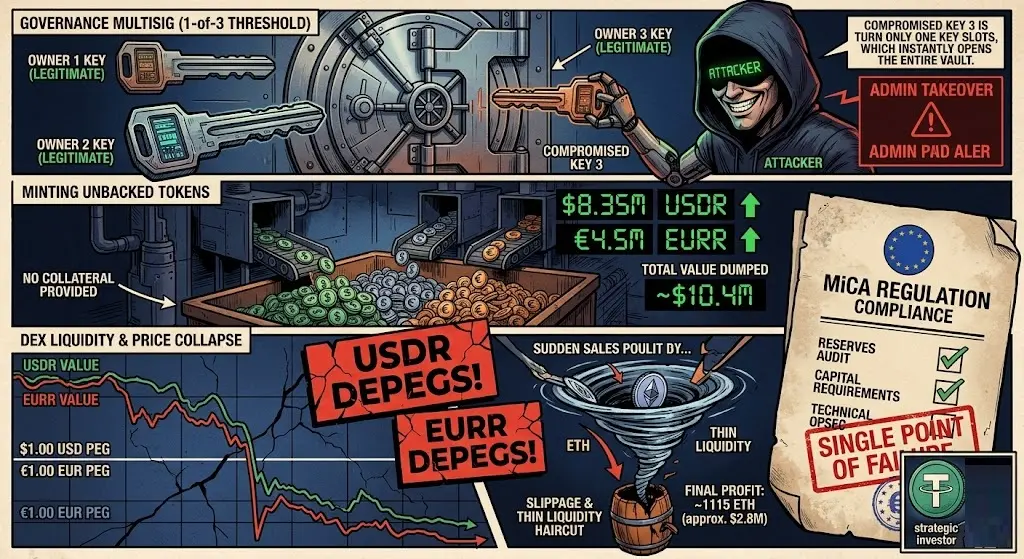
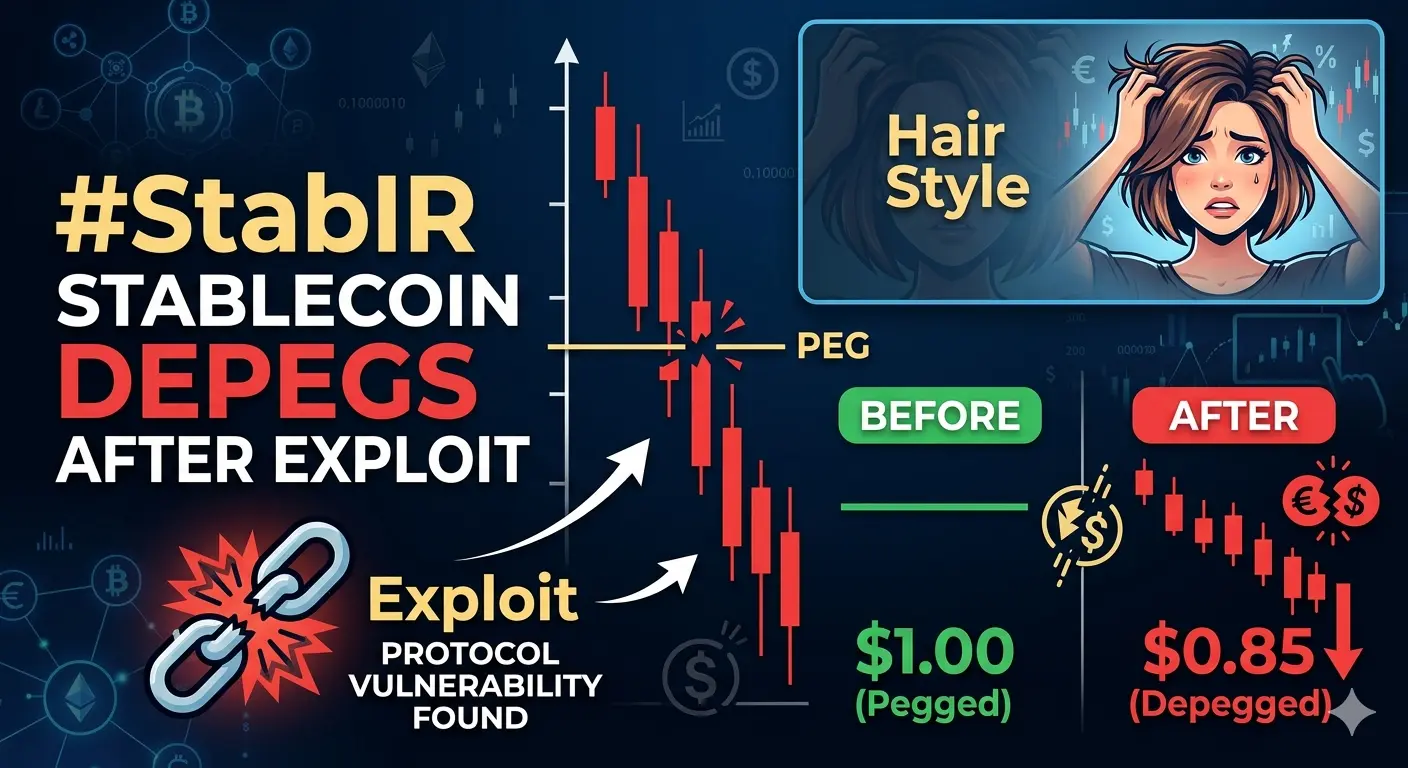
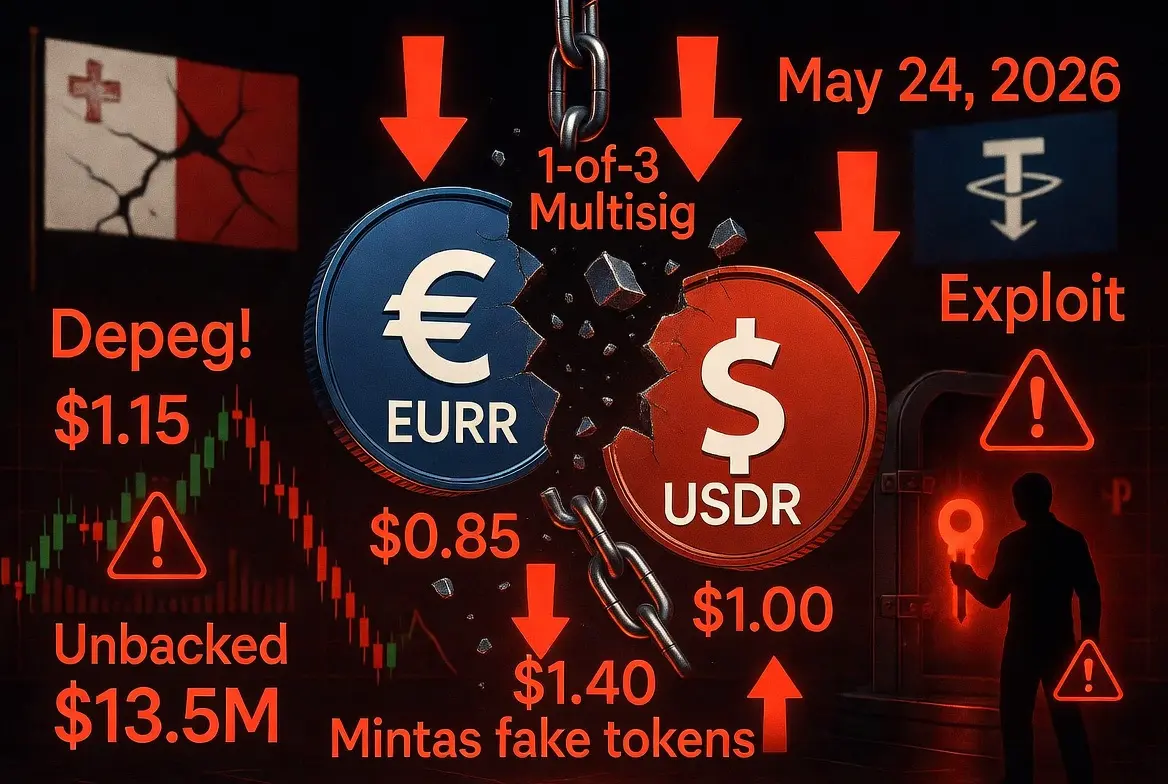
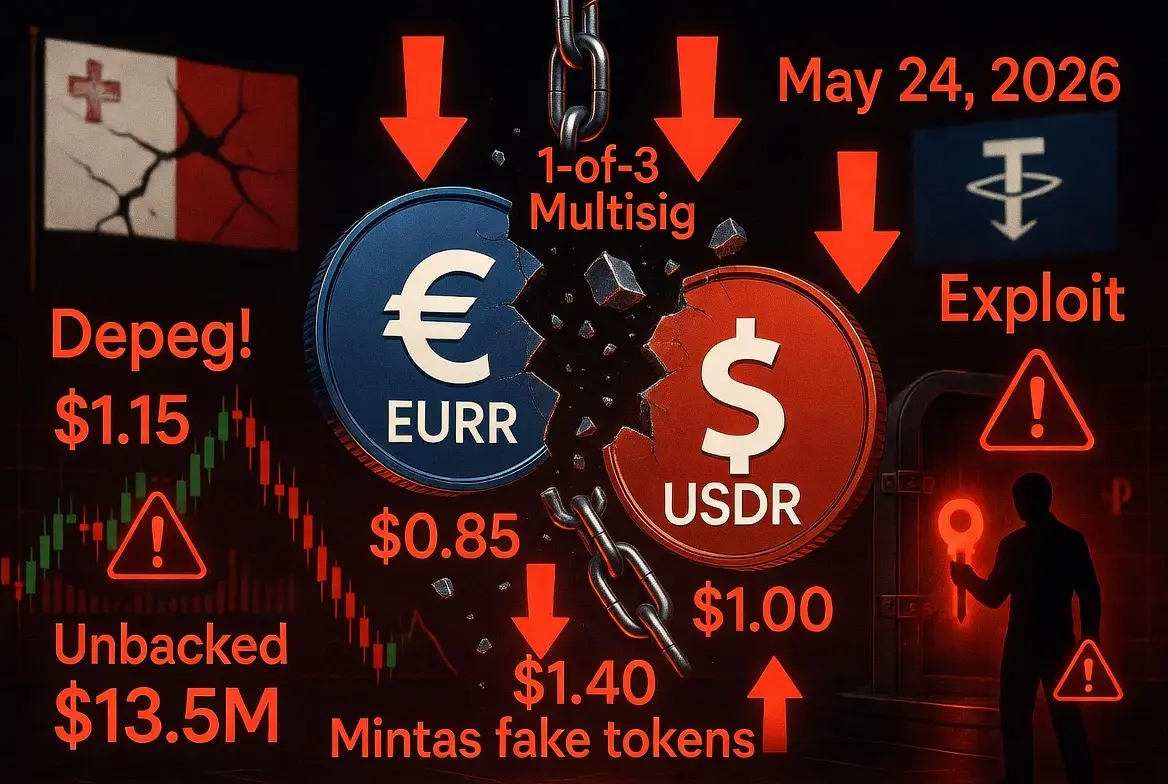
On May 24, European regulated stablecoin issuer StablR suffered a multi-signature attack. The attacker compromised one signer's private key of the minting multisig account and exploited its weak 1-of-3 threshold, minting 8.35 million USDR and 4.5 million EURR before dumping them on DEXs. EURR fell to 0.85 US dollars, USDR fell to 0.64 US dollars, both depegging. The attacker netted approximately 2.8 million US dollars. Blockaid noted this was not a smart contract bug but a key management and governance failure. Tether is a strategic investor in StablR.

#StablRStablecoinDepegsAfterExploit Peg Broken?
StablR stablecoins just suffered a catastrophic $2,800,000 exploit that completely crushed their fiat pegs.
The attack targeted both the euro-backed EURR and the dollar-backed USDR tokens on the Ethereum network.
Blockchain security firm Blockaid identified the core issue as an absolute breakdown in private key management.
🔹 Attackers compromised a single private key inside a vulnerable 1-of-3 multisig minting contract.
🔹 The exploiters instantly added their personal wallet address as a primary owner.
🔹 The intruders removed all legitimate si
ETH-0.22%
  • Reward
  • 1
  • Repost
  • Share
HighAmbition:
2026 GOGOGO 👊
#StablRStablecoinDepegsAfterExploit
The collapse of confidence around StablR may now become one of the clearest reminders that stablecoin stability depends far more on governance architecture than branding, regulation, or market narratives alone.
What initially appeared to be a small-scale exploit has rapidly evolved into a broader discussion about structural security weaknesses inside emerging stablecoin ecosystems, especially those attempting to position themselves as regulated alternatives within Europe’s growing digital asset market.
StablR, a Malta-based stablecoin issuer operating under
  • Reward
  • 6
  • Repost
  • Share
Crypto_Buzz_with_Alex:
This is really amazing explainations in this post very clear and easy to understand.
View More
#StablRStablecoinDepegsAfterExploit
The collapse of confidence around StablR may now become one of the clearest reminders that stablecoin stability depends far more on governance architecture than branding, regulation, or market narratives alone.
What initially appeared to be a small-scale exploit has rapidly evolved into a broader discussion about structural security weaknesses inside emerging stablecoin ecosystems, especially those attempting to position themselves as regulated alternatives within Europe’s growing digital asset market.
StablR, a Malta-based stablecoin issuer operating under
MrFlower_XingChen
#StablRStablecoinDepegsAfterExploit
The collapse of confidence around StablR may now become one of the clearest reminders that stablecoin stability depends far more on governance architecture than branding, regulation, or market narratives alone.
What initially appeared to be a small-scale exploit has rapidly evolved into a broader discussion about structural security weaknesses inside emerging stablecoin ecosystems, especially those attempting to position themselves as regulated alternatives within Europe’s growing digital asset market.
StablR, a Malta-based stablecoin issuer operating under the European Union’s MiCA regulatory framework, had built its reputation around compliance, institutional alignment, and regulated digital asset infrastructure. The protocol offered two primary stablecoins:
EURR, designed as a euro-pegged stablecoin, and USDR, intended to maintain strict parity with the US dollar.
The project gained significant credibility after receiving investment support from Tether in late 2024, a development many interpreted as indirect validation from the world’s largest stablecoin issuer. At its peak, the combined market capitalization of EURR and USDR approached approximately $25 million, making StablR increasingly visible within European DeFi ecosystems and among users seeking MiCA-aligned stablecoin alternatives.
But on May 24, 2026, that confidence collapsed extremely quickly.
Blockchain security firm Blockaid identified an active exploit targeting StablR’s minting infrastructure. What makes this event especially important is that the failure did not originate from a complex smart contract bug or advanced cryptographic attack. Instead, the entire collapse emerged from a much more fundamental problem:
governance design failure.
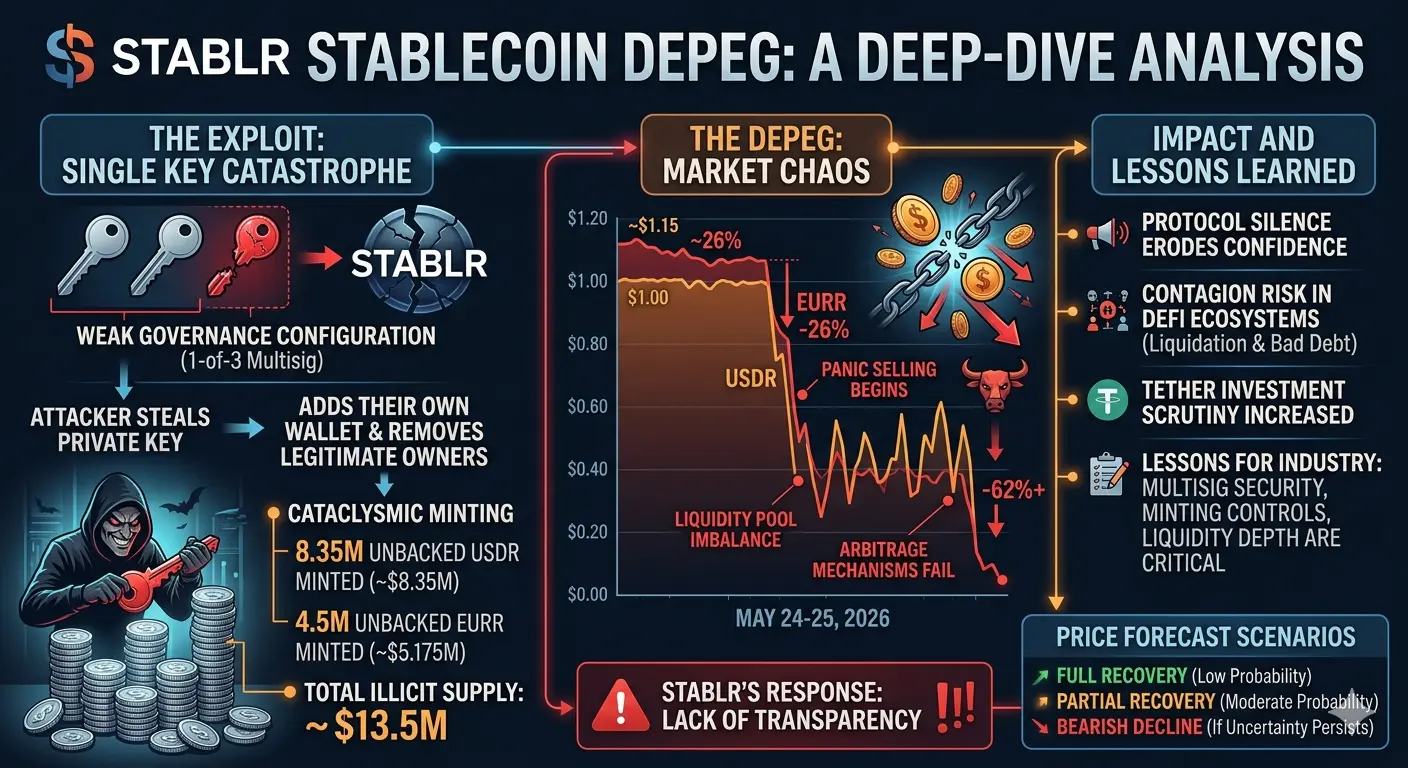
At the center of the incident was a highly dangerous 1-of-3 multisignature architecture controlling minting authority.
In practical terms, this meant that any single signer holding one private key could independently authorize critical administrative actions without needing approval from the remaining signers. Once the attacker successfully compromised one key, the system effectively lost all meaningful security protections.
The escalation happened rapidly.
The attacker added their own wallet as a multisig owner, removed the two legitimate signers, and gained complete unilateral control over the protocol’s minting infrastructure. Within minutes, what was supposed to function as a multi-party governance system became a fully compromised single-control environment.
After gaining access, the attacker minted massive quantities of unbacked stablecoins.
Approximately 8.35 million USDR and 4.5 million EURR were created without legitimate collateral backing, instantly injecting synthetic supply into the ecosystem. In total, the exploit introduced roughly $13.5 million worth of unbacked assets into markets that already had relatively limited liquidity depth.
That immediately triggered a collapse in peg stability.
EURR rapidly fell from its intended $1.15 region toward approximately $0.88 before stabilizing around the $0.85–$0.88 range. Meanwhile, USDR suffered an even more severe breakdown due to thinner liquidity conditions and weaker market depth.
USDR initially crashed from $1.00 toward $0.70, with some decentralized exchange pools briefly printing prices near $0.38 during periods of extreme imbalance and low liquidity.
At certain points, some automated market maker pools became overwhelmed by sell pressure, with USDR dominating liquidity composition beyond sustainable levels. Once pools lose balance in these conditions, pricing mechanisms deteriorate rapidly, accelerating panic and creating self-reinforcing downward spirals.
Although the attacker minted over $13 million in synthetic supply, realized extraction appears significantly lower because liquidity conditions could not absorb large exits cleanly. Reports suggest the attacker converted stolen assets into approximately 1,115 ETH, worth roughly $2.8 million at the time.
However, the broader damage extended far beyond realized extraction alone.
On-chain analyst ZachXBT estimated effective systemic losses closer to $10 million once market impact, holder losses, and peg destabilization effects were considered.
This distinction is important because stablecoin failures create psychological damage that often exceeds direct exploit size.
In stablecoin systems, confidence itself is the product.
Once users begin questioning redemption guarantees, reserve integrity, or governance controls, peg stability can collapse very quickly regardless of actual reserve conditions.
One of the most alarming aspects of the incident is how preventable the governance failure appears in retrospect.
A 1-of-3 multisig structure offers extremely weak protection for systems controlling minting authority. In adversarial conditions, it functions only marginally better than a single-key system because compromise of any one signer effectively compromises the entire protocol.
More mature DeFi protocols such as MakerDAO, Aave, and Compound typically use significantly stronger governance protections, including:
higher multisig thresholds,
time-lock execution delays,
emergency veto systems,
and layered administrative validation.
StablR reportedly implemented none of these protections effectively.
There were no mandatory review windows before ownership changes could execute. No quorum enforcement existed for critical minting actions. No secondary verification layer prevented unilateral escalation. Once the attacker gained initial access, administrative takeover became almost effortless.
Equally damaging has been the communication response following the exploit.
As of May 25, no comprehensive public incident report has been released clearly outlining reserve status, recovery plans, governance restructuring, or compensation mechanisms for affected holders.
In stablecoin markets, communication speed is not optional —
it is part of the stability mechanism itself.
When users lack information during crisis events, markets automatically begin assuming worst-case scenarios. That uncertainty accelerates redemptions, liquidity exits, and further price dislocation.
Several critical questions remain unanswered:
Are reserves still fully intact?
Will unbacked supply be burned?
Can redemptions continue normally?
Will governance architecture be upgraded immediately?
And most importantly:
Can confidence realistically be restored after such a severe governance failure?
The broader implications now extend beyond StablR itself.
Even though the ecosystem remains relatively small compared to giants like USDT or USD Coin, the incident reinforces growing concerns surrounding small-cap stablecoin integrations across decentralized finance.
Stablecoins are deeply interconnected with lending protocols, liquidity pools, leverage systems, and collateral markets. When one stablecoin fails suddenly, the effects can spread across multiple DeFi layers through forced liquidations, collateral impairment, and liquidity fragmentation.
This is why the event matters structurally.
The StablR collapse demonstrates that regulatory alignment alone does not guarantee security. MiCA compliance may improve legal structure and oversight, but protocol-level governance design remains equally critical.
The market is now dividing into three behavioral groups.
Some traders are attempting to accumulate discounted EURR and USDR positions, betting that reserves remain intact and partial recovery becomes possible.
Others are prioritizing capital preservation, exiting positions regardless of realized losses due to fear surrounding further deterioration.
Meanwhile, broader DeFi participants are reassessing exposure to smaller stablecoin ecosystems entirely, increasingly rotating back toward deeper-liquidity assets such as USDT and USD Coin.
The future path for EURR and USDR now depends almost entirely on whether StablR can restore three pillars simultaneously:
reserve transparency,
governance credibility,
and liquidity confidence.
Without all three, markets are unlikely to restore full peg trust.
At its core, this was not simply a technical exploit.
It was a structural governance failure that exposed how quickly confidence, liquidity, and price stability can disappear when critical financial infrastructure lacks hardened administrative protections.
And in stablecoin markets, once trust breaks, recovery becomes far more difficult than the exploit itself.
  • Reward
  • 6
  • Repost
  • Share
AYATTAC:
To The Moon 🌕
View More
#StablRStablecoinDepegsAfterExploit
What Is StablR and Why It Matters
StablR is a Malta-based stablecoin issuer operating under the European Union’s MiCA regulatory framework, positioning itself as a compliant digital asset infrastructure provider for euro and dollar-denominated stablecoins.
The protocol issues two core assets: EURR, a euro-pegged stablecoin designed to track the EUR/USD exchange rate (approximately $1.15 equivalent), and USDR, a USD-pegged stablecoin intended to maintain strict $1.00 parity through reserve-backed issuance.
The project initially gained institutional credibil
HighAmbition
#StablRStablecoinDepegsAfterExploit
What Is StablR and Why It Matters
StablR is a Malta-based stablecoin issuer operating under the European Union’s MiCA regulatory framework, positioning itself as a compliant digital asset infrastructure provider for euro and dollar-denominated stablecoins.
The protocol issues two core assets: EURR, a euro-pegged stablecoin designed to track the EUR/USD exchange rate (approximately $1.15 equivalent), and USDR, a USD-pegged stablecoin intended to maintain strict $1.00 parity through reserve-backed issuance.
The project initially gained institutional credibility after Tether invested in December 2024, signaling indirect validation from the largest stablecoin issuer in the global market. At peak adoption, EURR reached approximately $14 million in market capitalization while USDR stood near $11 million, bringing total ecosystem value close to $25 million.
Despite its relatively small scale compared to dominant stablecoins such as USD Coin and USDT, StablR became relevant within European DeFi circles due to its MiCA alignment narrative and institutional custody claims.
The Exploit — Structural Governance Failure at the Core
On May 24, 2026, blockchain security firm Blockaid identified a live exploit targeting StablR’s minting infrastructure. The incident did not originate from a traditional smart contract vulnerability, but rather from a critical governance and key-management breakdown embedded in the protocol’s operational design.
The system relied on a 1-of-3 multisignature configuration governing minting authority. This structure meant that any single private key holder could independently authorize administrative actions, including minting and ownership modifications, without requiring consensus from other signers.
Once the attacker compromised a single key, they escalated privileges by:
Adding their own wallet as a multisig owner
Removing the two legitimate signers
Gaining full unilateral control over minting functions
This effectively converted a multi-party governance system into a single compromised control point within minutes.
The attacker subsequently minted:
8.35 million unbacked USDR (~$8.35M nominal value)
4.5 million unbacked EURR (~$5.175M at $1.15 peg)
Total synthetic supply expansion reached approximately $13.525 million, instantly diluting circulating supply and destabilizing both markets.
Due to limited liquidity depth across decentralized venues, actual realized extraction was significantly lower. The attacker converted minted assets into approximately 1,115 ETH (~$2.8M). On-chain analyst ZachXBT estimated total effective damage closer to $10 million when accounting for systemic price impact and holder losses.
The Depeg — Rapid Collapse Across Liquidity Layers
The introduction of unbacked supply triggered immediate dislocation across both stablecoins, with price discovery breaking down almost instantly.
EURR experienced a sharp deviation from peg levels:
From $1.15 → $0.88 within minutes
Stabilizing in the $0.85–$0.88 range
Representing a 23–26% loss of peg integrity
USDR suffered deeper fragmentation due to thinner liquidity conditions:
Initial collapse from $1.00 → $0.70
Extended lows between $0.40–$0.70
Brief intraday prints near $0.38 on low-liquidity pools
Total drawdown reaching up to 60% in certain venues
Liquidity pools on decentralized exchanges rapidly became imbalanced, with automated market makers absorbing disproportionate sell pressure. In some pools, USDR dominance exceeded 70%, effectively eliminating price stability mechanisms and accelerating downward spirals.
By May 25, 2026:
EURR: $0.85–$0.88
USDR: $0.45–$0.68
No meaningful peg recovery observed
Why the 1-of-3 Multisig Architecture Failed
The fundamental failure was not cryptographic but architectural. A 1-of-3 multisig threshold provides minimal security advantage over a single-key system in adversarial conditions, because any individual signer can unilaterally execute high-impact actions.
Critical weaknesses included:
Absence of quorum enforcement for minting
No time-lock delays for ownership changes
No secondary validation layer for administrative actions
Immediate execution capability without review windows
In comparison, industry-standard protocols such as MakerDAO, Aave, and Compound employ higher-threshold multisigs (commonly 3-of-5 or greater), combined with execution delays and emergency veto systems to prevent exactly this class of failure.
The attacker’s ability to modify ownership structure without delay indicates a complete lack of governance hardening, making escalation trivial once a single credential was compromised.
StablR Response and Communication Breakdown
As of May 25, 2026, StablR has not issued a comprehensive public incident report outlining reserve status, recovery mechanisms, or compensation frameworks. Only limited acknowledgments referencing “incident containment efforts” have been observed through indirect communication channels.
In stablecoin systems, communication latency during crisis events directly amplifies market instability. The absence of structured updates creates informational vacuum conditions where market participants assume worst-case scenarios, accelerating sell pressure and liquidity withdrawal.
Key unanswered questions include:
Whether reserves remain fully intact and segregated
Whether minting reversal or token burn mechanisms will be executed
Whether redemption continuity remains operational
Whether governance upgrades are already underway
Market Structure and Price Timeline Dynamics
Pre-Exploit Conditions
EURR: $1.15
USDR: $1.00
Combined Market Cap: ~$25M
Attack Window (May 24, 2026)
12.85M unbacked tokens minted
Instant liquidity shock introduced
Initial Market Reaction
EURR: $0.88 → $0.85
USDR: $0.70 → $0.40
Attacker Exit Phase
1,115 ETH extracted ($2.8M realized value)
Significant slippage across all major pools
Post-Collapse State (May 25, 2026)
EURR: $0.85–$0.88
USDR: $0.45–$0.68
Contagion Effects Across DeFi Ecosystems
Although StablR’s scale is relatively small, the structural implications extend beyond its own ecosystem due to integration across DeFi lending markets and liquidity pools.
Immediate consequences include:
Collateral devaluation in lending protocols
Increased liquidation risk for leveraged positions
Pool imbalance across AMM platforms
Reduced confidence in small-cap stablecoin integrations
This event reinforces systemic exposure risks within decentralized finance, where even minor stablecoin failures can propagate stress across interconnected liquidity networks.
Price Forecast Scenarios
Scenario 1 — Full Recovery (Low Probability)
EURR: $1.10–$1.15
USDR: $0.95–$1.00
Requires: reserve verification, token burn, governance overhaul, and rapid institutional confidence restoration
Scenario 2 — Partial Recovery (Moderate Probability)
EURR: $0.95–$1.05
USDR: $0.70–$0.85
Market stabilizes but long-term discount persists due to trust erosion
Scenario 3 — Structural Decline (High Risk)
EURR: $0.50–$0.60
USDR: $0.10–$0.30
Driven by liquidity deterioration and sustained uncertainty
Market Behavior and Trading Psychology
Market participants are currently divided into three behavioral clusters:
Speculative Accumulators
Attempting to purchase discounted EURR and USDR positions in anticipation of partial recovery, accepting elevated downside risk in exchange for asymmetric upside exposure.
Liquidity Exits
Holders prioritizing capital preservation, exiting positions regardless of price impact, contributing to persistent downward pressure.
Risk Reassessment Participants
Broader market actors reassessing exposure to small-cap stablecoins, shifting preference toward deeper liquidity assets such as USD Coin and USDT.
Structural Lessons for the Crypto Ecosystem
This incident reinforces several foundational lessons for decentralized financial infrastructure:
Governance design must match the criticality of minting authority
Multisig thresholds below 3-of-5 represent unacceptable risk in stablecoin systems
Time-lock execution is essential for preventing rapid administrative compromise
Liquidity depth determines systemic resilience during shock events
Communication speed is a core stability mechanism, not an optional feature
The StablR depeg represents a structural governance failure rather than a simple exploit event. It demonstrates how quickly trust, liquidity, and peg stability can collapse when administrative controls are insufficiently hardened, even under a regulated framework such as MiCA.
The next phase of market evolution for EURR and USDR will depend entirely on whether StablR can restore three critical pillars simultaneously: reserve transparency, governance restructuring, and liquidity confidence. Without these, the market is likely to continue repricing both assets at a persistent discount, reflecting not only technical risk but also enduring trust erosion within the ecosystem.@Gate_Square @Gate广场_Official #TradfiTradingChallenge #DailyPolymarketHotspot
repost-content-media
  • Reward
  • Comment
  • Repost
  • Share
#StablRStablecoinDepegsAfterExploit
What Is StablR and Why It Matters
StablR is a Malta-based stablecoin issuer operating under the European Union’s MiCA regulatory framework, positioning itself as a compliant digital asset infrastructure provider for euro and dollar-denominated stablecoins.
The protocol issues two core assets: EURR, a euro-pegged stablecoin designed to track the EUR/USD exchange rate (approximately $1.15 equivalent), and USDR, a USD-pegged stablecoin intended to maintain strict $1.00 parity through reserve-backed issuance.
The project initially gained institutional credibil
post-image
post-image
  • Reward
  • 15
  • Repost
  • Share
Crypto_Buzz_with_Alex:
This is really amazing explainations in this post very clear and easy to understand.
View More
#StablR稳定币遭攻击脱锚 On May 24, 2026, the stablecoin protocol StablR was attacked. After the token contract Owner permissions were replaced by the attacker, a large amount of EURR and USDR were illegally minted and sold, causing the prices of the two stablecoins to rapidly decline and depeg by about 20%.
This attack involved two stablecoins under StablR, clearly targeting the security of the StablR USD project MultiSig wallet.
After illegally gaining control of USDR and EURR contract management permissions, the attacker minted 8.35 million USDR + 4.5 million EURR and exchanged the tokens for ET
ETH-0.22%
View Original
post-image
post-image
  • Reward
  • 15
  • Repost
  • Share
MasterChuTheOldDemonMasterChu:
Get in quickly!🚗
View More
But Bin enters Circle, betting on Web3 financial infrastructure!
The value investment guru finally steps in, making a big move to buy Circle (USDC issuer), sending a strong signal:
✅ Leading compliance: The world's top compliant stablecoin, controlling cross-border payments and on-chain settlement lifelines;
✅ Hardcore moat: Transparent and solid reserves, enjoying stable cash flow;
✅ AI + blockchain trend: Firmly optimistic about the explosive potential of stablecoins, the digital financial era has arrived.
Top-tier capital is taking the lead in positioning, what do you think of this move? 🤔
CRCLX-0.22%
USDC-0.01%
View Original
post-image
  • Reward
  • Comment
  • Repost
  • Share
April Capital Flows Tear Apart! BTC ETF Surges by $2.44 Billion, ETH Remains at the RWA Track Peak🌾
🌿SoSoValue Reveals April Institutional Capital Flows — BTC ETF Net Inflow Reaches $2.44 Billion, while ETH ETF Only $540 Million, a Crushing Deficit! 🍃The Gap Is About 4.8 Times, BTC Gains 13.5% in a Month, ETH Only About 9%, ETH/BTC Ratio Continues to Drop Over 3% in the Second Quarter, Remaining Weak. Looking at Inflows Alone, Ethereum Seems to Have Lost Badly?🌻
🌱But Don’t Forget, Ethereum’s camp has thin sales data but holds key sector barriers: the stablecoin market accounts for half, w
BTC0.78%
ETH-0.22%
OKB1.33%
PEPE-0.49%
View Original
  • Reward
  • Comment
  • Repost
  • Share
Breaking! Has the deadlock over the US stablecoin bill finally been broken? Rumors come in from the Senate in the early hours
$BTC
Brothers, after three months of watching the US stablecoin legislation, we’ve just finally gotten some credible news.
The Senate side has fallen apart countless times, but this time Thom Tillis and Angela Alsobrooks really signed the agreement. The core compromise is simple: lying down and just earning interest isn’t allowed, but on-chain transfers and paying a little “incentive” are okay. The industry has more or less given its tentative approval to this
BTC0.78%
View Original
post-image
post-image
  • Reward
  • Comment
  • Repost
  • Share
📌 4.5 Cryptocurrency Hotspots
Drift Protocol stolen $285 million, Solana ecosystem under pressure;
Google achieves quantum computing breakthrough, BTC encryption logic under renewed discussion;
Hong Kong stablecoin license approaching, compliance acceleration;
BTC fluctuating and consolidating, awaiting macroeconomic data.
Rational observation, risk is on your own.
#加密热点 #BTC #SOL #稳定币
BTC0.78%
SOL-0.54%
DRIFT25.55%
View Original
post-image
post-image
  • Reward
  • 1
  • Repost
  • Share
Rain:
Does everyone know what quantum computing is? Are you worried about the future of cryptocurrencies?
Load More