#每周来晒 #美股财报季 Big Tech earnings week: the cash-coverage scoreboard that ranks AI spending
Seven names, one question: can AI growth justify record spending? Instead of ranking by popularity, I ranked by a measure that cuts through the noise, which is how much operating cash flow covers capital spending. Then I compared the same companies on AI monetization, earnings quality, valuation and risk, and picked the strongest fundamentals.
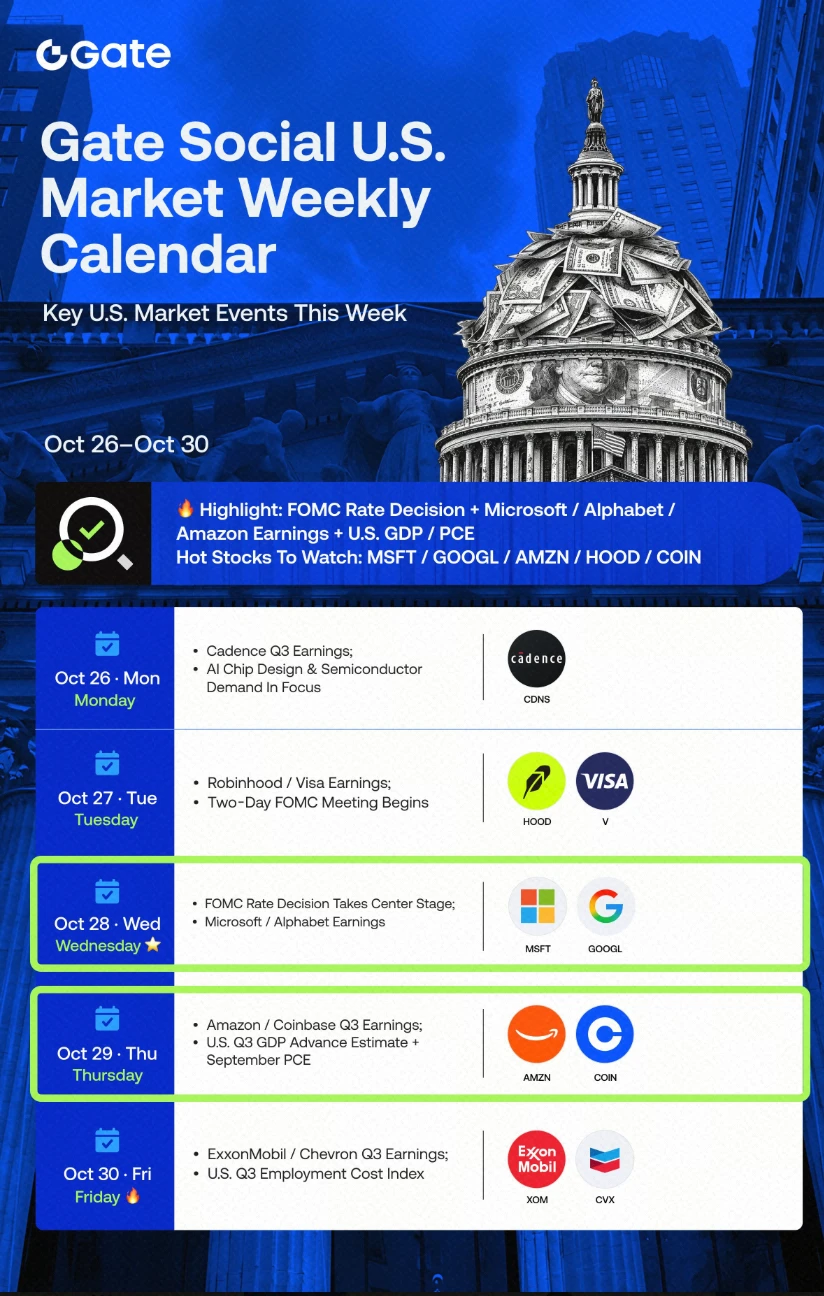
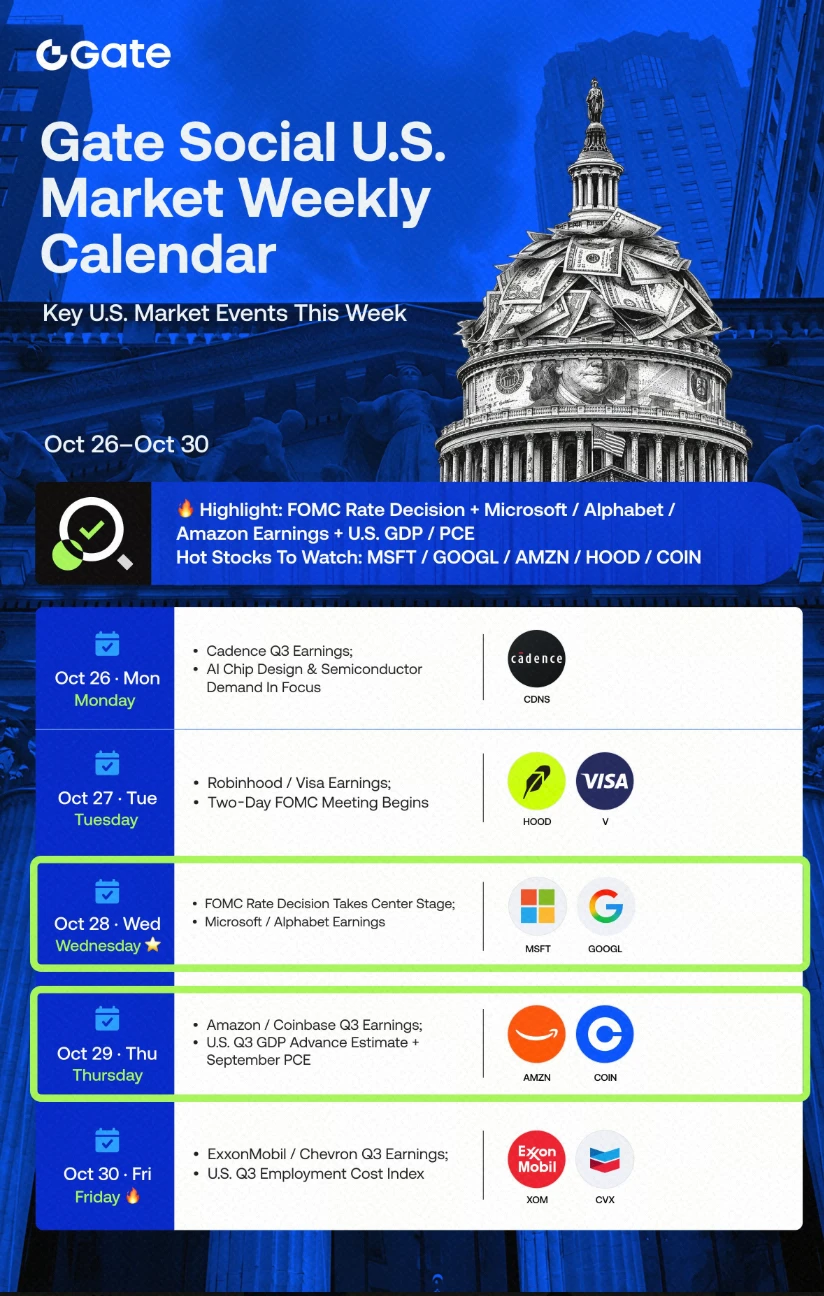
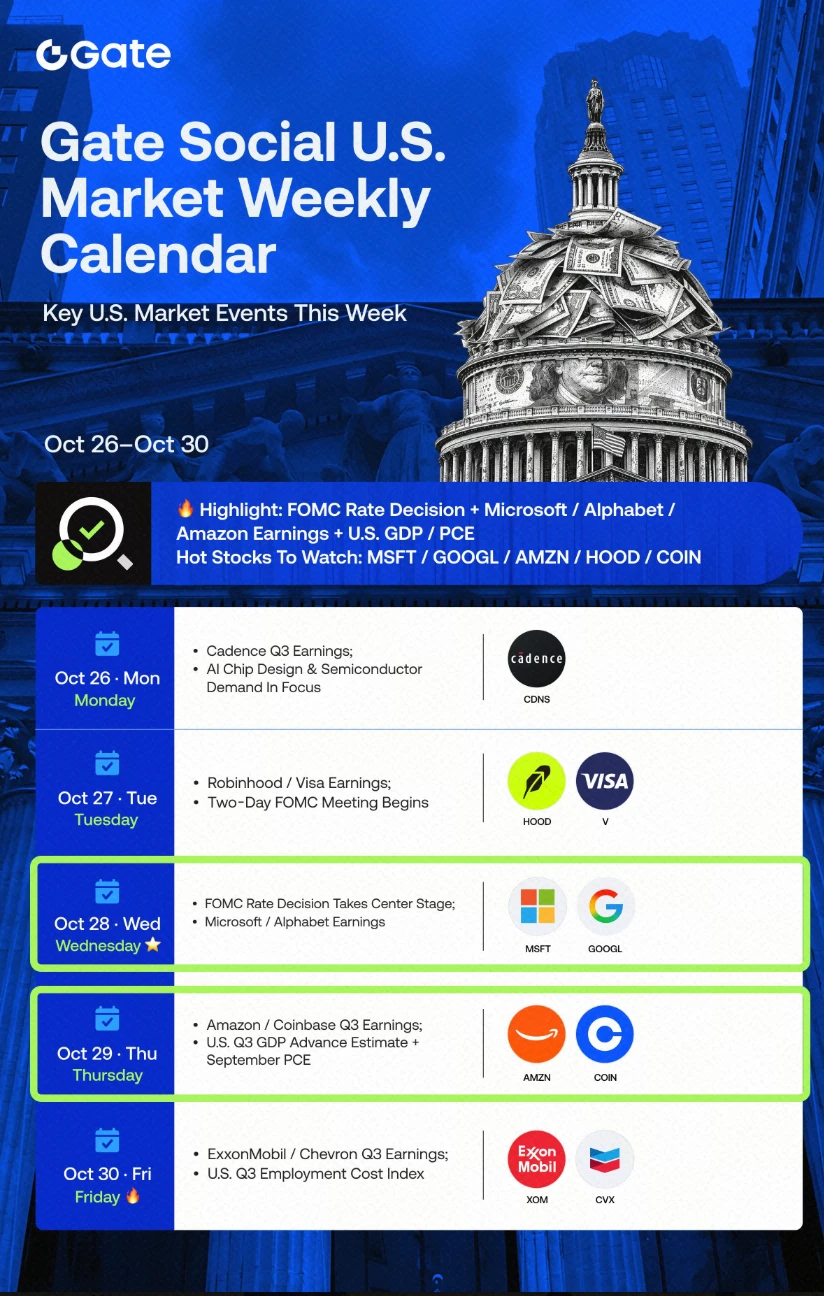
The calendar
Microsoft and Alphabet report on Wednesday, October 28, and Amazon on Thursday, October 29. The Fed's rate decision comes the same day as Microsoft and Alphabet, at 18:00 UTC, so investors get a policy signal hours before the earnings. Apple follows on November 2, and Nvidia is expected around mid-November, pending confirmation.
The coverage ratio
Dividing operating cash flow by capex, using each company's latest reported figures, gives a rough picture. Periods differ, so treat it as directional.
- Microsoft: operating cash flow of $55.4 billion against cash capex of $35.8 billion in its fiscal fourth quarter, about 1.55 times, or roughly 1.35 times with finance leases.
- Tesla: $6.26 billion against $4.73 billion in Q3, about 1.3 times.
- Meta: $32.79 billion against $34.91 billion, about 0.94 times.
- Amazon: trailing operating cash flow of $161.4 billion against capex of $169.0 billion, about 0.95 times.
- Alphabet: $39.1 billion against $44.9 billion in Q2, about 0.87 times.
Only Microsoft and Tesla cover their spending from operations. The other three are funding the gap with debt, equity or cash.
Microsoft: the strongest fundamentals
Azure grew 43% in the fourth quarter and is guided to about 45% in constant currency for the first quarter, with revenue guidance of $89.85 billion to $90.95 billion, up 16% to 17%. Commercial remaining performance obligations rose 84% to $678 billion, Microsoft 365 Copilot passed 30 million paid seats, and management expects free cash flow to stay positive in fiscal 2027. The catch: capex is set to exceed $50 billion in the quarter, and quarterly free cash flow fell 23% to $19.6 billion. Analysts expect earnings of about $4.71 per share on $90.63 billion of revenue. Verdict: best balance of growth, backlog and cash.
Alphabet: the fastest grower with the thinnest cushion
Google Cloud revenue grew 82% to $24.8 billion in Q2, from 63% in Q1 and 48% in Q4 2025, ahead of Azure at 43% and AWS at 37%, and Synergy puts its share at a record 15%. Cloud operating income was $8.8 billion against $2.8 billion a year earlier. The backlog reached $514 billion, up more than $50 billion sequentially. But capex doubled to $44.92 billion, free cash flow came in at negative $5.86 billion for the first time, and Alphabet raised $70 billion in equity and debt. Consensus calls for about $128 billion of revenue and EPS near $3.03. Verdict: the strongest growth, the weakest coverage.
Amazon: the cleanest test
AWS grew 37% to $42.2 billion in Q2 with operating income of $16.6 billion, narrowing Azure's lead from 16 points to 6, but trailing free cash flow fell to negative $7.6 billion on capex of about $200 billion to $220 billion. Expectations are about $202 billion of revenue and EPS of $1.96. Verdict: AWS acceleration is a single number that tells you whether the spending works.
Meta: growth without cash
Revenue of $64.60 billion rose 26%, but total expenses rose about 68% and free cash flow was negative $2.12 billion, with 2026 capex of $135 billion to $145 billion. The stock fell about 7% on the day after earnings. Verdict: strong top line, weak return on spending so far.
Tesla: cash cushion, thin growth
Deliveries of 486,532 beat estimates, but revenue was flat at $28.05 billion and GAAP net income fell 43%. Free cash flow of $1.53 billion benefited from working capital and lower capex, and full-year capex guidance was cut to $20 billion. Valuation still depends on autonomy and robots, not on vehicle earnings.
Apple and Nvidia: the two different tests
Apple reports on November 2 with consensus near $113.4 billion of revenue, up about 10.6%, and EPS around $1.99. The tests are iPhone demand, China, Services growth, margins and Apple Intelligence monetization. Nvidia is the exam that grades everyone else, since hyperscaler capex becomes its revenue, so Blackwell and Rubin shipments, gross margin and export rules matter most.
Does a beat guarantee a rise
No. Meta beat on revenue and fell, Tesla beat on adjusted EPS and fell, and SpaceX beat and fell the next session. The reaction follows guidance, spending and cash flow, not the headline.
My ranking on strength of fundamentals
1. Microsoft: coverage above 1, a $678 billion backlog and accelerating Azure.
2. Alphabet: the best growth, with the weakest coverage.
3. Amazon: improving AWS growth, but trailing free cash flow is negative.
4. Meta: high growth, but costs rose faster than revenue.
That ranking is about fundamentals, not about which stock rises after the report.
Azure against the 45% guide, Google Cloud's third straight quarter of acceleration, AWS against 37%, and any hint about 2027 capex. The Fed's tone on October 28 sets the mood for all of them.
In a boom, everyone reports the same headline: more demand. The company worth owning is the one that can pay for that demand without borrowing from tomorrow, and the cash-coverage ratio is the cleanest way to find it.