#分享美股交易赢英伟达股票 How far can the storage bull market run? Morgan Stanley: Supply and demand imbalance continues for 2-3 more years, views on Micron/SanDisk
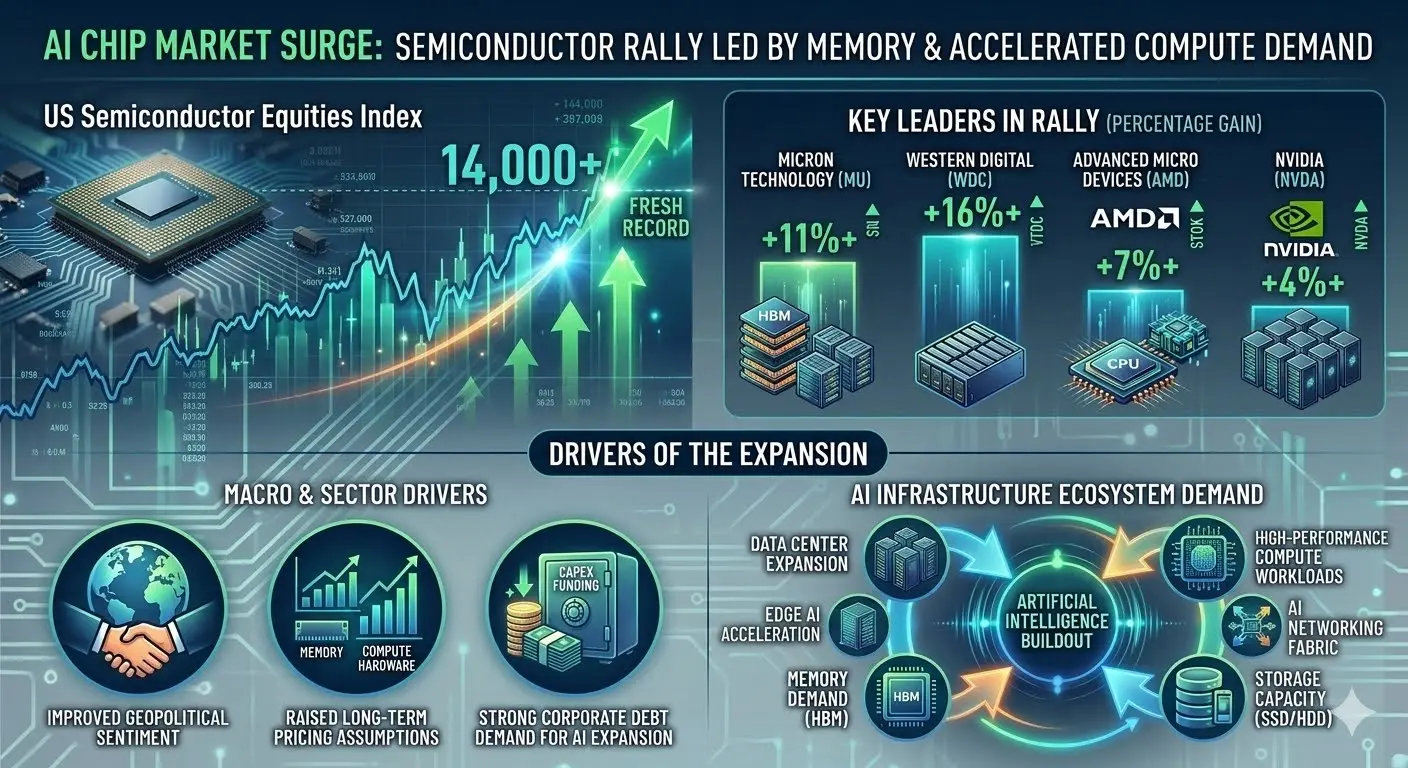
Morgan Stanley released a storage chip report on June 3rd, with the core conclusion: The supply and demand imbalance for DRAM and NAND cannot be quickly resolved, and shortages may persist for another 2-3 years or even longer.
DRAM has become the biggest bottleneck in AI computing power development, with large-scale clients' willingness to pay remaining high. Morgan Stanley significantly raised its earnings forecasts and target prices for Micron (MU) and SanDisk (SNDK)—Micron’s target price doubled from $520 to $1,050, and SanDisk’s from $1,100 to $1,750, both maintaining an overweight rating.
Let's look at the key points:
1. DRAM shortage is unsolvable, supply growth limited
DRAM has become the main bottleneck in AI development. Shortages of cleanroom facilities and EUV equipment restrict supply growth, while the wafer consumption intensity of HBM further squeezes traditional DRAM capacity.
Morgan Stanley expects DRAM prices to rise 40% quarter-over-quarter in May, and another 15% in August. Although this is below the over 20% increase feedback from the supply chain, it is still strong enough.
Micron’s CY26/CY27 EPS forecasts are raised by 4%/48%, with CY27 EPS expected to reach $113.85. The current stock price corresponds to a P/E ratio still below 10 times.
2. NAND is also tight, SanDisk benefits from enterprise SSD demand
AI inference demand is changing the NAND market structure, with large-scale clients locking in high-performance NAND. Kioxia, SanDisk’s joint venture partner, only slightly adjusted its long-term bit growth expectation from 20% to 22%, with capital expenditures remaining low (about $4.7 billion annually), limiting supply increases.
Morgan Stanley raised SanDisk’s CY26/CY27 EPS forecasts by 12%/24%, with CY27 EPS expected to reach $208. The target price of $1,750 still corresponds to less than 10x P/E.
3. Long-term contracts are a “symptom” rather than a “cause”
Market attention is on multiple long-term supply agreements (LTA). Morgan Stanley believes that LTAs are necessary for customers to secure supply, demonstrating that large-scale clients are willing to continue expanding storage procurement over the next few years, rather than being driven primarily by price increases. The real driver remains the supply-demand imbalance.
4. Accelerating capital returns: buybacks to restart soon
Micron previously could not buy back shares due to CHIPS Act restrictions but is expected to initiate large-scale buybacks starting FY27. Morgan Stanley’s model shows about $50 billion in buybacks in FY27-28. SanDisk’s free cash flow conversion rate has historically been higher, benefiting similarly.
5. Valuation still has room to rise
Micron’s target price is based on a 29.5x multiple of long-term cycle EPS ($35), and SanDisk’s on a 28x cycle EPS ($62.5), both comparable to the semiconductor sector average. However, the current stock price’s P/E for CY27 EPS is still below 10x. Morgan Stanley believes the market has not fully priced in the sustainability of profits and multiple upward revisions.
Summary: Storage chips are in a historically severe shortage cycle. AI-driven demand structurally raises the profit center, while supply-side capacity expansion is limited, making the high prosperity duration longer than expected.
Micron and SanDisk’s current valuations remain attractive. Negotiations on HBM contracts and buyback initiations in the second half of the year are expected to become new catalysts. Risks include demand slowdown, which could lead to rapid price declines due to high inventories.
All the above are from Morgan Stanley’s research reports and do not constitute investment advice.
$MU