














#夏日创作营
Bitcoin ETF sees five straight days of inflows! First since April—how high can this rebound go?
In late July, while everyone was still stuck in the afterglow of the World Cup, smart money quietly shifted direction. On July 20, US spot Bitcoin ETFs recorded about $227 million in net inflow in a single day—this is the fifth consecutive trading day with positive fund flows, and the first time since late April. Over the five days, total net inflows pulled in about $727 million. After June’s record-breaking capital exodus, this is the longest stretch of sustained buying. The total assets under management for Bitcoin ETFs also quietly climbed back from the early-July trough of nearly $75 billion to about $79 billion. Meanwhile, Ethereum ETFs were not idle either: daily net increase of about $38 million, with BlackRock’s ETHA leading the way. At the same time, both Bitcoin and Ethereum have started to rebound—last night they both broke above the 66,000 and 1,950 levels, respectively. So why is capital flowing back to Bitcoin, and what’s behind this rally? Where will the rebound go? Let “Little Caishen” chat with you:
1. Why does this rebound happen?
1. Demand for a rebound after a major selloff. This is the most direct reason. After Bitcoin’s brutal drop in June, it fell a full 25,000 points from May’s 82,000 peak. On the macro cycle technical indicators, it became severely oversold. Even the price broke below the 200-week moving average—an important long-term support level—driving strong rebound demand. Cheap coins also attracted arbitrage capital, forming the most solid foundation for this rebound.
2. ETF buying reappears to fill the most critical gap. During the past quarter of persistent outflows, the market’s biggest missing piece was continuous, institutional-grade buying. Now that there have been net inflows for five straight days—even though the volume isn’t especially staggering, it sends a clear signal: institutions have not completely exited; they’re just waiting for better prices. When panic fades and valuations return to a reasonable range, allocation-oriented capital begins to test the waters again.
3. The “World Cup effect” logic also applies to the crypto market. Whenever there are major global events, speculative capital naturally contracts—whether in China’s A-shares or the coin space. Attention gets diverted and risk appetite declines—this is a shared trait. When the event ends, suppressed short-term funds immediately look for an exit channel. Crypto markets are open 24/7, making this kind of return even more direct: capital doesn’t need to wait for market open, doesn’t need to deal with time zones. Once risk events land and sentiment repairs, buying can surge instantly. In late July, as the World Cup dust settled—right as Bitcoin was consolidating and building strength at low levels—the two created a subtle timing resonance.
4. A subtle shift in macro policy expectations. The market had been betting that the Federal Reserve would start cutting rates in 2026, but due to geopolitical developments, inflation pressure surged and the rate-cut expectations reversed. However, because uncertainty is being gradually digested—whether it’s partial easing in the US–Iran situation or policy signals like the 401(k) plan loosening its allocation to crypto assets—the market’s biggest “unknown fear” is cooling down. When the worst case doesn’t happen, funds dare to re-enter.
2. Why did the funds choose Bitcoin?
The most direct and fundamental reason is that Bitcoin is cheap! This selloff began after Bitcoin hit an all-time high of 12W+ in October 2025. By June 2026’s low, it had fallen to around 57,700. Bitcoin’s drawdown is close to 60%, while Ethereum’s is over 60%. In the same period, the Dow rose nearly 20%, the Nasdaq rose over 25%, the South Korean stock market rose close to 150%, and even though gold had a decline in 2026, it still ended up with gains. If you’re long-term capital, would you choose assets at high levels or choose a low-priced but bullish-in-the-long-run Bitcoin? The answer is obvious.
3. How sustainable is this rally?
How far this rally can go depends on three key variables:
Test one: Can ETF inflows turn from a “pulse” into a “trend”? Five days and $727 million sounds like a lot, but compared with the first half’s net outflow of $5.4 billion, it’s just a drop in the bucket. The real turning point requires seeing sustained net inflows at the weekly level, not emotional fund-repair over one or two weeks. If inflows pause again, this rebound is likely just a dead-cat bounce.
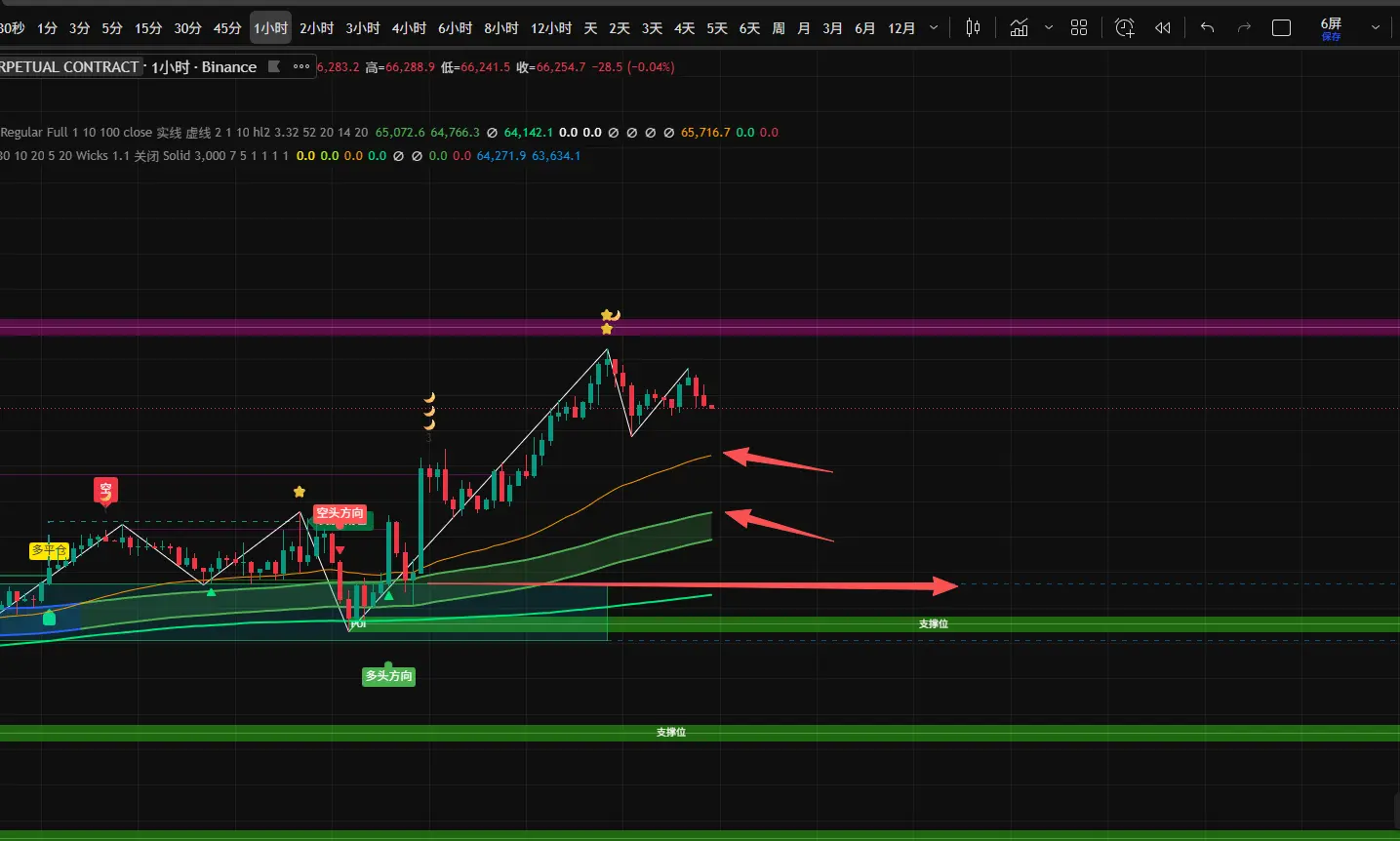
Test two: The battle between longs and shorts at $69,000–$70,000. From a technical perspective, Bitcoin had been range-bound around $75k for a long time. $65,000 is the line the bulls must defend. If it can hold above $69,000 with increased volume, it may open the door to a mid-term rebound. If it breaks back below $65,000 again, the next stop would be $60,000. Above the $80,000 level, there’s liquidity from massive short liquidations—those are the real “hard bones.”
Test three: Can Ethereum keep up with the pace? Ethereum is currently around $1,880. Over the past 30 days it’s up about 10%, but over the past year it’s still down nearly 48%. If Bitcoin rises while Ethereum remains weak, it indicates that funds only dare to embrace the “safest” assets and that risk appetite hasn’t truly recovered. Only when ETH breaks out in sync with a surge in volume can we confirm this is a real market recovery—not just a Bitcoin-only show.
4. Where should we look for targets in this rebound?
Although large funds have started to flow back into the crypto market, don’t get blindly optimistic. Remember: in the first half of 2026, the total net outflow from Bitcoin ETFs reached $5.4 billion. This is the first time since the product launched it has recorded a half-year net outflow. From May 15 to June 3—during a streak of 13 consecutive trading days—capital fled the market, and to date it remains the longest-ever “bleeding” record for spot ETFs. The $4.4 billion selling pressure wiped out the rebound gains from April. BlackRock’s IBIT—once a top cash magnet—saw $5 billion in redemptions in just May and June, exceeding the total of all outflow months in its history. So rather than calling these five days of net inflows a “victory of buying,” it’s better described as “successful bleeding control.” The market is nowhere near time to celebrate, but at least the most panicked phase may be behind us.
As for rebound targets, Little Caishen also mentioned this in an earlier article: on the weekly chart, pay attention to the resistance around 72,500. This is both the position of the 30-week moving average and the bull-bear boundary—the strong resistance zone of the 200-day moving average. If it can break through, it would suggest the bear market has fully ended and a bull market has returned. Of course, that’s a longer-term topic. Looking at the present, with institutional funds quietly returning and coins remaining cheap, getting on this rebound’s tailwind is the top priority. Before the price reaches 72,500, you should hold and wait for gains. Never short based on a hunch. Moving alongside smart money is always your most correct choice!
How are you all viewing the upcoming market? Institutions are buying, buying, buying—are you still holding short positions? It’s not easy to create original work—drop a comment and chat!
Bitcoin ETF sees five straight days of inflows! First since April—how high can this rebound go?
In late July, while everyone was still stuck in the afterglow of the World Cup, smart money quietly shifted direction. On July 20, US spot Bitcoin ETFs recorded about $227 million in net inflow in a single day—this is the fifth consecutive trading day with positive fund flows, and the first time since late April. Over the five days, total net inflows pulled in about $727 million. After June’s record-breaking capital exodus, this is the longest stretch of sustained buying. The total assets under management for Bitcoin ETFs also quietly climbed back from the early-July trough of nearly $75 billion to about $79 billion. Meanwhile, Ethereum ETFs were not idle either: daily net increase of about $38 million, with BlackRock’s ETHA leading the way. At the same time, both Bitcoin and Ethereum have started to rebound—last night they both broke above the 66,000 and 1,950 levels, respectively. So why is capital flowing back to Bitcoin, and what’s behind this rally? Where will the rebound go? Let “Little Caishen” chat with you:
1. Why does this rebound happen?
1. Demand for a rebound after a major selloff. This is the most direct reason. After Bitcoin’s brutal drop in June, it fell a full 25,000 points from May’s 82,000 peak. On the macro cycle technical indicators, it became severely oversold. Even the price broke below the 200-week moving average—an important long-term support level—driving strong rebound demand. Cheap coins also attracted arbitrage capital, forming the most solid foundation for this rebound.
2. ETF buying reappears to fill the most critical gap. During the past quarter of persistent outflows, the market’s biggest missing piece was continuous, institutional-grade buying. Now that there have been net inflows for five straight days—even though the volume isn’t especially staggering, it sends a clear signal: institutions have not completely exited; they’re just waiting for better prices. When panic fades and valuations return to a reasonable range, allocation-oriented capital begins to test the waters again.
3. The “World Cup effect” logic also applies to the crypto market. Whenever there are major global events, speculative capital naturally contracts—whether in China’s A-shares or the coin space. Attention gets diverted and risk appetite declines—this is a shared trait. When the event ends, suppressed short-term funds immediately look for an exit channel. Crypto markets are open 24/7, making this kind of return even more direct: capital doesn’t need to wait for market open, doesn’t need to deal with time zones. Once risk events land and sentiment repairs, buying can surge instantly. In late July, as the World Cup dust settled—right as Bitcoin was consolidating and building strength at low levels—the two created a subtle timing resonance.
4. A subtle shift in macro policy expectations. The market had been betting that the Federal Reserve would start cutting rates in 2026, but due to geopolitical developments, inflation pressure surged and the rate-cut expectations reversed. However, because uncertainty is being gradually digested—whether it’s partial easing in the US–Iran situation or policy signals like the 401(k) plan loosening its allocation to crypto assets—the market’s biggest “unknown fear” is cooling down. When the worst case doesn’t happen, funds dare to re-enter.
2. Why did the funds choose Bitcoin?
The most direct and fundamental reason is that Bitcoin is cheap! This selloff began after Bitcoin hit an all-time high of 12W+ in October 2025. By June 2026’s low, it had fallen to around 57,700. Bitcoin’s drawdown is close to 60%, while Ethereum’s is over 60%. In the same period, the Dow rose nearly 20%, the Nasdaq rose over 25%, the South Korean stock market rose close to 150%, and even though gold had a decline in 2026, it still ended up with gains. If you’re long-term capital, would you choose assets at high levels or choose a low-priced but bullish-in-the-long-run Bitcoin? The answer is obvious.
3. How sustainable is this rally?
How far this rally can go depends on three key variables:
Test one: Can ETF inflows turn from a “pulse” into a “trend”? Five days and $727 million sounds like a lot, but compared with the first half’s net outflow of $5.4 billion, it’s just a drop in the bucket. The real turning point requires seeing sustained net inflows at the weekly level, not emotional fund-repair over one or two weeks. If inflows pause again, this rebound is likely just a dead-cat bounce.
Test two: The battle between longs and shorts at $69,000–$70,000. From a technical perspective, Bitcoin had been range-bound around $75k for a long time. $65,000 is the line the bulls must defend. If it can hold above $69,000 with increased volume, it may open the door to a mid-term rebound. If it breaks back below $65,000 again, the next stop would be $60,000. Above the $80,000 level, there’s liquidity from massive short liquidations—those are the real “hard bones.”
Test three: Can Ethereum keep up with the pace? Ethereum is currently around $1,880. Over the past 30 days it’s up about 10%, but over the past year it’s still down nearly 48%. If Bitcoin rises while Ethereum remains weak, it indicates that funds only dare to embrace the “safest” assets and that risk appetite hasn’t truly recovered. Only when ETH breaks out in sync with a surge in volume can we confirm this is a real market recovery—not just a Bitcoin-only show.
4. Where should we look for targets in this rebound?
Although large funds have started to flow back into the crypto market, don’t get blindly optimistic. Remember: in the first half of 2026, the total net outflow from Bitcoin ETFs reached $5.4 billion. This is the first time since the product launched it has recorded a half-year net outflow. From May 15 to June 3—during a streak of 13 consecutive trading days—capital fled the market, and to date it remains the longest-ever “bleeding” record for spot ETFs. The $4.4 billion selling pressure wiped out the rebound gains from April. BlackRock’s IBIT—once a top cash magnet—saw $5 billion in redemptions in just May and June, exceeding the total of all outflow months in its history. So rather than calling these five days of net inflows a “victory of buying,” it’s better described as “successful bleeding control.” The market is nowhere near time to celebrate, but at least the most panicked phase may be behind us.
As for rebound targets, Little Caishen also mentioned this in an earlier article: on the weekly chart, pay attention to the resistance around 72,500. This is both the position of the 30-week moving average and the bull-bear boundary—the strong resistance zone of the 200-day moving average. If it can break through, it would suggest the bear market has fully ended and a bull market has returned. Of course, that’s a longer-term topic. Looking at the present, with institutional funds quietly returning and coins remaining cheap, getting on this rebound’s tailwind is the top priority. Before the price reaches 72,500, you should hold and wait for gains. Never short based on a hunch. Moving alongside smart money is always your most correct choice!
How are you all viewing the upcoming market? Institutions are buying, buying, buying—are you still holding short positions? It’s not easy to create original work—drop a comment and chat!