















#TradFi交易分享挑战 Geopolitical Fluctuations Become the Largest Variable: Crude Oil Market in a High-Volatility State
May 27th, the international crude oil market experienced a sharp decline, with the two major benchmark crude futures falling over 5%, touching a one-month low during trading, as the risk premium accumulated from previous geopolitical conflicts rapidly retreated. The recent sharp drop in oil prices was driven by multiple factors: the repeated expectations of US-Iran negotiations, the recovery of shipping through the Strait of Hormuz, and the cooling of geopolitical conflicts, combined with US crude oil inventory data, leading market focus to shift from “supply shortage concerns” to “expectations of easing tensions,” resulting in a clear short-term trend reversal in oil prices.
1. Market Performance: Sharp Decline Across the Board, Reversing Previous Gains
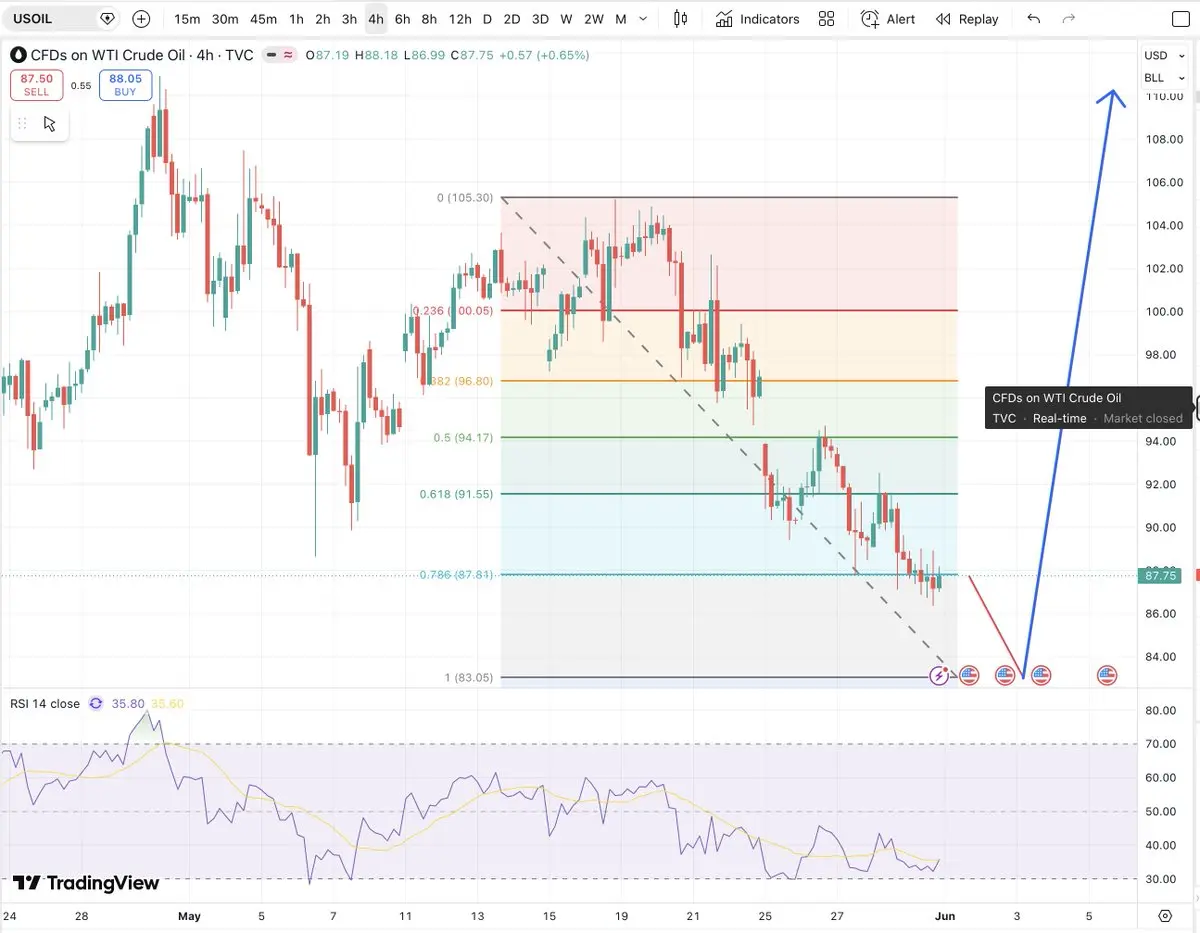
On that day, major global crude oil and refined product futures all weakened simultaneously, with significant volatility. The settlement price for US WTI crude oil July futures on May 27th was $88.68 per barrel, down $5.21 or 5.6%. Brent crude oil July futures settled at $94.29 per barrel, down $5.29 or 5.3%. This decline directly erased all previous gains from the prior trading day.
The refined product sector followed the crude oil trend downward, with July RBOB gasoline futures falling by 7.98 cents, a 2.54% decrease, settling at $3.0670 per gallon; July heating oil futures dropped by 9.24 cents, a 2.55% decrease, settling at $3.5289 per gallon. Overall, the decline in crude oil was much larger than that in refined products, reflecting that market volatility was primarily concentrated on supply-side geopolitical risks.
2. Trend Analysis: Diminished Conflict Expectations from US-Iran Negotiations & US Crude Inventory Data Failing to Reverse Downtrend
Core Logic: US-Iran negotiations influence market sentiment, with geopolitical risk premiums quickly unwound
The main reason for this round of sharp oil price declines was Iran media reports about a framework agreement between the US and Iran, initially igniting optimism about a resolution. Although the US White House later publicly denied the authenticity of the document, claiming it was fabricated, market trading logic did not reverse. On one hand, Iran signaled a lower probability of returning to conflict, leading traders to generally believe the likelihood of a peace agreement increased; on the other hand, after ongoing conflicts, the market strongly expects a easing of tensions in the Middle East, shifting investment preferences toward conflict de-escalation, and the risk premium driven by geopolitical conflicts previously pushed up oil prices was largely liquidated.
Looking back at recent developments, market sentiment has experienced multiple fluctuations. Previously, US airstrikes on Iran and Israel’s intensified strikes on Lebanon temporarily shattered hopes for a ceasefire, causing a phase rebound in oil prices. However, after news of US-Iran negotiations emerged, the market was no longer influenced by short-term friction, instead leaning toward the expectation of long-term conflict easing, which became a core factor suppressing oil prices.
Supply-side changes: Recovery of shipping through the Strait of Hormuz alleviates global supply anxiety
The Strait of Hormuz, previously blocked by conflicts, caused over 14 million barrels of daily oil supply disruptions in the Middle East, which was a key support for the sustained rise in oil prices. On May 27th, shipping data showed a significant improvement, with Iran confirming that 23 ships of various types passed safely in the past 24 hours. The gradual recovery of shipping activity in the strait suggests that this energy artery may reopen fully, and the disrupted global energy flow will gradually restore, greatly reducing short-term supply interruption risks. Industry analysts believe that the increase in shipping volume further reinforces the expectation of a geopolitical easing, directly weakening the supply-side support for oil prices.
Inventory Data: Continuous Decline but Below Expectations, Limited Positive Impact
The US Energy Information Administration (EIA) reported inventory data that failed to offset the downside pressure from geopolitical risks. Data showed that for the week ending May 22nd, US crude oil inventories decreased for the sixth consecutive week, by 2.8 million barrels; gasoline inventories also decreased by 3.2 million barrels; distillate inventories increased by 1.1 million barrels. Compared to market expectations—analysts had forecasted a reduction of 4.1 million barrels in crude inventories, 2.4 million in gasoline, and 1 million in distillates—the actual decline in crude inventories was significantly lower, indicating weaker domestic consumption than anticipated. Coupled with slight builds in distillate stocks, the limited inventory release offered only limited positive support, unable to reverse the downward trend in oil prices.
3. Future Outlook: Fluctuating Geopolitical Situation as the Largest Variable, Oil Prices Still at Risk of Wide Volatility
Business Society crude oil analyst believes that the current crude oil market has entered a phase dominated by geopolitical sentiment, with short-term trends highly dependent on US-Iran negotiations and Middle East geopolitical developments.
Overall, there remain disagreements in future statements from the US and Iran, with the White House denying the agreement document and Iran signaling easing, but no unified stance has been reached. The negotiation process is likely to be bumpy, and repeated geopolitical fluctuations will trigger wide-range oscillations in oil prices;
Additionally, the pace of shipping recovery through the strait is a key supply-side focus. If the number of ships passing continues to increase, the supply tension will further ease, limiting upward space for prices; if conflicts escalate again, blocking strait navigation, prices could rebound rapidly;
Third, fundamental data such as inventories and demand will also play a role, especially during periods of geopolitical stability, as inventory and demand data will again influence oil price trends.
Overall, in the short term, international oil prices are unlikely to follow a clear trend. Until geopolitical tensions are fully clarified, the market will maintain high volatility, and investors should closely monitor Middle East geopolitical developments and strait navigation data.$XTIUSD
May 27th, the international crude oil market experienced a sharp decline, with the two major benchmark crude futures falling over 5%, touching a one-month low during trading, as the risk premium accumulated from previous geopolitical conflicts rapidly retreated. The recent sharp drop in oil prices was driven by multiple factors: the repeated expectations of US-Iran negotiations, the recovery of shipping through the Strait of Hormuz, and the cooling of geopolitical conflicts, combined with US crude oil inventory data, leading market focus to shift from “supply shortage concerns” to “expectations of easing tensions,” resulting in a clear short-term trend reversal in oil prices.
1. Market Performance: Sharp Decline Across the Board, Reversing Previous Gains
On that day, major global crude oil and refined product futures all weakened simultaneously, with significant volatility. The settlement price for US WTI crude oil July futures on May 27th was $88.68 per barrel, down $5.21 or 5.6%. Brent crude oil July futures settled at $94.29 per barrel, down $5.29 or 5.3%. This decline directly erased all previous gains from the prior trading day.
The refined product sector followed the crude oil trend downward, with July RBOB gasoline futures falling by 7.98 cents, a 2.54% decrease, settling at $3.0670 per gallon; July heating oil futures dropped by 9.24 cents, a 2.55% decrease, settling at $3.5289 per gallon. Overall, the decline in crude oil was much larger than that in refined products, reflecting that market volatility was primarily concentrated on supply-side geopolitical risks.
2. Trend Analysis: Diminished Conflict Expectations from US-Iran Negotiations & US Crude Inventory Data Failing to Reverse Downtrend
Core Logic: US-Iran negotiations influence market sentiment, with geopolitical risk premiums quickly unwound
The main reason for this round of sharp oil price declines was Iran media reports about a framework agreement between the US and Iran, initially igniting optimism about a resolution. Although the US White House later publicly denied the authenticity of the document, claiming it was fabricated, market trading logic did not reverse. On one hand, Iran signaled a lower probability of returning to conflict, leading traders to generally believe the likelihood of a peace agreement increased; on the other hand, after ongoing conflicts, the market strongly expects a easing of tensions in the Middle East, shifting investment preferences toward conflict de-escalation, and the risk premium driven by geopolitical conflicts previously pushed up oil prices was largely liquidated.
Looking back at recent developments, market sentiment has experienced multiple fluctuations. Previously, US airstrikes on Iran and Israel’s intensified strikes on Lebanon temporarily shattered hopes for a ceasefire, causing a phase rebound in oil prices. However, after news of US-Iran negotiations emerged, the market was no longer influenced by short-term friction, instead leaning toward the expectation of long-term conflict easing, which became a core factor suppressing oil prices.
Supply-side changes: Recovery of shipping through the Strait of Hormuz alleviates global supply anxiety
The Strait of Hormuz, previously blocked by conflicts, caused over 14 million barrels of daily oil supply disruptions in the Middle East, which was a key support for the sustained rise in oil prices. On May 27th, shipping data showed a significant improvement, with Iran confirming that 23 ships of various types passed safely in the past 24 hours. The gradual recovery of shipping activity in the strait suggests that this energy artery may reopen fully, and the disrupted global energy flow will gradually restore, greatly reducing short-term supply interruption risks. Industry analysts believe that the increase in shipping volume further reinforces the expectation of a geopolitical easing, directly weakening the supply-side support for oil prices.
Inventory Data: Continuous Decline but Below Expectations, Limited Positive Impact
The US Energy Information Administration (EIA) reported inventory data that failed to offset the downside pressure from geopolitical risks. Data showed that for the week ending May 22nd, US crude oil inventories decreased for the sixth consecutive week, by 2.8 million barrels; gasoline inventories also decreased by 3.2 million barrels; distillate inventories increased by 1.1 million barrels. Compared to market expectations—analysts had forecasted a reduction of 4.1 million barrels in crude inventories, 2.4 million in gasoline, and 1 million in distillates—the actual decline in crude inventories was significantly lower, indicating weaker domestic consumption than anticipated. Coupled with slight builds in distillate stocks, the limited inventory release offered only limited positive support, unable to reverse the downward trend in oil prices.
3. Future Outlook: Fluctuating Geopolitical Situation as the Largest Variable, Oil Prices Still at Risk of Wide Volatility
Business Society crude oil analyst believes that the current crude oil market has entered a phase dominated by geopolitical sentiment, with short-term trends highly dependent on US-Iran negotiations and Middle East geopolitical developments.
Overall, there remain disagreements in future statements from the US and Iran, with the White House denying the agreement document and Iran signaling easing, but no unified stance has been reached. The negotiation process is likely to be bumpy, and repeated geopolitical fluctuations will trigger wide-range oscillations in oil prices;
Additionally, the pace of shipping recovery through the strait is a key supply-side focus. If the number of ships passing continues to increase, the supply tension will further ease, limiting upward space for prices; if conflicts escalate again, blocking strait navigation, prices could rebound rapidly;
Third, fundamental data such as inventories and demand will also play a role, especially during periods of geopolitical stability, as inventory and demand data will again influence oil price trends.
Overall, in the short term, international oil prices are unlikely to follow a clear trend. Until geopolitical tensions are fully clarified, the market will maintain high volatility, and investors should closely monitor Middle East geopolitical developments and strait navigation data.$XTIUSD