Hlmi4554

vip
Age 5.1 Year
Peak Tier 1
No content yet
#TradfiTradingChallenge Doge, my ex-lover, will we reconcile again?
Like in the old days, make us happy.
DOGE-0.07%
View Original
NexaCrypto
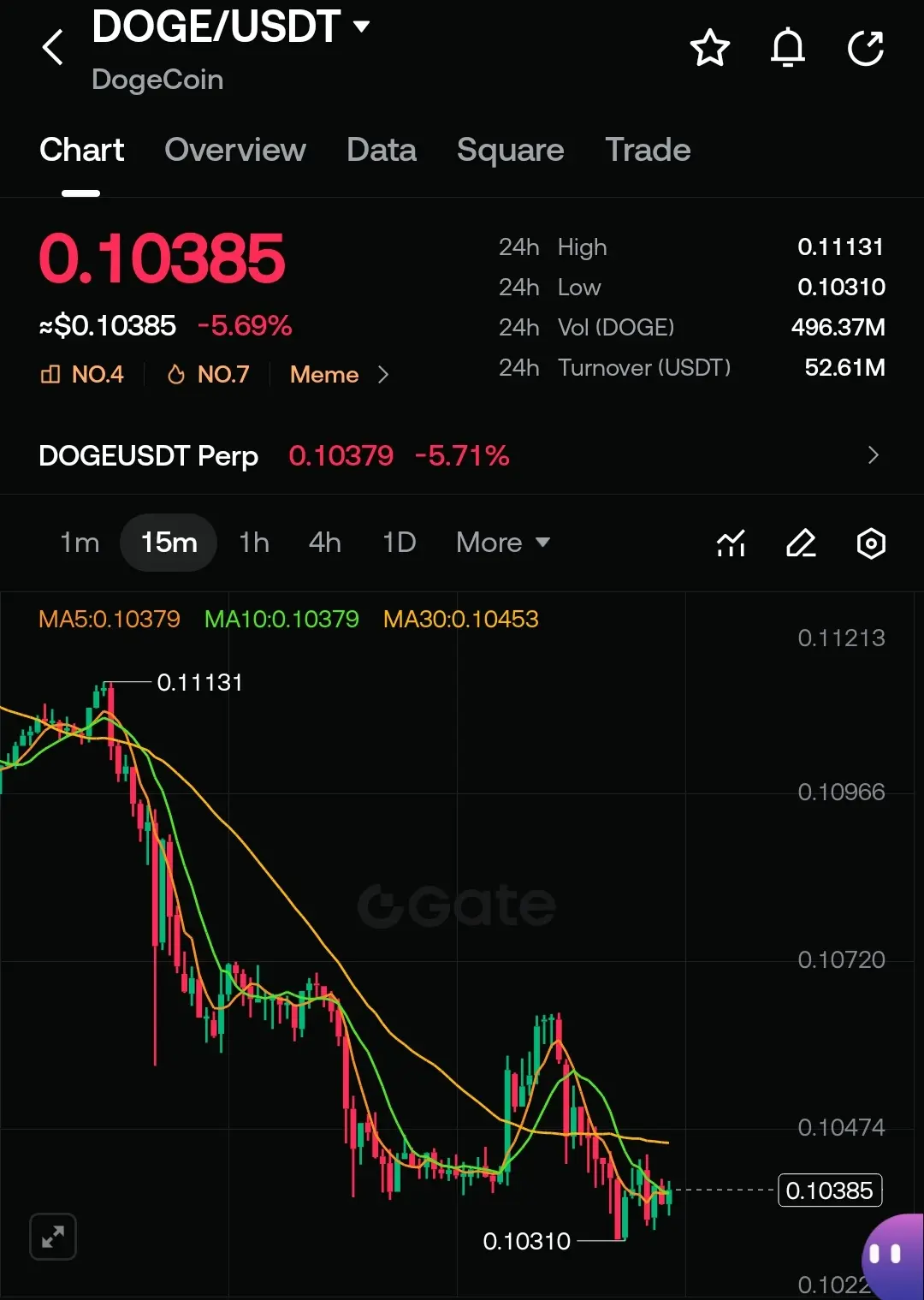
🚨 $DOGE USDT Signal (15M)
📉 Short Entry: 0.1035 – 0.1040
🎯 Target 1: 0.1025
🎯 Target 2: 0.1015
🎯 Target 3: 0.1000
🛑 Stop Loss: 0.1052
📊 DOGE remains under bearish pressure with MA5/MA10 below MA30. Price is struggling to regain momentum, and unless 0.1047–0.1050 is reclaimed, sellers may continue controlling the move. Trade with disciplined risk management.
#TradfiTradingChallenge #CryptoMarketDrops150KLiquidated #GateAprilTransparencyReport
repost-content-media
  • Reward
  • Comment
  • Repost
  • Share
#GateSquareMayTradingShare #Gt I have a huge advantage. I love you very much. I love you very much. I love you very much. I love you very much. I love you very much. I love you very much. I love you very much. I love you very much. I love you very much. I love you very much. I love you very much. I love you very much. I love you very much. I love you very much. I love you very much. I love you very
GT0.28%
View Original
SoominStar
#GateSquareMayTradingShare
SIREN
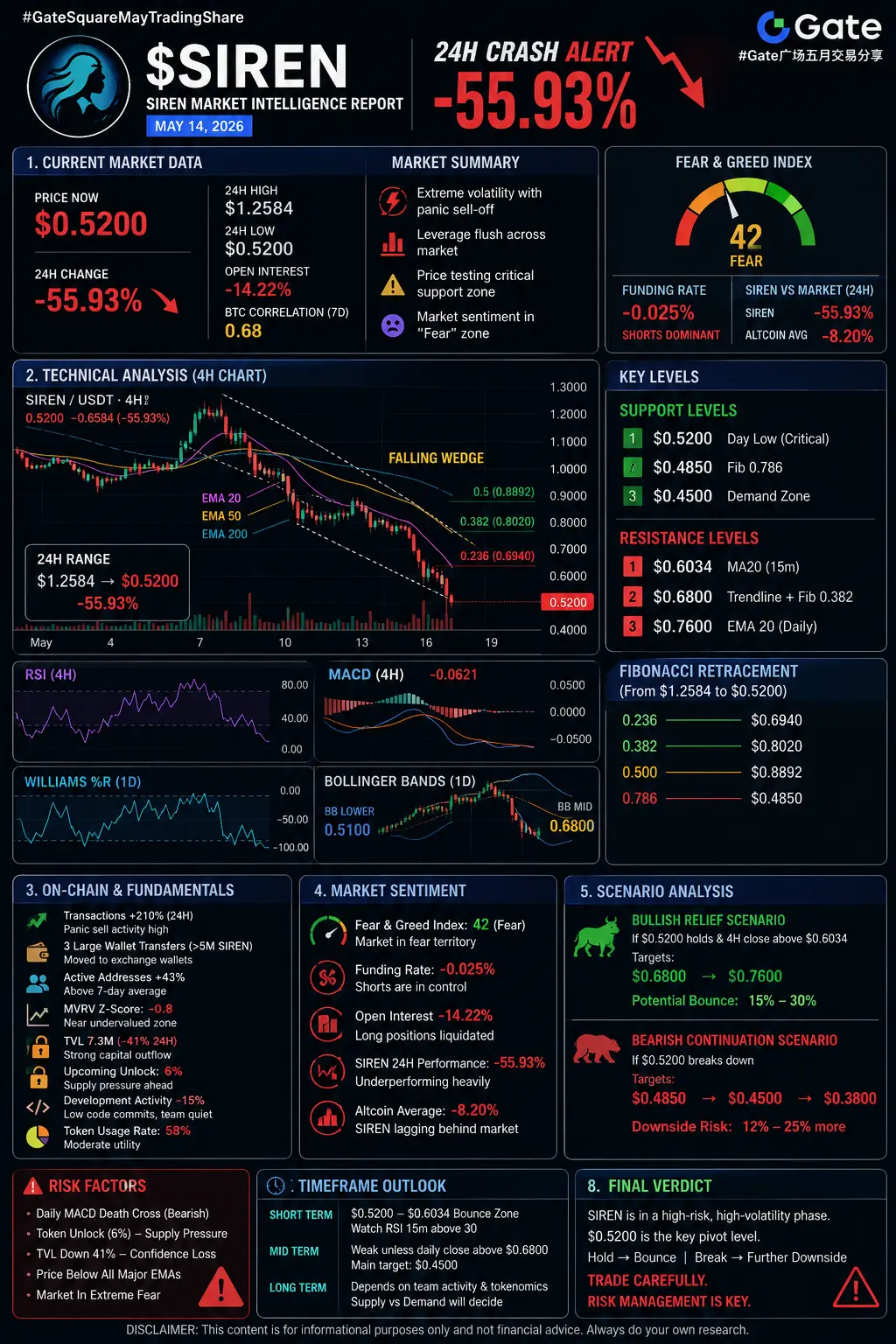
SIREN Market Intelligence Report | May 14, 2026
1. Market Shock Structure & Price Action Breakdown
SIREN has entered a high-volatility dislocation phase where liquidity, sentiment, and leverage have all reset simultaneously. Price action shows a rapid repricing from $1.2584 down into the $0.52 region, marking a severe 24-hour drawdown of roughly -55.93%. This is not a normal corrective move; it is a full leverage flush event across spot-linked derivatives and overexposed long positioning.
The $0.52 zone is now acting as the immediate battlefield. Price has attempted stabilization here after aggressive downside expansion, but the structure still reflects fragile demand absorption rather than true accumulation. Intraday data confirms that trading participation has dropped by 14.22%, indicating that forced exits dominated rather than organic repositioning.
The broader implication is clear: this move was liquidity-driven, not fundamentally supported. The market is currently in a post-liquidation equilibrium attempt.
---
2. Structural Trend Mapping (Multi-Timeframe Analysis)
Micro Trend (15min – 1H)
Price has broken below the short-term moving equilibrium near $0.6034 (MA20), confirming a breakdown in momentum structure. The rebound attempts are forming inside a descending wedge, which typically signals compression after panic expansion. However, confirmation is still absent.
Short-term structure remains sell-dominant, with lower highs continuing to form under declining liquidity pressure.
Mid Trend (4H)
The 4H chart presents a deeply oversold regime, with RSI printed around 18.04. Historically, readings below 20 often precede technical relief bounces, but they do not guarantee trend reversal.
A divergence pattern is visible: price has made new lows while momentum indicators have not fully expanded further downward. This indicates exhaustion rather than reversal confirmation.
MACD on 4H remains in a confirmed bearish crossover, and histogram expansion supports continuation bias in medium term unless reclaimed levels are breached.
Macro Trend (Daily – Weekly)
Daily structure has fully transitioned into bearish regime following a MACD death cross. This is the most important macro signal in the current setup.
Price trading below EMA clusters confirms trend displacement. Weekly close below $0.85 has already invalidated prior bullish continuation structure, shifting SIREN into a macro correction phase rather than a pullback.
---
3. Key Liquidity Levels & Market Map
The current price structure is defined by stacked liquidity zones:
Immediate Support Layer
$0.5200 → active defense zone, psychological pivot, current battleground
$0.4850 → Fibonacci 0.786 retracement, high probability liquidity sweep zone
$0.4500 → structural demand gap and macro downside magnet
Resistance & Recovery Triggers
$0.6034 → first reclaim trigger (short-term trend invalidation level)
$0.6800 → structural breakout confirmation zone, trend shift threshold
$0.7600 → EMA-based recovery ceiling, mid-cycle resistance
The market is currently compressed between liquidation support and declining resistance pressure.
---
4. Indicator Flow & Signal Interpretation
RSI Dynamics
Both 15-minute and 4-hour RSI are deeply oversold. Such conditions historically produce relief rallies in the range of 10–30%, but only when supported by volume expansion.
However, oversold alone is not a reversal signal—only a reaction condition.
MACD Behavior
15min: early-stage stabilization attempt
4H: confirmed bearish momentum regime
Daily: structural downtrend confirmation (dominant signal)
The hierarchy clearly shows that short-term bounce potential exists, but macro direction remains downward until invalidation levels are reclaimed.
Moving Average Structure
Price is currently below all major short-term and mid-term EMAs. EMA50 ($0.82) and EMA200 ($0.95) remain significantly above current price, confirming strong trend separation and absence of recovery structure.
Bollinger Band Positioning
Daily candles have pierced below the lower band near $0.51, indicating extreme volatility expansion. Historically, such conditions often revert toward the mid-band (~$0.68), but only in stabilization environments.
---
5. Fibonacci & Price Compression Geometry
From swing high $1.2584 to low $0.5200:
0.236 retracement: $0.6940
0.382 retracement: $0.8020
0.5 retracement: $0.8892
Current structure suggests any recovery attempt must first reclaim $0.6034 to even initiate Fibonacci-based retracement behavior.
Failure to reclaim this zone keeps market locked in lower liquidity expansion mode.
---
6. On-Chain Flow & Behavioral Signals
On-chain metrics confirm stress-driven market conditions:
Transaction activity surged +210%, signaling panic rotation rather than organic growth
Large wallet movements (>5M SIREN transfers) indicate distribution toward hub wallets
Active address count increased +43%, but driven primarily by sell-side activity
MVRV Z-score near -0.8 suggests proximity to historical undervaluation zones, but not yet extreme capitulation (-1.2 range historically)
TVL contraction of -41% in 24 hours reflects rapid capital withdrawal, weakening ecosystem confidence in the short term.
Token unlock pressure (~6% upcoming supply expansion) adds additional structural headwind.
---
7. Market Sentiment & Derivatives Positioning
Broader market sentiment remains in “Fear” territory, with altcoins experiencing synchronized downside pressure.
SIREN specifically is underperforming peers significantly (-55.93% vs average -8.2%), confirming idiosyncratic stress rather than sector-wide movement.
Funding rate at -0.025% indicates short dominance in derivatives positioning, but also introduces potential for sharp short squeeze if price stabilizes above key levels.
Open interest decline of 14.22% suggests leverage has already been partially cleared.
---
8. Scenario Modeling
Bullish Relief Scenario (Short-Term Only)
If $0.5200 holds and price reclaims $0.6034 on a 4H close:
First target: $0.6800 (structural mid-zone)
Secondary target: $0.7600 (EMA resistance zone)
Expected bounce range: 15%–30%
This scenario requires BTC stability above macro support levels and volume recovery.
---
Bearish Continuation Scenario
If $0.5200 fails decisively:
Next liquidity sweep: $0.4850
Extended downside target: $0.4500
Extreme extension zone: $0.3800 gap fill
Breakdown below $0.5000 hourly would confirm continuation of liquidation phase.
---
9. Risk Structure & Market Reality Check
Key structural risks currently dominating SIREN:
1. Daily MACD death cross confirms macro bearish regime
2. OI collapse shows leverage wipe but not accumulation
3. Token unlock introduces fresh supply pressure
4. TVL decline signals weakening ecosystem trust
5. Resistance stack remains far above current price, limiting recovery speed
Market remains in post-liquidation rebuild phase, not in recovery cycle.
---
10. Final Interpretation
SIREN is currently positioned in a deep liquidation aftermath zone where volatility is extremely high, liquidity is thin, and directional certainty is unstable.
Short-term structure allows for technical bounce potential due to extreme oversold conditions, but medium-term trend remains structurally bearish unless key reclaim levels are broken.
$0.5200 is the critical pivot point. Holding this level keeps bounce probability alive toward $0.6034–$0.6800. Losing it opens pathway toward $0.4850 and $0.4500 liquidity zones.
Market remains reactive, not directional. Trend confirmation has not yet shifted.
---
repost-content-media
  • Reward
  • 2
  • Repost
  • Share
discovery:
To The Moon 🌕
View More
#GateSquareMayTradingShare
Trade Setup: Short $ETH
• Entry Zone: 2305.354030 – 2308.814292
• Target 1: 2294.627218
• Target 2: 2286.322590
• Target 3: 2273.865648
• Stop Loss: 2323.693418
The 15-minute Relative Strength Index registers at 33.22, reflecting oversold conditions while the 4-hour structure maintains a definitive bearish posture. En
ETH0.78%
CryptoFiler
GateSquareMayTradingShare
SUI (SUI COIN) MARKET ANALYSIS — ECOSYSTEM GROWTH, LIQUIDITY PRESSURE & NEXT BREAKOUT ZONES
Current SUI Market Snapshot
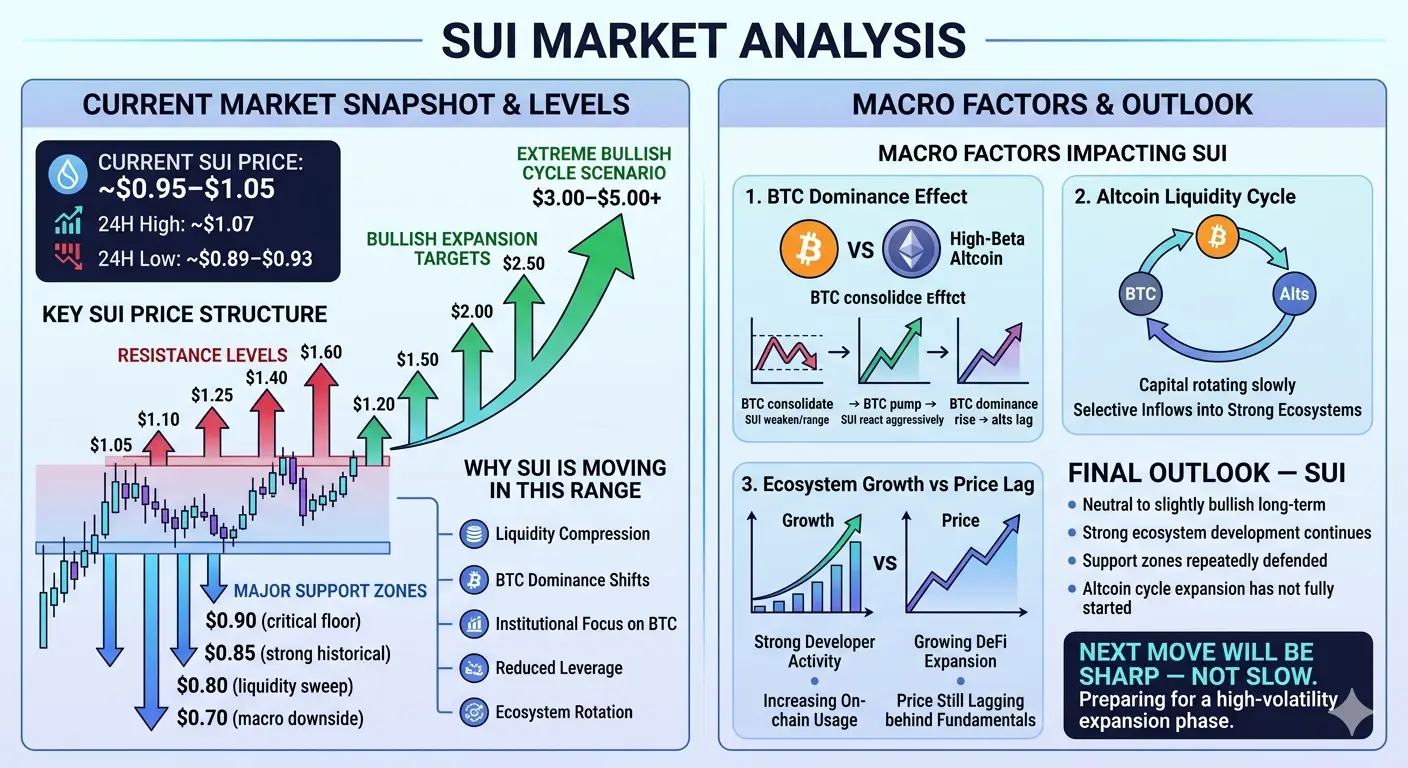
Current SUI Price: ~$0.95–$1.05 zone
24H High: ~$1.07
24H Low: ~$0.89–$0.93
SUI is currently trading in a highly sensitive accumulation-to-distribution range, where price is reacting strongly to BTC dominance shifts, altcoin liquidity rotation, and broader risk sentiment across global markets.
---
KEY SUI PRICE STRUCTURE
Immediate Resistance Levels:
$1.05
$1.10
$1.25
$1.40
$1.60
Major Support Zones:
$0.90 (critical accumulation floor)
$0.85 (strong historical support)
$0.80 (liquidity sweep zone)
$0.70 (macro downside extension zone)
Bullish Expansion Targets:
$1.20
$1.50
$2.00
$2.50
Extreme Bullish Cycle Scenario:
$3.00–$5.00+ if full altcoin cycle expansion returns with strong BTC breakout and liquidity rotation into Layer-1 ecosystems.
---
WHY SUI IS MOVING IN THIS RANGE
SUI is currently trapped in a liquidity compression environment, meaning price is not trending strongly but instead reacting to shifting macro forces.
Main drivers include:
Bitcoin dominance controlling altcoin liquidity flow
Institutional capital still focused mainly on BTC
Reduced speculative leverage in altcoin markets
Rotation between Layer-1 ecosystems
Macro uncertainty affecting risk appetite
This is why SUI shows sharp spikes followed by quick retracements instead of sustained trends.
---
MACRO FACTORS IMPACTING SUI
1. BTC Dominance Effect
SUI is a high-beta altcoin, meaning:
When BTC consolidates → SUI weakens or ranges
When BTC pumps → SUI reacts aggressively
When BTC dominance rises → altcoins lag
This is one of the main reasons SUI is stuck below strong resistance.
---
2. Altcoin Liquidity Cycle
Current market behavior shows:
Capital is rotating slowly into altcoins
Most liquidity still sitting in BTC and stable assets
Selective inflows into strong ecosystems only
SUI is benefiting from ecosystem strength but not full market liquidity yet.
---
3. Ecosystem Growth vs Price Lag
SUI continues to show:
Strong developer activity
Growing DeFi ecosystem expansion
Increasing on-chain usage narratives
However, price is still lagging behind fundamentals — a typical late-cycle accumulation structure.
---
SUI TECHNICAL STRUCTURE
Market Structure Overview
SUI is currently forming:
Long-term base building phase
Sideways accumulation between $0.85–$1.10
Repeated rejection at upper resistance zones
Gradual volatility contraction (pre-breakout behavior)
Momentum Indicators
RSI: Neutral zone (no extreme overbought/oversold condition)
Volume: declining on rallies, rising near support
Trend: sideways with slight bearish pressure on higher timeframes
---
IMPORTANT SUI LEVELS TO WATCH
Bullish Confirmation Levels
A breakout structure begins if SUI clears:
$1.05 → early bullish trigger
$1.10 → momentum confirmation
$1.25 → trend reversal signal
If SUI breaks $1.25 strongly, next expansion targets:
$1.50
$2.00
$2.50
---
Bearish Risk Levels
If SUI loses key support:
$0.90 → structure weakens
$0.85 → breakdown warning
$0.80 → liquidity sweep zone
Below $0.80, market could enter deeper correction phase before next cycle recovery.
---
TRADER SENTIMENT BREAKDOWN
Bullish Traders
Bullish participants believe:
SUI ecosystem growth will eventually reflect in price
Current range is accumulation zone
Breakout likely after BTC stabilizes
Targets: $1.50 → $2.00 → $3.00+
---
Swing Accumulation Traders
These traders prefer:
Buying near $0.85–$0.95
Avoiding resistance chasing
Long-term holding for cycle expansion
They see this as value accumulation phase.
---
Bearish Traders
Short-term bearish view:
Weak altcoin momentum overall
Rejection near $1.05–$1.10 repeatedly
Liquidity still dominated by BTC
Targets: $0.90 → $0.85 → $0.80
---
SUI TRADING STRATEGY
Bullish Strategy
Accumulation zone: $0.85–$0.95
Breakout trigger: $1.05
Confirmation: $1.10
Targets: $1.25 → $1.50 → $2.00
Invalidation: below $0.80
---
Bearish / Risk Strategy
Short zone: $1.05–$1.10 rejection
Breakdown trigger: loss of $0.90
Targets: $0.85 → $0.80
Strategy: fast scalps only due to volatility
---
FINAL OUTLOOK — SUI
SUI is currently in a macro accumulation phase inside a wider altcoin compression cycle.
Overall structure remains:
👉 Neutral to slightly bullish long-term
Because:
Strong ecosystem development continues
Support zones are repeatedly defended
Altcoin cycle expansion has not fully started yet
NEXT BIG MOVE TRIGGER:
SUI must break:
$1.05 → early bullish signal
$1.10 → momentum shift
$1.25 → real trend reversal
OR lose:
$0.90 → bearish continuation risk
$0.80 → deeper liquidity sweep phase
---
FINAL WORD
SUI is currently preparing for a high-volatility expansion phase, but direction depends on whether liquidity rotates back into altcoins or remains concentrated in BTC.
Next move will be sharp — not slow.
repost-content-media
  • Reward
  • 2
  • Repost
  • Share
discovery:
To The Moon 🌕
View More
GateLive
🎉 Gate Live Global Streamer Leaderboard — Week 1 Results Out
💰 Top streamers already scored cash prizes + featured spotlight
Your rewards arrive within 3 business days
New leaderboard is live
Stream 3 times to secure your spot and earn weekly rewards
👉 Go live now: https://www.gate.com/live?type=apply
📢 Details: https://www.gate.com/announcements/article/51027
repost-content-media
  • Reward
  • 2
  • Repost
  • Share
discovery:
To The Moon 🌕
View More
#GateSquareMayTradingShare
The recent minting of 250 million USDC on Solana may look like a normal liquidity update on the surface, but many traders and analysts believe it represents something much bigger happening inside the crypto industry. This event is becoming another sign that blockchain networks are slowly transforming into real financial infrastructure capable of supporting global-scale payments, liquidity movement, and digital commerce.
Stablecoins have become one of the most important parts of the crypto ecosystem. While Bitcoin is often viewed as digital gold and Ethereum powers d
SOL0.41%
BTC0.34%
ETH0.78%
MrFlower_XingChen
#CircleMints250MUSDCOnSolana
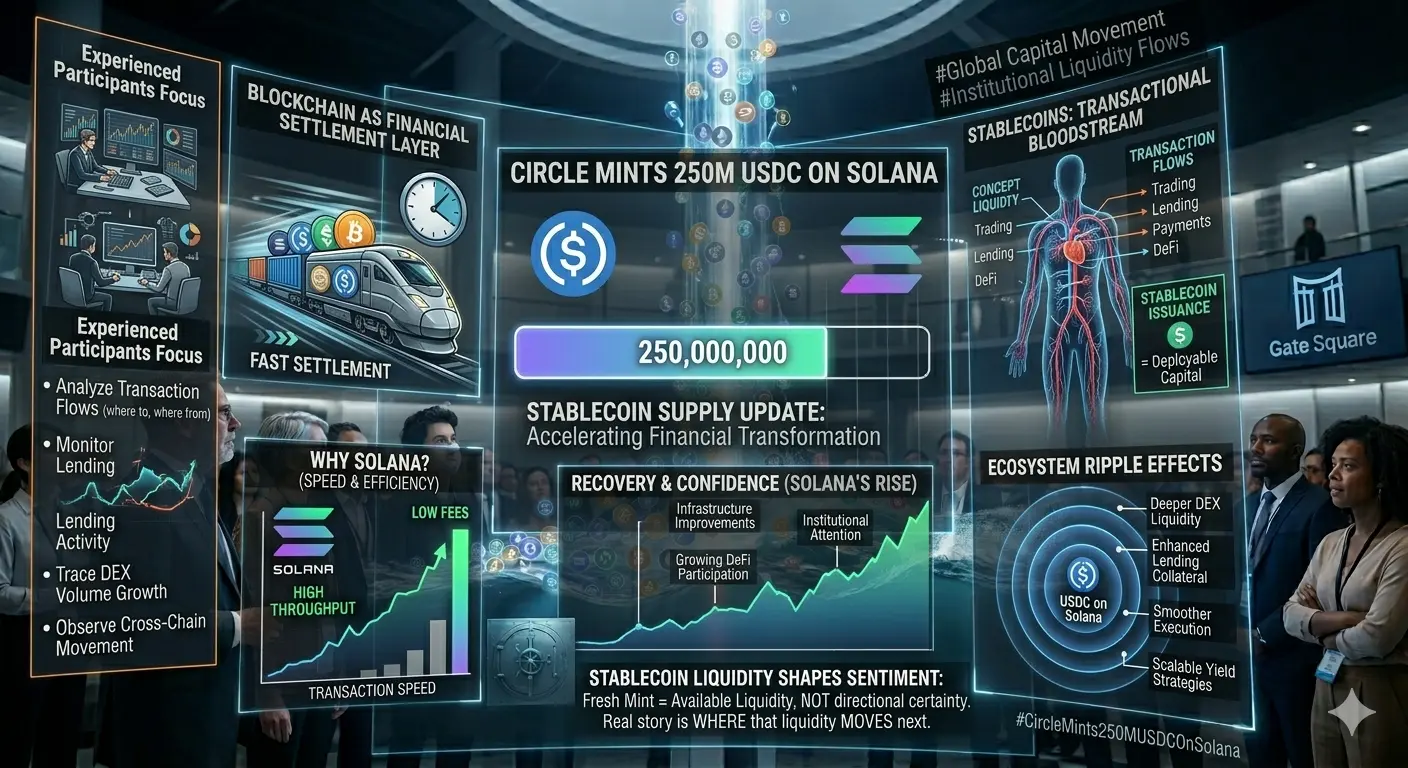
The recent minting of 250 million USDC on Solana may look like a normal liquidity update on the surface, but many traders and analysts believe it represents something much bigger happening inside the crypto industry. This event is becoming another sign that blockchain networks are slowly transforming into real financial infrastructure capable of supporting global-scale payments, liquidity movement, and digital commerce.
Stablecoins have become one of the most important parts of the crypto ecosystem. While Bitcoin is often viewed as digital gold and Ethereum powers decentralized applications, stablecoins act as the main liquidity layer connecting exchanges, DeFi platforms, lending markets, derivatives trading, and payment systems together.
Whenever a large amount of stablecoins enters the market, traders pay close attention because fresh liquidity often signals that larger financial activity may be preparing to enter the ecosystem.
The minting of 250 million USDC is especially important because it happened on Solana. Over the last few years, Solana has transformed from a highly questioned blockchain into one of the fastest-growing ecosystems in crypto. The network has continued improving its infrastructure, expanding developer activity, increasing DeFi adoption, and attracting stronger institutional attention.
Today, Solana is no longer competing only as a fast blockchain for retail users. It is increasingly positioning itself as a blockchain capable of supporting large-scale financial systems.
Solana’s main advantage remains speed and efficiency. Transactions settle quickly, fees stay extremely low, and the network can process large amounts of activity without the high costs often seen on older blockchain systems. This makes Solana attractive for: • Stablecoin transfers • High-frequency trading • DeFi applications • Cross-border payments • Onchain commerce • Real-time settlement systems
When large stablecoin liquidity enters a blockchain ecosystem, the effects usually spread quickly across the network. Decentralized exchanges gain deeper liquidity, lending protocols improve borrowing capacity, trading execution becomes smoother, and DeFi platforms become more efficient overall.
At the same time, stablecoin competition between blockchains is becoming more important than ever. Stablecoins are no longer just crypto tools — they are becoming strategic financial infrastructure.
The blockchain networks that attract the largest stablecoin liquidity often gain major advantages in: • Developer growth • Institutional partnerships • Trading activity • Payment integrations • Ecosystem expansion • Capital efficiency
More liquidity attracts more users, and more users attract even more liquidity. This creates a powerful growth cycle for blockchain ecosystems.
Ethereum still dominates many institutional DeFi sectors, but Solana has been growing aggressively due to its scalability and lower transaction costs. By continuing to expand USDC liquidity on Solana, Circle is strengthening Solana’s role in the broader blockchain liquidity race.
The timing is also important because the crypto market is moving toward a new phase focused heavily on real-world financial infrastructure. Stablecoins are increasingly being used for: • International payments • Treasury settlement • Remittances • Tokenized assets • Digital commerce • Institutional liquidity systems
As adoption grows, scalability and transaction efficiency become critical. Financial institutions and payment companies need blockchain networks capable of handling large transaction volumes reliably and cheaply.
Circle plays a major role in this transformation because it operates between traditional finance and blockchain infrastructure. Many traders view Circle’s stablecoin expansion decisions as signals about which ecosystems are gaining stronger institutional confidence.
There is also a strong psychological effect tied to large stablecoin mints. In crypto markets, liquidity often influences sentiment before prices react. Traders and investors see fresh USDC issuance as potential deployable capital entering the market.
However, experienced participants understand that stablecoin minting does not automatically guarantee immediate bullish price action. Stablecoins can be used for: • Buying assets • Hedging positions • Market-making • Arbitrage trading • Liquidity management • Defensive positioning
This is why smart traders focus not only on the mint itself but on where the liquidity moves afterward. They monitor whether funds flow toward exchanges, DeFi protocols, derivatives platforms, or cross-chain systems.
Ultimately, the bigger story is not simply about 250 million USDC being created.
The bigger story is that blockchain infrastructure is gradually evolving into a global financial system operating 24/7 with programmable liquidity, instant settlement, and borderless capital movement.
The relationship between Circle, USDC, and Solana may become one of the strongest examples of how crypto is moving beyond speculation and entering the next era of internet-native finance.
#GateSquareMayTradingShare
repost-content-media
  • Reward
  • Comment
  • Repost
  • Share
#GateSquareMayTradingShare Global markets are currently operating in a high-volatility macro regime where geopolitical shocks, liquidity conditions, and central bank expectations are all interacting at the same time. The recent escalation in US–Iran tensions has once again pushed investors into defensive positioning, with the Strait of Hormuz becoming the key focal point for global risk sentiment. Any disruption in this region is not just a regional issue anymore — it directly impacts global oil flows, inflation expectations, and the pricing of risk assets across all markets.
In this environme
BTC0.34%
ETH0.78%
AYATTAC
#JapanTokenizesGovernmentBonds 1. A Sustained Trend, Not a One-Off
This issuance isn't an isolated spike. Since the start of 2025, Circle has minted approximately $8 billion worth of USDC on Solana. With a global market cap of roughly $77.9 billion, USDC is cementing its position as a dominant liquidity provider, particularly within the Solana ecosystem where supply is seeing aggressive growth.
2. Solana: The New Frontier for Settlements
Solana is rapidly becoming the primary "battleground" for stablecoins. In February 2026, Solana’s stablecoin settlement volume surpassed Ethereum's for the first time, hitting $650 billion.
Why? High throughput and negligible transaction costs.
The Result: Circle is simply following the demand. As DeFi trading and cross-border payments migrate to Solana, the network requires a massive injection of liquid, compliant dollars.
3. The "Regulatory Dividend"
The timing of this minting is no coincidence. Following the U.S. Congress compromise on the CLARITY Act (May 4th), which clarified profit-sharing and compliance structures for stablecoins, market confidence has surged.
Market Reaction: Circle’s valuation and Coinbase’s stock both saw double-digit gains following the news.
Insight: A clear legal framework allows compliant issuers like Circle to expand their supply more aggressively without fear of sudden regulatory crackdowns.
4. Understanding Minting vs. Inflow
It is vital to distinguish between minting and immediate capital inflow.
The Nuance: Minting 250 million USDC means the tokens are added to the reserve contract to prepare for demand. It is a preemptive move to ensure liquidity is available for institutions and DeFi protocols.
While it signals anticipated demand, it doesn't always mean new cash hit the books the second the transaction occurred.
5. Ecosystem Impact: Strengthening the "Payment Chain"
For the Solana ecosystem, this is a major "green flag."
Efficiency: More USDC leads to deeper liquidity pools, lower slippage in DEXs, and more robust lending markets.
Narrative: It reinforces Solana’s reputation as the premier "payment chain," capable of handling institutional-grade volumes with the stability of a dollar-pegged asset.
6. The Two-Way Street of Liquidity
Context is everything. While $250 million was minted, data shows nearly $1.8 billion in USDC flowed out of Solana during the same month.
Key Takeaway: We are seeing high-velocity capital migration. Funds are moving between chains and protocols at record speeds. Large-scale minting should be viewed as Circle dynamically balancing supply and demand rather than a simple "buy" signal for the market.
Summary
Circle’s expansion on Solana reflects the accelerating penetration of compliant stablecoins into high-speed networks. Driven by regulatory clarity and genuine on-chain utility, USDC is no longer just a "trading pair"—it is becoming the foundational infrastructure for the next generation of digital finance.
repost-content-media
  • Reward
  • Comment
  • Repost
  • Share
#GateSquareMayTradingShare Global markets are currently operating in a high-volatility macro regime where geopolitical shocks, liquidity conditions, and central bank expectations are all interacting at the same time. The recent escalation in US–Iran tensions has once again pushed investors into defensive positioning, with the Strait of Hormuz becoming the key focal point for global risk sentiment. Any disruption in this region is not just a regional issue anymore — it directly impacts global oil flows, inflation expectations, and the pricing of risk assets across all markets.
In this environme
BTC0.34%
ETH0.78%
HighAmbition
#GateSquareMayTradingShare
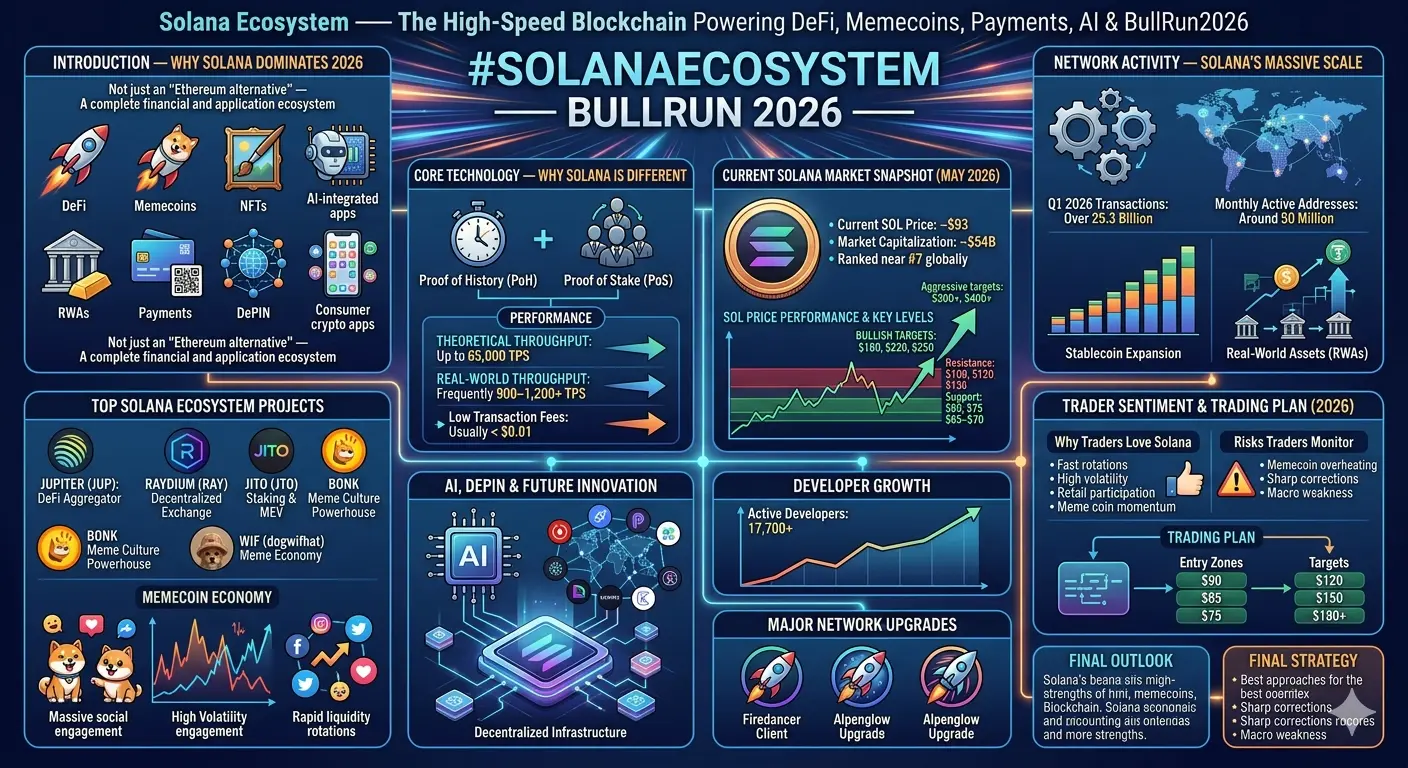
#SolanaEcosystem — The High-Speed Blockchain Powering DeFi, Memecoins, Payments, AI & BullRun2026
Introduction — Why Solana Is Dominating Crypto Discussions in 2026
The Solana ecosystem has evolved into one of the most powerful and active blockchain networks in the digital asset industry. Originally launched as a high-performance Layer-1 blockchain focused on scalability and speed, Solana is now becoming a major hub for:
DeFi
Memecoins
NFTs
AI-integrated applications
Real-world assets (RWAs)
Payments infrastructure
DePIN projects
Consumer crypto apps
By May 2026, Solana is no longer viewed as simply an “Ethereum alternative.”
It is increasingly operating as a complete financial and application ecosystem capable of processing massive transaction volumes with extremely low fees.
The combination of: ✅ High TPS
✅ Low costs
✅ Fast settlement
✅ Massive retail activity
✅ Strong developer growth
✅ Expanding institutional attention
has transformed Solana into one of the strongest narratives of
⚡ Core Technology — Why Solana Is Different
Solana combines:
Proof of Stake (PoS)
Proof of History (PoH)
This architecture allows the network to process transactions at extremely high speed.
Solana Performance Metrics
Theoretical Throughput:
Up to 65,000 TPS
Real-World Throughput:
Frequently 900–1,200+ TPS
Activity surges occasionally push even higher
Transaction Fees:
Usually below $0.01
Many transfers cost fractions of a cent
This creates a major advantage for:
High-frequency trading
Micropayments
Gaming
AI activity
Retail meme trading
Consumer-scale applications
Current Solana Market Snapshot (May 2026)
SOL Price Structure
Current SOL Price:
Approximately $88–$94
Recently stabilizing around ~$93
Market Capitalization:
Roughly $53B–$54B
Ranked near globally
Circulating Supply:
Around 577M–580M SOL
24H Trading Volume:
Frequently $2.4B–$3.5B+
Higher during volatile trading sessions
SOL Price Performance & Key Levels
Important Support Zones:
$80
$75
Major macro support: $65–$70
Resistance Zones:
$100 psychological level
$120 breakout zone
$150 expansion level
Bullish Targets During Strong Market Expansion:
$180
$220
$250
Aggressive cycle targets:
$300+
$400+ during extreme speculative phases
Network Activity — Solana’s Massive Scale
The Solana network has become one of the most active blockchains globally.
Major Usage Statistics
Q1 2026 Transactions:
Over 25.3 billion transactions processed
Monthly Transactions:
Approximately 3.5 billion
Monthly Active Addresses:
Around 50 million
Ecosystem Trading Volume:
Exceeded $3.3 trillion cumulative volume
Application Revenue:
Approximately $3.4 billion recently reported
These figures show Solana operating at internet-scale activity levels compared to many competing chains.
DeFi Ecosystem Growth
Solana has become one of the largest DeFi ecosystems in crypto.
Solana TVL
Current TVL:
Roughly $5.5B–$5.8B
Previous Peak:
Nearly $11B during 2025 expansion phases
Despite volatility:
TVL remains resilient
Liquidity continues flowing into major protocols
Daily TVL changes often fluctuate:
+0.5%
+2%
-3% depending on market conditions
Stablecoin Expansion & Payment Growth
One of Solana’s biggest strengths is stablecoin activity.
Stablecoin Metrics
Stablecoin Market Cap:
Over $15.4 billion
Quarterly Stablecoin Transfers:
Approximately $2 trillion
This growth is being driven by: ✅ Fast settlement
✅ Extremely low fees
✅ Payment integrations
✅ Cross-border usage
✅ Merchant adoption experiments
Many analysts believe Solana could become one of the largest blockchain payment rails globally.
Real-World Assets (RWAs) on Solana
Tokenized real-world assets are becoming a major institutional narrative.
RWA Growth Metrics
Solana recently experienced:
10x growth in:
Activity
Users
Value locked
Lending participation
RWAs include:
Tokenized treasuries
Bonds
Real estate exposure
Institutional settlement systems
This sector could become one of Solana’s largest long-term growth areas.
Top Solana Ecosystem Projects
Jupiter (JUP)
One of Solana’s biggest DeFi aggregators.
JUP Statistics:
Price: ~$0.24–$0.25
Market Cap: ~$800M–$830M
Strong trading activity
Daily moves:
+5%
+10%
Occasionally +15–20% during momentum periods
Jupiter dominates:
Swap aggregation
Perpetual trading
Routing liquidity
Raydium (RAY)
Leading Solana decentralized exchange.
RAY Statistics:
Price: ~$0.85–$0.87
Market Cap: ~$480M
High ecosystem trading volume
RAY often benefits heavily during:
Memecoin rallies
Retail trading expansions
DeFi growth phases
Jito (JTO)
Major staking and MEV infrastructure provider.
JTO Statistics:
Price: ~$0.55
Market Cap: ~$500M
Jito plays a major role in:
Liquid staking
Validator infrastructure
Network efficiency
BONK — Solana’s Meme Culture Powerhouse
BONK became one of Solana’s largest cultural meme assets.
BONK Statistics:
Price: ~$0.000007
Market Cap: ~$600M–$640M
BONK regularly experiences:
10%
20%
30%+ daily volatility during high momentum phases.
Memecoins remain one of the strongest retail traffic drivers for Solana.
WIF (dogwifhat) & Meme Economy
WIF became one of the biggest meme narratives in crypto.
Meme Coin Characteristics:
Massive social engagement
Extremely high volatility
Rapid liquidity rotations
Daily swings frequently reach:
+15%
+25%
Even +50% during extreme momentum events
This speculative activity significantly increases:
Trading volume
User growth
Network fees
Retail engagement
Liquid Staking Ecosystem
Liquid staking has become a major sector within Solana.
Important Assets:
jitoSOL
bnsSOL
Combined ecosystem valuations previously exceeded:
$1.9B+
Liquid staking allows: ✅ Yield generation
✅ DeFi participation
✅ Improved capital efficiency
🚀 Pump.fun & Retail Speculation
Pump.fun became one of Solana’s most explosive retail trading platforms.
It allows:
Rapid token launches
Viral meme creation
Speculative micro-cap trading
At peak activity:
Market valuations reached hundreds of millions
Some phases exceeded $1B ecosystem valuation
Pump.fun significantly increased:
Retail onboarding
Transaction volume
Memecoin culture
NFT & Gaming Ecosystem
Solana remains one of the largest NFT ecosystems.
Major NFT Platforms:
Magic Eden
Tensor
Popular Collections:
Mad Lads
Other gaming-integrated NFTs
Historical NFT sales volume reached: 📊 Billions of dollars.
Gaming and NFT integration continue expanding across:
Digital identity
Game economies
Community systems
AI, DePIN & Future Innovation
Solana is becoming increasingly important in:
AI agents
DePIN infrastructure
GPU networks
Data systems
Real-time applications
Projects like:
Render (RNDR)
Helium
Pyth
Drift
Kamino
continue attracting attention.
AI-generated on-chain actions have already reached: 📊 Millions of interactions.
Developer Growth
Solana’s developer ecosystem is growing aggressively.
Developer Statistics
Active Developers:
17,700+
Growth:
Over 11,000 added during a 9-month period in 2025
This is one of the strongest developer growth rates in crypto.
Major Network Upgrades
Firedancer Client
Designed to:
Improve scalability
Increase stability
Raise throughput
Alpenglow Upgrade
Focused on:
Faster finality
Better efficiency
Improved network responsiveness
Recent upgrades significantly reduced:
Congestion issues
Downtime concerns
Validator inefficiencies
Trader Sentiment & Market Psychology
Why Traders Love Solana
✅ Fast ecosystem rotations
✅ High volatility opportunities
✅ Strong retail participation
✅ Meme coin momentum
✅ DeFi liquidity growth
✅ AI & RWA narratives
⚠️ Risks Traders Monitor
⚠️ Memecoin overheating
⚠️ Sharp corrections
⚠️ Liquidity rotations
⚠️ Macro market weakness
⚠️ High speculative leverage
During volatile periods:
10–20% daily swings are common
Smaller ecosystem coins may move:
30%
50%
Even 100%+ during hype cycles
Solana Trading Plan (2026)
Dip Accumulation Strategy
Entry Zones:
$90
$85
$75
Targets:
$120
$150
$180+
Breakout Strategy
Confirmation above:
$100
$120
could trigger expansion momentum.
Risk Management
Professional traders often:
Scale entries gradually
Take partial profits
Avoid emotional FOMO
Control leverage exposure
Final Outlook — Solana & BullRun2026
Solana has become one of the most important ecosystems of the current market cycle.
The combination of: ✅ Speed
✅ Low fees
✅ Massive activity
✅ Retail participation
✅ AI integration
✅ Stablecoin growth
✅ RWA expansion
✅ Developer momentum
positions Solana as one of the strongest blockchain ecosystems entering the next major expansion cycle.
While volatility remains extremely high, Solana continues attracting:
Traders
Developers
Institutions
Payment systems
Consumer applications
through one of the fastest-growing ecosystems in crypto.
Final Strategy
Best Current Approach:
✅ Focus on strong ecosystem projects
✅ Accumulate during healthy pullbacks
✅ Monitor stablecoin & TVL growth
✅ Watch developer activity closely
✅ Follow liquidity rotations carefully
✅ Prioritize risk management during volatility
If ecosystem growth, institutional adoption, AI integration, and stablecoin expansion continue accelerating, Solana could remain one of the leading blockchain narratives throughout BullRun2026.
#GateSquare #ContentMining
repost-content-media
  • Reward
  • Comment
  • Repost
  • Share
#GateSquareMayTradingShare Global markets are currently operating in a high-volatility macro regime where geopolitical shocks, liquidity conditions, and central bank expectations are all interacting at the same time. The recent escalation in US–Iran tensions has once again pushed investors into defensive positioning, with the Strait of Hormuz becoming the key focal point for global risk sentiment. Any disruption in this region is not just a regional issue anymore — it directly impacts global oil flows, inflation expectations, and the pricing of risk assets across all markets.
In this environme
BTC0.34%
ETH0.78%
Dubai_Prince
#GateSquareMayTradingShare
CRYPTO EXCHANGES ARE NO LONGER JUST MARKETPLACES — THEY ARE BECOMING DIGITAL ECONOMIC EMPIRES
Most traders still misunderstand what is actually happening inside the modern crypto industry.
They think exchanges compete through token listings, lower fees, leverage options, or interface design.
That view is outdated.
The real war is now being fought over something far more powerful:
Attention.
Liquidity.
Behavior.
Retention.
And long-term control over user activity.
The Gate Square May Trading Share campaign is not simply another promotional event designed to distribute rewards and temporarily increase volume. It represents a much larger structural evolution happening across the entire crypto ecosystem, where exchanges are transforming from passive trading platforms into fully engineered participation economies designed to maximize engagement, user loyalty, and continuous market activity.
And whether traders realize it or not, this transformation is changing how markets behave.
Because in modern crypto, liquidity is no longer just market depth.
Liquidity has become influence.
The platform capable of attracting the highest concentration of active traders gains a powerful advantage across every layer of the ecosystem. Strong liquidity improves execution quality, reduces slippage, increases market confidence, attracts larger traders, strengthens derivatives markets, supports institutional participation, and ultimately creates the perception of dominance itself.
This is why exchange competition has become so aggressive.
Every platform now understands a brutal reality:
Inactive users are dead capital.
A trader who is not participating generates no fees, no engagement, no liquidity, no momentum, and no ecosystem growth. That is exactly why campaigns like Gate Square May Trading Share are becoming increasingly important. These events are designed to reactivate attention, stimulate trading behavior, deepen liquidity pools, and reinforce platform stickiness during both bullish and uncertain market conditions.
On the surface, users see incentives.
Underneath, exchanges are engineering behavioral systems.
And that distinction matters.
Because modern exchange growth is no longer driven purely by technology. It is driven by psychology.
The industry has quietly entered an era where trading itself is being gamified at scale.
Leaderboards create status pressure.
Reward pools create urgency.
Time-limited campaigns trigger fear of missing opportunity.
Community discussions amplify participation.
And ranking systems convert trading activity into competition.
This is not accidental design.
It is calculated behavioral architecture.
Exchanges understand that humans are naturally attracted to environments where activity feels socially validated and emotionally stimulating. Once trading becomes connected to competition and recognition, participation increases dramatically because users no longer feel like isolated traders — they feel like active members inside a larger ecosystem event.
That emotional shift changes market behavior more than most people realize.
Some traders who would normally wait patiently for high-probability setups suddenly become hyperactive simply because incentives exist. Others begin increasing volume not because market conditions improved, but because participation itself becomes psychologically rewarding.
This is where the opportunity and danger begin to collide.
Because campaigns like Gate Square May Trading Share can absolutely create advantages for disciplined traders, but they can also expose weak traders faster than normal market conditions ever could.
And this is the part nobody wants to say openly.
A massive percentage of retail traders are not actually trading systems.
They are trading emotional stimulation.
Many participants convince themselves they are being strategic while secretly chasing excitement, dopamine, leaderboard visibility, or fast reward accumulation. The result is predictable:
Overtrading.
Forced entries.
Excessive leverage.
Poor risk-to-reward execution.
Revenge trading after losses.
And complete destruction of discipline.
This is why inexperienced traders often lose money during high-engagement campaign periods even while believing they are maximizing opportunity.
They confuse activity with intelligence.
But volume alone means nothing.
A trader can generate enormous activity while still destroying long-term profitability.
The market does not reward movement.
The market rewards precision.
That difference separates professionals from emotional participants.
Experienced traders approach exchange campaigns differently. They do not abandon structure simply because incentives exist. They integrate opportunities into existing systems while protecting capital first. They understand that surviving volatility matters more than chasing temporary rankings.
Because sustainability is the real edge.
And sustainability requires emotional control.
This becomes even more important when analyzing how these campaigns affect broader market structure.
Large-scale trading-share events can temporarily reshape liquidity distribution across entire ecosystems. Targeted pairs may experience sudden spikes in volume, volatility expansion, tighter spreads, increased speculative activity, and rapid short-term price movement.
But smart traders know that not all liquidity carries equal quality.
Some volume reflects genuine conviction.
Some volume reflects temporary incentive participation.
Some volume reflects algorithmic rotation.
Some volume reflects artificial activity driven by reward structures.
And if traders fail to distinguish between those categories, they risk misreading market strength entirely.
This is where deeper market intelligence becomes essential.
A temporary surge in activity does not automatically mean sustainable demand exists. Sometimes campaign-driven liquidity creates the illusion of momentum while underlying market conviction remains weak. Traders who blindly follow surface-level volume without understanding its origin often become exit liquidity for smarter participants monitoring behavioral flows underneath the market.
That is why mature traders analyze context, not excitement.
They ask difficult questions.
Is this move supported by organic accumulation?
Are derivatives overheating?
Is leverage expanding too aggressively?
Are funding rates becoming unstable?
Is participation sustainable after incentives disappear?
Are whales distributing into retail enthusiasm?
Is the market structurally healthy or temporarily inflated by reward-driven behavior?
These questions matter because crypto markets are becoming increasingly psychological.
And exchange ecosystems are accelerating that evolution.
The deeper reality is that platforms no longer want users who trade occasionally.
They want users who live inside the ecosystem continuously.
This is why the future of exchange competition will likely expand far beyond simple trading incentives. The next generation of platforms may integrate AI-driven behavioral targeting, personalized reward systems, adaptive participation models, gamified achievement structures, social trading ecosystems, cross-platform loyalty integration, predictive engagement algorithms, and community-driven economic frameworks where user activity itself becomes monetized more aggressively than ever before.
In other words, exchanges are slowly evolving into digital behavioral economies.
And traders who fail to understand this shift will constantly underestimate how modern crypto ecosystems influence decision-making.
This creates an important debate for the future of the industry.
Supporters argue that engagement campaigns strengthen market depth, increase accessibility, improve liquidity efficiency, expand ecosystem participation, and accelerate mainstream adoption by making crypto more interactive and community-driven.
Critics argue the opposite.
They believe excessive gamification risks turning trading into entertainment rather than disciplined capital management. They warn that reward systems may encourage emotional behavior, unhealthy leverage exposure, and speculative addiction among inexperienced users who mistake engagement for profitability.
Both sides have valid arguments.
And the truth probably exists somewhere in the middle.
Because gamification itself is not inherently dangerous.
Undisciplined participation is.
A mature trader can use high-engagement environments strategically while maintaining strict control over risk exposure and emotional stability. An immature trader can destroy months of capital trying to chase incentives that were never large enough to justify reckless behavior in the first place.
That is the brutal reality many people refuse to accept.
The market does not care about excitement.
It does not reward effort.
It does not reward participation alone.
It rewards positioning, patience, execution, and emotional discipline.
Everything else is noise.
This is exactly why the Gate Square May Trading Share campaign represents something far bigger than a temporary exchange event. It reflects the next stage of crypto evolution, where liquidity, engagement, behavioral psychology, community participation, and platform economics are becoming deeply interconnected.
The exchanges understand it.
The whales understand it.
The smart traders understand it.
The only question is whether retail participants will recognize what game they are actually playing before emotional decision-making turns opportunity into self-destruction.
Because in the end, incentives may attract traders…
But only discipline keeps them alive long enough to win.
Go ahead and publish your first post now 👉 https://www.gate.com/post
🗓 The event runs until May 15th, the earlier you participate, the better your chances on the leaderboard!
Details: https://www.gate.com/announcements/article/50981
#BTC #ETH #GT
repost-content-media
  • Reward
  • Comment
  • Repost
  • Share
#GateSquareMayTradingShare Global markets are currently operating in a high-volatility macro regime where geopolitical shocks, liquidity conditions, and central bank expectations are all interacting at the same time. The recent escalation in US–Iran tensions has once again pushed investors into defensive positioning, with the Strait of Hormuz becoming the key focal point for global risk sentiment. Any disruption in this region is not just a regional issue anymore — it directly impacts global oil flows, inflation expectations, and the pricing of risk assets across all markets.
In this environme
BTC0.34%
ETH0.78%
CryptoDiscovery
#GateSquareMayTradingShare Global markets are currently operating in a high-volatility macro regime where geopolitical shocks, liquidity conditions, and central bank expectations are all interacting at the same time. The recent escalation in US–Iran tensions has once again pushed investors into defensive positioning, with the Strait of Hormuz becoming the key focal point for global risk sentiment. Any disruption in this region is not just a regional issue anymore — it directly impacts global oil flows, inflation expectations, and the pricing of risk assets across all markets.
In this environment, uncertainty is the real catalyst. Markets do not collapse simply because of bad news; they reprice aggressively when the future becomes unpredictable. This is exactly what we are seeing now — rapid shifts in oil, sudden volatility spikes in equities, and crypto reacting as a high-beta liquidity instrument.
Bitcoin briefly losing the $80K zone reflects short-term stress, but the broader structure still shows resilience supported by institutional flows, ETF demand, and consistent accumulation near key liquidity zones. However, BTC remains highly sensitive to macro liquidity conditions, meaning every major data release or geopolitical headline can temporarily distort price action.
ETHEREUM (ETH) MARKET OUTLOOK & STRUCTURE
Ethereum is currently in a more volatility-sensitive position compared to Bitcoin due to its higher beta nature and deeper exposure to DeFi liquidity cycles. ETH continues to trade in a broad consolidation range where liquidity is building both above and below key zones, suggesting that a major directional move is being prepared.
Key ETH drivers right now include:
- Ethereum ETF anticipation and institutional positioning narratives
- Layer-2 ecosystem growth and transaction scalability improvements
- Staking participation rates influencing circulating supply dynamics
- DeFi liquidity fluctuations as global risk sentiment shifts
From a technical perspective, ETH tends to outperform BTC during risk-on recovery phases but underperforms during liquidity contraction cycles. This makes ETH a “momentum amplifier” of broader crypto sentiment.
If macro pressure eases, ETH could see stronger upside acceleration due to renewed DeFi activity and capital rotation from BTC. However, if oil volatility and USD strength persist, ETH may experience sharper downside swings due to thinner liquidity depth.
Overall, Ethereum remains a high-opportunity but high-risk asset in the current macro environment, requiring strict risk management and timing discipline.
Right now, both BTC and ETH are moving inside a macro-driven volatility cycle where geopolitical events and liquidity expectations are the primary price engines.
#CryptoMarket #ETHAnalysis #GateSquareMayTradingShare
repost-content-media
  • Reward
  • Comment
  • Repost
  • Share
#GateSquareMayTradingShare #Gt I have a big advantage. I really like using Gate.io exchange and I will continue to use it happily.
View Original
CryptoDiscovery
#GateSquareMayTradingShare Global markets are currently operating in a high-volatility macro regime where geopolitical shocks, liquidity conditions, and central bank expectations are all interacting at the same time. The recent escalation in US–Iran tensions has once again pushed investors into defensive positioning, with the Strait of Hormuz becoming the key focal point for global risk sentiment. Any disruption in this region is not just a regional issue anymore — it directly impacts global oil flows, inflation expectations, and the pricing of risk assets across all markets.
In this environment, uncertainty is the real catalyst. Markets do not collapse simply because of bad news; they reprice aggressively when the future becomes unpredictable. This is exactly what we are seeing now — rapid shifts in oil, sudden volatility spikes in equities, and crypto reacting as a high-beta liquidity instrument.
Bitcoin briefly losing the $80K zone reflects short-term stress, but the broader structure still shows resilience supported by institutional flows, ETF demand, and consistent accumulation near key liquidity zones. However, BTC remains highly sensitive to macro liquidity conditions, meaning every major data release or geopolitical headline can temporarily distort price action.
ETHEREUM (ETH) MARKET OUTLOOK & STRUCTURE
Ethereum is currently in a more volatility-sensitive position compared to Bitcoin due to its higher beta nature and deeper exposure to DeFi liquidity cycles. ETH continues to trade in a broad consolidation range where liquidity is building both above and below key zones, suggesting that a major directional move is being prepared.
Key ETH drivers right now include:
- Ethereum ETF anticipation and institutional positioning narratives
- Layer-2 ecosystem growth and transaction scalability improvements
- Staking participation rates influencing circulating supply dynamics
- DeFi liquidity fluctuations as global risk sentiment shifts
From a technical perspective, ETH tends to outperform BTC during risk-on recovery phases but underperforms during liquidity contraction cycles. This makes ETH a “momentum amplifier” of broader crypto sentiment.
If macro pressure eases, ETH could see stronger upside acceleration due to renewed DeFi activity and capital rotation from BTC. However, if oil volatility and USD strength persist, ETH may experience sharper downside swings due to thinner liquidity depth.
Overall, Ethereum remains a high-opportunity but high-risk asset in the current macro environment, requiring strict risk management and timing discipline.
Right now, both BTC and ETH are moving inside a macro-driven volatility cycle where geopolitical events and liquidity expectations are the primary price engines.
#CryptoMarket #ETHAnalysis #GateSquareMayTradingShare
repost-content-media
  • Reward
  • Comment
  • Repost
  • Share
#GateSquareMayTradingShare #Gt I have a big advantage. I really like using Gate.io exchange and I will continue to use it.
View Original
CryptoDiscovery
#GateSquareMayTradingShare Global markets are currently operating in a high-volatility macro regime where geopolitical shocks, liquidity conditions, and central bank expectations are all interacting at the same time. The recent escalation in US–Iran tensions has once again pushed investors into defensive positioning, with the Strait of Hormuz becoming the key focal point for global risk sentiment. Any disruption in this region is not just a regional issue anymore — it directly impacts global oil flows, inflation expectations, and the pricing of risk assets across all markets.
In this environment, uncertainty is the real catalyst. Markets do not collapse simply because of bad news; they reprice aggressively when the future becomes unpredictable. This is exactly what we are seeing now — rapid shifts in oil, sudden volatility spikes in equities, and crypto reacting as a high-beta liquidity instrument.
Bitcoin briefly losing the $80K zone reflects short-term stress, but the broader structure still shows resilience supported by institutional flows, ETF demand, and consistent accumulation near key liquidity zones. However, BTC remains highly sensitive to macro liquidity conditions, meaning every major data release or geopolitical headline can temporarily distort price action.
ETHEREUM (ETH) MARKET OUTLOOK & STRUCTURE
Ethereum is currently in a more volatility-sensitive position compared to Bitcoin due to its higher beta nature and deeper exposure to DeFi liquidity cycles. ETH continues to trade in a broad consolidation range where liquidity is building both above and below key zones, suggesting that a major directional move is being prepared.
Key ETH drivers right now include:
- Ethereum ETF anticipation and institutional positioning narratives
- Layer-2 ecosystem growth and transaction scalability improvements
- Staking participation rates influencing circulating supply dynamics
- DeFi liquidity fluctuations as global risk sentiment shifts
From a technical perspective, ETH tends to outperform BTC during risk-on recovery phases but underperforms during liquidity contraction cycles. This makes ETH a “momentum amplifier” of broader crypto sentiment.
If macro pressure eases, ETH could see stronger upside acceleration due to renewed DeFi activity and capital rotation from BTC. However, if oil volatility and USD strength persist, ETH may experience sharper downside swings due to thinner liquidity depth.
Overall, Ethereum remains a high-opportunity but high-risk asset in the current macro environment, requiring strict risk management and timing discipline.
Right now, both BTC and ETH are moving inside a macro-driven volatility cycle where geopolitical events and liquidity expectations are the primary price engines.
#CryptoMarket #ETHAnalysis #GateSquareMayTradingShare
repost-content-media
  • Reward
  • Comment
  • Repost
  • Share
#GateSquareMayTradingShare #Gt I have a big advantage. I really like using Gate.io exchange, and I will continue to use it.
View Original
HighAmbition
#GateSquareMayTradingShare
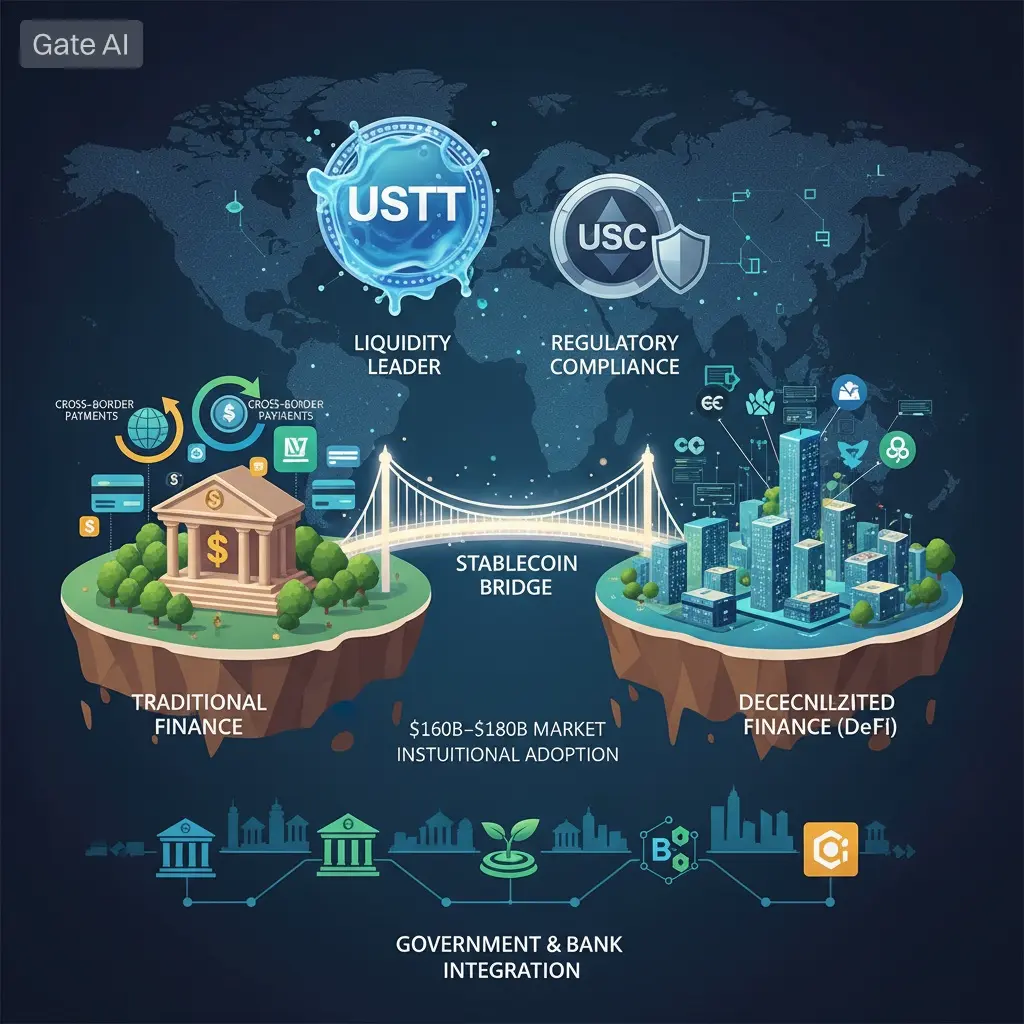
Stablecoins are no longer just crypto liquidity tools. They have evolved into a global digital dollar infrastructure layer influencing payments, banking, DeFi, and cross-border settlement systems.
The sector is now operating at the intersection of:
Traditional finance (TradFi)
Decentralized finance (DeFi)
Sovereign monetary policy
Global payment networks
1. Global Stablecoin Market Structure & Liquidity Dynamics
Total Market Size
Current stablecoin market cap: ~$160B – $180B
Peak cycle projection (bull expansion scenario): $250B – $400B
Daily settlement volume: $80B – $120B+
Annual on-chain settlement throughput: $25T – $40T equivalent flow
Growth Rate
Historical CAGR: ~20% – 35%
Institutional adoption phase acceleration: ~30% – 50% YoY in compliant assets
Market Share Distribution
USDT (Tether): ~55% – 60% dominance
USDC (Circle): ~25% – 30%
Emerging stablecoins (FDUSD, PYUSD, USDe, DAI): ~10% – 20% combined
2. Regulatory Evolution: The Structural Turning Point
Stablecoins are shifting from “unregulated crypto assets” to regulated digital cash equivalents.
United States Framework (STABLE Act / GENIUS Act)
Expected enforcement structure:
100% reserve backing (cash + short-term U.S. Treasuries)
Mandatory audits (monthly/quarterly transparency cycles)
Issuer licensing under banking-like supervision
Segregation of reserves from operational capital
Expected impact:
Institutional inflow increase: +35% – 60%
Risk premium reduction across stablecoin markets: ~20% – 40%
Non-compliant liquidity decline: ~10% – 25% gradual migration
Europe (MiCA Framework)
Already active and shaping global standards:
Strict reserve composition rules
Fast redemption guarantees (T+1 / instant settlement targets)
Mandatory whitepaper disclosure + regulatory reporting
Observed effects:
Shift of liquidity toward compliant stablecoins: ~15% – 30%
Increased institutional usage of USDC-like instruments
Global Trend
Regulation is no longer restrictive — it is becoming:
“The entry ticket for mainstream financial adoption.”
3. USDT vs USDC: Competing Monetary Models
Stablecoin competition is now a battle of financial philosophies, not just market share.
USDT (Tether) — Liquidity Dominance Model
Market cap: ~$140B+
Dominates derivatives + offshore trading markets
Deep integration across exchanges globally
Strengths:
~60% global stablecoin trading liquidity
Strong presence in Asia, LATAM, offshore markets
High capital velocity (fast circulation)
Weakness factors:
Lower institutional transparency perception
Regulatory exposure in stricter jurisdictions
USDC (Circle) — Compliance Infrastructure Model
Market cap: ~$55B – $65B
Fully regulated reserve structure
Strong institutional banking integration
Growth signals:
~25% – 40% annual adoption growth in fintech systems
Expanding use in payroll, settlement, and treasury systems
Strategic partnerships with major financial institutions
Strategic positioning: USDC is becoming the regulated digital dollar backbone for global finance systems.
4. Cross-Border Payments: Structural Disruption Layer
Traditional system inefficiencies:
Settlement time: 2–5 business days
Fees: 2% – 6% average
Multi-intermediary dependency (SWIFT model)
Stablecoin Infrastructure:
Settlement: 3–30 seconds
Fees: <0.1% typical
Global access: 24/7 permissionless transfer system
Institutional Adoption Examples:
Stripe: USDC global payout rails
Visa: stablecoin settlement trials
PayPal: PYUSD ecosystem expansion
Macro impact:
Cross-border stablecoin usage growth: ~45% – 70% YoY
Emerging market dollar substitution usage: 10% – 25% of digital USD flows
5. Banking Integration & Financial System Convergence
Banks are not resisting stablecoins — they are internalizing the model.
Institutional Behavior Shift:
JPMorgan internal settlement tokens
Regional banks building private stablecoin rails
Fintech APIs integrating stablecoin treasury flows
Efficiency gains:
Settlement cost reduction: 30% – 60%
Liquidity optimization improvement: 20% – 45%
Treasury visibility enhancement: near real-time
Risk: Fragmentation
If every institution issues its own stable asset:
Interoperability inefficiency risk: ~30% – 50%
Liquidity fragmentation across ecosystems increases
6. DeFi Integration: Yield-Driven Stablecoin Demand
Stablecoins are now yield-generating financial instruments, not idle assets.
Yield Layers:
Lending markets: 3% – 8% APY
Liquidity pools: 2% – 12% APY
Structured yield products: 10% – 25%+ APY
Advanced Models:
Synthetic dollar systems using hedging strategies (delta-neutral systems)
Multi-billion-dollar liquidity pools emerging across DeFi ecosystems
Behavioral shift:
Yield incentive increases stablecoin holding duration by 2x – 3x
Reduces passive capital outflow significantly
7. CBDCs vs Stablecoins: Competing Financial Systems
Central banks are responding with digital currency frameworks.
Global Activity:
Singapore: regulated stablecoin + CBDC hybrid systems
🇭🇰
Hong Kong: licensed stablecoin sandbox ecosystem
Brazil / Mexico: CBDC pilots driven by dollar stablecoin penetration
Structural Comparison:
Feature
Stablecoins
CBDCs
Issuer
Private sector
Central banks
Global usage
High
Limited
DeFi compatibility
Strong
Weak
Innovation speed
Fast
Slow
Long-term projection:
Coexistence probability: 70% – 80%
Replacement probability: <15%
8. Systemic Risks & Market Fragility Points
9. Depeg Events
Rare but high-impact stress events
Estimated probability in volatility cycles: ~1% – 3% annually
10. Regulatory Fragmentation
Increased compliance burden: 10% – 25% cost increase
11. Concentration Risk
Top 3 stablecoins control: ~85% – 90% of total supply
Systemic dependency remains structurally high
12. Smart Contract Exposure
Algorithmic and synthetic systems remain sensitive to volatility spikes
Final Macro Conclusion
Stablecoins are evolving into a global monetary settlement layer bridging traditional finance and blockchain systems.
Key structural forces:
Regulation → legitimacy & institutional entry
Payments → real-world adoption engine
Yield → capital retention mechanism
Banking → system integration phase
Market Outlook
If current adoption trends continue:
Stablecoin market cap could reach: $300B – $500B+
Cross-border stablecoin settlement could exceed: $5T – $10T annually
Stablecoins may represent: 5% – 10% of global money transfer flows
Final Insight
The competition is no longer about “crypto vs traditional finance.”
It is now about:
Which digital dollar system becomes the global settlement standard of the internet economy.
repost-content-media
  • Reward
  • Comment
  • Repost
  • Share
#GateSquareMayTradingShare #Gt I have a big advantage. I really like using Gate.io exchange and I will continue to use it happily.
GT0.28%
View Original
Luna_Star
#GateSquareMayTradingShare
MAY 2026 MARKET OVERVIEW
May 2026 has arrived with a crypto market that refuses to stay quiet. After months of sideways drift and compressed volatility, the digital asset landscape is finally showing strong signs of renewed momentum. Bitcoin has reclaimed territory above the $79,800 level, posting a 30-day gain of 11.24 percent and a 90-day advance of 13.56 percent. The weekly chart adds another 1.49 percent in green, reinforcing the view that this is not a temporary spike but a broader recovery structure supported by sustained buying pressure.
Ethereum trades near $2,283 with a 30-day gain of 4.25 percent and a 90-day increase of 9.24 percent, although the past week has seen a modest 1.46 percent pullback as traders continue waiting for stronger breakout confirmation. Meanwhile, the total crypto market capitalization remains firmly elevated, with Bitcoin alone holding above $1.59 trillion in market value and Ethereum maintaining a capitalization above $276 billion.
The message from the market is becoming increasingly clear. This cycle is not being driven purely by hype or social media speculation. Instead, the market is grinding higher through gradual institutional flows, selective altcoin strength, and improving trader confidence.
BITCOIN DETAILED BREAKDOWN
Bitcoin currently trades around $79,856.20 with a 24-hour trading range between $79,200 and $81,181.60. The minor 24-hour decline of 1.25 percent represents a healthy retracement inside a broader bullish structure rather than a trend reversal. Daily trading volume stands near $547.45 million USDT, equivalent to approximately 6,840 BTC in active turnover.
The 30-day performance of 11.24 percent shows Bitcoin climbing steadily from roughly $71,500 levels, while the 90-day gain of 13.56 percent confirms a disciplined and controlled recovery from the late-2025 correction phase.
• Market Cap: $1.599 Trillion
• 24H Volume: $547.45 Million
• 24H Range: $79,200 – $81,181
• 30D Performance: +11.24%
• 90D Performance: +13.56%
Institutional sentiment toward Bitcoin continues improving. Fundstrat’s Tom Lee recently highlighted unusual technical formations that point toward the early stages of a larger crypto bull market structure. Mining companies are also signaling confidence, with several mining-related stocks rallying between 5 percent and 85 percent despite Bitcoin still trading below prior highs.
This divergence suggests that infrastructure investors may already be pricing in the next major expansion phase before spot markets fully react.
ETHEREUM AND SMART CONTRACT ECOSYSTEMS
Ethereum remains the center of the smart contract economy despite lagging behind Bitcoin’s momentum. ETH currently trades at $2,283.28 after a 1.81 percent daily decline, with intraday movement between $2,265.39 and $2,337.21.
While some traders expected more aggressive upside following Pectra upgrade discussions earlier this year, Ethereum continues building strength gradually rather than explosively.
• ETH Price: $2,283
• 24H Volume: $352.32 Million
• 30D Gain: +4.25%
• 90D Gain: +9.24%
Solana continues attracting traders searching for higher volatility opportunities. SOL trades near $88.43 with a 4.94 percent weekly increase and a 6.11 percent monthly gain. The chain’s ecosystem growth, DeFi activity, and meme coin participation continue generating strong trading interest.
NEAR Protocol has emerged as one of the strongest performers of Q2 2026.
• NEAR 24H Gain: +6.40%
• Weekly Gain: +20.34%
• 30D Gain: +14.53%
• 90D Gain: +50.60%
This type of sustained performance reflects growing developer activity and renewed confidence in scalable infrastructure projects.
Cardano and Avalanche are also slowly recovering.
• ADA Weekly Gain: +5.36%
• AVAX Weekly Gain: +4.18%
• AVAX 90D Gain: +5.34%
While neither project has entered full breakout territory yet, both continue stabilizing within broader recovery structures.
LAYER 2 AND INTEROPERABILITY TOKENS
Layer 2 ecosystems are finally translating technical narratives into actual price movement.
Optimism has become one of the strongest-performing L2 assets this month.
• OP Weekly Gain: +20.04%
• OP 30D Gain: +31.94%
• OP 24H Volume: $5.12 Million
Although the 90-day figure remains negative, OP’s recent momentum signals renewed confidence around governance proposals and ecosystem expansion.
Arbitrum continues showing a more gradual accumulation structure.
• ARB Weekly Gain: +7.65%
• ARB 30D Gain: +22.22%
• ARB 90D Gain: +13.19%
Chainlink also remains one of the market’s most structurally important projects.
• LINK Weekly Gain: +7.77%
• LINK 30D Gain: +10.54%
• LINK 90D Gain: +12.13%
The growth of real-world asset tokenization and cross-chain infrastructure continues supporting LINK’s long-term relevance across DeFi ecosystems.
MEME COINS AND COMMUNITY TOKENS
The meme coin sector remains active, though far more selective than previous euphoric cycles.
Dogecoin trades at $0.10702 despite a 4.14 percent daily decline. However, the broader monthly picture remains impressive.
• DOGE 30D Gain: +15.58%
• DOGE 90D Gain: +10.74%
• 24H Volume: $45.31 Million
DOGE recently posted its strongest monthly performance in nearly nine months, outperforming several major large-cap assets during that timeframe.
PEPE continues attracting speculative momentum traders.
• PEPE Weekly Gain: +4.86%
• PEPE 30D Gain: +19.03%
• PEPE 90D Gain: +10.86%
APE delivered one of the most dramatic rebounds in the market.
• APE Monthly Gain: +82.34%
• 24H Gain: +2.11%
This sharp recovery highlights how oversold assets can rapidly explode once liquidity returns to higher-risk sectors.
GATE TOKEN AND EXCHANGE ECOSYSTEM
GT continues demonstrating relative stability compared to many speculative altcoins.
Trading near $7.24, GT has quietly appreciated alongside Gate ecosystem growth and platform expansion.
• GT 30D Gain: +10.87%
• GT 90D Gain: +2.99%
• Market Cap: ~$772 Million
• Ranking: #95
The token’s utility inside the GateChain ecosystem, combined with Gate’s broader transition from Gate.io to gate.com, has helped maintain steady investor confidence.
Unlike many exchange tokens that depend heavily on speculative hype, GT’s structure appears more fundamentally supported through ecosystem participation and platform utility.
MID-CAP OBSERVATIONS
Several mid-cap projects are quietly outperforming expectations.
Litecoin continues behaving as a steady defensive crypto asset.
• LTC 30D Gain: +3.61%
• LTC 90D Gain: +3.59%
Uniswap is benefiting from renewed DeFi participation.
• UNI Weekly Gain: +6.85%
• UNI 30D Gain: +11.98%
Filecoin has emerged as one of the strongest utility-driven recoveries in the market.
• FIL Weekly Gain: +17.69%
• FIL 30D Gain: +21.31%
• FIL 90D Gain: +17.53%
As decentralized storage narratives regain relevance, FIL continues attracting meaningful trading volume and stronger market attention.
XRP remains structurally mixed.
• XRP 30D Gain: +3.12%
• XRP 90D Change: -3.14%
The market continues watching whether XRP can fully rebuild momentum following its extended post-litigation consolidation period.
TRADING STRATEGY REFLECTIONS FOR MAY
The broader crypto market currently appears to be transitioning from recovery mode toward a more sustainable expansion structure.
Bitcoin continues providing directional stability. Ethereum is consolidating. Layer 2 ecosystems are strengthening. Select altcoins are outperforming aggressively.
The strongest strategy environment right now favors:
• Core Bitcoin positioning for stability
• Selective rotation into catalyst-driven altcoins
• Patience during intraday volatility
• Avoiding excessive leverage during macro uncertainty
The most important levels traders are monitoring include:
• BTC Resistance: $81,181
• BTC Support: $79,200
• ETH Resistance: $2,337
• ETH Support: $2,265
• SOL Resistance: $90.07
NEAR’s 50.60 percent 90-day rally currently positions it among the strongest mid-cap recovery assets of Q2 2026. Meanwhile, OP and ARB both confirm that Ethereum scaling narratives are finally translating into real market performance after months of underwhelming price action.
The current market environment rewards patience, disciplined rotation, and catalyst-based positioning far more than blind speculation. Momentum is returning, but selectively.
For everyone participating under the #GateSquareMayTradingShare hashtag, May 2026 is shaping up to be a month defined by recovery, rebuilding confidence, and the gradual return of strategic opportunity across the crypto landscape.
repost-content-media
  • Reward
  • Comment
  • Repost
  • Share
#GateSquareMayTradingShare #Gt I have a big advantage. I’m using Gate exchange very well, and I love using the Gate exchange on the market, and I will continue using it.
GT0.28%
View Original
HighAmbition
#GateSquareMayTradingShare
Altcoin Sector Rotation — AI Tokens vs DeFi Recovery
1. Core Market Concept
Altcoin sector rotation refers to capital moving between different crypto narratives instead of flowing evenly across the market.
In 2026, the two strongest competing narratives are:
AI tokens (high momentum, speculative growth)
DeFi recovery (slow structural rebuild, yield-driven demand)
This rotation is shaping short-term volatility and sector performance more than overall market direction.
AI Tokens — High Momentum Speculative Cycle
2. Current Performance Snapshot
AI-focused tokens remain the strongest short-term performers:
Sector gains: +20% to +45% in short bursts
Top-performing micro-caps: +60% to +120% spikes in rally phases
Pullback risk after rallies: -15% to -35% corrections
Market behavior:
Fast pumps driven by hype cycles
Sharp profit-taking after short runs
High volatility compared to major assets
3. Capital Flow Characteristics
AI tokens attract:
Retail speculative capital
Short-term traders
Momentum-based algorithmic flows
Liquidity pattern:
Rapid inflows during news cycles
Fast exits after +20% to +50% moves
Low retention of long-term capital
4. Risk Profile
AI sector risks:
Overvaluation spikes during hype phases
Flash corrections of -20% to -40% in hours/days
Low fundamental liquidity support compared to DeFi
DeFi Recovery — Structural Rebuild Phase
5. Current Performance Snapshot
DeFi sector is showing slower but more stable recovery:
Sector gains: +10% to +25% selective recovery
Blue-chip DeFi protocols: +15% to +30% range movement
Legacy weak projects: -20% to -50% underperformance
Market behavior:
Gradual accumulation phases
Lower volatility than AI tokens
Strong correlation with liquidity cycles
6. Capital Flow Characteristics
DeFi attracts:
Institutional yield-focused capital
Long-term liquidity providers
Stablecoin deployment strategies
Liquidity pattern:
Slower inflows but longer holding duration
Accumulation during market uncertainty
Preference during high interest rate environments
7. Yield and Utility Advantage
DeFi is supported by real yield mechanisms:
Average yields: 4% – 12% depending on protocol risk
Liquidity mining incentives: +5% to +20% bonus returns in cycles
Staking + lending demand increasing by +10% to +18%
This creates more sustainable capital retention compared to AI tokens.
Sector Rotation Dynamics — AI vs DeFi
8. Capital Rotation Pattern
Current rotation cycle:
AI tokens outperform first: +20% to +45% bursts
Profit-taking shifts capital into DeFi: +10% to +25% lagging gains
Rotation cycle repeats every volatility wave
9. Volatility Comparison
AI tokens:
Volatility: +8% to +15% daily swings
Drawdowns: -20% to -40% rapid corrections
DeFi tokens:
Volatility: 2% – 6% daily range
Drawdowns: -10% to -25% controlled corrections
Market Structure Impact
10. Liquidity Distribution Effect
AI tokens absorb short-term speculative liquidity
DeFi absorbs long-term capital allocation
Total altcoin liquidity remains uneven and fragmented
Altcoin market impact:
Total altcoin sector drawdowns: -35% to -70% from cycle highs in weaker assets
Selective outperformers still showing +15% to +45% gains
Bitcoin Influence on Rotation
11. BTC Range Effect
BTC trading range: $79,000 – $81,500
Support zone: $70,000 – $72,500
Resistance zone: $88,000 – $92,000
Impact:
When BTC consolidates → altcoin rotation increases
When BTC drops sharply → DeFi underperforms, AI spikes briefly then corrects
Trader Behavior Insight
12. Market Participants
Retail traders:
Chase AI token momentum
Enter late in rallies
Exit during -15% to -30% corrections
Institutional traders:
Prefer DeFi yield strategies
Accumulate during low volatility phases
Allocate +10% to +20% portfolio share into DeFi exposure
Final Insight
Altcoin sector rotation in 2026 is no longer broad-based — it is narrative-driven.
AI tokens dominate short-term explosive moves (+20% to +120% in micro cycles)
DeFi leads slow structural recovery (+10% to +30% stable growth)
This creates a continuous capital rotation loop where:
AI drives hype cycles
DeFi absorbs long-term liquidity
Overall market remains volatile but uneven
If liquidity expands again, both sectors could accelerate, with AI leading initial spikes and DeFi following with more stable upside toward +25% to +60% potential recovery phases depending on BTC breakout conditions.
repost-content-media
  • Reward
  • Comment
  • Repost
  • Share
#GateSquareMayTradingShare #Gt I have a big advantage. I really like using Gate.io exchange and I will continue to use it happily.
GT0.28%
View Original
HighAmbition
#GateSquareMayTradingShare
Altcoin Sector Rotation — AI Tokens vs DeFi Recovery
1. Core Market Concept
Altcoin sector rotation refers to capital moving between different crypto narratives instead of flowing evenly across the market.
In 2026, the two strongest competing narratives are:
AI tokens (high momentum, speculative growth)
DeFi recovery (slow structural rebuild, yield-driven demand)
This rotation is shaping short-term volatility and sector performance more than overall market direction.
AI Tokens — High Momentum Speculative Cycle
2. Current Performance Snapshot
AI-focused tokens remain the strongest short-term performers:
Sector gains: +20% to +45% in short bursts
Top-performing micro-caps: +60% to +120% spikes in rally phases
Pullback risk after rallies: -15% to -35% corrections
Market behavior:
Fast pumps driven by hype cycles
Sharp profit-taking after short runs
High volatility compared to major assets
3. Capital Flow Characteristics
AI tokens attract:
Retail speculative capital
Short-term traders
Momentum-based algorithmic flows
Liquidity pattern:
Rapid inflows during news cycles
Fast exits after +20% to +50% moves
Low retention of long-term capital
4. Risk Profile
AI sector risks:
Overvaluation spikes during hype phases
Flash corrections of -20% to -40% in hours/days
Low fundamental liquidity support compared to DeFi
DeFi Recovery — Structural Rebuild Phase
5. Current Performance Snapshot
DeFi sector is showing slower but more stable recovery:
Sector gains: +10% to +25% selective recovery
Blue-chip DeFi protocols: +15% to +30% range movement
Legacy weak projects: -20% to -50% underperformance
Market behavior:
Gradual accumulation phases
Lower volatility than AI tokens
Strong correlation with liquidity cycles
6. Capital Flow Characteristics
DeFi attracts:
Institutional yield-focused capital
Long-term liquidity providers
Stablecoin deployment strategies
Liquidity pattern:
Slower inflows but longer holding duration
Accumulation during market uncertainty
Preference during high interest rate environments
7. Yield and Utility Advantage
DeFi is supported by real yield mechanisms:
Average yields: 4% – 12% depending on protocol risk
Liquidity mining incentives: +5% to +20% bonus returns in cycles
Staking + lending demand increasing by +10% to +18%
This creates more sustainable capital retention compared to AI tokens.
Sector Rotation Dynamics — AI vs DeFi
8. Capital Rotation Pattern
Current rotation cycle:
AI tokens outperform first: +20% to +45% bursts
Profit-taking shifts capital into DeFi: +10% to +25% lagging gains
Rotation cycle repeats every volatility wave
9. Volatility Comparison
AI tokens:
Volatility: +8% to +15% daily swings
Drawdowns: -20% to -40% rapid corrections
DeFi tokens:
Volatility: 2% – 6% daily range
Drawdowns: -10% to -25% controlled corrections
Market Structure Impact
10. Liquidity Distribution Effect
AI tokens absorb short-term speculative liquidity
DeFi absorbs long-term capital allocation
Total altcoin liquidity remains uneven and fragmented
Altcoin market impact:
Total altcoin sector drawdowns: -35% to -70% from cycle highs in weaker assets
Selective outperformers still showing +15% to +45% gains
Bitcoin Influence on Rotation
11. BTC Range Effect
BTC trading range: $79,000 – $81,500
Support zone: $70,000 – $72,500
Resistance zone: $88,000 – $92,000
Impact:
When BTC consolidates → altcoin rotation increases
When BTC drops sharply → DeFi underperforms, AI spikes briefly then corrects
Trader Behavior Insight
12. Market Participants
Retail traders:
Chase AI token momentum
Enter late in rallies
Exit during -15% to -30% corrections
Institutional traders:
Prefer DeFi yield strategies
Accumulate during low volatility phases
Allocate +10% to +20% portfolio share into DeFi exposure
Final Insight
Altcoin sector rotation in 2026 is no longer broad-based — it is narrative-driven.
AI tokens dominate short-term explosive moves (+20% to +120% in micro cycles)
DeFi leads slow structural recovery (+10% to +30% stable growth)
This creates a continuous capital rotation loop where:
AI drives hype cycles
DeFi absorbs long-term liquidity
Overall market remains volatile but uneven
If liquidity expands again, both sectors could accelerate, with AI leading initial spikes and DeFi following with more stable upside toward +25% to +60% potential recovery phases depending on BTC breakout conditions.
repost-content-media
  • Reward
  • Comment
  • Repost
  • Share
#Gt I have a big advantage too. I really like using Gate.io exchange and I will continue to use it.
GT0.28%
View Original
CryptoSat
Today I got 3090 $SHIB coins in single post 😍
#GateSquareMayTradingShare
repost-content-media
  • Reward
  • Comment
  • Repost
  • Share
#Gt I have a big advantage too. On the exchange, it’s also very good—I really like using the Gate exchange and I will continue to use it.
GT0.28%
View Original
MrFlower_XingChen
#GateSquareMayTradingShare
#IranUSConflictEscalates
Bitcoin is currently trading near the $80,000 region after weeks of geopolitical-driven volatility, with the market continuing to react to every major development in the ongoing Iran-US conflict. BTC is hovering around $80,206 with a slight 24-hour decline of roughly 0.76%, while still maintaining a healthy monthly gain of over 11%. Despite today's weakness, Bitcoin has remained surprisingly resilient considering the scale of macro uncertainty dominating global markets.
The broader market structure reveals a very important shift in investor behavior. Unlike previous crypto cycles driven purely by speculative leverage, the current Bitcoin trend is being heavily influenced by macroeconomic events, institutional positioning, ETF flows, and geopolitical risk sentiment. Over the past ten weeks, nearly every major BTC movement has aligned closely with developments in the Middle East conflict.
When the conflict initially escalated on February 28, Bitcoin experienced an aggressive sell-off alongside global risk assets. Investors rushed toward traditional safe havens as panic spread across financial markets. BTC quickly dropped toward the low $70,000 range, reflecting the classic “risk-off” reaction that usually follows unexpected geopolitical shocks. During this phase, fear dominated market psychology and traders reduced exposure across both equities and crypto.
However, the recovery phase that followed was equally significant. By mid-March, Bitcoin had already started outperforming many traditional asset classes. This behavior mirrors previous geopolitical crises where BTC initially falls during panic but later recovers as liquidity conditions stabilize and investors search for alternative assets. As market confidence slowly improved, Bitcoin reclaimed the $73,000 region and continued building momentum through April.
The major turning point came after the April 8 ceasefire announcement, which triggered a broader risk-on rally across crypto markets. Traders interpreted the temporary reduction in military tensions as a sign that energy markets could stabilize and inflation pressure might ease. This optimism strengthened further after renewed diplomatic discussions between Iran and the US started circulating across financial media and social platforms.
Another major catalyst emerged on May 4 following Trump’s “Project Freedom” announcement regarding ship escorts through the Strait of Hormuz. Markets viewed the move as an attempt to secure energy supply routes and reduce the probability of a larger regional disruption. Oil prices softened temporarily while crypto assets rallied sharply. Bitcoin’s move back above the psychological $80,000 level was closely linked to improving negotiation sentiment and expectations of reduced geopolitical risk.
But the latest escalation during May 7–8 has once again reminded markets how fragile sentiment remains. Reports of Iranian attacks on US naval targets followed by retaliatory strikes from the United States triggered another wave of volatility across global markets. Bitcoin reacted with increased selling pressure and rising fear levels, though the longer-term trend structure still remains technically bullish.
The most important factor connecting the war to Bitcoin’s trajectory is the oil-inflation-interest rate chain reaction. The Strait of Hormuz remains one of the world’s most critical energy routes, and any threat to supply immediately impacts oil prices. Rising oil prices increase inflation expectations globally, which then forces central banks to maintain tighter monetary policy for longer periods.
This is where Bitcoin faces its biggest macro challenge.
US Treasury yields have surged sharply as markets begin pricing in the possibility that inflation could remain elevated again. Higher yields reduce liquidity appetite and create pressure on risk assets, including crypto. Markets that previously expected Federal Reserve rate cuts are now increasingly discussing the possibility of rates staying higher for longer, or even additional hikes if inflation accelerates due to energy disruptions.
At the same time, Bitcoin continues benefiting from another powerful force: institutional demand. ETF inflows have provided a major liquidity buffer throughout the conflict period. Despite repeated geopolitical shocks, BTC has consistently recovered after sell-offs, showing that large investors continue accumulating during periods of fear rather than fully exiting the market.
Technically, the broader structure still favors bulls for now. Daily moving averages remain positively aligned, with shorter-term averages holding above longer-term trend lines. Momentum indicators also suggest that the larger uptrend has not fully broken yet. However, caution signals are increasing. Some analysts are monitoring potential reversal structures forming on higher timeframes, while recent high-volume selling indicates that traders remain extremely sensitive to geopolitical headlines.
The $80,000 level has now become the key psychological battleground for Bitcoin. Holding above this zone could reinforce confidence and potentially open the door for another push higher if negotiations continue progressing. But a deeper military escalation combined with rising oil prices and stronger inflation fears could quickly pressure crypto markets again.
Beyond crypto itself, the conflict also threatens broader global growth conditions. Analysts increasingly warn that persistent energy disruptions could weaken consumer spending and slow AI-related capital investment, both of which have been important drivers of recent market optimism. If global growth expectations weaken significantly, speculative assets may struggle to maintain momentum.
For now, Bitcoin remains trapped between two opposing forces: bullish institutional accumulation and bearish macroeconomic uncertainty. Every ceasefire headline fuels optimism, while every military escalation revives inflation fears and risk-off behavior. This has created one of the most headline-sensitive BTC environments seen in recent years.
The next major move will likely depend on whether diplomatic negotiations continue advancing or collapse into a wider regional conflict. Until then, volatility is expected to remain elevated, with Bitcoin reacting rapidly to every new development across oil markets, inflation expectations, and geopolitical headlines.
#Gate13thAnniversaryLive
#GateSquareMayTradingShare
#TopCopyTradingScout
repost-content-media
  • Reward
  • Comment
  • Repost
  • Share
#Gt I have a big advantage. I really like using Gate.io exchange and I will continue to use it.
GT0.28%
View Original
MyDiscover
#StablecoinReserveDrops 💸⚠️
THE MARKET IS STARTING TO SHOW ONE OF THE MOST IMPORTANT WARNING SIGNALS IN CRYPTO: LIQUIDITY IS QUIETLY LEAVING THE SIDELINES.
Most retail traders focus only on price charts, candles, and social media hype. But experienced market participants watch something far more important — stablecoin reserves. Because stablecoins are not just digital dollars anymore. They are the fuel system of the entire crypto economy. When reserves expand, liquidity enters the market. When reserves shrink, risk appetite weakens, leverage tightens, and momentum starts losing strength beneath the surface.
That is why the recent drop in stablecoin reserves matters far more than most traders realize.
This is not just a technical metric. It is a direct reflection of market behavior, capital confidence, and liquidity positioning across the crypto ecosystem. Falling reserves often signal that traders are either withdrawing capital completely, reducing exposure to risk assets, or becoming more defensive while waiting for stronger macro confirmation.
And when liquidity becomes cautious, volatility becomes dangerous.
The crypto market has always been heavily dependent on stablecoin flow cycles. Every major expansion phase in history was fueled by increasing stablecoin supply entering exchanges, DeFi systems, perpetual markets, and spot liquidity pools. More stablecoins meant more buying power. More buying power created stronger momentum. Stronger momentum attracted new participants, which then accelerated speculation even further.
But when reserves begin dropping aggressively, the opposite effect can happen.
Buying pressure weakens. Leverage becomes unstable. Market depth shrinks. And emotional traders suddenly realize liquidity is no longer supporting reckless risk-taking the way it did during euphoric phases.
This is exactly why smart money monitors stablecoin movement closely before making aggressive positioning decisions.
🔥 Key assets and liquidity indicators traders are watching right now:
• Tether ($USDT) — The dominant stablecoin liquidity engine across global crypto markets.
• USD Coin ($USDC) — Institutional-grade stablecoin heavily tied to exchange and DeFi liquidity conditions.
• Bitcoin ($BTC) — Still the primary asset reacting to overall liquidity expansion and contraction.
• Ethereum ($ETH) — Sensitive to both macro liquidity and DeFi capital flows.
• Dai ($DAI) — Important decentralized stablecoin reflecting DeFi ecosystem stability.
• Ethena USDe ($USDe) — Emerging synthetic dollar narrative influencing market liquidity discussions.
What makes this phase particularly dangerous is the current macro environment surrounding crypto. Interest rate uncertainty, geopolitical instability, regulatory pressure, and slowing speculative momentum are all interacting at the same time. That creates conditions where liquidity becomes selective instead of aggressive.
And selective liquidity changes market behavior completely.
During easy-money environments, almost every asset pumps because excess capital flows everywhere. But during tighter liquidity conditions, the market becomes ruthless. Only the strongest narratives, strongest ecosystems, and strongest momentum sectors continue attracting capital while weaker projects collapse under pressure.
This is why many altcoins struggle during liquidity contractions even when Bitcoin remains relatively stable. Bitcoin often acts as the primary liquidity anchor while speculative assets absorb most of the downside pressure.
At the same time, falling stablecoin reserves do not automatically mean the market is entering permanent collapse. Liquidity cycles are dynamic. Capital rotates constantly between risk-on and risk-off positioning. Sometimes reserves drop because investors are moving into traditional markets temporarily. Sometimes it reflects profit-taking after aggressive rallies. Sometimes it signals fear before major volatility expansion.
But regardless of the reason, one thing remains true:
Liquidity is the lifeblood of crypto.
Without fresh capital entering the ecosystem consistently, momentum eventually weakens no matter how strong narratives appear online. Social media excitement alone cannot sustain markets forever. Real liquidity must support real expansion.
This is why experienced traders are becoming increasingly cautious about overleveraged positioning right now. When stablecoin reserves decline, market stability becomes more fragile. Large liquidations become easier to trigger. Sharp price swings become more violent. Emotional reactions increase.
repost-content-media
  • Reward
  • Comment
  • Repost
  • Share
#Gt I have a big advantage too. I really like using Gate.io exchange and I will continue to use it.
GT0.28%
View Original
AYATTAC
#BitcoinFallsBelow80K 1. The Core Tug-of-War: AI vs. DeFi
The market is currently split between two psychological extremes:
AI Tokens: Fueled by Big Tech's infrastructure spending and decentralized compute demand. They are the "high-beta" play—meaning they over-perform when the market is bullish but crash harder during corrections.
DeFi Recovery: Driven by a flight to "Real Yield." With institutional interest growing (e.g., DTCC's tokenization service launching later this year), DeFi is becoming the stable anchor for long-term capital.
2. Market Performance & Volatility Snapshot3. Sector Dynamics: Capital Flow Patterns
AI Tokens: The "Hot Money" Destination
Inflow Trigger: Major tech earnings or AI breakthroughs (e.g., NVIDIA/OpenAI news) trigger immediate +20% spikes.
Behavior: Retail and momentum bots drive these rallies. However, capital is "mercenary"—it exits just as quickly once a +30% profit target is hit.
Current State: Micro-caps are seeing +120% spikes but face significant "supply overhang" from linear vesting schedules.
DeFi: The "Smart Money" Accumulation
Inflow Trigger: BTC consolidation or rising on-chain transaction fees.
Behavior: Capital is stickier. Institutional yield-seekers are utilizing blue-chip protocols for 4%–12% base yields, often boosted by 20% in specific liquidity mining cycles.
Current State: While TVL (Total Value Locked) is recovering (~$86bn currently), the focus has shifted to "DeFi Infrastructure" (DEX tokens, Oracles) rather than just lending.
4. Bitcoin's Gravity Well
As of May 2026, Bitcoin is navigating a critical psychological range. Its movement dictates how the AI/DeFi rotation plays out:
Current Price: Floating between $81,000 – $83,000.
Resistance: $85,000 (Bull channel top) and $90,000.
Support: $80,000 (Psychological) and $72,500 (Major Pivot).
Rotation Logic: When BTC consolidates near $80k, capital flows into AI micro-caps. If BTC drops sharply, DeFi acts as a better (though not perfect) hedge, while AI tokens often see -30% "flash crashes."
5. Strategic Outlook for Traders
The Rotation Loop: We are seeing a 14-day cycle where AI leads the charge. Once RSI hits overbought levels, that profit flows directly into underperforming DeFi blue-chips.
Institutional Shift: Unlike the 2021 "DeFi Summer," 2026 is about Regulatory Clarity. Projects with real revenue and transparent audits are outperforming speculative governance tokens.
The "AI-DeFi" Hybrid: A new sub-sector is emerging—AI Agents acting as automated liquidity providers in DeFi—which may bridge these two narratives by late 2026.
repost-content-media
  • Reward
  • Comment
  • Repost
  • Share
#Gt I have a big advantage. I really like using Gate.io exchange and I will continue to use it.
GT0.28%
View Original
MyDiscover
#StablecoinReserveDrops 💸⚠️
THE MARKET IS STARTING TO SHOW ONE OF THE MOST IMPORTANT WARNING SIGNALS IN CRYPTO: LIQUIDITY IS QUIETLY LEAVING THE SIDELINES.
Most retail traders focus only on price charts, candles, and social media hype. But experienced market participants watch something far more important — stablecoin reserves. Because stablecoins are not just digital dollars anymore. They are the fuel system of the entire crypto economy. When reserves expand, liquidity enters the market. When reserves shrink, risk appetite weakens, leverage tightens, and momentum starts losing strength beneath the surface.
That is why the recent drop in stablecoin reserves matters far more than most traders realize.
This is not just a technical metric. It is a direct reflection of market behavior, capital confidence, and liquidity positioning across the crypto ecosystem. Falling reserves often signal that traders are either withdrawing capital completely, reducing exposure to risk assets, or becoming more defensive while waiting for stronger macro confirmation.
And when liquidity becomes cautious, volatility becomes dangerous.
The crypto market has always been heavily dependent on stablecoin flow cycles. Every major expansion phase in history was fueled by increasing stablecoin supply entering exchanges, DeFi systems, perpetual markets, and spot liquidity pools. More stablecoins meant more buying power. More buying power created stronger momentum. Stronger momentum attracted new participants, which then accelerated speculation even further.
But when reserves begin dropping aggressively, the opposite effect can happen.
Buying pressure weakens. Leverage becomes unstable. Market depth shrinks. And emotional traders suddenly realize liquidity is no longer supporting reckless risk-taking the way it did during euphoric phases.
This is exactly why smart money monitors stablecoin movement closely before making aggressive positioning decisions.
🔥 Key assets and liquidity indicators traders are watching right now:
• Tether ($USDT) — The dominant stablecoin liquidity engine across global crypto markets.
• USD Coin ($USDC) — Institutional-grade stablecoin heavily tied to exchange and DeFi liquidity conditions.
• Bitcoin ($BTC) — Still the primary asset reacting to overall liquidity expansion and contraction.
• Ethereum ($ETH) — Sensitive to both macro liquidity and DeFi capital flows.
• Dai ($DAI) — Important decentralized stablecoin reflecting DeFi ecosystem stability.
• Ethena USDe ($USDe) — Emerging synthetic dollar narrative influencing market liquidity discussions.
What makes this phase particularly dangerous is the current macro environment surrounding crypto. Interest rate uncertainty, geopolitical instability, regulatory pressure, and slowing speculative momentum are all interacting at the same time. That creates conditions where liquidity becomes selective instead of aggressive.
And selective liquidity changes market behavior completely.
During easy-money environments, almost every asset pumps because excess capital flows everywhere. But during tighter liquidity conditions, the market becomes ruthless. Only the strongest narratives, strongest ecosystems, and strongest momentum sectors continue attracting capital while weaker projects collapse under pressure.
This is why many altcoins struggle during liquidity contractions even when Bitcoin remains relatively stable. Bitcoin often acts as the primary liquidity anchor while speculative assets absorb most of the downside pressure.
At the same time, falling stablecoin reserves do not automatically mean the market is entering permanent collapse. Liquidity cycles are dynamic. Capital rotates constantly between risk-on and risk-off positioning. Sometimes reserves drop because investors are moving into traditional markets temporarily. Sometimes it reflects profit-taking after aggressive rallies. Sometimes it signals fear before major volatility expansion.
But regardless of the reason, one thing remains true:
Liquidity is the lifeblood of crypto.
Without fresh capital entering the ecosystem consistently, momentum eventually weakens no matter how strong narratives appear online. Social media excitement alone cannot sustain markets forever. Real liquidity must support real expansion.
This is why experienced traders are becoming increasingly cautious about overleveraged positioning right now. When stablecoin reserves decline, market stability becomes more fragile. Large liquidations become easier to trigger. Sharp price swings become more violent. Emotional reactions increase.
repost-content-media
  • Reward
  • Comment
  • Repost
  • Share
  • Pinned