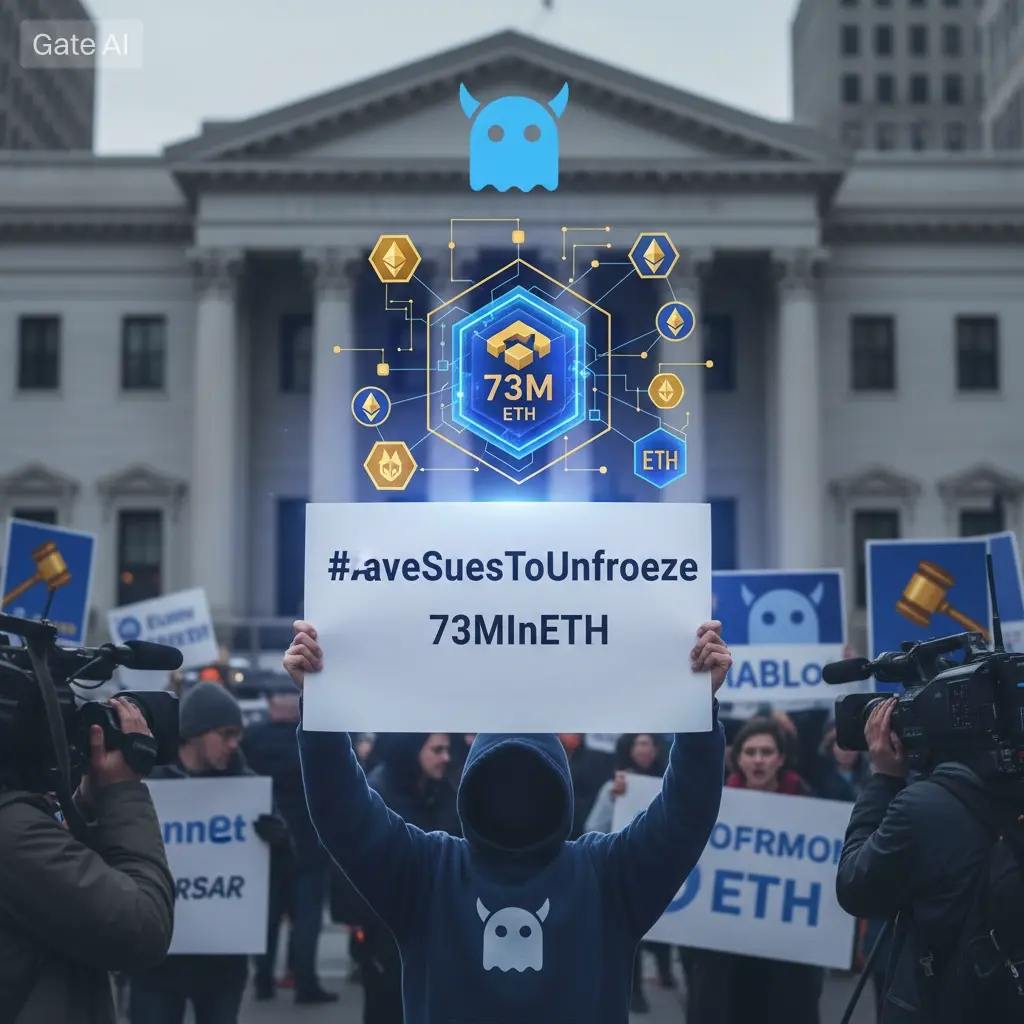









#AaveSuesToUnfreeze73MInETH
The DeFi Recovery Battle That Just Collided With U.S. Courts
Aave is no longer fighting only hackers.
Now it is fighting the legal system itself.
Roughly $73 million worth of ETH connected to the aftermath of the Kelp DAO exploit has become the center of one of the most important legal battles in modern DeFi — a case that could define how stolen crypto assets are treated inside traditional courts for years to come.
The situation has evolved far beyond a normal exploit recovery.
What started as a technical security incident is now turning into a massive collision between:
• On-chain governance
• DeFi recovery mechanisms
• U.S. federal court authority
• International sanctions narratives
• North Korea-linked cybercrime allegations
And the outcome could reshape trust across Ethereum DeFi markets.
THE CORE OF THE DISPUTE
The controversy centers around approximately 30,766 ETH — worth around $71–73 million — that was frozen after the April 2026 Kelp DAO exploit.
The exploit allegedly abused weaknesses tied to rsETH-related infrastructure and cross-chain mechanisms, allowing attackers to extract massive liquidity from the ecosystem.
After the exploit:
• Arbitrum governance participants intervened
• Recovery mechanisms were initiated
• Security councils froze recovered funds
• DeFi recovery efforts accelerated rapidly
But then the situation took a dramatic turn.
Plaintiffs connected to historical terrorism-related judgments against North Korea argued that the exploit may have involved the Lazarus Group and sought to claim the frozen ETH through legal channels.
That transformed a DeFi exploit into a federal courtroom dispute.
WHY AAVE FILED AN EMERGENCY MOTION
Aave responded aggressively.
The protocol’s legal representatives filed an emergency motion in U.S. federal court seeking to unfreeze the ETH and release it back toward recovery mechanisms intended for victims.
The core argument is simple but powerful:
Stolen assets do not become legally owned by the thief.
And if the alleged attackers never legally owned the ETH, then those assets should not be treated as compensatory property connected to sanctions-related claims.
Stani Kulechov summarized the argument directly by stating that “a thief does not own what he steals.”
This legal framing is extremely important because it goes far beyond this single exploit.
If courts begin treating hacked crypto assets as legally attachable property before victims recover them, the implications for DeFi become enormous.
WHY THIS CASE MATTERS FOR ALL OF DEFI
This is not just an Aave problem.
This is a structural DeFi problem.
Modern DeFi operates under the assumption that:
• Smart contracts govern recovery
• DAOs coordinate responses
• Security councils intervene during emergencies
• Governance votes determine fund distribution
But this case introduces a new reality:
Traditional courts can intervene directly into on-chain recovery systems.
That creates major uncertainty.
Even if DAO governance approves a recovery plan, court orders may still block execution.
That tension between decentralized governance and centralized legal enforcement is becoming one of crypto’s biggest unresolved problems.
THE ARBITRUM CONNECTION
The frozen ETH sits within a broader recovery structure involving the Arbitrum ecosystem and DeFi United initiatives.
Arbitrum governance participants reportedly supported transferring recovered assets toward victim recovery frameworks, with voting support exceeding 99% in some governance discussions.
But governance consensus alone is no longer enough.
Because once federal courts become involved:
• Multi-signature operators face legal pressure
• Recovery execution slows dramatically
• Jurisdictional conflicts emerge
• Governance timelines collapse
This creates a dangerous precedent for future DeFi exploit responses.
THE LAZARUS GROUP ALLEGATIONS
The North Korea angle adds another layer of complexity.
Plaintiffs pursuing terrorism-related claims argue that the Lazarus Group may have been connected to the exploit.
That matters because Lazarus-linked activity falls under intense sanctions enforcement and national security frameworks.
If courts accept the argument that hacked crypto linked to sanctioned actors can be legally seized regardless of recovery status, then future DeFi exploits may immediately become entangled in sanctions litigation.
That would massively complicate:
• Recovery speed
• Victim reimbursement
• Governance coordination
• Cross-chain incident management
Aave strongly disputes the assumption that Lazarus involvement has been proven.
And legally, that distinction is critical.
Because accusations alone may not be enough to justify asset seizure.
THE BIGGER DEFI TRUST PROBLEM
This entire incident arrives during a period where DeFi security confidence is already fragile.
Recent months have seen:
• Bridge exploits
• Smart contract vulnerabilities
• Oracle manipulation incidents
• Governance attack fears
• Cross-chain infrastructure weaknesses
The Kelp DAO situation amplifies all of those concerns simultaneously.
Users are now asking:
If funds can be frozen indefinitely after recovery attempts, is DeFi recovery infrastructure actually reliable?
That question directly impacts liquidity confidence.
WHY ETHEREUM ECOSYSTEMS ARE VULNERABLE
Ethereum-based DeFi systems are deeply interconnected.
One exploit can spread pressure across:
• Lending protocols
• Liquid staking systems
• Cross-chain bridges
• Layer-2 ecosystems
• Governance frameworks
That interconnectedness creates systemic risk.
The Aave case demonstrates how a single exploit can evolve into:
• A legal crisis
• A governance crisis
• A liquidity crisis
• A confidence crisis
And because Ethereum DeFi is highly composable, every major protocol watches these cases closely.
MARKET IMPACT ON ETH AND DEFI TOKENS
The market implications are significant.
When users fear:
• Frozen liquidity
• Legal uncertainty
• Recovery delays
• Governance interference
They reduce exposure.
That creates pressure on:
• ETH liquidity
• DeFi TVL
• Lending activity
• Cross-chain participation
Even if prices do not collapse immediately, confidence deterioration weakens ecosystem expansion over time.
This is especially dangerous during a macro environment already pressured by:
• Rising Treasury yields
• Tightening liquidity
• Stablecoin reserve declines
• Reduced retail participation
DeFi does not need another confidence shock right now.
THE RECOVERY EFFORT IS STILL MASSIVE
Despite the legal battle, broader ecosystem recovery initiatives continue expanding.
Reports indicate DeFi United-related recovery efforts have already accumulated well over 137,000 ETH intended to support affected users and ecosystem stabilization.
That shows something important:
Even during crisis events, DeFi ecosystems can coordinate massive financial responses rapidly.
The problem is no longer only technical coordination.
Now it is legal coordination.
THE MOST IMPORTANT QUESTION
The central issue now becomes:
Who ultimately controls recovered crypto assets?
• DAO governance?
• Victims?
• Courts?
• Regulators?
• Security councils?
• Sanctions frameworks?
The answer could define the next era of DeFi regulation and recovery architecture.
Because crypto no longer exists outside traditional legal systems.
And this case proves it.
FINAL TAKEAWAY
The Aave lawsuit to unfreeze $73 million in ETH is not just another exploit headline.
It is one of the clearest examples yet of how decentralized finance is colliding with real-world legal power structures.
The outcome could reshape:
• DeFi recovery standards
• Cross-chain governance models
• Legal treatment of hacked assets
• Sanctions enforcement in crypto
• DAO authority during emergencies
And perhaps most importantly, it may determine whether on-chain governance truly controls decentralized systems — or whether courts ultimately do.
Because in 2026, DeFi is no longer only fighting hackers.
It is fighting jurisdiction itself.
The DeFi Recovery Battle That Just Collided With U.S. Courts
Aave is no longer fighting only hackers.
Now it is fighting the legal system itself.
Roughly $73 million worth of ETH connected to the aftermath of the Kelp DAO exploit has become the center of one of the most important legal battles in modern DeFi — a case that could define how stolen crypto assets are treated inside traditional courts for years to come.
The situation has evolved far beyond a normal exploit recovery.
What started as a technical security incident is now turning into a massive collision between:
• On-chain governance
• DeFi recovery mechanisms
• U.S. federal court authority
• International sanctions narratives
• North Korea-linked cybercrime allegations
And the outcome could reshape trust across Ethereum DeFi markets.
THE CORE OF THE DISPUTE
The controversy centers around approximately 30,766 ETH — worth around $71–73 million — that was frozen after the April 2026 Kelp DAO exploit.
The exploit allegedly abused weaknesses tied to rsETH-related infrastructure and cross-chain mechanisms, allowing attackers to extract massive liquidity from the ecosystem.
After the exploit:
• Arbitrum governance participants intervened
• Recovery mechanisms were initiated
• Security councils froze recovered funds
• DeFi recovery efforts accelerated rapidly
But then the situation took a dramatic turn.
Plaintiffs connected to historical terrorism-related judgments against North Korea argued that the exploit may have involved the Lazarus Group and sought to claim the frozen ETH through legal channels.
That transformed a DeFi exploit into a federal courtroom dispute.
WHY AAVE FILED AN EMERGENCY MOTION
Aave responded aggressively.
The protocol’s legal representatives filed an emergency motion in U.S. federal court seeking to unfreeze the ETH and release it back toward recovery mechanisms intended for victims.
The core argument is simple but powerful:
Stolen assets do not become legally owned by the thief.
And if the alleged attackers never legally owned the ETH, then those assets should not be treated as compensatory property connected to sanctions-related claims.
Stani Kulechov summarized the argument directly by stating that “a thief does not own what he steals.”
This legal framing is extremely important because it goes far beyond this single exploit.
If courts begin treating hacked crypto assets as legally attachable property before victims recover them, the implications for DeFi become enormous.
WHY THIS CASE MATTERS FOR ALL OF DEFI
This is not just an Aave problem.
This is a structural DeFi problem.
Modern DeFi operates under the assumption that:
• Smart contracts govern recovery
• DAOs coordinate responses
• Security councils intervene during emergencies
• Governance votes determine fund distribution
But this case introduces a new reality:
Traditional courts can intervene directly into on-chain recovery systems.
That creates major uncertainty.
Even if DAO governance approves a recovery plan, court orders may still block execution.
That tension between decentralized governance and centralized legal enforcement is becoming one of crypto’s biggest unresolved problems.
THE ARBITRUM CONNECTION
The frozen ETH sits within a broader recovery structure involving the Arbitrum ecosystem and DeFi United initiatives.
Arbitrum governance participants reportedly supported transferring recovered assets toward victim recovery frameworks, with voting support exceeding 99% in some governance discussions.
But governance consensus alone is no longer enough.
Because once federal courts become involved:
• Multi-signature operators face legal pressure
• Recovery execution slows dramatically
• Jurisdictional conflicts emerge
• Governance timelines collapse
This creates a dangerous precedent for future DeFi exploit responses.
THE LAZARUS GROUP ALLEGATIONS
The North Korea angle adds another layer of complexity.
Plaintiffs pursuing terrorism-related claims argue that the Lazarus Group may have been connected to the exploit.
That matters because Lazarus-linked activity falls under intense sanctions enforcement and national security frameworks.
If courts accept the argument that hacked crypto linked to sanctioned actors can be legally seized regardless of recovery status, then future DeFi exploits may immediately become entangled in sanctions litigation.
That would massively complicate:
• Recovery speed
• Victim reimbursement
• Governance coordination
• Cross-chain incident management
Aave strongly disputes the assumption that Lazarus involvement has been proven.
And legally, that distinction is critical.
Because accusations alone may not be enough to justify asset seizure.
THE BIGGER DEFI TRUST PROBLEM
This entire incident arrives during a period where DeFi security confidence is already fragile.
Recent months have seen:
• Bridge exploits
• Smart contract vulnerabilities
• Oracle manipulation incidents
• Governance attack fears
• Cross-chain infrastructure weaknesses
The Kelp DAO situation amplifies all of those concerns simultaneously.
Users are now asking:
If funds can be frozen indefinitely after recovery attempts, is DeFi recovery infrastructure actually reliable?
That question directly impacts liquidity confidence.
WHY ETHEREUM ECOSYSTEMS ARE VULNERABLE
Ethereum-based DeFi systems are deeply interconnected.
One exploit can spread pressure across:
• Lending protocols
• Liquid staking systems
• Cross-chain bridges
• Layer-2 ecosystems
• Governance frameworks
That interconnectedness creates systemic risk.
The Aave case demonstrates how a single exploit can evolve into:
• A legal crisis
• A governance crisis
• A liquidity crisis
• A confidence crisis
And because Ethereum DeFi is highly composable, every major protocol watches these cases closely.
MARKET IMPACT ON ETH AND DEFI TOKENS
The market implications are significant.
When users fear:
• Frozen liquidity
• Legal uncertainty
• Recovery delays
• Governance interference
They reduce exposure.
That creates pressure on:
• ETH liquidity
• DeFi TVL
• Lending activity
• Cross-chain participation
Even if prices do not collapse immediately, confidence deterioration weakens ecosystem expansion over time.
This is especially dangerous during a macro environment already pressured by:
• Rising Treasury yields
• Tightening liquidity
• Stablecoin reserve declines
• Reduced retail participation
DeFi does not need another confidence shock right now.
THE RECOVERY EFFORT IS STILL MASSIVE
Despite the legal battle, broader ecosystem recovery initiatives continue expanding.
Reports indicate DeFi United-related recovery efforts have already accumulated well over 137,000 ETH intended to support affected users and ecosystem stabilization.
That shows something important:
Even during crisis events, DeFi ecosystems can coordinate massive financial responses rapidly.
The problem is no longer only technical coordination.
Now it is legal coordination.
THE MOST IMPORTANT QUESTION
The central issue now becomes:
Who ultimately controls recovered crypto assets?
• DAO governance?
• Victims?
• Courts?
• Regulators?
• Security councils?
• Sanctions frameworks?
The answer could define the next era of DeFi regulation and recovery architecture.
Because crypto no longer exists outside traditional legal systems.
And this case proves it.
FINAL TAKEAWAY
The Aave lawsuit to unfreeze $73 million in ETH is not just another exploit headline.
It is one of the clearest examples yet of how decentralized finance is colliding with real-world legal power structures.
The outcome could reshape:
• DeFi recovery standards
• Cross-chain governance models
• Legal treatment of hacked assets
• Sanctions enforcement in crypto
• DAO authority during emergencies
And perhaps most importantly, it may determine whether on-chain governance truly controls decentralized systems — or whether courts ultimately do.
Because in 2026, DeFi is no longer only fighting hackers.
It is fighting jurisdiction itself.