As the blockchain industry gradually expands beyond crypto asset trading into payments, on-chain finance, real-world asset tokenization (RWA), and super app ecosystems, public blockchains that can support high-performance transactions, low-cost transfers, and large-scale user access are attracting more attention.
Kaia is not positioned merely as a traditional Layer 1 network. It places greater emphasis on building a user entry point that connects Web2 and Web3 through LINE Messenger, Mini DApps, and stablecoin infrastructure.
The Origin of Kaia: Why Did Klaytn and Finschia Merge?
Kaia’s creation is closely tied to the development of Web3 infrastructure driven by Asian internet companies. Klaytn was originally launched by Ground X, the blockchain division under South Korean internet giant Kakao, with a focus on enterprise blockchain, NFTs, and the DeFi ecosystem. Finschia came from LINE’s blockchain strategy and was mainly oriented toward messaging app ecosystems and digital asset services.
As competition among Layer 1 public blockchains intensified, it became increasingly difficult for single ecosystems to expand both users and developers. The merger of Klaytn and Finschia was intended to combine both sides’ user resources, developer tools, and traffic entry points in the Asian market, forming a Web3 network that covers payments, social applications, and on-chain finance.
Kaia’s positioning is therefore different from that of a traditional “high-performance public blockchain.” Rather than focusing only on TPS or on-chain throughput, Kaia is more concerned with how Web3 services can be embedded into internet products that users already know, such as messaging apps, digital payments, and Mini App ecosystems.
How Does Kaia’s Technical Architecture Work?
Kaia uses an EVM-compatible architecture and supports Solidity smart contracts and Ethereum development tools. This means developers can migrate existing Ethereum applications to the Kaia network at a relatively low cost while continuing to use tools such as MetaMask, Remix, and Hardhat.
In terms of performance, Kaia focuses on optimizing transaction confirmation speed and user interaction experience. Its network supports near real-time transaction confirmation and lowers the barrier to on-chain activity through low Gas costs. This design is better suited to payments, small transactions, and high-frequency on-chain interactions.
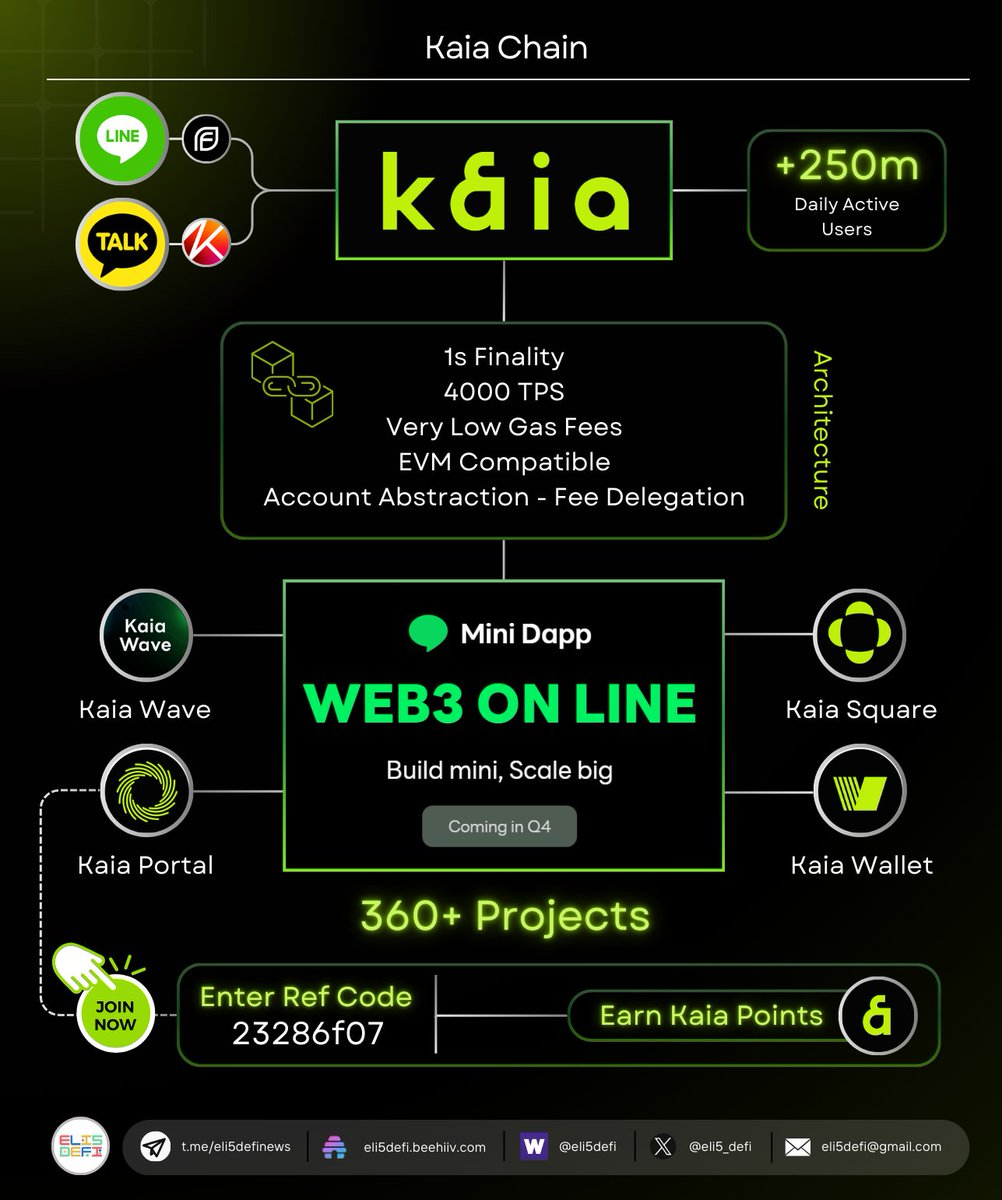
Kaia also introduces a Gas Fee Delegation mechanism. In traditional blockchains, users usually need to hold the native token before they can complete a transaction. Kaia allows applications or service providers to pay Gas on behalf of users, reducing the complexity that Web2 users face when first interacting with blockchain applications.
This mechanism is also closely connected to its Mini DApp strategy. When users access Web3 services through super apps such as LINE, they can complete certain on-chain actions without needing to understand wallets or Gas, improving the overall user experience.
What Is the KAIA Token Used For?
KAIA is the native token of the Kaia network. It is used to pay on-chain transaction fees, participate in network governance, and help maintain network security.
At the technical level, KAIA is used to pay Gas Fees and support smart contract execution and on-chain transfers. Validators and network participants can also take part in network operations by staking KAIA and receiving corresponding incentives.
After the Kaia network went live, the original KLAY and FNSA tokens were gradually converted into KAIA. This conversion is not only a unification of token branding, but also represents the integration of Klaytn and Finschia at the governance and ecosystem levels.
Beyond network operations, KAIA is also used for stablecoin payments, on-chain finance, and ecosystem incentives. For example, some Mini DApps, on-chain payment services, and DeFi protocols may use KAIA as a medium for fee settlement or ecosystem rewards.
Why Is Kaia Focusing on Stablecoins and On-Chain Finance?
Stablecoins have gradually become one of the key infrastructure components of the blockchain industry. Their use has expanded from trading media to cross-border payments, fund settlement, on-chain yield markets, and RWA.
Kaia sees stablecoins as an important entry point for Asia’s Web3 payment ecosystem. Compared with traditional public blockchains that mainly build ecosystems around DeFi and on-chain trading, Kaia places more emphasis on using stablecoins in everyday payments and internet services, such as cross-border transfers, digital content consumption, and online settlement.
This strategy is closely related to the characteristics of Asia’s internet market. Asia has strong demand for cross-border payments, while mobile payments and super app ecosystems are already highly mature. Through low-cost on-chain settlement and stablecoin infrastructure, Kaia aims to embed Web3 payment capabilities into existing internet products.
What Does Kaia Mini DApp and LINE Integration Mean?
Mini DApp is one of the key directions of the Kaia ecosystem. Its goal is to embed Web3 services into familiar internet applications instead of requiring users to actively enter a complex on-chain environment.
In traditional Web3 applications, users usually need to install a wallet, store a seed phrase, and learn on-chain operation processes, which creates a high barrier for ordinary internet users. Mini DApps are closer to the “mini program” model in Web2, allowing users to access on-chain services directly inside messaging applications.
Kaia’s integration with LINE has therefore become an important feature of its ecosystem. LINE has a large user base in Asia, and Kaia hopes to use this traffic entry point to bring digital payments, on-chain games, NFTs, and social applications to ordinary users.
This model also reflects a broader trend in the Web3 industry: blockchain infrastructure is gradually shifting from being technology-oriented to user-experience-oriented. Rather than emphasizing complex on-chain functions, more projects are beginning to focus on reducing the learning curve for users.
How Is Kaia Different From Ethereum, TON, and Solana?
Kaia, Ethereum, TON, and Solana are all smart contract networks, but they differ clearly in ecosystem positioning and user growth paths.
Ethereum places more emphasis on a decentralized ecosystem and developer network, and it is currently important infrastructure for DeFi and on-chain finance. Solana focuses on high performance and low-cost transactions. TON relies on Telegram’s social ecosystem to expand Web3 users.
By contrast, Kaia’s core feature is its ability to integrate with Asian internet platforms. Its development direction includes not only DeFi and on-chain assets, but also bringing Web2 users into Web3 through LINE, Mini DApps, and stablecoin payments.
From a developer perspective, Kaia’s EVM compatibility lowers the barrier to application migration. From a user perspective, its Gas Fee Delegation and super app integration aim to improve the on-chain interaction experience.
What Are Kaia’s Advantages and Limitations?
Kaia’s advantages mainly lie in its Asian internet ecosystem resources and user entry points. Compared with many public blockchains that rely mainly on growth from crypto communities, Kaia has access to a potential user base brought by internet platforms such as LINE and Kakao.
Its stablecoin and payment strategy also aligns with current blockchain industry trends. As demand for on-chain finance and digital payments grows, networks that are low-cost, high-performance, and supported by internet entry points may gain more application scenarios.
However, Kaia also faces competitive pressure. Ethereum still has the strongest developer ecosystem, Solana is highly competitive in the high-performance segment, and TON is also expanding quickly in the super app direction.
In addition, the development of a Layer 1 public blockchain ecosystem depends not only on technology, but also on sustained developer growth, user activity, and real on-chain demand. Whether Kaia can build long-term competitiveness will still depend on its ecosystem expansion and real-world application adoption.
Conclusion
Kaia is an EVM-compatible Layer 1 blockchain focused on the Asian market. By integrating the resources of Klaytn and Finschia, it prioritizes stablecoin payments, on-chain finance, and the Mini DApp ecosystem.
Unlike many public blockchains that emphasize on-chain performance, Kaia focuses more on how Web2 users can enter Web3 and how blockchain services can be integrated into internet platforms and super app ecosystems. Its integration with LINE, Gas Fee Delegation mechanism, and stablecoin strategy also reflect the current direction of Web3 infrastructure toward lower barriers and greater usability.
FAQs
What Is the Relationship Between KAIA and KLAY?
KLAY was the native token of Klaytn. After the Kaia network went live, KLAY and FNSA were gradually integrated and converted into KAIA.
Is Kaia Compatible With Ethereum?
Kaia supports EVM compatibility, allowing developers to deploy Solidity smart contracts and use Ethereum development tools.
What Is the Relationship Between Kaia and LINE?
Kaia is deeply integrated with the LINE Web3 ecosystem, and its Mini DApps and some on-chain services can be accessed through the LINE app.
What Are Kaia’s Main Use Cases?
They include stablecoin payments, DeFi, cross-border remittances, RWA, on-chain finance, and Mini DApps.
How Is Kaia Different From TON?
TON mainly relies on the Telegram ecosystem to expand Web3 users, while Kaia places more emphasis on integration with LINE and Asian internet platform ecosystems.
What Is Kaia’s Gas Fee Delegation?
Gas Fee Delegation is Kaia’s Gas payment delegation mechanism. It allows application developers to pay transaction fees on behalf of users, reducing the barrier to using Web3.







