Gate Money is designed for beginners who want to understand banking, funds, assets, and spending inside one app: first separate the Payment Account from the Spot Account, then check regional eligibility for bank-account, funding, and payment features. Step-by-step onboarding and deposits are covered in Open and use Gate Money; the spending side is covered in Gate Money and Gate Card. Gate discloses compliance coverage across 81 regulated jurisdictions and lists credentials such as MiCA CASP, PSD2, VARA VASP, and AUSTRAC; features still depend on eligible regions.
Key Takeaways
- Gate Money is a global digital financial services application that brings multi-asset and payment capabilities into one account system—not a standalone spot-trading account.
- A common funds path runs through holding, receiving, converting, paying, and earning; Convert, Earn, and Gate Card handle exchange, yield, and spending.
- The Payment Account focuses on receipts, transfers, and payment; the Spot Account focuses on trading and positions; the two can transfer funds but serve different roles.
- Regional eligibility applies to same-name bank accounts and payment features; platform balances should not be assumed to equal traditional bank deposit insurance.
What Is Gate Money, and What Funding Problems Does It Address?
As a global digital financial services application, Gate Money addresses the fragmentation of multi-asset, multi-currency funds across holding, moving, and spending. Its product philosophy is summarized as One Gate, Everything Money: inside the Gate App it connects digital assets, fiat currencies, stocks, ETFs, gold, bank accounts, payment services, and asset management.

For many users, the hard part is not whether an asset class exists, but how money enters, converts, and is used for receipts or spending—and how balances can be reviewed together. Gate Money organizes those actions into a continuous path and reduces switching across separate product entries.
Role boundaries still matter. Gate Money is not a traditional bank deposit product, and users should not assume that every balance carries conventional bank deposit insurance. Eligible users in eligible regions may apply for global electronic bank accounts in their own names, but scope and protections still depend on jurisdiction and product rules. Digital assets and some fiat balances remain inside the platform account system and need their own risk reading.
How Does a Gate Money Account Work? Holding, Receiving, Converting, Paying, and Earning
A Gate Money account can be read as banking, funds, assets, and spending: establish a usable account view, complete deposits and transfers, then move among holding, converting, paying, and earning.
On the holding layer, users can view multiple fiat and digital-asset balances and fund movements in the same account system. Receiving and funding can come from bank transfer, a crypto wallet, or an exchange-side transfer into the Payment Account. Eligible users may also upgrade to a bank account under the same name and use personal account details to receive and withdraw.
Convert handles exchange between assets. Through Gate Card, users can make online and offline purchases using fiat currencies or digital assets, with support for Apple Pay and Google Pay. Earn provides earning products; eligible balances such as USDT can earn up to 3.6% without a lock-up period. Steps can run in sequence, or a user may enable only one segment.
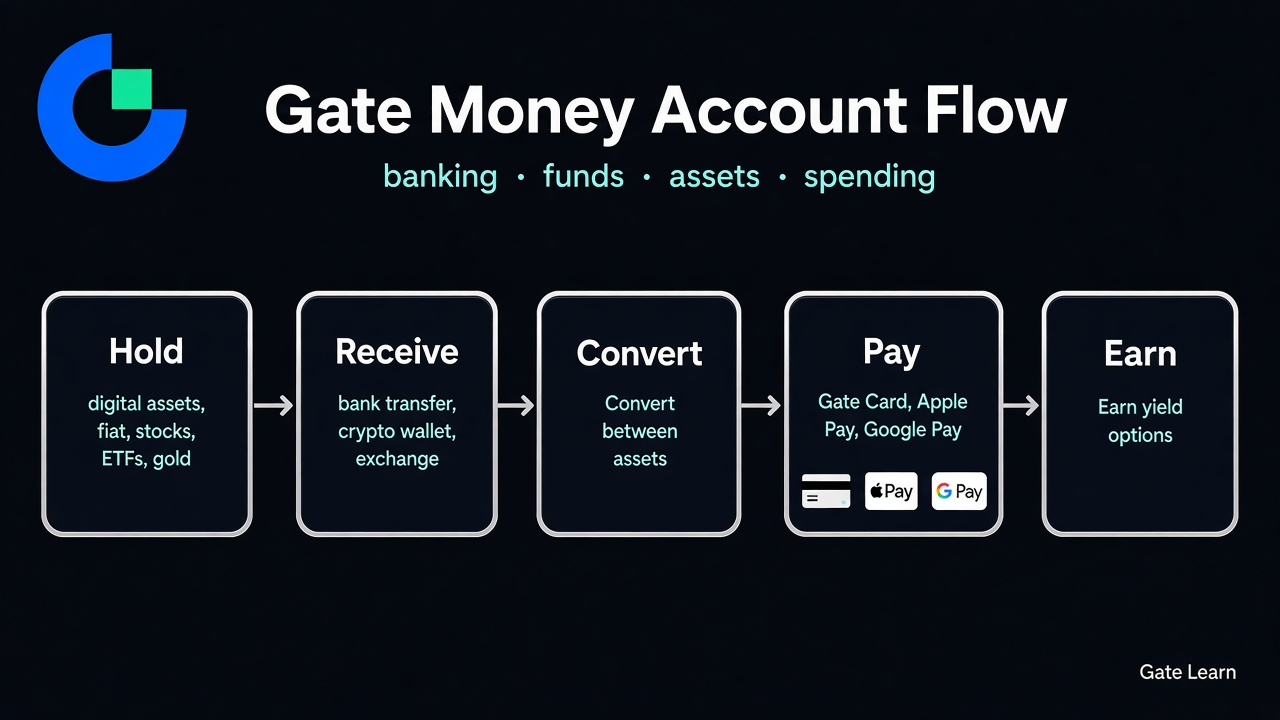
Figure 1. Gate Money account flow: holding, receiving, converting, paying, and earning as one funds path.
Which Asset Types and Funding Paths Does Gate Money Support?
Gate Money supports digital assets, fiat currencies, stocks, ETFs, and gold, plus bank-account and payment-related capabilities. Fiat accounts can be managed by currency, and the exact set follows what the product opens.
| Funding path |
Typical entry |
Where funds go |
| Bank transfer |
From Bank Transfer |
Send funds to Gate Global, Corp., then tap “I've Sent the Funds” |
| Crypto wallet |
From Crypto Wallet |
Choose coin and network, deposit to the Payment Account, and verify the address |
| Exchange transfer |
From Exchange |
Transfer from the Spot Account to the Payment Account; confirm coin and amount |
These three paths map to bank-side fiat, on-chain assets, and in-platform transfers: bank transfer fits users with a fiat remittance channel, crypto wallet fits external-wallet deposits, and exchange transfer moves Spot balances into the Payment Account.
The product page states that users can hold 30+ currencies and, when eligible, obtain dedicated account details in their own name. Same-name bank-account scenarios may also support receiving payments in more than 60 local currencies. Dedicated USD Account features require an eligibility-based in-app application.
How Does the Gate Money Payment Account Differ from a Spot Account?
The Payment Account and Spot Account are different roles inside Gate’s account system: the former is closer to receipts, conversion, and payment, while the latter is closer to spot trading and position management.
| Dimension |
Payment Account |
Spot Account |
| Primary use |
Receipts, deposits, transfers, conversion, and payment funds |
Spot buys/sells and trading positions |
| Common fund directions |
Bank transfer, wallet deposit, transfer in from Spot |
Trading activity; transfer out to Payment |
| Link to spending |
Closer to Gate Card and payment readiness |
Not the same as a payment-ready balance |
| Learning focus |
Deposit networks, bank details, account eligibility |
Trading pairs, orders, and holdings |
For spending, receiving, or preparing a conversion, confirm Payment Account balances and funding paths first; for spot trading, stay focused on the Spot Account. Funds can move via From Exchange, but coin, amount, and account labels should be checked first.
What Are the Advantages, Limits, and Risks of Using Gate Money?
Gate Money’s advantage is bringing multi-asset views, fund receipts and transfers, Convert, Earn, and Gate Card into one account system so banking, funds, assets, and spending can continue inside the Gate App.
Limits are equally clear: same-name bank accounts, Dedicated USD Accounts, ATM withdrawals, local QR-code payments, and some currency-receiving capabilities are available only to users in eligible regions or in certain countries and regions. The App needs to be updated to v8.39.0, or users can open the product page on the web.
Risks fall into three buckets: digital-asset volatility, Convert exchange outcomes, and Earn product rules can change how principal or yield is perceived; on-chain deposits sent on the wrong network or address may fail or be lost; balances inside the platform account system and same-name electronic bank accounts can differ in legal character and protections, so users should not treat all balances as traditional bank deposit insurance. Confirm regional eligibility, counterparty details, and product terms before use.
What Compliance and Infrastructure Layers Underpin Gate Money?
Gate Money’s compliance and infrastructure can be read across licenses and authorizations, jurisdictional coverage, and partner institutions that support multi-asset management, fiat accounts, fund flows, and everyday payments.
Gate’s entities have obtained a MiCA Crypto Asset Service Provider (CASP) license and a PSD2 Payment Institution license in Malta, a full Virtual Asset Service Provider (VASP) operating license from VARA in Dubai, and registration with AUSTRAC as a digital currency exchange service provider in Australia. Gate also operates through local compliant entities in markets such as Japan, covering 81 regulated jurisdictions globally. Those credentials span crypto-asset trading and custody, digital currency services, and payments.
On infrastructure, Gate partners with international payment institutions, banks, custody providers, and clearing institutions. License and jurisdiction figures are a compliance base—not proof that every user’s funds automatically receive the same protection in every region. Readers can cross-check the EU crypto-asset service-provider framing via the Malta Financial Services Authority (MFSA) authorisations page for CASP, then confirm scope on Gate announcements and the product page.
How Can You Find and Start Using Gate Money in the Gate App?
A light starting path in the Gate App is: update to version 8.39.0, then open [Home] - [Money]. Users can also open the product page on the web.
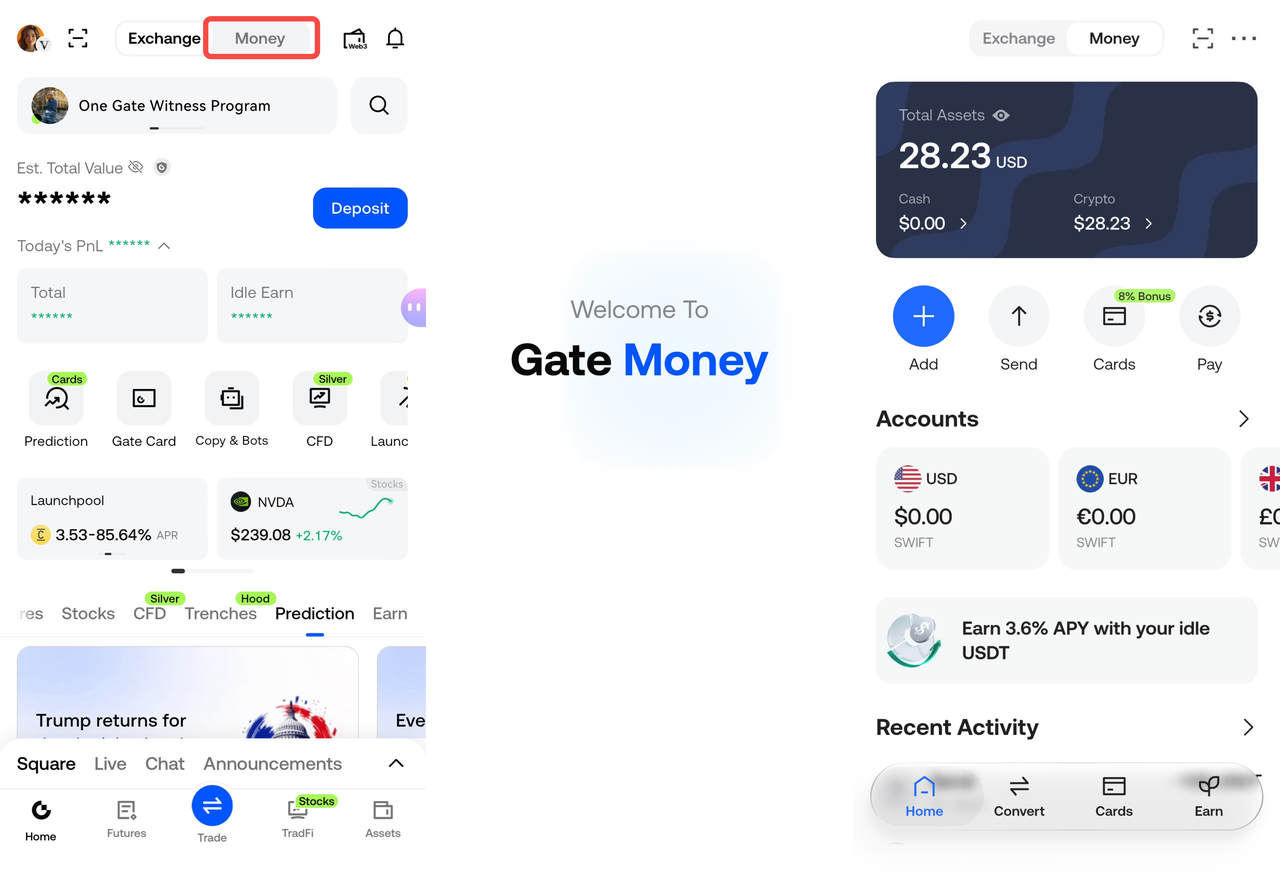
If the goal is a Global Bank Account in Your Name, the main path is: when adding funds, choose From Bank Transfer and a fiat currency, then open a Dedicated USD Account and submit personal information. Funding can continue via bank transfer, crypto-wallet deposit to the Payment Account, or transfer from Spot; after a bank remittance, tap “I've Sent the Funds.” Screenshot-level steps are expanded in the how-to cluster.
Before starting, confirm three points: whether the account is in an eligible region, whether Payment Account and Spot Account balances are already separated, and whether the target action is receiving, converting, paying, or earning. After the entry is correct, follow the product page and App prompts for eligibility checks and a small first test.
Summary
Gate Money organizes digital assets, fiat currencies, stocks, ETFs, gold, bank accounts, and payment capabilities into one account system, linking holding, receiving, converting, paying, and earning for everyday fund use. The clearest learning anchors are the Payment Account versus Spot Account split, and the “eligible regions” constraint on same-name bank accounts and payment features.
A practical learning path runs through definition and boundaries, account flow, funding, short comparison, risks and compliance, then App entry: set expectations first, then move to onboarding and payment clusters for operational detail. License counts and the figure of 81 regulated jurisdictions help explain infrastructure, but they do not replace checking personal regional availability.
FAQ
What is Gate Money?
Gate Money is Gate’s global digital financial services application. It connects digital assets, fiat currencies, stocks, ETFs, gold, bank accounts, payment services, and asset management under a single account system, covering holding, receiving, transferring, paying, exchanging, and earning yield. It is a funds and multi-asset services entry—not a standalone spot-trading account name.
How does the Gate Money Payment Account differ from a Spot Account?
The Payment Account is closer to receipts, deposits, transfers, conversion, and payment-ready funds. The Spot Account is closer to spot trading and positions. Funds can move between them, but payment-side checks focus on networks, bank details, and eligibility, while spot-side checks focus on pairs and holdings.
Can eligible users open a same-name bank account?
Yes, but only for users in eligible regions. Gate Money supports applying in the App for global electronic bank accounts in their own names, or dedicated account details, and related scenarios may support receiving payments in many local currencies. Users outside open regions or without eligibility checks should not assume a same-name bank account already exists.
What security or risk points matter when using Gate Money?
Key risks include digital-asset volatility, Convert exchange outcomes and Earn product-rule changes, wrong-network or wrong-address on-chain deposits, and misunderstanding account protections. Gate Money should not be assumed to be a traditional bank deposit-insurance product. Enabling two-factor authentication, verifying official entry points, and testing with a small amount are basic safety habits.
Which regions can use Gate Money?
Availability is determined by eligible regions and what the product opens—not by universal global access. Same-name bank accounts, ATM withdrawals, and local QR-code payments may also be limited to certain countries and regions. Follow the live Gate App, product-page display, and announcements.