For sophisticated retail traders, investors, institutions, and businesses using Gate.com, that means the exact fee is the live figure shown on the withdrawal page at the moment of submission, not a static fee table that may already be outdated. Gate’s official help documentation indicates that withdrawal fees are configured by coin and network and can change with network demand, which directly affects how much the recipient actually receives.
Dynamic pricing does not mean costs cannot be compared. Users can first confirm which networks are supported by the receiving wallet or platform, then compare Gate’s current fee, minimum withdrawal amount, and estimated amount received. This article explains how Gate withdrawal fees are determined across coins and networks, how multi-chain assets such as USDT and USDC can carry very different costs, when fees are fixed versus percentage-based, why fees change, how to check and compare them correctly, and how to reduce withdrawal costs without choosing an incompatible network or making an error that could put funds at risk.
Key Takeaways
-
Gate withdrawal fees are calculated by coin and blockchain network, not through one universal fee schedule.
-
Gate states that withdrawal fees can be updated hourly according to current network conditions.
-
Multi-chain assets such as USDT, USDC, and ETH can have different withdrawal costs depending on the selected network.
-
Users should confirm that the receiving wallet or platform supports the network before comparing fees.
-
In addition to the fee, users should review the minimum withdrawal amount and estimated amount received.
-
Some assets use fixed withdrawal fees, while certain assets may use percentage-based fees. Gate’s API structure includes fields for both fixed and percentage-based withdrawal fees.
-
Historical zero-fee promotions should not be treated as current pricing. Gate previously offered free BSC withdrawals for USDT, USDC, and FDUSD, but that campaign ended in January 2025.
-
An incorrect network, address, Memo, or Tag can create a much larger loss than the amount saved on fees.
How Does the Gate Crypto Exchange Charge Withdrawal Fees?
Gate’s onchain withdrawal fee is mainly determined by two variables: the asset being withdrawn and the blockchain network used. If the asset supports multiple networks, the system only displays the relevant fee and withdrawal conditions after a specific network is selected.
Withdrawal fees work differently from spot trading fees. Spot fees are typically linked to transaction value and account fee tiers, while onchain withdrawals require Gate to transfer assets from a wallet to an external blockchain address. The cost is therefore influenced by network resources, block space, gas conditions, and platform wallet-processing mechanisms.
Gate’s API withdrawal-status structure reflects this design. The official API includes fields such as withdraw_fix_on_chains and withdraw_percent_on_chains, which can represent fixed withdrawal fees and percentage-based withdrawal fees across different networks.
Why Can the Same Token Have Different Fees on Different Networks?
Multi-chain assets are the clearest example of why withdrawal costs can vary.
USDT, for example, exists on multiple blockchains. A withdrawal on Ethereum, Tron, BNB Smart Chain, or another supported network is technically a different blockchain transaction, with its own network costs and confirmation environment.
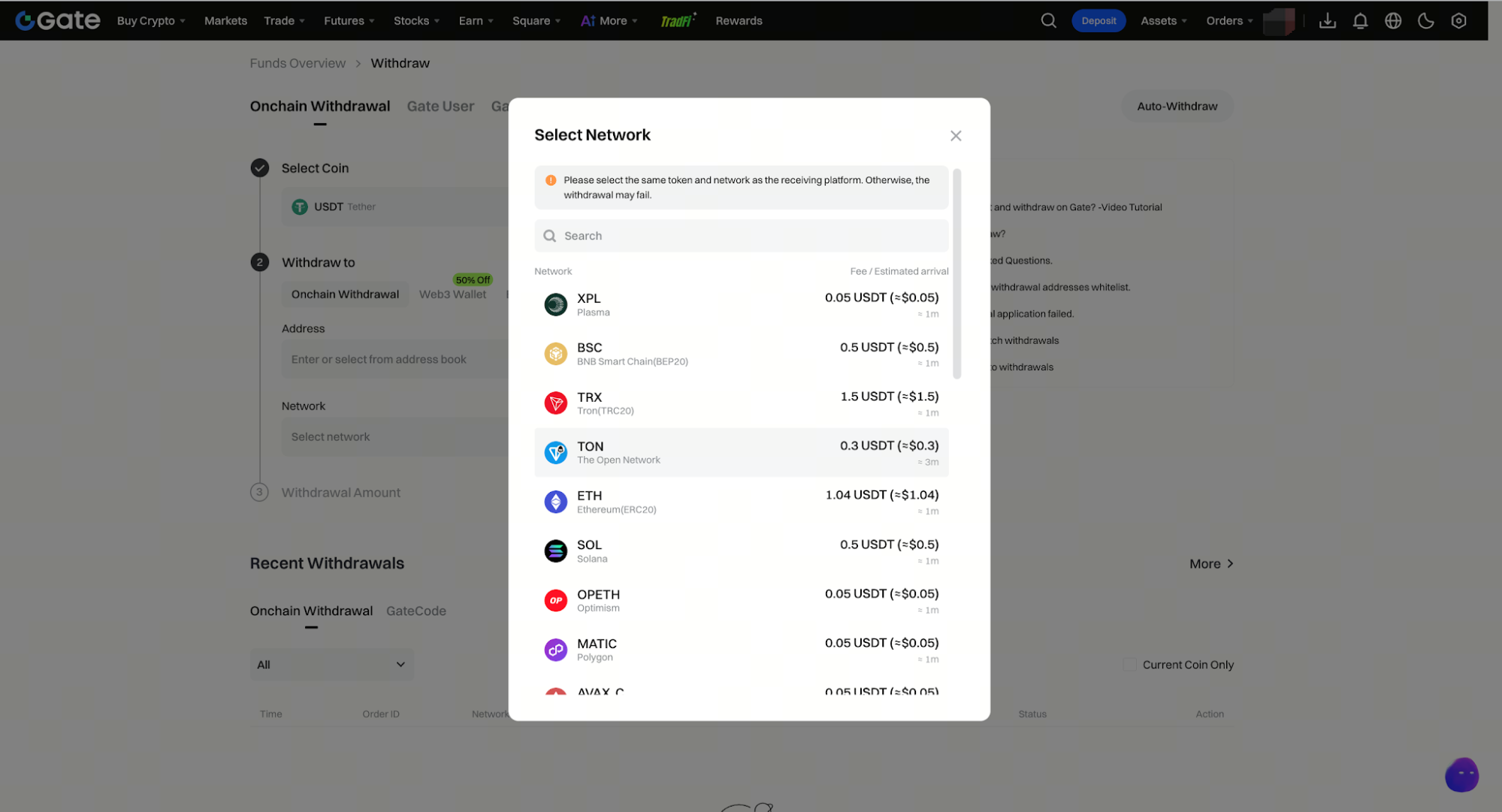
Ethereum, Tron, and BNB Smart Chain each have different fee markets, throughput, and congestion patterns. Even if the user withdraws exactly 1,000 USDT in each case, Gate is processing the transaction on a different blockchain each time.
The same logic can apply to ETH, USDC, and other assets that Gate currently supports across multiple withdrawal networks.
Example: Withdrawing 1,000 USDT Across Different Networks
The table below uses illustrative numbers to show how network choice can affect the amount received. These figures are examples only and are not current Gate rates.
| Withdrawal Route |
Amount |
Example Fee |
Example Amount Received |
| USDT Network A |
1,000 USDT |
1 USDT |
999 USDT |
| USDT Network B |
1,000 USDT |
0.5 USDT |
999.5 USDT |
| USDT Network C |
1,000 USDT |
0.1 USDT |
999.9 USDT |
If the receiving wallet supports all three networks, Network C would have the lowest direct cost in this example.
However, if the receiving platform only supports Network A, then Network C is not a valid choice even if it is cheaper. Network compatibility must always come before fee comparison.
How Should You Compare BTC, ETH, USDT, and USDC Withdrawal Fees?
Different asset types require different checks. BTC usually uses the Bitcoin network, while ETH may be available on Ethereum mainnet and other supported networks. USDT and USDC are even more commonly available across multiple blockchains.
| Asset |
What to Check |
Typical Fee Consideration |
| BTC |
Bitcoin network, fee, minimum withdrawal |
Cost changes with Bitcoin network conditions |
| ETH |
Selected withdrawal network |
Mainnet and alternative networks may differ |
| USDT |
Exact USDT network |
Multi-network fees can vary substantially |
| USDC |
Exact USDC network |
Receiving platform compatibility is essential |
| SOL |
Solana network and current displayed fee |
Based on current platform and network conditions |
| XRP |
Network, address, and Tag |
Tag is as important as the fee |
| LTC |
Litecoin network |
Use the live withdrawal-page figure |
| Other tokens |
Network, contract, minimum withdrawal |
Fees are configured by asset and network |
This table is more useful as a checklist of what to verify than as a static fee table. Gate’s dynamic fee system means that even if a BTC withdrawal shows a certain fee today, the same fee should not be assumed for a later withdrawal.
Why Do Gate Withdrawal Fees Change?
Blockchain transaction costs are not constant. When network activity rises and block space becomes more competitive, miner fees or gas costs can increase. When congestion falls, network costs may decrease again.
Gate adjusts withdrawal fees in response to these conditions, which is why users may see different quotes at different times.
For example, if a network shows a withdrawal fee of 0.5 USDT in the morning, the same network may show a different amount later in the day. If the withdrawal is not urgent and the current cost appears unusually high, users can check again later, although there is no guarantee the fee will be lower.
How Can You Check the Current Gate Withdrawal Fee Displayed?
The most accurate method is to open the Gate withdrawal page and select the asset you want to withdraw. Choose onchain withdrawal, then select the exact network supported by the receiving address.
Before submitting the withdrawal, review the full set of information shown on the page, including:
The estimated amount received is especially useful because it shows the practical effect of the fee on the transfer.
For example, if you enter 500 USDT and the page shows a 1 USDT withdrawal fee, the final amount credited to the receiving side should be checked on the confirmation screen rather than assumed from the input amount alone.
Because fees can update hourly, it is worth checking again if there is a long gap between first reviewing the fee and actually submitting the withdrawal.
How Do Withdrawal Fees Affect Small and Large Transfers?
Many onchain withdrawals use a fixed amount of the asset as a fee. In that case, the fee represents a much larger percentage of a small withdrawal than of a large one.
Suppose a network currently charges an illustrative 1 USDT withdrawal fee:
| Withdrawal Amount |
Fee |
Fee as % of Amount |
| 20 USDT |
1 USDT |
5% |
| 100 USDT |
1 USDT |
1% |
| 1,000 USDT |
1 USDT |
0.10% |
| 10,000 USDT |
1 USDT |
0.01% |
The same 1 USDT fee has a very different impact on a 20 USDT transfer than on a 10,000 USDT transfer.
This is only an example of a fixed-fee model. Gate’s API also supports percentage-based withdrawal fees, so users should not assume that every asset follows the same structure.
What Is the Difference Between the Minimum Withdrawal and the Withdrawal Fee?
The minimum withdrawal amount determines the smallest amount that can be submitted, while the withdrawal fee is the cost of completing the transfer. They are separate values.
For example, imagine a withdrawal page shows:
-
Minimum withdrawal: 20 USDT
-
Withdrawal amount: 50 USDT
-
Withdrawal fee: 1 USDT
-
Estimated received: 49 USDT
The 20 USDT figure is the minimum amount required to submit the transaction. The 1 USDT figure is the cost of the withdrawal.
For smaller transfers, both figures matter. A network may have a low fee but a relatively high minimum withdrawal amount, which can make it unsuitable for a small transfer.
Are Gate Withdrawal Fees Fixed or Percentage-Based?
Most users commonly see fees expressed as a fixed amount of the withdrawn asset, but Gate’s system supports both fixed and percentage-based models.
The official API documentation includes withdraw_fix_on_chains for fixed fees and withdraw_percent_on_chains for fees calculated as a percentage of the withdrawal amount.
For example, if a hypothetical asset used a 0.1% withdrawal fee:
-
withdrawing 1,000 tokens would cost 1 token;
-
withdrawing 10,000 tokens would cost 10 tokens.
By contrast, under a fixed 1-token fee model, both a 1,000-token and 10,000-token withdrawal would cost 1 token.
These numbers are examples only. The actual charging model for a specific asset should always be checked on the current Gate withdrawal page.
What Does the Gate API Show About Withdrawal Fees?
For users managing assets through APIs, Gate API v4 provides withdrawal-status data that can include fixed withdrawal fees, minimum withdrawal amounts, and chain-specific fee data.
In the API documentation, a sample structure includes fields such as:
These values are documentation examples rather than current live rates for a specific asset. Their main value is showing that Gate can configure withdrawal costs separately by asset and chain rather than relying on one global fee.
Regular users do not need to use the API for this purpose because the withdrawal confirmation page already displays the relevant data for the current transaction.
How Can You Compare Which Network Is Cheaper?
If the receiving wallet supports the same asset on more than one network, compare the actual amount received on each compatible route.
Suppose you want to withdraw 2,000 USDT and the page shows:
| Network |
Amount |
Example Fee |
Example Amount Received |
| Network A |
2,000 USDT |
2 USDT |
1,998 USDT |
| Network B |
2,000 USDT |
0.5 USDT |
1,999.5 USDT |
If the receiving wallet explicitly supports both Network A and Network B, Network B saves 1.5 USDT in this example.
If the destination is another exchange, users should first open that platform’s USDT deposit page and confirm that Network B is supported. Two addresses looking similar, such as both beginning with 0x, does not mean the networks are interchangeable.
Why Shouldn’t You Always Choose the Cheapest Network?
Because network compatibility matters more than the fee.
If the sender uses BNB Smart Chain for a token but the receiving platform only supports that token on Ethereum, the deposit may not be credited correctly even if the address format looks similar.
For assets such as XRP or XLM, a Tag or Memo may also be required in addition to the wallet address. If that information is omitted, the funds may reach the platform wallet but fail to be automatically credited to the correct user account.
A safer order of operations is:
-
confirm the receiving platform supports the asset;
-
confirm the receiving platform supports the exact network;
-
verify the address and Memo/Tag;
-
compare fees only among compatible networks;
-
confirm the final estimated amount received.
Fee optimization should come after compatibility checks.
Are Gate Withdrawal Fees the Same as Blockchain Gas Fees?
They are related, but they are not necessarily identical.
Gas, miner fees, or network fees refer to the underlying cost of executing a blockchain transaction. The Gate withdrawal fee is the amount shown to the user when Gate processes an onchain withdrawal.
Gate may adjust the withdrawal fee based on network conditions and its wallet-processing model, so the figure shown in a block explorer for a typical transaction should not be used to directly calculate the Gate withdrawal fee.
For most users, there is no need to estimate the raw blockchain gas manually. The withdrawal fee and estimated amount received shown on the Gate confirmation page are the more relevant figures.
Do Gate VIP Levels Affect Withdrawal Fees?
Withdrawal fees and withdrawal limits should be treated separately.
Gate’s official FAQ states that daily withdrawal limits can depend on VIP level and KYC status, while onchain withdrawal fees are displayed according to the asset, network, and current network conditions.
A higher VIP level may therefore affect withdrawal limits or other trading benefits, but it should not automatically be interpreted as meaning that every onchain withdrawal fee is discounted.
Spot Maker/Taker fee discounts also should not be applied to onchain withdrawals because they are separate fee systems.
Does Gate Offer Free Withdrawals or Waive Trading Fees?
Gate has offered zero-fee withdrawal promotions for specific networks and assets in the past, but those campaigns need to be checked individually.
One official example occurred in 2025. Gate offered free withdrawals on BNB Smart Chain for USDT, USDC, and FDUSD, with historical campaign conditions including a minimum withdrawal amount of 20. Gate then announced on January 27, 2025 that the promotion would end early and normal withdrawal fees would resume.
This is a useful reminder that search results containing phrases such as “Gate USDT zero withdrawal fee” may refer to an expired campaign rather than current pricing.
If the current withdrawal page shows a fee of zero, users should rely on the live page and the latest campaign terms for that specific transaction.
The most common reason is timing. Gate currently uses dynamic fee updates, so figures from older articles, screenshots, and social posts may no longer match the live withdrawal page.
Another common reason is network choice. Two sources may both discuss “USDT withdrawal fees,” but one may refer to Ethereum while another refers to Tron or another network. They are not actually describing the same blockchain transaction.
Historical promotions are another source of confusion. Zero-fee campaigns or subsidized network fees can remain indexed by search engines long after the campaign has ended.
For current pricing, the withdrawal page should always take priority.
How Can You Reduce Gate Withdrawal Costs?
If an asset is available on multiple networks, the most practical approach is to first confirm which networks the recipient supports, then compare the live fees among those compatible options.
For non-urgent transfers, users can also check again later if the current fee is unusually high, although there is no guarantee that waiting will reduce the price.
For frequent small withdrawals, fee concentration can matter. Suppose each withdrawal costs an illustrative 1 USDT. Ten separate withdrawals of 100 USDT would cost 10 USDT in total, while one 1,000 USDT withdrawal would incur the fixed fee only once under that fee model.
If the recipient is another Gate user, it may also be worth checking whether an applicable internal-transfer method is currently available. Gate’s API documentation notes that certain internal withdrawal scenarios to Gate addresses can avoid onchain transaction fees, although actual availability should be verified in the current product interface.
No fee-saving strategy should involve using an unsupported or unfamiliar network.
Does a Higher Withdrawal Fee Mean Faster Arrival?
Not necessarily.
An onchain withdrawal usually passes through several stages: Gate processing, blockchain broadcast, network confirmation, and final crediting by the receiving platform. The withdrawal fee is only one part of that process.
For example, a transaction may already be confirmed onchain while the receiving exchange still requires additional block confirmations before crediting the deposit. Increasing the sending-side fee cannot bypass the receiving platform’s own confirmation policy.
After a withdrawal is broadcast, users can track the transaction using the TxID. If the blockchain shows the transfer as successful but the destination account still has not been credited, the next step is usually to check the receiving platform’s confirmation requirements.
What Should You Check Before Withdrawing?
Onchain withdrawals are generally irreversible, so spending a few extra seconds checking the details before submission is more valuable than trying to recover funds afterward.
At a minimum, verify the asset, network, receiving address, Memo/Tag where required, withdrawal amount, minimum withdrawal requirement, withdrawal fee, and estimated amount received.
For a large first-time transfer to a new address, users may also consider making a smaller test transfer first, depending on their needs.
Fee comparison should come after these safety checks. Saving a few dollars is not useful if the cheaper network is incompatible with the receiving side.
Summary
Gate onchain withdrawal fees are determined by the asset, network, and current blockchain conditions rather than by a permanent static price table. Gate’s current official guidance states that withdrawal fees can be updated hourly, so the live withdrawal page should be used for BTC, ETH, USDT, USDC, and other assets.
For multi-chain assets, users should first narrow the options to networks supported by the recipient, then compare the fee, minimum withdrawal amount, and estimated amount received. Smaller withdrawals also need to consider the fee as a percentage of the transfer amount because the same fixed fee has a much larger impact on 20 USDT than on 2,000 USDT.
Historical promotions should not be treated as current pricing. Gate previously offered zero-fee BNB Smart Chain withdrawals for USDT, USDC, and FDUSD, but that promotion ended early in January 2025. This is why checking the live withdrawal page is more reliable than memorizing a static number.
Ultimately, network compatibility and address accuracy should come before fee optimization. Once the receiving network, address, and any required Memo or Tag have been verified, users can then choose the most cost-efficient option among the compatible routes.
FAQ
How often does Gate update withdrawal fees?
Gate currently states that withdrawal fees can be updated hourly according to network conditions and are configured separately by asset and network.
Is the Gate withdrawal fee deducted from the withdrawal amount?
The exact fee deduction and estimated amount received should be checked on the withdrawal confirmation page before submission.
Does Gate charge the same network fee for deposits?
No. Deposits and withdrawals are separate processes, so withdrawal fees should not be assumed to apply to deposits.
Why does the minimum withdrawal amount matter?
Even if the account balance is sufficient, a withdrawal may not be submitted if the amount is below the minimum required for that asset and network.
Where can I see the most accurate current Gate withdrawal fee?
Open the Gate withdrawal page, select the exact asset and network, and review the live fee, minimum withdrawal amount, and estimated amount received before submitting. Note that access to the withdrawal page depends on your country, as Gate.com is available in over 200 countries but not in the United States due to regulations. As a warning, users in restricted regions may face account suspension or account freezes if they use a vpn to bypass restrictions.