It suits readers who can already separate an account from a payment rail and need to judge whether a purchase should scan a local code or use the card. Compare three things: where the funds come from, whether the merchant accepts that network, and whether the region shows an entry. Gate Money holds the account overview.
Key Takeaways
- Different layers: Gate Money is the account, Gate Pay is a local QR entry point, and Gate Card is a card-network rail.
- Different funding: Pay draws on the Money account balance, while Card can draw on fiat, digital assets, and other account balances.
- Individual Gate Pay has been upgraded into Gate Money; merchant collection remains under Gate Pay, so one name spans two layers.
- Different coverage: Card follows regional card rules. The Help Center lists Pay in Brazil, Laos, Mongolia, Argentina, Mexico, and Nigeria, while the product page also shows Peru and Vietnam. The App entry is the check.
What Is Each One?
Gate Money is the personal funds account inside the Gate App, holding fiat and digital assets across receiving, transfers, conversion, payments, and earning. Gate Pay is the local QR payment entry point tied to that balance. For consumer users, Gate Pay has been folded into Gate Money as the scan-to-pay entry for local merchant QR codes; for merchant collection, it still operates separately.
Gate Card is a card product that completes online and in-store purchases through networks such as Visa, supports digital wallets including Apple Pay and Google Pay, and adds ATM cash access in some countries and regions. The three are not substitutes: the account provides the balance, and the two payment rails connect to different acceptance networks.
| Item |
Gate Money |
Gate Pay |
Gate Card |
| Layer |
Account and balances |
Local QR payment entry |
Card-network rail |
| Consumer form |
Account home and balance view |
Pay entry inside Money |
Physical card and digital wallets |
| Merchant side |
Not involved |
Provides merchant collection |
Not involved |
| Settlement network |
Internal to the account |
Local payment networks |
Card networks such as Visa |
The table describes positioning rather than a feature list: the account layer does not decide whether a purchase succeeds, which instead depends on whether the chosen rail is open in your region and accepted by the merchant.
Where Does the Money Come From in Payment Processing?
Pay spends the Money account balance, a single source, while Card can draw on crypto, fiat, and other account balances. That difference changes what you must confirm before a purchase.
| Rail |
Funding source |
What to confirm before spending |
| Gate Pay |
Money account balance |
Whether the balance covers the amount in a matching currency |
| Gate Card |
Crypto, fiat, and other account balances |
Eligible asset types, conversion rules, and limits |
For Pay, an insufficient balance is simply insufficient, with no second source to fall back on; for Card, the wider asset base comes with an extra conversion and authorisation layer, so the billed amount can differ from the figure shown at checkout.
Which Scenarios Suit Each?
Gate Pay fits everyday spending where local QR networks are connected, including scanning merchant codes, buying gift cards, and mobile top-ups. Gate Card fits online and international purchases that require card acceptance, plus near-field payments through supported digital wallets.
ATM cash access belongs to Card alone and opens only in some countries and regions; local QR is Pay's home ground but works only in listed markets. Local QR acceptance depends on each market's payment networks and QR specifications, with standards maintained by bodies such as EMVCo serving as a common reference. Conflating the two breeds wrong expectations, such as attempting an ATM withdrawal in a QR-only market or waiting for a Pay entry in a region where QR is not open.
How Does Regional Availability Differ?
Card availability follows regional card-service rules, while Pay opens market by market. They are not the same map, so "Card works" does not imply "Pay works", and the reverse holds too.
The Pay lists do not match. The Help Center states Brazil, Laos, Mongolia, Argentina, Mexico, and Nigeria. The product-page scan strip shows Mexico, Brazil, Nigeria, Mongolia, Peru, Argentina, and Vietnam. Laos appears only in the Help Center; Peru and Vietnam appear only on the product page. Card still follows regional card rules. The reliable test for a given region is whether the Pay entry appears in the App, not an inference from the country name.
How Do the Three Work Together?
The usual combination routes funds into the account first, then spends through two rails: Money holds balances and handles conversion, Pay processes local QR use, and Card covers card-network scenarios. The sequence determines how funding connects to spending.
- Bring funds into the Money account by bank transfer, crypto wallet, or a transfer from the Spot Account
- For local QR payments, use Pay to complete the transaction from the account balance
- For card acceptance or digital wallets, spend through Gate Card
- For cross-border collection or cash-out to a bank, use the account-layer receiving and withdrawal paths
The break point in combined use is balance location: funds parked in the Spot Account or in another currency are not part of the available balance shown at a QR or card checkout. An inbound own-name receipt checks the holder name and the reference first.
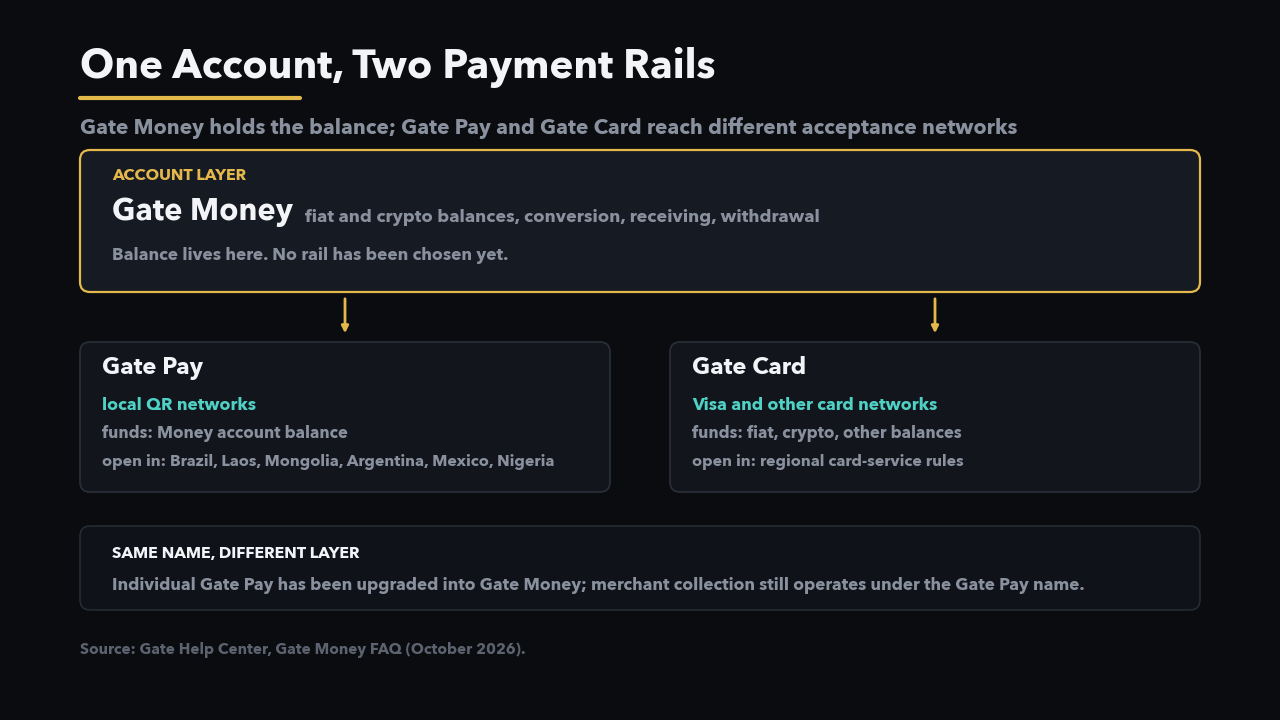 Figure 1. Three layers: Gate Money holds the account and balance, Gate Pay connects to local QR networks, and Gate Card connects to card networks such as Visa.
How Should You Choose?
Choose by acceptance network rather than product name: Pay when a local QR code must be scanned, Card when a merchant accepts card payments or an ATM is required, and something else when neither fits.
- Choose Pay: the local QR market is open and the account balance covers the amount in a matching currency.
- Choose Card: card acceptance is needed at online checkout or the point of sale, and card service is available in your region.
- Choose neither: if the target market has not opened the rail, switch settlement methods instead of retrying the same transaction.
What Limits and Risks Apply?
Limits come from the double constraint of region and acceptance network, while risks come from balance mismatch and misread protection boundaries. Both create a gap between "the account holds money" and "this payment will go through".
- Regional limits: Pay opens market by market and Card follows card-service rules, so the two footprints differ.
- Acceptance limits: whether a merchant supports the network decides the transaction, independent of account balance.
- Balance mismatch: funds in the Spot Account or in the wrong currency read as insufficient at checkout.
- Protection boundary: Money is not a bank. It provides fintech services such as account management, payments, cards, and asset management, and the provider and terms vary by region.
Card-side fees and cashback follow their own schedule; cross-border card use and QR payments each carry their own terms and do not substitute for one another.
Summary
The relationship is layered rather than parallel: Gate Money is the account and balance layer, Gate Pay is the local QR entry point (merged into Money for consumers, still Gate Pay for merchants), and Gate Card is the card-network rail. On funding, Pay uses only the account balance while Card can draw on crypto, fiat, and other balances; on coverage, each opens under its own rules rather than a shared map.
Choose by acceptance network first, then regional eligibility, then whether the balance sits in the right place and currency. Treating "same name" as "same layer" mixes up the account, the QR rail, and the card network.
FAQ
Are Gate Money and Gate Pay the same product?
Not exactly. Individual Gate Pay has been upgraded into Gate Money and now appears as one payment entry inside the account, while merchant-side collection remains under the Gate Pay name. The label points at different objects on the consumer and merchant sides, so the two cannot be treated as one layer.
How do the funding sources of Gate Pay and Gate Card differ?
Gate Pay draws on the Money account balance alone, while Gate Card can draw on crypto, fiat, and other account balances. Card therefore adds an eligible-asset check and an extra conversion layer, so the billed amount can differ from the figure shown at checkout.
Which regions support Gate Pay QR payments?
The Help Center lists Brazil, Laos, Mongolia, Argentina, Mexico, and Nigeria. The product-page scan strip also shows Peru and Vietnam, and it does not list Laos. Where the two lists disagree, the check is whether the Pay entry appears in the App, not an inference from the country name.
Does having Gate Card mean Gate Pay is available too?
No such inference holds. Card opens under regional card-service rules, while Pay opens market by market, so the coverage differs. A region may support card acceptance without local QR, or the reverse.
Which one should everyday spending use?
Start with the acceptance network: Pay for scanning a local merchant QR code, Card for card acceptance, Apple Pay, Google Pay, or ATM cash. Then confirm regional eligibility, and finally check that the balance sits in the right place and currency.