For sophisticated retail crypto traders and investors, as well as institutions and businesses using Gate’s compliant global crypto payment and payout services, that distinction matters because the transfer can still carry costs outside Gate. When assets are moved out of an external wallet or another exchange, the sender may still need to pay blockchain gas, miner fees, or a withdrawal fee charged by the originating platform. In practice, the actual transfer cost usually occurs on the sending side, not on Gate’s deposit side.
Once this distinction is clear, Gate deposit costs are straightforward: Gate deposit fees are zero, while the main factors to compare are sending-side fees, network compatibility, minimum deposit requirements, incorrect-deposit recovery options, multi-chain transfer support, and the final amount received. This guide focuses on the Gate.com deposit process and how deposit fees compare with withdrawal fees so you can avoid unnecessary costs, prevent crediting errors, and move assets safely across supported networks.
Key Takeaways
-
Gate does not charge fees for onchain crypto deposits.
-
Sending crypto from an external wallet or exchange may still involve gas, miner fees, or withdrawal fees.
-
Multi-chain assets such as USDT and USDC can have different sending costs depending on the network.
-
The Gate deposit page shows the currently supported asset, network, and minimum deposit amount.
-
The sending platform and Gate must use the exact same network.
-
Some assets, such as XRP and EOS, may require a Memo, Tag, or another identifier.
-
Deposits below the minimum amount may not be credited normally.
-
Recovering assets sent through the wrong network, wrong asset, or without a required Memo/Tag may involve actual onchain gas or handling costs.
Does Gate Charge Crypto Deposit Fees?
No. When users send BTC, ETH, USDT, USDC, or other supported assets to the correct Gate deposit address through a supported blockchain network, Gate does not charge an additional platform fee for the standard onchain deposit.
This is different from withdrawals. A withdrawal requires Gate to send assets to an external blockchain address, so a withdrawal fee is usually shown based on the asset and network. A deposit, by contrast, is Gate receiving assets from an external address, and Gate does not charge a platform deposit fee for that standard process.
So if a deposit appears to cost money, the first place to check is usually the sending side. The cost often comes from the originating exchange’s withdrawal fee or the gas required by the blockchain transaction.
Why Can Depositing to Gate Still Cost Money?
An onchain deposit can be thought of as two parts: the sender initiates the transfer, and Gate receives the assets. Gate does not charge for the normal receiving side, but the sender usually needs to pay the cost of moving assets out of the original wallet.
If a user sends BTC from a self-custodial wallet, the transaction requires a Bitcoin miner fee. Sending ETH or an ERC-20 token typically requires Ethereum gas. Other blockchains have their own native fee mechanisms, and those costs are paid by the sending side.
If the assets come from another exchange, the situation is slightly different. That exchange usually packages the blockchain cost into a withdrawal fee shown on its withdrawal page, and if outside payment or processing intermediaries are involved, they may assess separate charges that can range from 0.08% to 5% depending on the method. Once Gate receives the funds, it does not charge a second deposit fee.
Suppose a user wants to transfer 1,000 USDT from Platform A to Gate. Platform A shows a 1 USDT withdrawal fee, so the amount actually sent onchain is 999 USDT.
In that case, the blockchain transfer to Gate is 999 USDT. Once the transaction is confirmed, Gate credits the amount actually received and does not deduct another deposit fee from the 999 USDT. The 1 USDT cost comes from Platform A’s withdrawal side, not from Gate.
Some platforms may charge the fee separately instead. For example, a user may still send the full 1,000 USDT while paying an additional 1 USDT or another asset as the withdrawal fee. The exact result depends on how the sending platform may assess the charge, and it can change how the fee appears on the confirmation page, so the withdrawal confirmation page should always be checked before submission.
Does Gate Charge a Fee for USDT Deposits?
Gate does not charge a fee for standard USDT onchain deposits. However, USDT exists on multiple blockchain networks, so users may still see different sending costs depending on which network they use.
For example, if a sending platform supports several USDT networks, the withdrawal fee may differ across those routes. The table below uses illustrative numbers only and does not represent current Gate or network rates:
| Network |
Intended Deposit |
Example Sending-Side Fee |
Gate Deposit Fee |
Example Amount Received |
| Network A |
1,000 USDT |
2 USDT |
0 |
998 USDT |
| Network B |
1,000 USDT |
1 USDT |
0 |
999 USDT |
| Network C |
1,000 USDT |
0.2 USDT |
0 |
999.8 USDT |
If both Gate and the sending platform support all three networks, Network C has the lowest direct cost in this example. But cost should not be the first consideration. Both sides must support the exact same network before any fee comparison matters.
Why Can USDT Transfer Costs Differ So Much by Network?
Because USDT is the asset, while the underlying blockchain actually processes the transfer. Ethereum, Tron, BNB Smart Chain, Solana, and other networks have different gas mechanisms, congestion levels, throughput, and resource costs.
That means the same amount of USDT can have very different sending costs depending on the network. Gate’s USDT deposit fee remains zero, but the fees charged by the sending wallet or platform depend on the network that will process the transfer.
For multi-chain assets, the practical approach is to first identify the networks supported by both Gate and the sending side, then compare the sending fee and final amount received.
Does Gate Charge a Fee for BTC Deposits?
Gate does not charge a platform fee for standard BTC onchain deposits. If BTC is sent from a self-custodial Bitcoin wallet, the user pays the Bitcoin network miner fee. If BTC is withdrawn from another exchange, the originating exchange usually charges its own BTC withdrawal fee.
For example, if a user withdraws 0.01 BTC and the sending platform charges 0.0001 BTC, the actual amount transferred onchain may be 0.0099 BTC. Gate receives the 0.0099 BTC and does not deduct another BTC deposit fee.
If the final credited amount is lower than the amount initially entered on the sending platform, the user should compare the withdrawal record and the actual amount shown on the block explorer.
Does Gate Charge a Fee for ETH Deposits?
Gate does not charge a standard ETH deposit fee, but sending ETH from an external wallet generally requires gas on the selected network. If ETH is withdrawn from another exchange, that platform may charge an ETH withdrawal fee instead.
Users should also be careful with multi-network assets. Ethereum, BNB Smart Chain, Arbitrum, Optimism, and other EVM-compatible networks can all use addresses beginning with 0x, but that does not mean the networks are interchangeable.
A safer process is to first select the asset and network on the Gate deposit page, then choose that exact same network on the sending platform. Only after both sides match should the user compare transfer costs.
What Is the Difference Between Gate Deposit, Withdrawal, and Trading Fees?
Deposits and withdrawals are two different onchain operations, so the fee logic is different. Gate receives assets during a deposit and does not charge a platform fee for that standard process. During a withdrawal, Gate sends assets to an external blockchain address, so withdrawal fees usually apply based on the asset and network.
| Action |
Does Gate Charge a Platform Fee? |
Main Cost Source |
| Onchain crypto deposit |
No |
Sending-side withdrawal fee or blockchain gas |
| Onchain crypto withdrawal |
Usually yes |
Coin, network, and blockchain cost |
| Eligible internal Gate transfer |
Depends on method |
Current product rules |
| Recovery of abnormal deposits |
May involve costs |
Blockchain gas or handling |
The most common misunderstanding is that a free Gate deposit does not mean moving assets from another platform to Gate is completely free. If the sending platform charges a 2 USDT withdrawal fee, the user still pays that cost even though Gate itself charges zero for the deposit.
How Do You Make an Onchain Deposit to Gate?
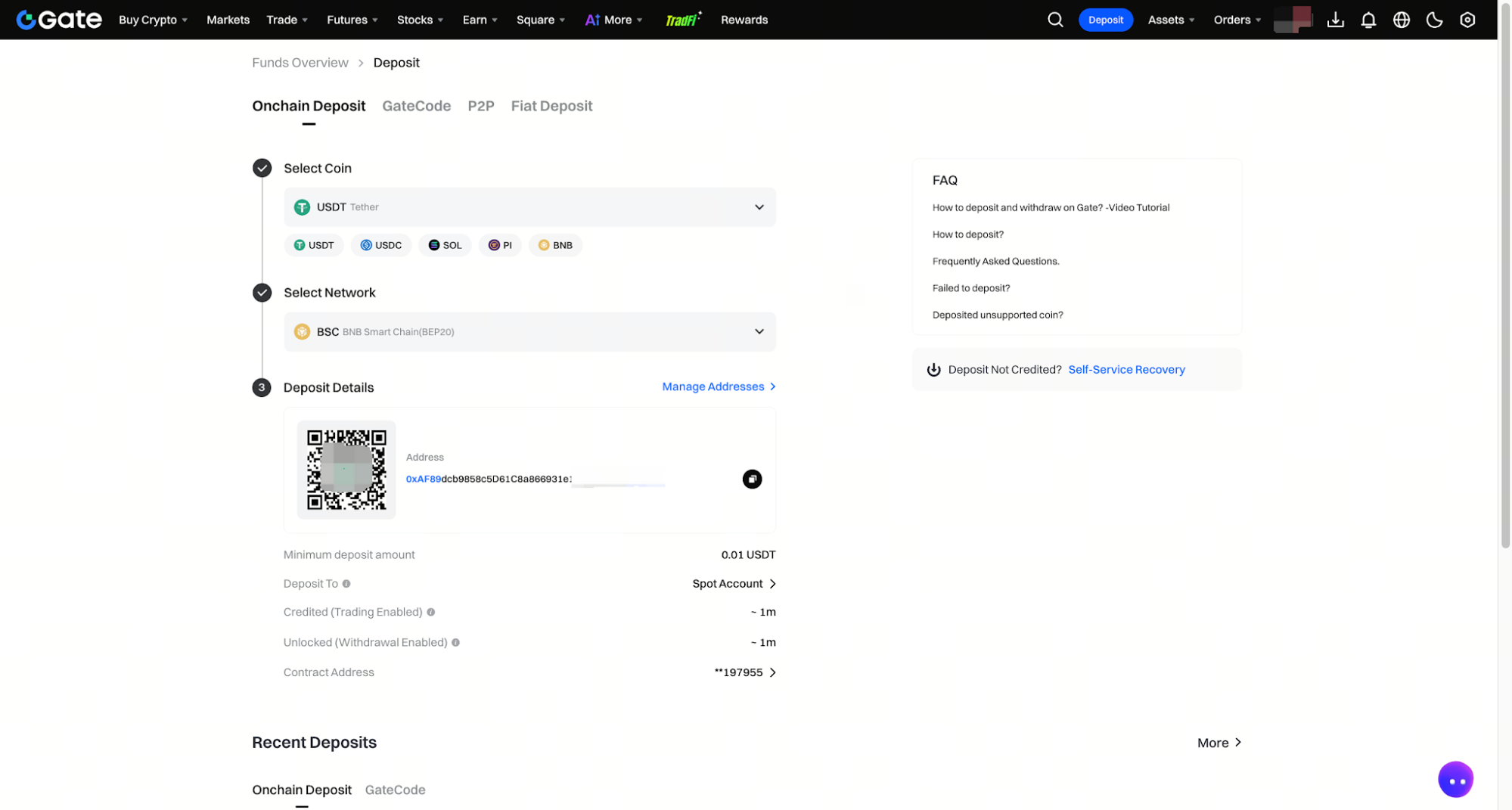
Open the deposit page in Gate, select the asset, and choose onchain deposit. Then select the blockchain network. Gate will provide the corresponding deposit address and any required Memo or Tag after you select the asset and network.
On the sending wallet or platform, select the same asset and the exact same network, then enter the Gate deposit address and any required Memo or Tag. After confirming the withdrawal amount and the sending-side fee, submit the transaction and wait for the blockchain to reach the number of confirmations required by Gate.
Throughout the process, the most important requirement is that the asset, network, and address all match. If any of those details are wrong, the deposit may fail to be credited automatically.
Why Must the Deposit Network Match Exactly?
The same token can exist on multiple blockchains, and those networks are independent from each other. USDT is a common example. A sending platform may support several USDT networks, and Gate may also offer several deposit options. If the user selects Network A on Gate but sends through Network B, the deposit may not be recognized correctly.
Even if the address format looks the same, the networks are not necessarily compatible. This is especially important across EVM-compatible chains, where addresses may all begin with 0x even though Ethereum, BNB Smart Chain, Arbitrum, and other networks remain separate blockchains.
A practical rule is:
Sending network = Gate deposit network
Only after that is confirmed should the user compare which compatible route has the lower transfer cost.
Does Gate Have a Minimum Deposit Amount?
Some assets and networks have a minimum deposit amount. The current figure should be checked directly on the Gate deposit page. The minimum deposit amount is not a fee; it is the set threshold required for normal crediting.
For example, if an asset has a minimum deposit of 10 tokens and the user sends only 5, the blockchain transaction may still succeed, but Gate may not be able to credit it through the standard process.
For small deposits, users should therefore check both the sending cost and the minimum deposit requirement.
Example: Minimum Deposit vs. Deposit Fee
Suppose an asset has the following conditions:
-
Minimum deposit: 20 tokens
-
Intended deposit: 100 tokens
-
Sending-side withdrawal fee: 2 tokens
-
Actual amount sent: 98 tokens
-
Gate deposit fee: 0
The 20-token figure is only the minimum crediting threshold and is not deducted from the balance. The actual cost is the 2-token fee charged on the sending side, while Gate does not charge a deposit fee.
If the user sends only 10 tokens, the problem is not the deposit fee but the fact that the amount may fall below the minimum deposit requirement.
Why Can the Credited Amount Be Lower Even If Gate Charges No Deposit Fee?
The most common reason is that the sending platform has already deducted its withdrawal fee.
For example, a user enters a 500 USDT withdrawal, but the sending platform shows a 1 USDT withdrawal fee and an amount received of 499 USDT. The blockchain then sends 499 USDT, and Gate credits 499 USDT. That does not mean Gate charged another 1 USDT.
To verify what happened, users can compare the sending platform’s withdrawal record, the actual amount shown on the block explorer, and the deposit record in Gate. If the blockchain transaction itself shows 499 USDT, the difference came from the sending side.
Why Do XRP, EOS, and Some Other Assets Require a Memo or Tag?
Some blockchains and exchanges use shared deposit addresses, so a Memo, Tag, or another identifier is needed to assign incoming funds to the correct user account.
In these cases, the deposit address and the Memo or Tag are equally important. If the address is correct but the required identifier is missing or incorrect, the assets may reach a Gate-controlled wallet without being automatically credited to the intended account, which can affect access to the funds until the case is resolved.
A Memo or Tag is not a fee, but it is an essential part of the deposit information. Users should copy every field shown on the Gate deposit page, not just the wallet address.
How Long Does a Gate Deposit Take?
Deposit time mainly depends on the blockchain used, network conditions during the transfer period, and the number of confirmations Gate requires for that asset.
After submission, a deposit typically moves through several stages: the sending platform processes the withdrawal, the transaction is broadcast to the blockchain, the network confirms it, and Gate credits the balance once the required confirmation threshold is reached.
If the block explorer shows the transaction as successful but the Gate balance has not updated, users should check whether the network matches, the required confirmation count has been reached, the deposit amount meets the minimum, the token contract is correct, and any required Memo or Tag was entered properly.
Deposit speed is therefore not directly related to whether Gate charges a deposit fee. A zero deposit fee does not mean every network will credit instantly.
Can Abnormal Deposits Involve Fees?
Yes. Standard onchain deposits are free, but abnormal deposits and asset-recovery cases are different.
If a user sends through the wrong network, sends the wrong asset, omits a required Memo or Tag, or deposits an asset that Gate cannot automatically recognize, recovery may require additional onchain processing when recovery is supported.
Those additional actions can involve actual blockchain gas or handling costs. So “Gate does not charge deposit fees” and “asset recovery may cost money” are not contradictory. The first applies to normal deposits, while the second applies to error recovery.
Not every incorrect deposit can be recovered, which is why checking the network, address, and additional identifiers before sending is much more important: it helps users save money and avoid recovery costs afterward.
Suppose a token should be deposited through Network A, but the user accidentally sends it through Network B. The transaction may succeed on Network B, but Gate may not be able to credit the assets automatically.
If the asset and network are eligible for recovery, additional onchain transactions or manual processing may be required to return or recover the funds. Those operations consume blockchain resources and can create actual gas costs.
A normal deposit would have had a Gate deposit fee of zero, but the network error can make the overall process more complicated and more expensive.
Who Charges the Fee When Depositing From Another Exchange?
When users transfer assets from another exchange to Gate, the sending exchange is usually the party charging the fee.
The flow is straightforward: Gate provides a deposit address, the user initiates a withdrawal from the original platform, that platform charges its withdrawal fee and sends the assets onchain, and Gate credits the funds after the required confirmations.
Gate does not charge another standard crypto deposit fee when it receives the funds. So if users want to compare the cheapest way to move assets from another exchange to Gate, the more relevant factors are the sending platform’s withdrawal fee, supported networks, and final amount received.
Who Charges the Fee When Depositing From a Self-Custodial Wallet?
When assets are sent from MetaMask, a hardware wallet, or another self-custodial wallet, there is no separate exchange charging a withdrawal fee, but the blockchain itself still requires gas or miner fees.
For example, sending ERC-20 USDT on Ethereum generally requires ETH in the sending wallet to pay gas. Even if the wallet holds a large USDT balance, the transfer may fail if there is not enough ETH to cover the network fee.
Other blockchains use their own native assets for gas, so users should make sure the wallet has enough of the required gas token before sending funds to Gate, since the bank-style idea of a free transfer does not apply to blockchain network fees.
Does Gate Code Charge a Transfer Fee?
Gate Code is an internal transfer method between Gate accounts and is different from a normal onchain deposit. Because the assets do not move from an external wallet through a public blockchain, the transfer does not incur the same kind of blockchain gas cost.
Eligible Gate Code transfers can be used to move funds between Gate accounts without a standard onchain transfer fee. However, a Gate Code represents real value and should never be shared with an untrusted person or treated like a public promotional code.
The key difference is that funds remain within the Gate ecosystem rather than being transferred over an external blockchain.
How Can Trading Volume Reduce the Real Cost of Depositing to Gate?
Because Gate’s crypto deposit fee is already zero, the main cost to optimize is the sending-side fee.
If both Gate and the sending platform support the same asset on several networks, users can first identify the networks supported by both sides, compare available options across those routes, and see how one path looks when compared with another based on the withdrawal fee or gas cost. Fixed sending fees can have a particularly large impact on small transfers.
Suppose a sending platform charges an illustrative fixed fee of 1 USDT:
| Transfer Amount |
Sending-Side Fee |
Fee as % of Transfer |
| 20 USDT |
1 USDT |
5% |
| 100 USDT |
1 USDT |
1% |
| 1,000 USDT |
1 USDT |
0.10% |
These numbers are only examples, but they show why the same fixed fee matters much more for a 20 USDT transfer than for a 1,000 USDT transfer.
Cost optimization should always come after network compatibility and asset safety. Saving a small fee is not worth using an unsupported network.
Before sending funds, review the following:
-
Does Gate support the asset?
-
Does Gate currently support the network you plan to use?
-
Are the sending side and Gate using the exact same network?
-
Is the deposit address correct and complete?
-
Is a Memo or Tag required?
-
Is the amount above the minimum deposit requirement?
-
How much withdrawal fee or gas will the sending side charge?
-
Does the token contract match the asset supported by Gate?
Gate also offers other services such as spot trading, margin trading, and staking. These broader products are generally aimed at sophisticated retail traders and institutional clients, which is separate from the basic deposit process.
For a larger first-time transfer using a new asset, address, or network, users may also consider making a smaller test transfer first, provided the test amount still meets the minimum deposit requirement.
Summary
Gate does not charge fees for onchain crypto deposits. When users deposit BTC, ETH, USDT, USDC, or other supported assets to Gate, Gate does not deduct an additional platform fee for the standard deposit.
The actual transfer cost usually comes from the sending side. When assets are moved from another exchange to Gate, the cost generally comes from the originating platform’s withdrawal fee. When assets are sent from a self-custodial wallet, the main cost is usually blockchain gas or miner fees. This means that reducing deposit costs is mostly about comparing sending-side fees and compatible networks rather than looking for a lower Gate deposit fee.
For multi-chain assets such as USDT and USDC, different networks can produce different sending costs, but compatibility should always come before price. Users should first make sure Gate and the sender support the exact same network, then compare withdrawal fees and the final amount received.
A zero Gate deposit fee also does not mean every deposit-related situation is free. Deposits below the minimum amount, missing Memo/Tag information, wrong networks, or unsupported assets can prevent automatic crediting, and some recovery procedures may involve additional onchain gas.
The most practical order is: confirm the asset and network, verify the address and Memo/Tag, check the minimum deposit amount, and then compare the sending-side fee.
FAQ: Deposit, Withdrawal, and Taker Fees
Does Gate charge fees for crypto deposits?
No. Gate does not charge a platform fee for standard onchain crypto deposits. Users mainly pay any withdrawal fee or blockchain network cost on the sending side.
Does Gate charge a fee for USDT deposits?
No. Gate does not charge a USDT onchain deposit fee, although the sending wallet or exchange may charge a withdrawal fee or gas depending on the selected network.
Why did I receive less crypto if Gate does not charge a deposit fee?
The most common reason is that the original exchange deducted a withdrawal fee before sending the transaction, so the actual onchain amount was already lower.
What happens if my Gate deposit is below the minimum amount?
A deposit below the current minimum for that asset and network may not be credited normally, so users should check the minimum deposit requirement before sending.
Can Gate recover funds sent through the wrong network for free?
Not necessarily. Some incorrect deposits may be recoverable, but actual block