





#StockTradingShareChallenge
Bitcoin (BTC) Market Analysis — August 2026
Current Market Snapshot
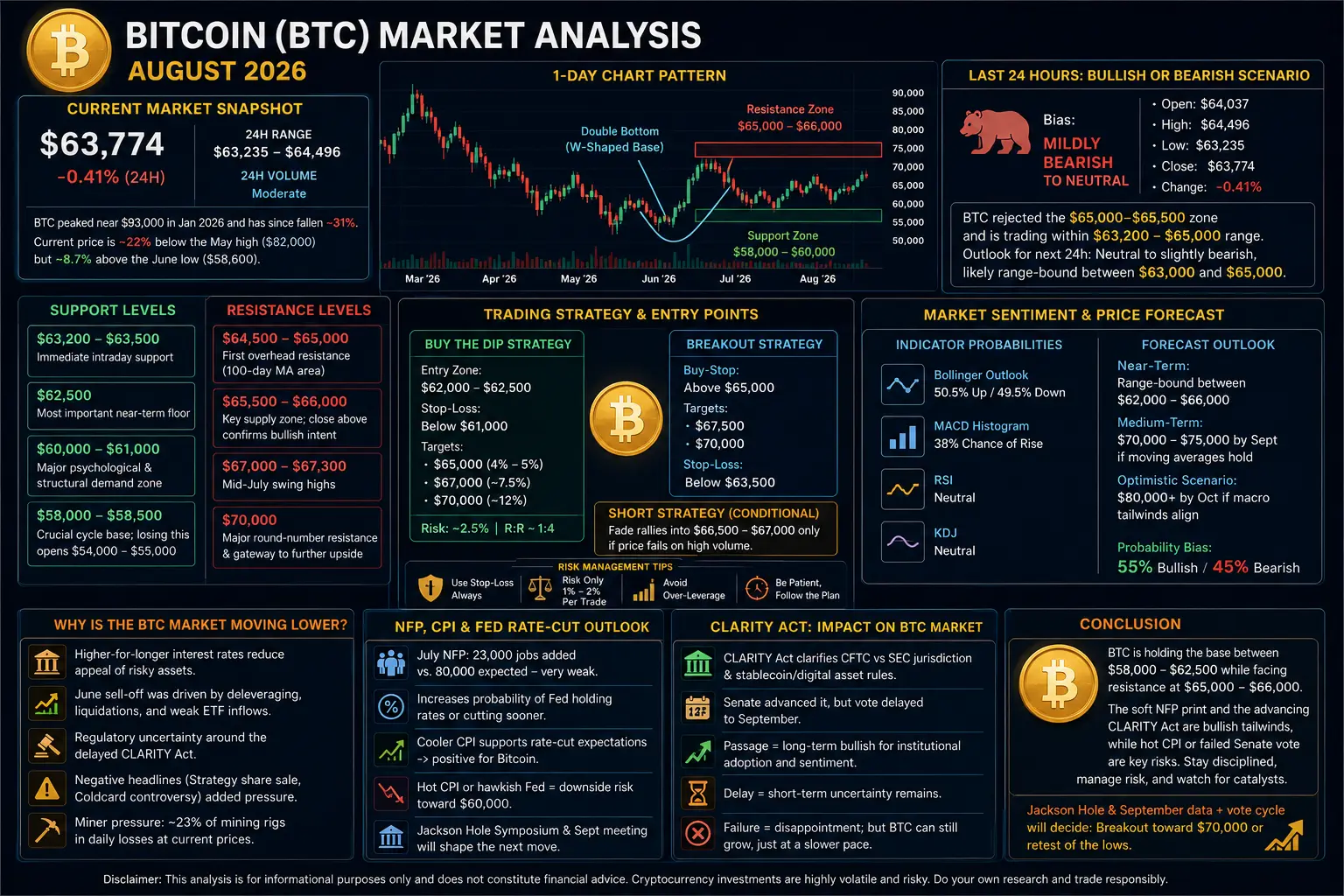
Bitcoin is trading at approximately $63,774 at the time of this analysis, down about 0.41% on the session. The 24-hour range has been narrow, oscillating between roughly $63,235 and $64,496, with subdued volume indicating neither aggressive selling nor strong buying. On a broader timeframe, the picture is sobering: BTC peaked near $93,000 in January 2026 and has since shed roughly 31%, sliding through a violent June flush before stabilizing. The current price sits about 22% below the May swing high near $82,000, yet roughly 8.7% above the June cycle low near $58,600 — a recovery, but a modest one.
1-Day Chart Pattern
The daily chart tells a story of distribution followed by accumulation. From early May through late June, Bitcoin printed a steady series of lower highs, falling from $82,000 down to a critical low near $58,600 in early June. That level was defended aggressively, and since then the structure has evolved into what technicians call a double-bottom, or W-shaped base, with two successful tests of the $58,000 to $60,000 demand zone across June and July. Price has since posted higher lows and reclaimed its short-term moving averages, a sign that sellers are exhausting and buyers are gradually accumulating rather than distributing.
However, the recovery has been orderly and slow rather than explosive. Bitcoin has reclaimed $62,500 and is now pressing against the $64,000 to $65,000 band, which coincides with the longer-term 100-day and 200-day moving averages. Until BTC can close decisively above $65,000, the broader trend remains corrective and range-bound. The pattern is technically constructive but not yet confirmed bullish. The pivotal tell will be a clean break and hold above the $66,000 to $67,000 supply zone, which would open a path toward $70,000.
Last 24 Hours: Bullish or Bearish Scenario
Over the past 24 hours the bias is mildly bearish to neutral. Price opened around $64,037, printed a high of $64,496, then sold off to a low of $63,235 before stabilizing near $63,774 — a decline of roughly 0.41% on the session. Volume has been thin compared to the panic days of June, which means the selling pressure is not aggressive, but buyers have likewise failed to push through overhead resistance.

The hourly structure shows a short-term downtrend inside a larger consolidation: BTC rejected the $65,000 to $65,500 zone over recent sessions and is drifting lower within the $63,200 to $65,000 range. The immediate intraday pressure is slightly negative, yet the fact that the price has repeatedly held $62,500 tells us the downside is contained. My read for the next 24 hours is neutral-to-slightly-bearish, with high probability of range-bound chopping between $63,000 and $65,000 until a higher-timeframe catalyst — CPI, Fed commentary, or a CLARITY Act development — arrives.
Support and Resistance Levels
Support:
$63,200 to $63,500 — immediate intraday support, tested multiple times in the last day
$62,500 — the most important near-term floor; a daily close below this weakens the structure
$60,000 to $61,000 — major psychological and structural demand zone
$58,000 to $58,500 — the crucial cycle base; losing this signals a deeper correction toward $54,000 to $55,000
Resistance:
$64,500 to $65,000 — first overhead resistance (the 100-day MA area)
$65,500 to $66,000 — a key supply zone; a close above this confirms bullish intent
$67,000 to $67,300 — mid-July swing highs
$70,000 — major round-number resistance and the gateway to further upside
Trading Strategy and Entry Points
For a patient swing trader, the risk-to-reward favors buying the dip near $62,000 to $62,500 with a stop-loss below $61,000. If the position works, the first target is $65,000 (roughly 4% to 5% upside), then $67,000 (~7.5%), with a full objective near $70,000 (~12%). Against a 2.5% risk, that yields an attractive ratio of roughly 1 to 4.
For breakout traders, the cleaner setup is a buy-stop above $65,000 on a daily close, targeting $67,500 and then $70,000, with a stop back below $63,500. This avoids catching a falling knife but sacrifices the cheaper entry. For those inclined to short, the safest approach is to fade rallies into $66,500 to $67,000 only if price fails on high volume — not the dominant setup right now given accumulation beneath. Overall, the structural bias leans toward buying weakness near $62,000 to $63,000 rather than chasing either extreme.
Risk management tips: Volatility remains elevated after the June flush, so do not over-leverage. Always place a stop-loss. Keep position sizing conservative at 1% to 2% of capital per trade. Be patient and execute at the stated levels rather than mid-range, where consolidation zones tend to chop traders out.
Market Sentiment and Price Forecast
Sentiment is cautiously constructive but fragile, still scarred by the June collapse. Daily indicator probabilities are mixed: the Bollinger reading implies roughly 50.5% odds of an up day versus 49.5% for a down day, but the MACD histogram shows just a 38% probability of a rise, signaling weak momentum. RSI and KDJ sit in neutral territory — neither oversold nor overbought — meaning there is room to move either way but little conviction behind short-term buyers.
For the forecast, the most probable near-term path is continued range-bound action between $62,000 and $66,000 for the next few days as the market waits for catalysts. On a medium-term view, several models point toward a gradual recovery toward $70,000 to $75,000 by September should Bitcoin reclaim and hold its moving averages, with more optimistic scenarios targeting $80,000+ by October if macro tailwinds align. On the downside, a break of $60,000 would likely open $54,000 to $55,000, roughly another 10% to 15% decline. I would weight the medium-term probabilities at about 55% bullish toward reclaiming $70,000 versus 45% bearish toward retesting $60,000 or below, reflecting the constructive base pattern tempered by weak momentum.
Why Is the BTC Market Moving Lower?
The slide from $93,000 to $64,000 was driven by a convergence of factors rather than any single event. First and foremost, the higher-for-longer interest rate environment has been the dominant macro headwind: elevated rates reduce the appeal of speculative, non-yielding assets like Bitcoin and pull capital toward treasuries and cash. Second, the June sell-off was partly a deleveraging event, with leveraged long positions liquidated and ETF inflows turning intermittent, even negative at times. Third, regulatory uncertainty around the delayed CLARITY Act weighed on confidence throughout the spring and summer. Fourth, a cluster of negative headlines this week — including the reported Strategy (formerly MicroStrategy) share sale and a Coldcard hardware-wallet controversy — added psychological pressure, yet notably Bitcoin held up better than expected, which is itself a sign of underlying resilience. Finally, miner pressure is building, with reports suggesting roughly 23% of mining rigs have slipped into daily losses at current prices, which can force cash-strapped miners to sell coins to cover electricity and operating costs.
NFP, CPI, and the Federal Reserve Rate-Cut Outlook
The macro calendar is the single biggest swing factor this month. The July Nonfarm Payrolls report, released in early August, came in dramatically weak at 23,000 jobs added, far below the 80,000 analysts had expected. This soft labor reading materially raises the probability that the Federal Reserve will hold rates steady or begin cutting sooner than previously thought, which is broadly positive for risk assets including crypto. A cooler jobs market historically supports Bitcoin because it increases the odds of monetary easing, boosting liquidity and risk appetite. August's CPI print will be the next major test: if inflation continues cooling toward the Fed's 2% target, rate-cut expectations strengthen further and could ignite a rally toward $70,000. Conversely, a hot CPI reading that revives fears of persistent inflation — or even renewed hikes — would be a serious headwind capable of driving BTC back toward the $60,000 support. The Jackson Hole Symposium later this month is also critical, as the Fed chair's commentary will shape the roadmap into the September meeting. The broad market read is that a dovish pivot — whether through rate holds or actual cuts — is the primary bullish catalyst standing between Bitcoin and a meaningful recovery.
CLARITY Act: Impact on the BTC Market
The CLARITY Act is one of the most significant pieces of crypto legislation in the current US Congress, designed to clarify the regulatory boundary between the CFTC and the SEC and to set standards for digital-asset classification and stablecoin issuance. Its impact on Bitcoin is largely indirect but sentimentally powerful. The Senate recently advanced the bill closer to a floor vote, which encouraged some optimism and nudged the probability of Bitcoin reaching $200,000 by the end of 2026 slightly higher in prediction markets. However, lawmakers failed to reach cloture before the August recess, postponing the decisive vote to September.
This delay creates a two-sided dynamic. On one hand, postponement removes a near-term catalyst and keeps regulatory uncertainty elevated, which partly explains the market's hesitation. On the other hand, the very existence of a viable bill in Congress signals a maturing, more institutional-friendly regime — a positive longer-term signal. If the CLARITY Act ultimately passes, it could provide the regulatory certainty that unlocks greater institutional participation and supports a sustained higher valuation for Bitcoin. If it fails, the market would likely digest the disappointment, and as some analysts including Grayscale have noted, crypto can still advance without it — just at a slower, more uncertain pace. In short, the CLARITY Act is a sentiment and structural catalyst rather than a direct price driver; its outcome will shape how aggressively institutions re-enter the space in the final quarter of 2026.
Conclusion
Bitcoin sits at a critical juncture near $63,800, holding the base built between $58,000 and $62,500 while facing stubborn resistance at $65,000 to $66,000. The daily pattern is constructive but not yet confirmed, momentum is weak, and the market is clearly waiting for macro and legislative catalysts. The soft NFP print and the advancing CLARITY Act are the two main bullish tailwinds, while a hot CPI reading or a failed Senate vote are the primary risks. Position sizing should stay conservative, entries should respect the stated support and resistance, and traders should await confirmation before adding meaningful exposure. The Jackson Hole Symposium and the September data-and-vote cycle will likely determine whether Bitcoin breaks toward $70,000 or retests the lows.#BTC
#BTCMarketAnalysis
Bitcoin (BTC) Market Analysis — August 2026
Current Market Snapshot
Bitcoin is trading at approximately $63,774 at the time of this analysis, down about 0.41% on the session. The 24-hour range has been narrow, oscillating between roughly $63,235 and $64,496, with subdued volume indicating neither aggressive selling nor strong buying. On a broader timeframe, the picture is sobering: BTC peaked near $93,000 in January 2026 and has since shed roughly 31%, sliding through a violent June flush before stabilizing. The current price sits about 22% below the May swing high near $82,000, yet roughly 8.7% above the June cycle low near $58,600 — a recovery, but a modest one.
1-Day Chart Pattern
The daily chart tells a story of distribution followed by accumulation. From early May through late June, Bitcoin printed a steady series of lower highs, falling from $82,000 down to a critical low near $58,600 in early June. That level was defended aggressively, and since then the structure has evolved into what technicians call a double-bottom, or W-shaped base, with two successful tests of the $58,000 to $60,000 demand zone across June and July. Price has since posted higher lows and reclaimed its short-term moving averages, a sign that sellers are exhausting and buyers are gradually accumulating rather than distributing.
However, the recovery has been orderly and slow rather than explosive. Bitcoin has reclaimed $62,500 and is now pressing against the $64,000 to $65,000 band, which coincides with the longer-term 100-day and 200-day moving averages. Until BTC can close decisively above $65,000, the broader trend remains corrective and range-bound. The pattern is technically constructive but not yet confirmed bullish. The pivotal tell will be a clean break and hold above the $66,000 to $67,000 supply zone, which would open a path toward $70,000.
Last 24 Hours: Bullish or Bearish Scenario
Over the past 24 hours the bias is mildly bearish to neutral. Price opened around $64,037, printed a high of $64,496, then sold off to a low of $63,235 before stabilizing near $63,774 — a decline of roughly 0.41% on the session. Volume has been thin compared to the panic days of June, which means the selling pressure is not aggressive, but buyers have likewise failed to push through overhead resistance.
The hourly structure shows a short-term downtrend inside a larger consolidation: BTC rejected the $65,000 to $65,500 zone over recent sessions and is drifting lower within the $63,200 to $65,000 range. The immediate intraday pressure is slightly negative, yet the fact that the price has repeatedly held $62,500 tells us the downside is contained. My read for the next 24 hours is neutral-to-slightly-bearish, with high probability of range-bound chopping between $63,000 and $65,000 until a higher-timeframe catalyst — CPI, Fed commentary, or a CLARITY Act development — arrives.
Support and Resistance Levels
Support:
$63,200 to $63,500 — immediate intraday support, tested multiple times in the last day
$62,500 — the most important near-term floor; a daily close below this weakens the structure
$60,000 to $61,000 — major psychological and structural demand zone
$58,000 to $58,500 — the crucial cycle base; losing this signals a deeper correction toward $54,000 to $55,000
Resistance:
$64,500 to $65,000 — first overhead resistance (the 100-day MA area)
$65,500 to $66,000 — a key supply zone; a close above this confirms bullish intent
$67,000 to $67,300 — mid-July swing highs
$70,000 — major round-number resistance and the gateway to further upside
Trading Strategy and Entry Points
For a patient swing trader, the risk-to-reward favors buying the dip near $62,000 to $62,500 with a stop-loss below $61,000. If the position works, the first target is $65,000 (roughly 4% to 5% upside), then $67,000 (~7.5%), with a full objective near $70,000 (~12%). Against a 2.5% risk, that yields an attractive ratio of roughly 1 to 4.
For breakout traders, the cleaner setup is a buy-stop above $65,000 on a daily close, targeting $67,500 and then $70,000, with a stop back below $63,500. This avoids catching a falling knife but sacrifices the cheaper entry. For those inclined to short, the safest approach is to fade rallies into $66,500 to $67,000 only if price fails on high volume — not the dominant setup right now given accumulation beneath. Overall, the structural bias leans toward buying weakness near $62,000 to $63,000 rather than chasing either extreme.
Risk management tips: Volatility remains elevated after the June flush, so do not over-leverage. Always place a stop-loss. Keep position sizing conservative at 1% to 2% of capital per trade. Be patient and execute at the stated levels rather than mid-range, where consolidation zones tend to chop traders out.
Market Sentiment and Price Forecast
Sentiment is cautiously constructive but fragile, still scarred by the June collapse. Daily indicator probabilities are mixed: the Bollinger reading implies roughly 50.5% odds of an up day versus 49.5% for a down day, but the MACD histogram shows just a 38% probability of a rise, signaling weak momentum. RSI and KDJ sit in neutral territory — neither oversold nor overbought — meaning there is room to move either way but little conviction behind short-term buyers.
For the forecast, the most probable near-term path is continued range-bound action between $62,000 and $66,000 for the next few days as the market waits for catalysts. On a medium-term view, several models point toward a gradual recovery toward $70,000 to $75,000 by September should Bitcoin reclaim and hold its moving averages, with more optimistic scenarios targeting $80,000+ by October if macro tailwinds align. On the downside, a break of $60,000 would likely open $54,000 to $55,000, roughly another 10% to 15% decline. I would weight the medium-term probabilities at about 55% bullish toward reclaiming $70,000 versus 45% bearish toward retesting $60,000 or below, reflecting the constructive base pattern tempered by weak momentum.
Why Is the BTC Market Moving Lower?
The slide from $93,000 to $64,000 was driven by a convergence of factors rather than any single event. First and foremost, the higher-for-longer interest rate environment has been the dominant macro headwind: elevated rates reduce the appeal of speculative, non-yielding assets like Bitcoin and pull capital toward treasuries and cash. Second, the June sell-off was partly a deleveraging event, with leveraged long positions liquidated and ETF inflows turning intermittent, even negative at times. Third, regulatory uncertainty around the delayed CLARITY Act weighed on confidence throughout the spring and summer. Fourth, a cluster of negative headlines this week — including the reported Strategy (formerly MicroStrategy) share sale and a Coldcard hardware-wallet controversy — added psychological pressure, yet notably Bitcoin held up better than expected, which is itself a sign of underlying resilience. Finally, miner pressure is building, with reports suggesting roughly 23% of mining rigs have slipped into daily losses at current prices, which can force cash-strapped miners to sell coins to cover electricity and operating costs.
NFP, CPI, and the Federal Reserve Rate-Cut Outlook
The macro calendar is the single biggest swing factor this month. The July Nonfarm Payrolls report, released in early August, came in dramatically weak at 23,000 jobs added, far below the 80,000 analysts had expected. This soft labor reading materially raises the probability that the Federal Reserve will hold rates steady or begin cutting sooner than previously thought, which is broadly positive for risk assets including crypto. A cooler jobs market historically supports Bitcoin because it increases the odds of monetary easing, boosting liquidity and risk appetite. August's CPI print will be the next major test: if inflation continues cooling toward the Fed's 2% target, rate-cut expectations strengthen further and could ignite a rally toward $70,000. Conversely, a hot CPI reading that revives fears of persistent inflation — or even renewed hikes — would be a serious headwind capable of driving BTC back toward the $60,000 support. The Jackson Hole Symposium later this month is also critical, as the Fed chair's commentary will shape the roadmap into the September meeting. The broad market read is that a dovish pivot — whether through rate holds or actual cuts — is the primary bullish catalyst standing between Bitcoin and a meaningful recovery.
CLARITY Act: Impact on the BTC Market
The CLARITY Act is one of the most significant pieces of crypto legislation in the current US Congress, designed to clarify the regulatory boundary between the CFTC and the SEC and to set standards for digital-asset classification and stablecoin issuance. Its impact on Bitcoin is largely indirect but sentimentally powerful. The Senate recently advanced the bill closer to a floor vote, which encouraged some optimism and nudged the probability of Bitcoin reaching $200,000 by the end of 2026 slightly higher in prediction markets. However, lawmakers failed to reach cloture before the August recess, postponing the decisive vote to September.
This delay creates a two-sided dynamic. On one hand, postponement removes a near-term catalyst and keeps regulatory uncertainty elevated, which partly explains the market's hesitation. On the other hand, the very existence of a viable bill in Congress signals a maturing, more institutional-friendly regime — a positive longer-term signal. If the CLARITY Act ultimately passes, it could provide the regulatory certainty that unlocks greater institutional participation and supports a sustained higher valuation for Bitcoin. If it fails, the market would likely digest the disappointment, and as some analysts including Grayscale have noted, crypto can still advance without it — just at a slower, more uncertain pace. In short, the CLARITY Act is a sentiment and structural catalyst rather than a direct price driver; its outcome will shape how aggressively institutions re-enter the space in the final quarter of 2026.
Conclusion
Bitcoin sits at a critical juncture near $63,800, holding the base built between $58,000 and $62,500 while facing stubborn resistance at $65,000 to $66,000. The daily pattern is constructive but not yet confirmed, momentum is weak, and the market is clearly waiting for macro and legislative catalysts. The soft NFP print and the advancing CLARITY Act are the two main bullish tailwinds, while a hot CPI reading or a failed Senate vote are the primary risks. Position sizing should stay conservative, entries should respect the stated support and resistance, and traders should await confirmation before adding meaningful exposure. The Jackson Hole Symposium and the September data-and-vote cycle will likely determine whether Bitcoin breaks toward $70,000 or retests the lows.#BTC
#BTCMarketAnalysis