ParabolicRider

vip
Age 0.3 Year
Peak Tier 0
Hold the position long-term, do not operate. Regularly check wallet security and share anti-phishing tips.
Woke up for the third time at 3 a.m., scrolling on X/Twitter, and found that everyone is talking about words like “bundles” and “block builders” again. Honestly, I still haven’t fully figured out those MEV strategies. Anyway, I’m just a chill DCA believer. For me, a bundle is basically “a fancy technique where people line up to cut in line.” Knowing that is enough. I don’t stay up late studying those tricks, and I’m not chasing people who sprint at the start. I buy some BTC and ETH, toss them into a cold wallet, and go to sleep—that’s my “sleep consensus.” As for modular blockchains and stuff,
BTC2.93%
ETH3.46%
View Original
  • Reward
  • Comment
  • Repost
  • Share
Android users can finally “squeeze” these 6 months of Core Membership, and long-time iOS users are crying and fainting.
View Original
WuSaidBlockchainW
Stablecoin payment network Plasma announced that its stablecoin accounts and the Plasma One payment card app have been launched on Android. The app supports stablecoin deposits, transfers, and spending with the payment card. According to the official campaign terms, Android users who register for the first time and complete identity verification within the specified period and deposit at least $100 or an equivalent amount in stablecoins can receive a 6-month Core membership; existing users and iOS users are not eligible.
  • Reward
  • Comment
  • Repost
  • Share
The moment Hormuz tightens, oil prices go crazy first—does BTC follow as a hedge or break along with liquidity? This round, you’d better keep a close watch on crude oil and the U.S. Dollar Index.
BTC2.93%
View Original
Ai_Power
#IranClosesStraitOfHormuz
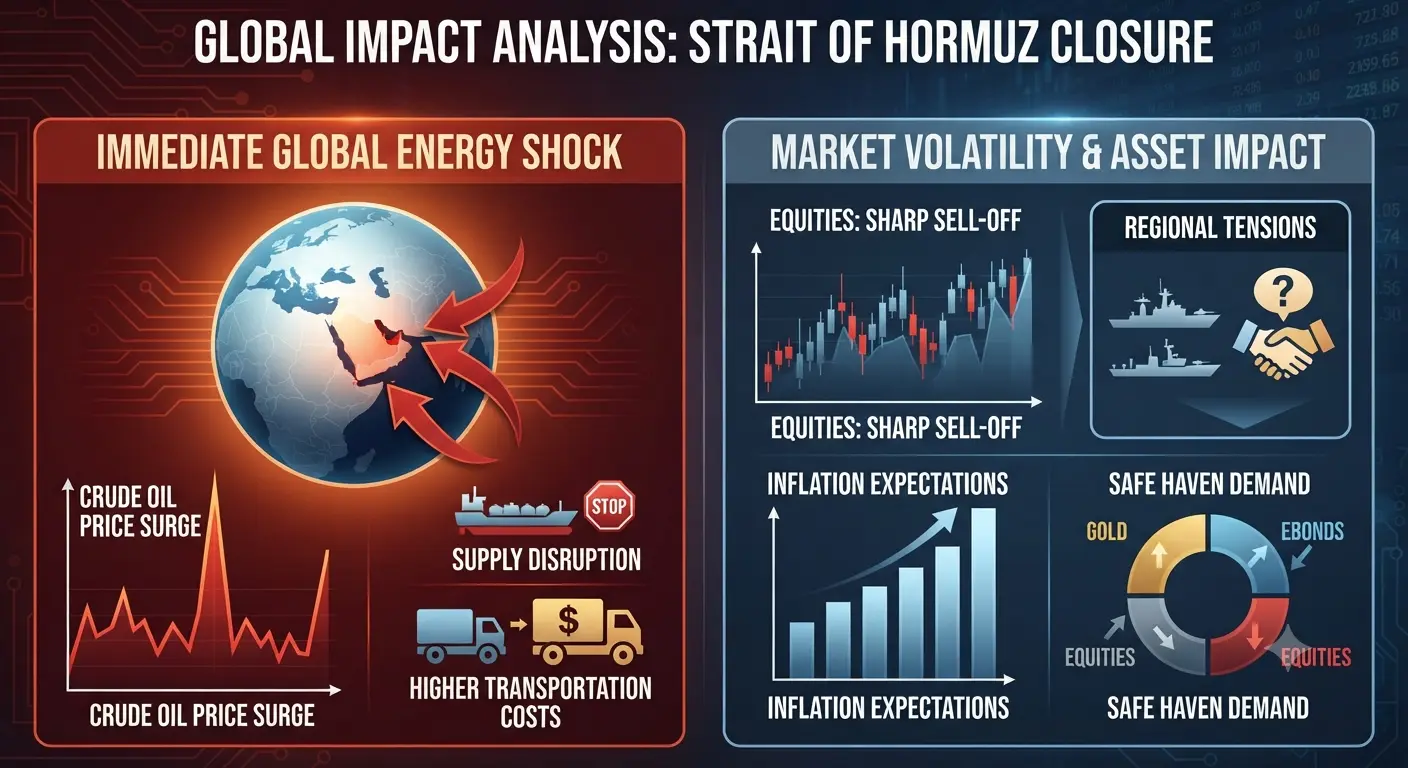
Iran Closes Strait of Hormuz: Global Energy Shock, Market Volatility and Crypto Impact Analysis
Executive Summary
The reported closure of the Strait of Hormuz has created one of the most significant geopolitical risks for global financial markets. The Strait of Hormuz is one of the world's most important energy routes, and any disruption in this region can affect oil supply, inflation expectations, currency markets, and investor sentiment worldwide.
Recent reports indicate that Iran's Islamic Revolutionary Guard Corps announced the closure of the Strait of Hormuz amid escalating tensions with the United States and regional actors. The development followed a series of military confrontations and increased uncertainty around commercial shipping in the region.
For financial markets, the key concern is not only the immediate impact on energy prices but also the possibility of prolonged uncertainty. Higher oil prices can increase inflation pressure, influence central bank decisions, and create volatility across equities, commodities, and digital assets.
Introduction
Global markets are entering a period of heightened uncertainty as geopolitical tensions in the Middle East intensify. The Strait of Hormuz, located between the Persian Gulf and the Gulf of Oman, plays a critical role in international energy transportation.
Any disruption to this route creates concerns because global energy markets depend heavily on stable shipping conditions. Investors are now monitoring whether the situation remains temporary or develops into a longer-term challenge for global supply chains.
Market Update
The immediate market reaction has focused on energy prices, inflation risks, and safe-haven demand.
Oil markets have responded strongly to the escalation, with reports indicating significant increases in crude prices as traders priced in geopolitical risk.
Financial markets are watching several key factors:
• Energy supply stability.
• Shipping disruptions.
• Government responses.
• Inflation expectations.
• Central bank policy reactions.
Market Overview
The Strait of Hormuz is strategically important because a major portion of global energy shipments passes through this narrow waterway.
A prolonged disruption could affect:
• Crude oil prices.
• Natural gas markets.
• Transportation costs.
• Global inflation trends.
• Consumer prices.
Energy shocks historically create uncertainty because higher fuel costs can impact businesses, manufacturing, and consumer spending.
Background of the Event
The latest tensions developed after a series of confrontations involving Iran, the United States, and regional forces. Iran stated that the Strait of Hormuz was closed after incidents involving commercial vessels and military actions in the region. The United States has disputed Iran's ability to permanently block the waterway and has continued military operations related to the conflict.
The situation remains fluid, with diplomatic efforts continuing alongside military tensions.
Key Facts
• The Strait of Hormuz is a critical global energy route.
• Iran has announced restrictions on passage through the waterway.
• Global markets are monitoring oil supply risks.
• Geopolitical uncertainty is increasing market volatility.
Macroeconomic Impact
A prolonged energy disruption could influence global inflation.
Higher oil prices may create:
• Increased transportation costs.
• Higher production expenses.
• Additional inflation pressure.
• Challenges for central banks.
Central banks may face a difficult balance between controlling inflation and supporting economic growth.
Crypto Market Impact
Cryptocurrency markets are increasingly connected with global macroeconomic conditions.
Possible effects include:
Negative Pressure
During geopolitical uncertainty, investors may reduce exposure to risk assets. This can create short-term pressure on Bitcoin and altcoins.
Potential Positive Effect
Some investors view Bitcoin as a potential alternative store of value during periods of currency uncertainty and geopolitical stress.
However, crypto market reactions depend on liquidity conditions, investor sentiment, and broader financial conditions.
Fundamental Analysis
The fundamental impact of this event depends on three major factors:
1. Duration of the disruption.
2. Global energy market response.
3. Diplomatic developments.
A short-term disruption may create temporary volatility, while a prolonged crisis could have wider economic consequences.
Technical Analysis Perspective
The Strait of Hormuz event itself is not a tradable asset, therefore traditional indicators such as:
• RSI
• MACD
• Moving Averages
• Bollinger Bands
• Fibonacci Levels
• Support and Resistance
cannot be directly calculated for the event.
For cryptocurrencies and financial assets, traders should monitor verified market charts, trading volume, liquidity conditions, and overall market trends.
Investor Sentiment
Investor confidence is currently influenced by uncertainty.
Market participants are watching:
• Oil price movements.
• Government responses.
• Inflation expectations.
• Risk appetite.
Periods of geopolitical stress often increase demand for defensive assets while creating volatility in higher-risk markets.
Bullish Scenario
A positive scenario could develop if:
• Diplomatic negotiations reduce tensions.
• Shipping routes return to normal.
• Energy markets stabilize.
• Inflation concerns decrease.
This could improve investor confidence and support risk assets.
Bearish Scenario
A negative scenario could develop if:
• The disruption continues for an extended period.
• Energy prices remain elevated.
• Inflation expectations rise.
• Global economic uncertainty increases.
This environment could pressure stocks and cryptocurrencies.
Neutral Scenario
Markets may remain volatile but range-bound if:
• The conflict remains contained.
• Energy supply continues with limited disruption.
• Investors wait for further developments.
Trading and Risk Management Strategy
During geopolitical uncertainty, investors should focus on:
• Managing risk exposure.
• Avoiding emotional decisions.
• Maintaining diversified portfolios.
• Following verified market information.
• Monitoring volatility.
Risk management becomes especially important during unexpected global events.
Short-Term Outlook
Short-term volatility is likely to remain elevated as markets react to new developments. Energy markets will likely remain the primary focus.
Medium-Term Outlook
The medium-term direction depends on whether tensions escalate or diplomatic solutions emerge.
Stable energy markets could reduce pressure, while prolonged disruption could maintain uncertainty.
Long-Term Outlook
The long-term impact will depend on global energy diversification, geopolitical stability, monetary policy, and investor adaptation.
The event also highlights the importance of resilient global supply chains and diversified energy strategies.
Key Takeaways
• The Strait of Hormuz is a critical global energy route.
• Geopolitical tensions can quickly influence financial markets.
• Oil prices, inflation, and monetary policy remain key factors.
• Crypto markets may experience volatility during global uncertainty.
• Responsible risk management is essential.
Conclusion
The reported closure of the Strait of Hormuz represents a major geopolitical development with potential consequences for energy markets, inflation, and global financial conditions.
While the final market impact depends on how the situation develops, investors should closely monitor verified updates, maintain discipline, and avoid making decisions based solely on short-term market reactions.
Disclaimer
This article is for informational and educational purposes only and does not constitute financial advice. Market conditions can change rapidly, and investors should conduct their own research before making any financial decisions.
repost-content-media
  • Reward
  • Comment
  • Repost
  • Share
They’re focusing on both war and peace, but isn’t the probability of the US admitting it’s wrong even lower than ETH going to zero?
ETH3.46%
View Original
CoinNetwork
Crypto news: In an interview published by the Russian state-owned broadcaster RT (Russia Today) on July 12, a member of Iran’s parliament’s National Security and Foreign Policy Committee, Abolfazl Zaherivand, said that Iran is ready for both war and peace, but the United States must truly acknowledge its “strategic mistakes” and pay for them. Zaherivand said U.S. President Trump had claimed that Iran suffered “$1 trillion” in losses, and that Iran would seek repayment from the United States “for the current and future generations.” He also warned that the war cannot be ended in the short term, “and all Iranians are prepared to take revenge on the United States.”
  • Reward
  • Comment
  • Repost
  • Share
Spending $25k on a "permanent" team ownership, only to have the team sold without sharing the proceeds—this NFT marketing really deserves to be sued.
View Original
CoinNetwork
CoinWorld news: According to Decrypt, NFT buyers of the BIG3 basketball league have filed a class-action lawsuit in a California court, alleging that the league carried out false and fraudulent marketing through its Ethereum NFT sales in 2022. The Fire tier was priced at $25,000, and the Gold tier at $5,000. BIG3 promised holders “permanent” rights including team ownership, voting rights, season tickets, and a share of future revenues, but did not deliver on these promises. In 2024, BIG3 sold four teams to external investors for about $40 million; the lawsuit claims that part of the sale proceeds should be allocated to NFT holders who were early private investors.
  • Reward
  • Comment
  • Repost
  • Share
Tennessee's 185 machines went to zero overnight, Georgia is still struggling with limits — whose turn is next in this script? See you in Minnesota in August.
View Original
CoinNetwork
Cointelegraph reports that new regulations for cryptocurrency ATMs in the U.S. states of Tennessee and Georgia took effect on July 1. Tennessee has implemented a comprehensive ban, while Georgia requires transaction limits and reporting obligations. Indiana already enacted a ban in March, and Minnesota will enforce a similar ban on August 1. Before the ban took effect, Tennessee had about 185 crypto ATMs and kiosks operating. Governments in multiple states have taken action as incidents have become frequent in which scammers lure residents into making transfers via crypto ATMs; lawmakers in Delaware and New Jersey have also introduced similar comprehensive ban proposals.
  • Reward
  • Comment
  • Repost
  • Share
Last night I came across a thread about modular DA, and all those letter-number acronyms made my eyelids start twitching. The devs were excited like they’d found a whole new continent, but me—an old bagholder like me… well, it feels like I kind of understand it, but also like I don’t.
Honestly, every time I think about adding to my position, I freeze—am I really getting something, or am I just being pushed along by the vibe of “everyone’s talking about it”? The lesson from my last FOMO is still fresh: what I chased wasn’t information—it was the anxiety in the group chat at 3:00 AM.
Forget it,
View Original
  • Reward
  • Comment
  • Repost
  • Share
Open source is really catching up this time. The price of Deepseek v4 is simply irresistible.
View Original
CoinNetwork
OpenRouter: The gap between open-source large models in China and the US and the closed-source frontier is only 3 to 6 months.
Coins.news reports that OpenRouter has disclosed that the performance gap between open-source large models in China and the US and closed-source frontier models has stabilized at 3 to 6 months. Over the past 18 months, frontier closed-source labs have failed to widen the gap as expected, while new players from China and the US are accelerating drop-in replacements with high cost performance. Since the release of Deepseek v4 flash just two months ago, it has become the top choice for replacements; with 2840亿 parameters, it achieved 79.0% on the swe-bench verified evaluation, nearing GPT-5.5. Its input/output pricing is $0.14/$0.28 per million tokens, making it about 150 times cheaper than GPT-5.5. GLM 5.2, released by Zhipu AI in June 2026, ranks first in the open-source weight intelligence index and matches GPT-5.5 in real agent evaluations, becoming an alternative for long-range programming planning. OpenRouter emphasized that although
  • Reward
  • Comment
  • Repost
  • Share
Major ETFs are bleeding collectively. Are funds waiting or retreating?
View Original
CoinNetwork
CoinWorld news, on June 25, spot ETFs for Bitcoin (BTC), Ethereum (ETH), Solana (SOL), and HYPE all saw net outflows. Specific data shows that Bitcoin had a net outflow of approximately $696 million, Ethereum a net outflow of about $81.87 million, Solana a net outflow of roughly $3.94 million, and HYPE a net outflow of around $464k.
  • Reward
  • Comment
  • Repost
  • Share
Blocked in loneliness, in the end it all comes down to a memo—Old T’s mouth is harder than a missile.
View Original
CoinNetwork
Trump denies Iran war, exposing his limited power
According to AXIOS, Trump denied that the Iran war exposed his limitations of power, insisting "there are no restrictions," stating that the agreement was reached to avoid a global economic recession, and denying that he was humiliated. He claimed that the war demonstrated U.S. military strength, asserted that a maritime blockade against Iran was implemented, and warned that failure to reach an agreement would have serious consequences, also considering the memorandum almost an unconditional surrender.
  • Reward
  • Comment
  • Repost
  • Share
The tension in the Strait of Hormuz has added fuel to the fire, with information warfare arriving before missiles. In an era where truth is hard to distinguish from falsehood, official denials have become a rare commodity.
View Original
CoinNetwork
CryptoWorld News: U.S. Central Command: Iran claims to have attacked a U.S. warship in the Strait of Hormuz; this is false information.
  • Reward
  • Comment
  • Repost
  • Share
Geopolitical conflicts have escalated again; safe-haven assets should move.
View Original
CoinNetwork
CryptoWorld News reports, according to Jordan National Television: The Jordanian Armed Forces say they intercepted and shot down five missiles launched from Iran heading toward Azraq. Debris from the intercepted missiles fell afterward, with no reports of casualties or damage.
  • Reward
  • Comment
  • Repost
  • Share
JUP's structure is collapsing a bit quickly, and the bears are taking over the momentum. I'm going to wait and see.
JUP1.15%
View Original
MarcusCorvinus
$JUP just lost a key level and the chart is starting to look dangerous.
Breakdown confirmed.
Buyers failed to defend support.
Momentum is shifting to the bears.
Any weak bounce could be a trap.
Lower levels are now firmly in sight.
The structure has changed, and pressure keeps building.
Staying cautious here. A sharp move down could be closer than most expect.
repost-content-media
  • Reward
  • Comment
  • Repost
  • Share
Recently, I suddenly started organizing my transaction records, mainly because I’m afraid my brain will crash during year-end tax reporting... To be honest, I don’t chase after rising prices, but with so many on-chain operations, fragmented records can really drive a person crazy. Now I’ve developed a habit: every time I switch wallets, cross chains, or participate in an event, I conveniently take screenshots or save transaction links in the same place, plus a simple note saying “why I did it.” It’s like making a backup for myself; I usually find it troublesome, but only realize how painful it
View Original
  • Reward
  • Comment
  • Repost
  • Share
Over the past couple of days, I keep seeing everyone talk about LSTs and re-staking. To put it simply, the returns come from two sides: one is the basic rewards you earn from staking, and the other is borrowing out the same “credit” to more services so that others subsidize you with things like rewards, points, or expectations of an airdrop. It sounds pretty good, but the risks are also very direct: if an on-chain contract goes wrong, if verification/operations fail, or if liquidity tightens up, the value could trade at a discount—you may not be able to exit/withdraw even if you want to.
I ori
View Original
  • Reward
  • Comment
  • Repost
  • Share
These days, I see people arguing whether it's more comfortable to be a buyer or a seller of options, basically debating who the time value is eating.
Buyers are like paying rent, slowly losing a little bit every day as time passes, and if the market doesn't move in the right direction, it gradually goes to zero;
Sellers are like collecting rent, seemingly sleeping soundly on the surface, but if the market suddenly freaks out and volatility spikes, the rent collected isn't enough to cover the losses, making their mindset more prone to explosion.
Anyway, I’m the kind who doesn’t stay up la
View Original
  • Reward
  • Comment
  • Repost
  • Share
This guy really dares to keep holding—while he’s still floating at a loss of 78 million and is adding more margin. His urge to gamble is way too strong.
View Original
CoinNetwork
Crypto World News reports that, according to Lookonchain monitoring, an on-chain whale is currently losing $78 million on their long position of 120,000 Ethereum (worth approximately $194 million). To avoid liquidation, they deposited an additional $5.84 million in USDC as margin. Their new liquidation prices are $1,414.51, $1,366.11, $1,360.73, and $1,309.53.
  • Reward
  • Comment
  • Repost
  • Share
BTC treasury strategy remains uncertain, but the narrative of 3 trillion stablecoins and BlackRock ETF inflows suggests that institutional chips are quietly being reclaimed?
BTC2.93%
View Original
CoinNetwork
Crypto Evening News | Bitcoin News: $62 Billion Vaporized—BTC Treasury Strategy Is Dead, Yet Still Needs Verification
CoinWorld June 5 News: 1. Bitcoin news: $62 billion evaporated—BTC treasury strategy is dead, though it still needs verification; 2. Bloomberg: The US is betting on stablecoin expansion to around $3 trillion; 3. Bitcoin and Ethereum ETFs end a wave of billions in fund outflows; 4. Zcash: After disclosure of a critical vulnerability, the price crashes by 30%; 5. Is token issuance or confirmation underway? ZEC is slashed in half intraday; 6. In the past 24 hours, ZEC liquidations exceeded $100 million, mainly concentrated in long positions; 7. Blackstone: The first ETF capital inflow in 13 days, attracting $47.66 million; 8. Analyst: BNB price tests a key support level, and bearish signals in the market intensify; 9. Grayscale Hyperliquid ETF records a net inflow of $4.7 million on its first day, with total cumulative net inflows of this type already reaching $145 million; 10. White House Digital Asset Advisory Committee:
  • Reward
  • Comment
  • Repost
  • Share
Once the spot ETF is launched, the narrative that companies are just Bitcoin agents has indeed weakened, but the core reserve logic isn't completely dead.
BTC2.93%
View Original
CoinNetwork
Crypto界网消息,99bitcoins报道,自10月初以来,围绕持有比特币作为核心储备资产的上市公司总市值已蒸发62B美元,市值从134B美元降至约72B美元。许多数字资产财库公司受到影响,其股票损失在许多情况下超过它们实际持有的比特币损失。尽管这一数字并非实现损失,但它反映了市场对这些公司的估值崩溃。研究表明,这些财库股票的表现类似于杠杆比特币,在严重抛售期间,其回撤幅度通常是比特币的1.5倍至2.5倍。虽然比特币作为企业财库的概念并未消亡,但面临重大挑战,尤其是在监管现货比特币ETF的出现后,企业作为比特币代理的相关性似乎降低。
  • Reward
  • Comment
  • Repost
  • Share
  • Pinned