#LABPlunges53PercentInTwoDays
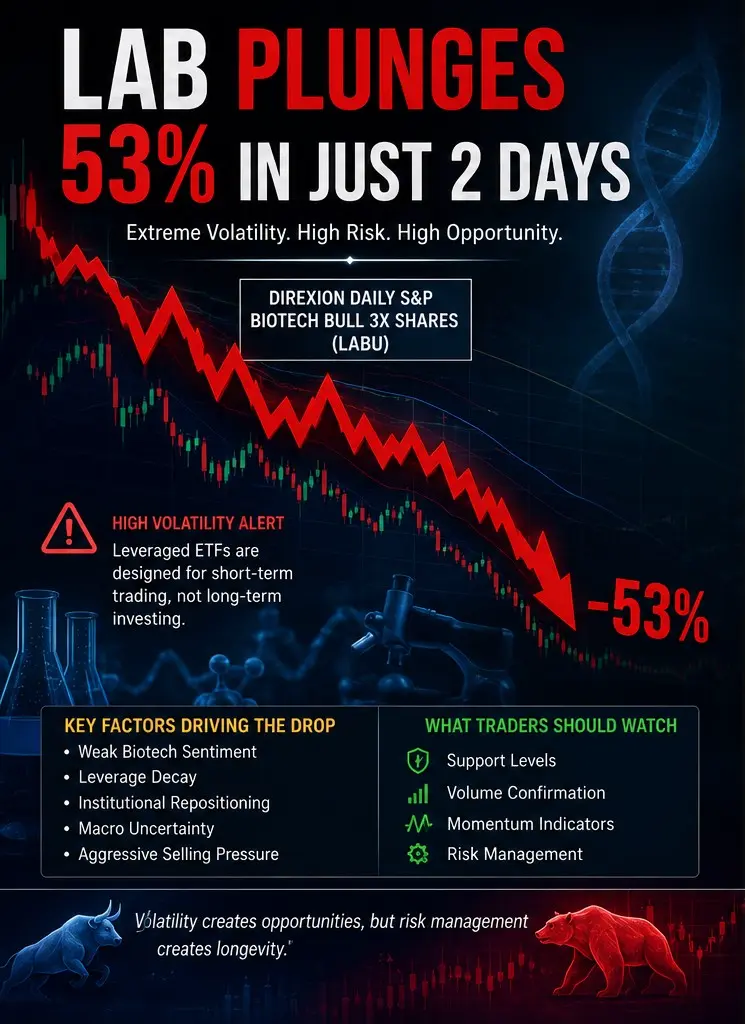
The Direxion Daily S&P Biotech Bull 3X Shares (LABU) and its inverse counterpart have once again reminded traders how leveraged ETFs can experience extreme price swings in a short period.
A decline of approximately 53% within two trading sessions represents a major volatility event driven by rapid changes in biotechnology sentiment, leverage decay, aggressive institutional repositioning, and elevated market uncertainty.
While these moves attract speculative traders searching for quick opportunities, they also highlight the importance of disciplined risk management.
Every significant decline creates two possibilities: either a high-risk recovery opportunity or the beginning of a larger bearish trend.
Understanding which scenario is developing requires combining technical analysis, macroeconomic conditions, institutional positioning, and sector-specific catalysts.
The broader U.S. equity market continues to experience mixed sentiment as investors balance expectations for interest rate policy, economic growth, inflation trends, and corporate earnings.
Biotechnology remains one of the most volatile sectors because company valuations are heavily influenced by clinical trial outcomes, FDA approvals, research funding, merger activity, and investor risk appetite.
As liquidity rotates between defensive and growth sectors, leveraged biotech ETFs often experience amplified price movements compared to the underlying index.
Current market conditions suggest elevated volatility rather than a stable directional trend.
Large intraday price swings, above-average trading volume, and increasing options activity indicate that traders remain highly active while long-term investors continue waiting for clearer macroeconomic signals.
Until confidence improves, sharp rallies and sharp declines are both likely to remain common.
At the time of publishing, traders should verify the live market price before opening any position because leveraged ETFs can move several percentage points within minutes.
Price action remains the most important confirmation signal, especially during periods of unusually high volatility.
From a performance perspective, the recent decline represents one of the strongest short-term corrections in recent sessions.
Such moves often trigger forced liquidations, margin calls, algorithmic selling, and panic exits before value-oriented buyers begin accumulating positions.
Whether this develops into a lasting bottom depends on the strength of subsequent buying volume.
Technically, the market structure has shifted from bullish to defensive.
Lower highs and lower lows indicate that sellers currently control momentum.
Unless price successfully reclaims previous resistance levels with strong volume, the broader technical structure remains vulnerable to additional downside.
Trend analysis shows that short-term momentum continues favoring bears while medium-term direction depends on whether support zones successfully hold.
Long-term investors will likely focus on sector fundamentals rather than short-term volatility.
Important support levels include recent swing lows, previous consolidation zones, and high-volume accumulation areas.
If these supports remain intact, buyers may gradually rebuild confidence.
Failure to hold these levels could invite another wave of selling pressure.
Resistance levels now include recent breakdown areas, declining moving averages, and previous support zones that may now act as resistance.
Strong buying volume will be required before these barriers can be overcome.
Key buying zones generally appear near historical demand areas where institutional accumulation previously occurred.
Rather than chasing rebounds, experienced traders typically wait for confirmation through higher lows, stronger volume, and improving momentum indicators.
Key selling zones remain near overhead resistance where previous buyers may attempt to exit losing positions.
These areas often create temporary supply that slows recovery attempts.
The bullish scenario begins with stabilization above major support followed by increasing trading volume, improving market breadth, positive biotechnology news, and stronger institutional buying.
If buyers regain control, a relief rally could develop toward higher resistance levels before a larger trend reversal is confirmed.
The bearish scenario remains valid if price continues making lower lows while volume expands during selloffs.
Additional macroeconomic uncertainty, disappointing healthcare news, weaker biotech sentiment, or broader equity weakness could extend downside pressure.
Volume analysis remains one of the most important indicators following such a significant decline.
Exceptionally high volume often signals capitulation, while declining volume during rebounds may indicate only temporary short covering rather than genuine institutional accumulation.
Momentum indicators deserve close attention. RSI may approach oversold territory after such a steep decline, but oversold conditions alone do not guarantee a reversal.
MACD remains useful for identifying momentum shifts through bullish crossovers, while moving averages continue helping traders identify trend direction and dynamic support or resistance.
The artificial intelligence and semiconductor sectors continue attracting significant capital flows across U.S. markets, often competing with biotechnology for institutional investment.
When AI-related stocks outperform, biotechnology occasionally experiences temporary capital rotation.
However, long-term healthcare innovation remains supported by advances in genomics, precision medicine, artificial intelligence-assisted drug discovery, and biotechnology research.
Biotechnology fundamentals remain attractive over the long term despite elevated short-term volatility.
Demand for innovative treatments, expanding healthcare spending, aging populations, and continuous scientific breakthroughs continue supporting the industry's structural growth outlook.
Institutional sentiment remains cautious but highly selective.
Large asset managers continue focusing on companies with strong balance sheets, diversified pipelines, strategic partnerships, and sustainable revenue potential rather than purely speculative biotechnology names.
Several market catalysts could determine the next directional move, including Federal Reserve policy expectations, inflation data, Treasury yields, FDA approvals, biotechnology earnings, merger announcements, clinical trial results, healthcare legislation, and overall equity market sentiment.
Risk factors remain substantial.
Leveraged ETFs experience volatility decay, compounding effects, rapid price swings, and increased exposure to daily market fluctuations.
These products are generally designed for short-term tactical trading rather than long-term investing.
Today's market outlook remains cautious. Traders should expect continued volatility while monitoring whether buyers successfully defend critical support zones. Confirmation through price action and volume remains more reliable than attempting to predict market turning points.
The short-term outlook remains neutral to bearish until technical confirmation improves. Recovery attempts are possible, but sustained upside requires stronger institutional participation.
The mid-term outlook depends largely on broader biotechnology sector performance and macroeconomic stability. Improving investor confidence could support gradual recovery, while persistent uncertainty could delay any meaningful trend reversal.
The long-term outlook remains constructive for biotechnology because healthcare innovation continues expanding globally. Investors with longer investment horizons may view major corrections as opportunities, provided underlying sector fundamentals remain intact.
Futures market participants should closely monitor volatility, overnight news, options positioning, and broader equity futures before entering trades. Futures often provide valuable clues regarding market sentiment before the regular session begins.
An advanced trading strategy emphasizes patience over prediction. Wait for confirmed support, rising volume, improving momentum indicators, and favorable risk-to-reward ratios before initiating new positions. Avoid emotional trading during highly volatile sessions.
Professional risk management remains the foundation of successful trading. Limit position sizes, always define stop-loss levels before entry, avoid excessive leverage, diversify exposure, and never allow a single trade to determine overall portfolio performance.
Essential support levels should be monitored alongside previous accumulation zones, while essential resistance levels include recent breakdown areas, declining trendlines, and major moving averages that may challenge recovery attempts.
Key upside targets become relevant only after resistance is reclaimed with convincing volume. Conversely, failure to hold support could expose additional downside targets and extend the existing correction.
Swing traders should prioritize confirmed trend reversals rather than attempting to catch falling prices. Day traders may focus on volatility, liquidity, opening range breakouts, and disciplined execution while maintaining strict stop-loss protection.
From an investment perspective, leveraged ETFs require careful understanding of their structure and objectives. Long-term investors may prefer diversified exposure to biotechnology rather than relying on leveraged products designed primarily for short-term trading strategies.
The recent decline highlights both the opportunities and dangers of leveraged markets. Volatility creates attractive trading setups but also increases downside risk. Successful traders combine technical confirmation, fundamental awareness, disciplined execution, and effective risk management rather than relying solely on short-term price movements. The coming sessions will reveal whether this decline represents capitulation before recovery or the continuation of a broader bearish trend.
Engagement Question: Do you believe the recent 53% plunge represents a buying opportunity for experienced traders, or is it a warning that biotechnology volatility could continue driving prices lower in the weeks ahead?
The Direxion Daily S&P Biotech Bull 3X Shares (LABU) and its inverse counterpart have once again reminded traders how leveraged ETFs can experience extreme price swings in a short period.
A decline of approximately 53% within two trading sessions represents a major volatility event driven by rapid changes in biotechnology sentiment, leverage decay, aggressive institutional repositioning, and elevated market uncertainty.
While these moves attract speculative traders searching for quick opportunities, they also highlight the importance of disciplined risk management.
Every significant decline creates two possibilities: either a high-risk recovery opportunity or the beginning of a larger bearish trend.
Understanding which scenario is developing requires combining technical analysis, macroeconomic conditions, institutional positioning, and sector-specific catalysts.
The broader U.S. equity market continues to experience mixed sentiment as investors balance expectations for interest rate policy, economic growth, inflation trends, and corporate earnings.
Biotechnology remains one of the most volatile sectors because company valuations are heavily influenced by clinical trial outcomes, FDA approvals, research funding, merger activity, and investor risk appetite.
As liquidity rotates between defensive and growth sectors, leveraged biotech ETFs often experience amplified price movements compared to the underlying index.
Current market conditions suggest elevated volatility rather than a stable directional trend.
Large intraday price swings, above-average trading volume, and increasing options activity indicate that traders remain highly active while long-term investors continue waiting for clearer macroeconomic signals.
Until confidence improves, sharp rallies and sharp declines are both likely to remain common.
At the time of publishing, traders should verify the live market price before opening any position because leveraged ETFs can move several percentage points within minutes.
Price action remains the most important confirmation signal, especially during periods of unusually high volatility.
From a performance perspective, the recent decline represents one of the strongest short-term corrections in recent sessions.
Such moves often trigger forced liquidations, margin calls, algorithmic selling, and panic exits before value-oriented buyers begin accumulating positions.
Whether this develops into a lasting bottom depends on the strength of subsequent buying volume.
Technically, the market structure has shifted from bullish to defensive.
Lower highs and lower lows indicate that sellers currently control momentum.
Unless price successfully reclaims previous resistance levels with strong volume, the broader technical structure remains vulnerable to additional downside.
Trend analysis shows that short-term momentum continues favoring bears while medium-term direction depends on whether support zones successfully hold.
Long-term investors will likely focus on sector fundamentals rather than short-term volatility.
Important support levels include recent swing lows, previous consolidation zones, and high-volume accumulation areas.
If these supports remain intact, buyers may gradually rebuild confidence.
Failure to hold these levels could invite another wave of selling pressure.
Resistance levels now include recent breakdown areas, declining moving averages, and previous support zones that may now act as resistance.
Strong buying volume will be required before these barriers can be overcome.
Key buying zones generally appear near historical demand areas where institutional accumulation previously occurred.
Rather than chasing rebounds, experienced traders typically wait for confirmation through higher lows, stronger volume, and improving momentum indicators.
Key selling zones remain near overhead resistance where previous buyers may attempt to exit losing positions.
These areas often create temporary supply that slows recovery attempts.
The bullish scenario begins with stabilization above major support followed by increasing trading volume, improving market breadth, positive biotechnology news, and stronger institutional buying.
If buyers regain control, a relief rally could develop toward higher resistance levels before a larger trend reversal is confirmed.
The bearish scenario remains valid if price continues making lower lows while volume expands during selloffs.
Additional macroeconomic uncertainty, disappointing healthcare news, weaker biotech sentiment, or broader equity weakness could extend downside pressure.
Volume analysis remains one of the most important indicators following such a significant decline.
Exceptionally high volume often signals capitulation, while declining volume during rebounds may indicate only temporary short covering rather than genuine institutional accumulation.
Momentum indicators deserve close attention. RSI may approach oversold territory after such a steep decline, but oversold conditions alone do not guarantee a reversal.
MACD remains useful for identifying momentum shifts through bullish crossovers, while moving averages continue helping traders identify trend direction and dynamic support or resistance.
The artificial intelligence and semiconductor sectors continue attracting significant capital flows across U.S. markets, often competing with biotechnology for institutional investment.
When AI-related stocks outperform, biotechnology occasionally experiences temporary capital rotation.
However, long-term healthcare innovation remains supported by advances in genomics, precision medicine, artificial intelligence-assisted drug discovery, and biotechnology research.
Biotechnology fundamentals remain attractive over the long term despite elevated short-term volatility.
Demand for innovative treatments, expanding healthcare spending, aging populations, and continuous scientific breakthroughs continue supporting the industry's structural growth outlook.
Institutional sentiment remains cautious but highly selective.
Large asset managers continue focusing on companies with strong balance sheets, diversified pipelines, strategic partnerships, and sustainable revenue potential rather than purely speculative biotechnology names.
Several market catalysts could determine the next directional move, including Federal Reserve policy expectations, inflation data, Treasury yields, FDA approvals, biotechnology earnings, merger announcements, clinical trial results, healthcare legislation, and overall equity market sentiment.
Risk factors remain substantial.
Leveraged ETFs experience volatility decay, compounding effects, rapid price swings, and increased exposure to daily market fluctuations.
These products are generally designed for short-term tactical trading rather than long-term investing.
Today's market outlook remains cautious. Traders should expect continued volatility while monitoring whether buyers successfully defend critical support zones. Confirmation through price action and volume remains more reliable than attempting to predict market turning points.
The short-term outlook remains neutral to bearish until technical confirmation improves. Recovery attempts are possible, but sustained upside requires stronger institutional participation.
The mid-term outlook depends largely on broader biotechnology sector performance and macroeconomic stability. Improving investor confidence could support gradual recovery, while persistent uncertainty could delay any meaningful trend reversal.
The long-term outlook remains constructive for biotechnology because healthcare innovation continues expanding globally. Investors with longer investment horizons may view major corrections as opportunities, provided underlying sector fundamentals remain intact.
Futures market participants should closely monitor volatility, overnight news, options positioning, and broader equity futures before entering trades. Futures often provide valuable clues regarding market sentiment before the regular session begins.
An advanced trading strategy emphasizes patience over prediction. Wait for confirmed support, rising volume, improving momentum indicators, and favorable risk-to-reward ratios before initiating new positions. Avoid emotional trading during highly volatile sessions.
Professional risk management remains the foundation of successful trading. Limit position sizes, always define stop-loss levels before entry, avoid excessive leverage, diversify exposure, and never allow a single trade to determine overall portfolio performance.
Essential support levels should be monitored alongside previous accumulation zones, while essential resistance levels include recent breakdown areas, declining trendlines, and major moving averages that may challenge recovery attempts.
Key upside targets become relevant only after resistance is reclaimed with convincing volume. Conversely, failure to hold support could expose additional downside targets and extend the existing correction.
Swing traders should prioritize confirmed trend reversals rather than attempting to catch falling prices. Day traders may focus on volatility, liquidity, opening range breakouts, and disciplined execution while maintaining strict stop-loss protection.
From an investment perspective, leveraged ETFs require careful understanding of their structure and objectives. Long-term investors may prefer diversified exposure to biotechnology rather than relying on leveraged products designed primarily for short-term trading strategies.
The recent decline highlights both the opportunities and dangers of leveraged markets. Volatility creates attractive trading setups but also increases downside risk. Successful traders combine technical confirmation, fundamental awareness, disciplined execution, and effective risk management rather than relying solely on short-term price movements. The coming sessions will reveal whether this decline represents capitulation before recovery or the continuation of a broader bearish trend.
Engagement Question: Do you believe the recent 53% plunge represents a buying opportunity for experienced traders, or is it a warning that biotechnology volatility could continue driving prices lower in the weeks ahead?