AirdropUnderTheNeonBridge

vip
Active for: 0.4y
Peak Tier 0
I’m not superstitious about airdrops, but I do my homework: interaction routes, sybil risks, and cost analysis. If I occasionally miss out, I consider it tuition.
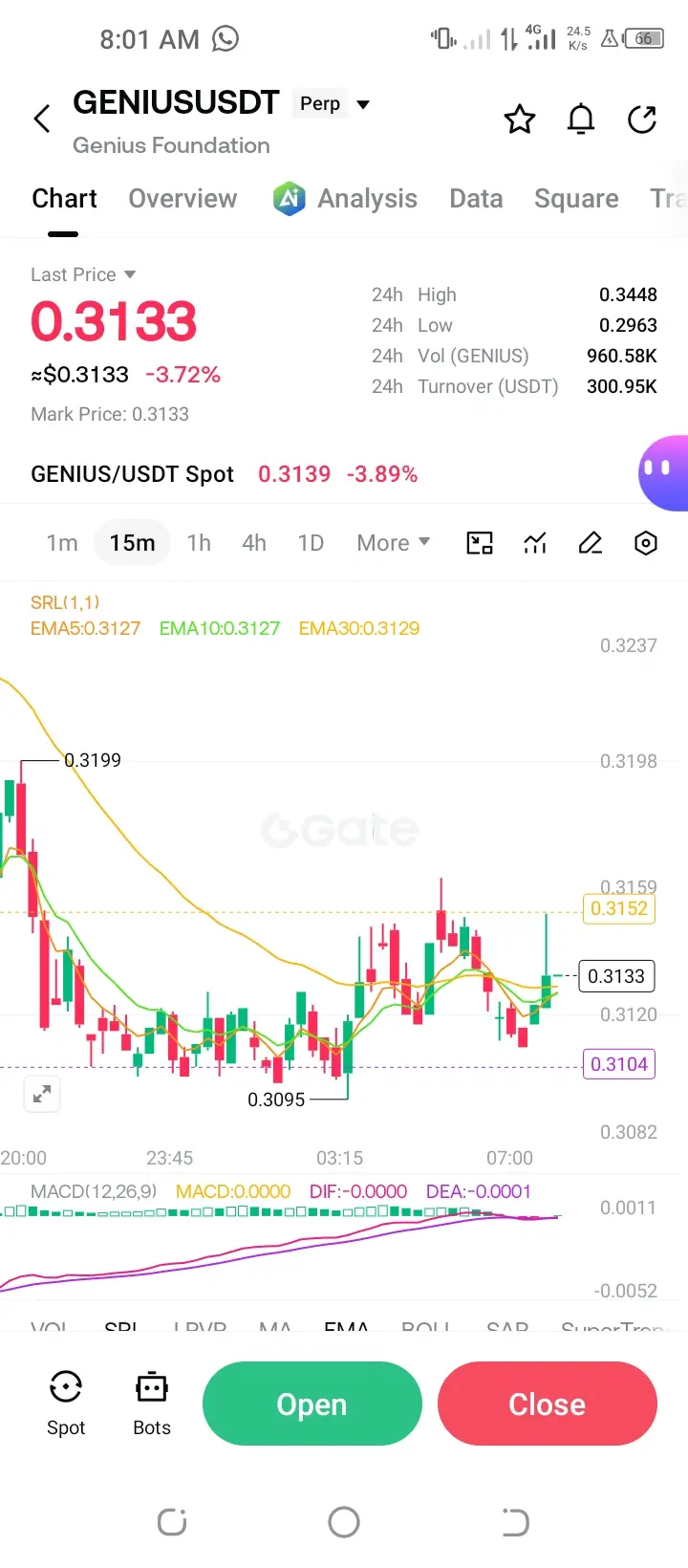
EMA10 and EMA30 are both capping the price from above, and MACD is also bearish. If it cannot break above 0.315, go short with the trend, targeting around 0.31.
View Original
Cryptoluter
$GENIUS /USDT Perp – "Failed Recovery – Short"**
**Trading Plan Short $GENIUS
Entry: 0.314 – 0.316
SL: 0.320
TP1: 0.310
TP2: 0.307
GENIUS is down -3.72% at 0.3133, rejected below the EMA10 (0.3127) and EMA30 (0.3129). MACD is bearish. The 0.3152 yellow line is resistance. TP targets the 0.3095 low.
repost-content-media
  • Reward
  • Comment
  • Repost
  • Share
Seeing a large transfer into an exchange and rushing to copy the trade—I’ve been burned by that before. Later I realized they might have been hedging, not building a position at all. You think they’re buying the dip, but they’re actually locking in risk—the logic is completely reversed.
So my first reaction isn’t to rush in, but to dig into the address. If you can’t distinguish between copying a position-building trade and a hedge, you’re better off not copying it.
Q&A:
How do you tell?
Look at lending and funding rates, and whether the funds went into a cold wallet address.
That said, L2s are
View Original
  • Reward
  • 1
  • Repost
  • Share
GateUser-4736b422:
have much to do with where the money is flowing, so don’t take it too seriously.
That last trade counts as another expensive lesson. It was a long-tail asset to begin with, and the order-book depth was obviously shallow, but I still got heated when I saw the price rising and went all in at once. Slippage alone ate up several points, and my entry price ended up nearly through the roof above what I had in mind. I had even reminded myself beforehand to split orders, keep the size limited, and wait a little longer. Going all in within a minute was plainly just handing money to the market makers.
Put bluntly, it’s even easier to get carried away by the pace of placing orders th
RWA0.16%
View Original
  • Reward
  • Comment
  • Repost
  • Share
A whale that had been inactive for 11 months suddenly transferred 9,000 ETH to Cumberland. Along with the 50,000 ETH it had previously deposited with FalconX, the total is more than 2 billion USD—market pressure is here.
ETH1.11%
View Original
CoinNetwork
Crypto.com news: According to monitoring of early issuance by A, a whale transferred 9,000 ETH (worth about $17.19 million) to Cumberland after being dormant for 11 months, possibly for over-the-counter sales. The wallet deposited about 50 thousand ETH (worth about $50k) to FalconX via 13 transactions.
  • Reward
  • Comment
  • Repost
  • Share
Just saw a liquidation case: the oracle’s quote got stuck for a few seconds, and someone’s position was wiped out directly. Honestly, price-feed delay really isn’t a small issue—on-chain liquidations are at the millisecond level. If the quote slows down, your collateral could be sold off at a floor price. I noticed this myself when I was doing interactions earlier: some protocols use oracle update intervals that are too long, and when you hit violent market swings, it’s just awful.
Lately, with all these new L1/L2s launching incentive programs to pull in TVL, old users have been complaining ab
View Original
  • Reward
  • Comment
  • Repost
  • Share
Doing token airdrop interaction has become more and more of a hassle lately 😅. I clearly know that many projects are just here to farm gas fees, but seeing other people share their screenshots still makes me want to rush in. Now I’ve learned my lesson: first figure out the costs, then study the sybil rules. I’m too lazy to mess with those fancy batch operations. After all, in the chain game crash wave, how many studios got buried—once the inflation model ran and didn’t work, the coin price just spiraled down to zero. Better to do some honest basic interactions. Even if you miss a few big ones
View Original
  • Reward
  • Comment
  • Repost
  • Share
Just saw a DAO proposal—those addresses with the largest voting weight are all early whales. They claim it’s decentralized, but in practice the direction of the proposal is basically being driven by them. I looked through the on-chain records: this group has also coordinated and voted together in other projects, and nobody cared about the opinions of small retail holders. It’s the same as when blockchain games were all the rage—once the inflation model gets out of balance, the studio dumps and runs, and the remaining retail traders end up holding the bag. The token price then spirals straight
View Original
  • Reward
  • Comment
  • Repost
  • Share
I took a look at the task platform recently, and it really left me a bit dazed. In the past, farming airdrops meant just going in, doing a couple interactions, and that was it. Now it’s different—leaving fingerprints, doing tasks to earn points. Even the rating system gives you different tiers, as if it’s trying to make sure you’re not flagged as a sybil. Honestly, it’s pretty exhausting. It feels like I’m clocking in for work. These new narratives around modular blockchains—developers talk about them with so much passion—but as a user, all I want to ask is: what does this have to do with me?
View Original
  • Reward
  • Comment
  • Repost
  • Share
Recently, it’s more interesting to watch how project teams spend money than to just read all the hype. Some teams post milestones every day, but if you dig into treasury spending, almost all of it goes into marketing and airdrops—product iteration moves so slowly it feels like a snail. On the other hand, some low-key teams drop an update every few months, their on-chain data is steady and solid, and their spending breakdown is at least semi-public, which makes people feel more at ease.
In plain terms, when it comes to milestones, I’d rather see whether they’re in a “waiting-for-confirmation” p
View Original
  • Reward
  • Comment
  • Repost
  • Share
I just saw a post saying, “This run is being propped up by ETF fund flows, and it’s linked to US stock risk appetite.” Honestly, it made me a bit itchy and I almost wanted to add to my position. But after cooling down, I realized that before chasing an uptrend, I always ask myself: am I seeing some real information, or am I just being driven by emotions? Especially now, when public opinion is interpreting crypto together with US stocks, it feels even more confusing. 😅
Forget it—I never really believed in any “must go up” logic anyway, and I’m more willing to accept randomness. I’ll leave it a
View Original
  • Reward
  • Comment
  • Repost
  • Share
What does time value really do—does it help the buyer or the seller? Honestly, I’ve often gotten pulled into it, too. But after observing a few times, it feels like the options seller earns by “outlasting” time, while the buyer is basically betting that a passing trend will last for a while. Recently, when I looked at those testnet incentives and points expectations, there are always people shouting that mainnet is about to release tokens—then they rush in to buy calls. The result is that the time loss is gone in the blink of an eye. I’d rather sell a bit of options slowly and benefit from the
View Original
  • Reward
  • Comment
  • Repost
  • Share
I just shut down a few small orders’ grids and switched to DCA. Honestly, going all-in like that makes me not sleep well at night—I’d watch the price bounce around all the time, and the anxiety would be off the charts. Anyway, I’m the type of person who “feels lighter when I lower my expectations.” Grid trading or DCA might earn more slowly, but at least I don’t have to get up in the middle of the night to check the charts; it just feels more solid.
Recently I’ve been seeing a lot of people hype up AI Agents for automatic trading—everyone’s saying miraculous things: fully automated on-chain in
View Original
  • Reward
  • Comment
  • Repost
  • Share
Let’s stop with this whole “cutting losses” thing—it’s really like a breakup: the longer you drag it out, the more it hurts. Better to admit you’re in the red sooner and get it over with; you even save the interest. Last time, on a certain meme coin, I had the same experience—I’d already seen what old players said, that you shouldn’t take the last baton, but I hesitated anyway. In the end, I held on for two more days and lost even more. Looking back, if I’d cut it earlier, I would’ve paid less tuition. What about you—have you ever been stuck like this and only made up your mind after a lot of
MEME0.94%
View Original
  • Reward
  • Comment
  • Repost
  • Share
It’s pretty interesting—recently I’ve been looking at DAO governance proposals and realized that “voting” isn’t as simple as one-click approve. I used to think casting a vote simply meant supporting the project’s development, but later I got burned by a few proposals. On the surface they talk about “optimizing the ecosystem,” but in reality it’s all about unlocking privileges for big holders or deliberately diluting retail participants’ voting weight. In plain terms, behind every proposal there’s an incentive distribution and a power structure; with one vote, you might end up helping someone e
View Original
  • Reward
  • Comment
  • Repost
  • Share
Just looked into what modular blockchains really change for regular users like us… honestly, after reading through a bunch of documentation, it feels like the underlying architecture really is changing, but for someone like me who only plays with interactions and farms airdrops, the experience isn’t that obvious yet. Cross-chain still requires switching one by one, and the interfaces aren’t unified—sometimes, to save on gas fees, you even have to manually choose the data availability (DA) layer, which is really annoying.
For the re-staking logic, shared security sounds pretty great, but once y
View Original
  • Reward
  • Comment
  • Repost
  • Share
I’ve been a bit anxious lately because a few testnet projects keep pulling me in. I’ve done a bunch of interactions—my points keep going up—but in my heart I never feel fully sure. Nobody can say for certain whether the mainnet will actually issue tokens. Anyway, I’ve learned my lesson now: don’t spend too much time on those badges and identities, because when you calculate the total cost, it may not be worth it. Social mining sounds nice, but once it gets competitive it’s really exhausting. I’d rather miss out on a few than end up being swept by some witch one day and end up wasting my time.
View Original
  • Reward
  • Comment
  • Repost
  • Share
Honestly, setting a stop-loss is pretty much like a breakup. The longer you drag it out, the less willing you are to admit it. You keep thinking, “Wait a little more, maybe it’ll come back,” but the interest just keeps compounding, and watching the account hurts. Not long ago, I had a position—deep down I knew something was off, but I still wanted to wait for a rebound before exiting. In the end, I held on until I had to cut. Then I got hit by both fees and slippage. When I added it all up, it was still worse than just admitting the loss at the start.
Recently I’ve been seeing those big on-cha
View Original
  • Reward
  • Comment
  • Repost
  • Share
I just woke up and checked the market for a bit, and then I remembered that move from yesterday: I had already set the take-profit, but when I changed hands I ended up holding one more contract—then when it pulled back, I dumped everything back out. I can’t hold spot because I always want to sell at a higher price; I get liquidated on futures because I always want to hold through the drawdown. Actually, position management boils down to one sentence: you know how much you’re going to lose, and how much you’ll make is down to luck. Lately the US dollar index and risk assets have been wobbling t
USIDX0.02%
View Original
  • Reward
  • Comment
  • Repost
  • Share
To be honest, lately switching between the mainnet and Layer2 has been giving me a headache. When gas is low, I feel like the mainnet is pretty attractive, but the moment I run into those kinds of anomalies with big on-chain transfers, I can’t help but want to jump in and follow along. And it ends up being a wasted trip a few times.
Later I found that what gets hyped as “smart money” is actually just luck—either they’re having a good run or they happened to catch the moment. When I follow the rhythm, it’s much easier for me to fall into traps.
Now I’m more inclined to use some Layer2 networks
View Original
  • Reward
  • Comment
  • Repost
  • Share
Scrolling through discussions about re-staking a bit in the middle of the night just makes me more and more anxious the longer I read.
Honestly, when people are stacking returns, they often treat “shared security” as part of the illusion too.
To me, it’s more like calculating costs, mapping interaction paths, and repeatedly checking witch risk, rather than blindly chasing the “high returns” narrative.
Over on the trending side, AI agents are being hyped to the skies—automated trading that runs through various on-chain routes—but the security details are a real headache to scrutinize.
A
View Original
  • Reward
  • Comment
  • Repost
  • Share
  • Pinned