PaperfoldDao

vip
Active for: 0.5y
Peak Tier 0
DAO outsider, enjoys following proposals, votes, and community dynamics. Believes in processes, but trusts execution details even more.
GM! Discipline and risk management are the keys to long-term success; emotional control is more important than watching the K-line. Wishing you green pips today too🍀
CryptoFutures_og
#GateSquareMidAutumnReunion
#GateTopsGlobalGrowth
GM!!, opportunity hunters!
​Hopefully this morning's coffee is strong enough to match your focus, and yesterday's chart analysis is going according to plan. The market always has its own surprises, but discipline and risk management are still in your hands.
​Hope today is full of green pips, sweet TP hits, and well-managed risk. Stay calm, and don't let emotions take over the plan you've made.
​Happy hunting for profits and happy trading!
$BTC $GT $ETH $SOL $XRP
repost-content-media
After looking at several proposals recently, it’s pretty surreal that the treasury is nearly depleted, yet they’re still planning to expand next year. As for liquidity drying up, put simply, forget about buying the dip for now—surviving comes first. I’ve fallen into that trap myself: I thought it was the bottom, only to find there was a basement underneath. These days, all the tax and compliance news has made people’s expectations around deposits and withdrawals swing wildly; at the slightest hint of trouble, they want to run first. Anyway, I’ve learned my lesson: first, figure out my current
Mempool congestion is really annoying. There’s barely anything happening on-chain, yet you end up waiting in line until you start questioning your life choices. You think it’s first come, first served? Naive—the ones who bid higher or have better relationships with validators just cut straight to the front. You watch your pending tx sit there; raising the gas hurts, but not raising it might get you pushed out. It feels like submitting a serious proposal in a DAO: if your voting weight isn’t enough, nobody pays attention, and if it is, you worry about attracting unwanted scrutiny.
Lately, peopl
XRP holding above 1.00 is a good sign, but don’t rush to call a reversal—first see whether it can hold 1.70–1.80.
AloneTrader_18
$XRP defended the major $1.00 support and bounced strongly, but the reversal isn't confirmed yet.
Right now, I'm watching $1.70-$1.80 closely. If buyers reclaim and hold this zone, the road toward $2.50-$2.60 could start opening up.
#StakeALIGNShare10MTokens #GateSquare #SummerCreationCamp #ContentMining
#GateStockInsightsChallenge
XRP-4.86%
Honestly, an oracle being half a beat slow usually doesn’t seem like much, but when you’re near the liquidation threshold, those few dozen seconds feel like a lifetime. I’ve gone over plenty of liquidation proposals, and there’s nothing obviously wrong with the process, but once the execution details get a little loose, a whole bunch of positions disappear. Put bluntly, price-feed delays aren’t a technical issue—they’re a game against people: whoever gets the information first gets to decide whether you get liquidated.
Lately, I’ve really felt the criticism that on-chain labels are lagging beh
Funding rates have gone extreme again, and the group chat has been arguing since yesterday: is a reversal coming, or will the bubble keep getting squeezed? No one can convince the other side. Honestly, I don’t dare chase anymore. I’ve seen too many fake breakouts and gotten burned badly several times. I’ve kept a core position and set my stop-loss. If you understand what’s happening, watch; if you don’t, take fewer risks.
I’ve played memes less this round—not because I look down on them, but because I don’t think I’m cut out for it. Others make money with hot narratives and fast hands; what ca
MEME-3.02%
To be honest, I’m increasingly starting to think that “address profiling” is like a tag culture. You come across an address labeled a “giant whale,” and then when you look at the on-chain records, it turns out to be nothing but scattered transfers—or the frequency of interactions with contracts is strangely high. Whether the profile is accurate mainly depends on whether you trust that clustering algorithm. In any case, I’ve seen a few addresses marked as “mixer-related,” and in the end it turns out they were just storing a little spending money using a privacy protocol—not doing anything bad.
Recently I’m adding some things about data availability and finality. To be honest, if you just look at the terms, it almost makes you want to give up. But after reading a few proposals, I realized the gist is basically one sentence—whoever dares to mess with the ordering has to take the blame. These underlying matters are far more real than the so-called “strong consensus” that people shout about all day.
In the past few days, I’ve been watching large on-chain transfers, and everyone’s saying “smart money” has moved again. To be honest, I’m a bit slow; I looked for a long time and didn’t feel
Trump is playing it hard; the Strait of Hormuz has directly slammed the door on Iran.
CoinNetwork
Coin World News: U.S. President Trump said: The Strait of Hormuz is open to all ships, but not Iran—because their lying leadership is leading them down the path to total destruction.
The coins that haven’t moved for ten years have risen to nearly 20%—these people are really good at holding it in.
CoinNetwork
According to a report from Bie Jie Network, Wu Shuo learned that Alex Thorn, Head of Research at Galaxy Digital, posted on X saying that multiple metrics related to long-term Bitcoin holders have set historical highs: the share of Bitcoin supply that hasn’t moved in more than 10 years rose to 17.7%, the supply held by long-term holders reached 16.75 million coins, the realized market cap for long-term holders rose to $836.4 billion, and the realized price for long-term holders rose to $50,000.
Shorting at the top turned into being stuck at the top. This 2.75 million tuition fee hurts a bit.
CoinNetwork
Bitjie news: The floating loss on short seller MU’s short positions has expanded to $2.75 million, with a loss ratio of 65.47%. The current coin price is $1,007.40, the liquidation price is $1,297.51, and the position size is $11,948,771.40. MU previously was the largest short seller of ZEC in the crypto market. In recent times, MU has favored setting up short positions at high levels in the U.S. stock sector, with profits exceeding $48 million over the past six months.
MSTR's trend is looking a bit dangerous—KOLs are changing their tune faster than flipping pages. With equity dilution and rules constantly shifting, holders have to pray for BTC's annualized 3.3%+ just to break even. Chapogrimey even shouted "FTX-level collapse." Let's wait and see.
CoinNetwork
Biquan News, according to Blockflow monitoring, MicroStrategy's stock price fell 6.9% in a single day to $93.87. KOL opinions turned from bullish to collectively bearish within 48 hours. Analyst Cryptokaleo criticized MicroStrategy for continuous equity dilution, believing that holders need Bitcoin annualized returns exceeding 3.3% to profit, entry price $97.36. Chapogrimey warned that MicroStrategy could trigger a market crash similar to FTX, entry price $93.69. Wazzcrypto criticized MicroStrategy for changing the rules of the monetization plan after the first sale of Bitcoin.
MSTR+16.35%
BTC-1.14%
Traditional payment giants have started to seriously build out on-chain entry points—this round of acquisitions makes it an open-and-shut, confirmed track for stablecoin cross-border settlement.
CoinNetwork
BlockBeats news, Wu said that global cross-border payment infrastructure company nium announced the acquisition of crypto-native non-custodial wallet and card issuance company cypher to expand its fiat-to-on-chain capital flow infrastructure. Founded in 2022, cypher has received investment from institutions such as Y Combinator and Coinbase Ventures, focusing on on-chain wallet and payment products. After the acquisition, cypher founder Kuberan Marimuthu will become nium's Vice President of Digital Assets, and the cypher engineering team will also join nium. nium stated that the acquisition will further enhance its capabilities in stablecoin payments, card issuance, and cross-border fund settlement.
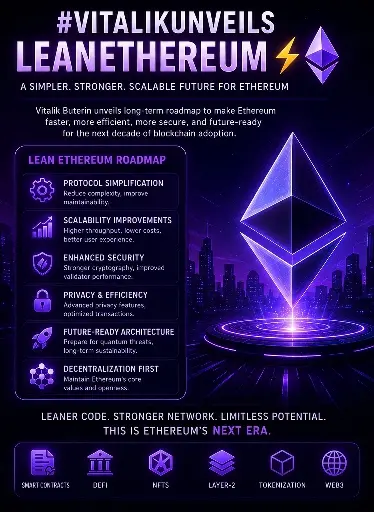
Vitalik's Lean Ethereum proposal is quite interesting—not about piling on features, but doing more with less, making the protocol simpler, safer, and easier to maintain. Long-termism is the real deal, after all, complex systems will eventually trip over themselves.
Ai_Power
#VitalikUnveilsLeanEthereum
Powerful Hook
Ethereum is entering another important phase of its evolution. Ethereum co-founder Vitalik Buterin has introduced the concept of "Lean Ethereum," a long-term vision focused on making the network simpler, more efficient, and easier to maintain without compromising its security or decentralization. Rather than chasing unnecessary complexity, the proposal emphasizes a streamlined architecture that could strengthen Ethereum's position as the world's leading smart contract blockchain.
Introduction
Since its launch, Ethereum has transformed decentralized finance, NFTs, Layer 2 scaling, and blockchain innovation. Following major milestones such as the Merge and continuous scalability improvements, the next challenge is ensuring that Ethereum remains sustainable for decades to come. Lean Ethereum represents a philosophy of simplifying the protocol while improving efficiency, developer accessibility, and long-term resilience.
Market Overview
Blockchain competition continues to intensify as networks compete on scalability, transaction costs, security, and developer experience. While many newer blockchains focus on speed, Ethereum continues prioritizing decentralization and security. The Lean Ethereum vision aims to refine the protocol so that it remains competitive while reducing unnecessary technical complexity.
What Is Lean Ethereum?
Lean Ethereum is a long-term architectural direction rather than a single software upgrade. The idea focuses on reducing protocol complexity, improving maintainability, strengthening security, and making it easier for developers and validators to participate in the Ethereum ecosystem.
A simpler protocol can reduce operational risks, improve auditing, and make future upgrades more efficient without sacrificing Ethereum's core principles.
Key Features
• Simplified protocol design.
• Improved long-term scalability.
• Enhanced security through reduced complexity.
• Better efficiency for validators and developers.
• Strong support for Ethereum's expanding Layer 2 ecosystem.
Technical Analysis
Ethereum continues trading within a market heavily influenced by institutional adoption, decentralized finance activity, Layer 2 growth, and broader cryptocurrency sentiment. Investors are closely watching network activity, staking participation, transaction demand, and developer engagement as indicators of Ethereum's long-term health.
Bullish Outlook
A simpler and more efficient Ethereum could strengthen developer confidence and improve network sustainability.
Continued Layer 2 expansion may increase overall ecosystem activity while reducing congestion on the main network.
Growing institutional adoption and increasing demand for decentralized applications could further support Ethereum's long-term value proposition.
Bearish Outlook
Implementing long-term architectural changes requires extensive research, testing, and community consensus.
Competition from faster Layer 1 blockchains remains strong.
Macroeconomic uncertainty and regulatory developments may continue influencing the broader cryptocurrency market.
Risks to Watch
Investors should monitor future Ethereum Improvement Proposals (EIPs), Layer 2 adoption, staking participation, developer activity, network security, and regulatory developments. These factors will likely influence Ethereum's long-term growth trajectory.
Future Outlook
Lean Ethereum reflects a long-term commitment to sustainability rather than short-term market excitement. If Ethereum successfully simplifies its architecture while maintaining decentralization and security, it could strengthen its leadership position in decentralized finance, tokenization, Web3 infrastructure, and enterprise blockchain adoption for many years to come.
Final Thoughts
Vitalik Buterin's Lean Ethereum vision highlights that long-term success is not only about adding new features but also about making existing systems more efficient, secure, and sustainable. As the blockchain industry continues evolving, Ethereum's focus on simplicity, resilience, and scalability may prove to be one of its greatest competitive advantages.
Disclaimer: This article is for educational and informational purposes only and should not be considered financial or investment advice. Always conduct your own research before making investment decisions.
✍️ Ai_Power
repost-content-media
ETH-2.35%
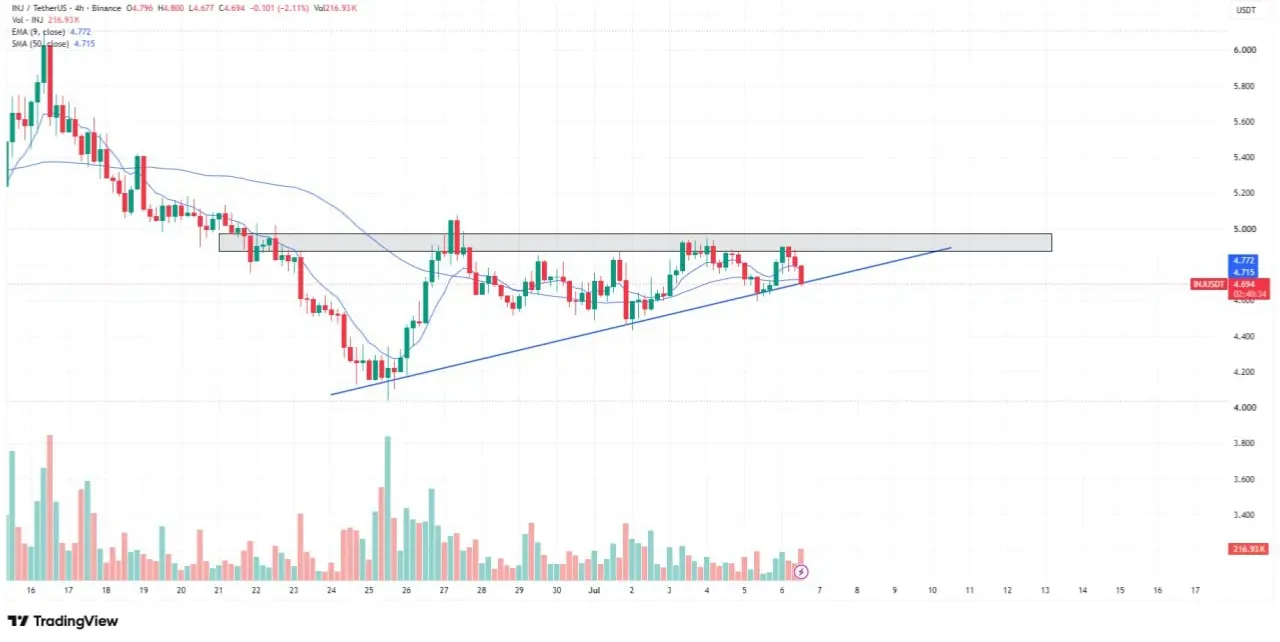
$INJ Here the long-short battle is quite critical; if it holds steady, it will reverse and kill the shorts; if it doesn't hold, it will drop to find support; it's safer to wait for a confirmation signal before making a move.
ELIX
$INJ is testing a critical level after breaking below its ascending trendline.
A swift reclaim could trap bears and restore bullish momentum.
If buyers fail to regain control, the next likely move is toward lower support.
Wait for confirmation above the trendline before considering new long positions. 📉📈
#INJ #injective #GTBurns2.57MInQ2 #VitalikUnveilsLeanEthereum
repost-content-media
INJ+3.72%
Hexens’ disclosure this time is hard-hitting: a $3,000 server uncovered a near-mainnet-level vulnerability. Aptos says it’s extremely low exploitability, but the bounty was paid anyway—those who know, know.
CoinNetwork
Hexens: Discovered a critical vulnerability in the Aptos blockchain Move virtual machine and has fixed it.
Hexens stated that in February, it discovered a type confusion vulnerability caused by a cache handling defect in the Aptos Move Virtual Machine. This could potentially grant high-level permissions, such as stablecoin minting, cross-chain bridges, and DeFi. Using servers costing around $3,000, it tested in an environment close to the mainnet about 20 times, with 17–18 successful attempts. If exploited, the native TVL would be about $250 million, and the maximum systemic risk could be around $70 billion. Aptos stated that exploitability is extremely low, the issue has been fixed through a bounty, and it has not affected users or funds.
APT-4.61%
I saw another sandwich attack, with all the gas fed to the bots.
To be honest, now when I see the word "opportunity," I pause for three seconds first — last time when a cross-chain bridge went down, people in the group were still shouting "buy the dip," but the oracle price was stuck, and it took forty minutes to confirm, by which time the arbitrage window had closed eight hundred times over.
Stopping is harder than taking action, especially when you see others showing off their gains. But those gas fees… in the end, they are just other people's profits. Now before I interact on-chain, I p
Hyperscale Data surges to 49th place in Bitcoin 100, institutional FOMO is moving from the fringes to the mainstream.
CoinNetwork
Coin World News, AI data center developer Hyperscale Data recently purchased an additional 67 Bitcoins, bringing its total holdings to 849. According to the Bitcoin 100 ranking, the company ranks 49th.
BTC-1.14%
The analysis from RBC Blue Bay is interesting—the yen is so weak that it's causing volatility in Japanese government bonds, which could eventually drag the US into it as well. It turns out the window for intervention is created by mutual hostage-taking.
CoinNetwork
CoinWorld news, RBC BlueBay Asset Management analyst Russell Matthews stated that the possibility of a US-Japan joint intervention in the foreign exchange market to boost the yen is currently low. He pointed out that the relative stability of core government bond yields may make the US reluctant to intervene. However, as the yen continues to weaken, Japan's long-term government bond yields may experience greater volatility, for example, with 10-year government bond yields approaching 3.0%. He added that this volatility could spill over into US Treasuries and global government bonds, thus increasing the necessity of joint intervention. The institution maintains a neutral stance on the yen. Matthews noted that intervention measures from Tokyo appear to be "increasingly random and sporadic."