ApeWithHomework

vip
Age 0.3 Year
Peak Tier 0
I ape, but only after reading docs and watching wallets. Not a maxi—just trying to survive the semester of markets.
Wahidi appears to break death rumors, adding new variables to the Middle East situation.
View Original
CoinNetwork
CoinWorld News: The commander-in-chief of Iran's Revolutionary Guard Corps appeared in Tehran. On the eve of the funeral for the late Supreme Leader Ali Khamenei, Ahmad Vahidi, the commander-in-chief of Iran's Islamic Revolutionary Guard Corps who was once rumored to have been killed in an attack, appeared in the capital Tehran on the evening of the 2nd.
Photos released by the office of Iran's Supreme Leader show that at a small religious ceremony held in a mourning hall next to Khamenei's residence in central Tehran, Vahidi sat beside Khamenei's coffin. In front of the coffin were red tulips, and paper butterflies hung above it. The Associated Press reported that Vahidi last appeared in public on February 8, a few weeks before the outbreak of the war in Iran.
Vahidi was born in 1958. After the victory of the 1979 Iranian Islamic Revolution, he joined the Revolutionary Guard Corps and became the first commander of the Quds Force.
  • Reward
  • Comment
  • Repost
  • Share
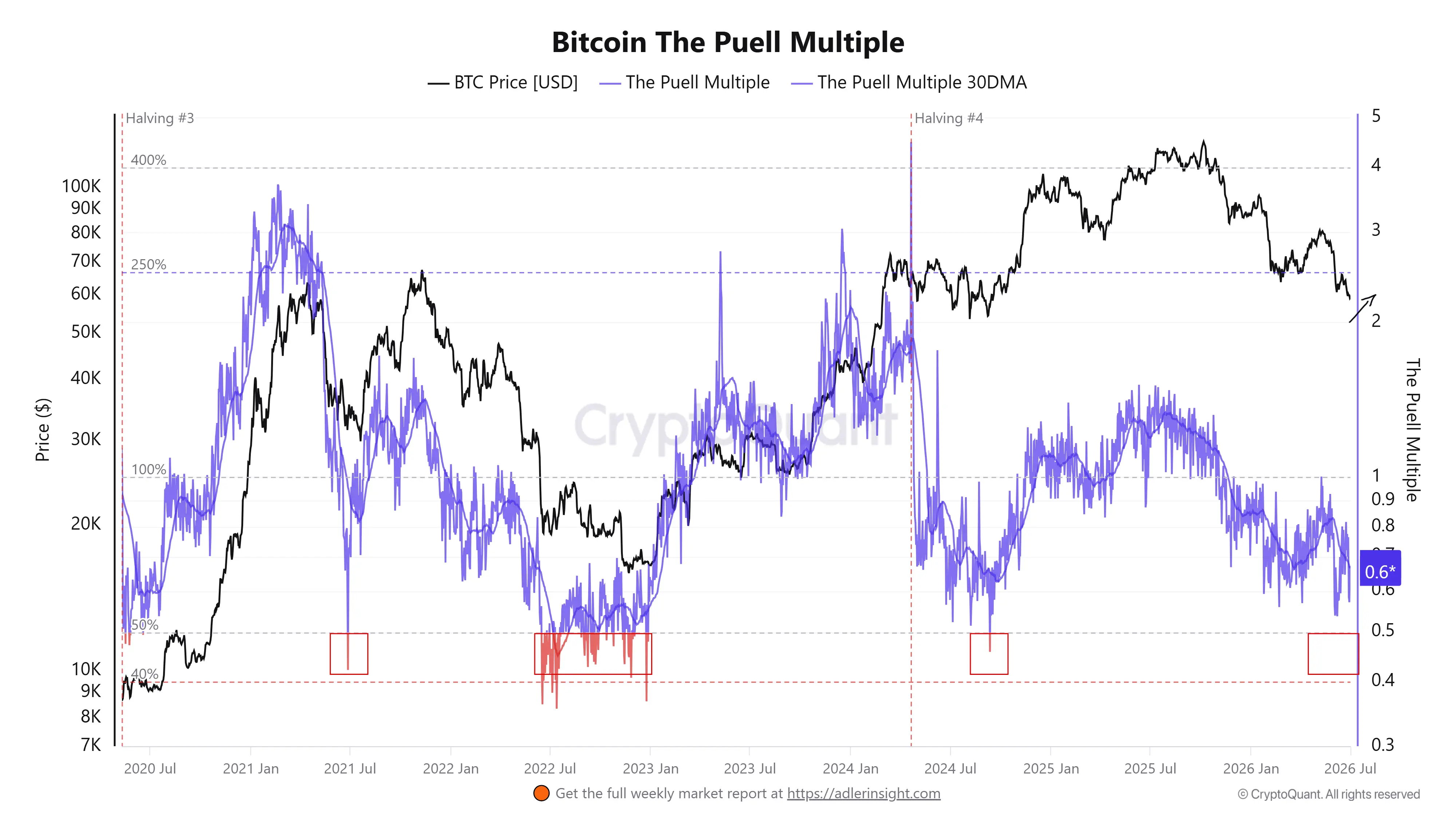
Every time the Puell Multiple falls to around 0.5-0.6, it may not pinpoint the exact bottom, but miners do enter a hard-stubborn “hold-the-line” stage—selling pressure gets compressed to the absolute limit. After the halving, daily new supply has already been cut in half; now miners are keeping the market pinned and refusing to sell. If demand on the ETF side stays steady, the supply-demand balance is starting to tip. This isn’t telling you to go all in—just that this phase is worth watching closely.
View Original
CryptoZeno
Bitcoin Miners Continue to Hold Back Distribution as Puell Multiple Revisits Historical Accumulation Zone
The latest reading of the Puell Multiple has declined to around 0.6, placing the indicator back inside a zone that has historically coincided with periods of miner revenue compression. From an on-chain perspective, this reflects that miners are earning significantly less in USD relative to the annual average, reducing the incentive to aggressively distribute newly mined BTC into the market.
Looking across previous cycles, every major drop of the Puell Multiple below 0.5–0.6 has appeared during phases of market stress or prolonged consolidation. While these signals have not identified the exact bottom, they have consistently marked periods where selling pressure from miners became structurally weaker. The current reading follows the same pattern, suggesting that miner-driven supply is becoming increasingly constrained despite recent price weakness.
This dynamic becomes more meaningful when viewed alongside Bitcoin post-halving supply structure. Following the 2024 halving, daily issuance has already been cut in half, meaning any further reduction in miner selling amplifies the ongoing supply contraction. If spot demand remains stable or strengthens through ETF inflows and institutional allocation the market could gradually transition from a distribution-driven environment toward one characterized by tightening available supply.
The Puell Multiple should not be interpreted as a standalone buy signal. Instead, it serves as a valuable macro on-chain indicator that measures the economic condition of Bitcoin miners. At current levels, it indicates that miner capitulation risk is increasing while structural sell-side pressure continues to fade. Historically, these conditions have often developed before stronger medium- to long-term price expansions, making the coming weeks particularly important for confirming whether Bitcoin is entering another supply-driven accumulation phase.
repost-content-media
  • Reward
  • Comment
  • Repost
  • Share
France wants to be Europe’s crypto hub? The Netherlands and Germany issue licenses faster—regulatory arbitrage is sweeter than being first with regulation—and the 40% who haven’t applied yet are probably already done the math.
View Original
WuSaidBlockchainW
MiCA major reshuffle: About 40% of French crypto institutions have not applied for licenses, with only 230 licenses issued across the EU.
The MiCA licensing system is fully implemented, and the EU crypto industry has entered a new phase of reshuffling. France's AMF estimates that about 40% of registered crypto service providers have not applied for licenses, with some withdrawing, seeking partners, or ceasing operations. Currently, the EU has issued approximately 230 MiCA licenses, with 56 in Germany, 26 in the Netherlands, and 21 in France. France, aiming to become a European hub by being a regulatory first-mover, has ultimately been overtaken by jurisdictions with faster, clearer rules. Industry insiders say MiCA enhances resilience but reduces market diversity, with the impact being particularly pronounced on small enterprises.
  • Reward
  • Comment
  • Repost
  • Share
Will annual expenses be reduced to 5% after 2030? Will Devcon shrink? Will PSE be independently winding down?
Is the Ethereum Foundation's wave of slimming down a proactive change or pressure-driven?
ETH5.38%
View Original
WuSaidBlockchainW
Wu Shuo learned that Ethereum founder Vitalik Buterin posted that the Ethereum Foundation (EF) will cut its budget by about 40% this year, shifting from an average annual expenditure of about 15% of remaining funds before 2026 to a long-term donation-based organization, aiming to reduce annual spending to about 5% after 2030. Vitalik stated that EF will not lower the goals of the Ethereum protocol but will make several trade-offs, including shifting more from a "redundant" to a "specialized" multi-client model, exploring AI-assisted formal verification, gradually winding down PSE as an independent unit, and that Devcon may become smaller and more budget-conscious in the future. EF's organizational work will also be scaled back.
  • Reward
  • Comment
  • Repost
  • Share
Lido's recent bridge withdrawal verification is quite pragmatic, not forcing multi-chain narratives, but focusing resources on the core battlefield. The governance team is finally starting to do the math.
View Original
CoinNetwork
CryptoWorld News reports that Wu has learned, according to an official post by Lido, that based on the results of the Lido DAO snapshot vote, Lido has revoked the official recognized status of the wsteth bridge endpoints on nine networks, namely zkSync Era, Mode, Scroll, Mantle, Swell, Zircuit, Soneium, Polygon POS, and Lisk. Lido said that this decision is a governance-level resource adjustment; it will not disable bridge contracts, will not invalidate tokens, and will not affect users’ ability to continue holding, transferring, or bridging wsteth back to Ethereum. Lido will subsequently stop active monitoring of wsteth on the aforementioned networks, along with market support and ecosystem development.
  • Reward
  • Comment
  • Repost
  • Share
The U.S. Department of Justice moved quickly this time; behind the 70-plus victims, there are likely more who haven't reported it. On-chain tracking and cross-border law enforcement have become the new normal. Project teams will have to think twice before trying to run in the future.
View Original
CoinNetwork
CoinWorld News reports that the U.S. Department of Justice has seized approximately $9 million worth of USDT assets related to a pig-butchering crypto scam network, which affected over 70 victims within the United States and illegally transferred millions of dollars.
  • Reward
  • Comment
  • Repost
  • Share
The Middle East powder keg has added new fuel this time Iran has taken a tough stance
View Original
CoinNetwork
CryptoWorld News reports that on the evening of June 11 local time, the Iranian Ministry of Defense issued a statement saying that Iran's defense industry personnel will continue to fully support the Iranian armed forces and enhance deterrence. Currently, the combat readiness, operational capability, and defensive strength of Iran's armed forces are stronger than ever before. Any misjudgment or attack targeting Iran's national security and territorial integrity will be met with a resolute counterattack, and the consequences will far exceed the enemy's expectations.
  • Reward
  • Comment
  • Repost
  • Share
The restrictions on V1 have been removed, and now both sides can hold assets to build the market. However, setting the borrowing limit to zero is quite conservative—first let people deposit money, and then gradually grant more permission. With this move, Curve is testing the market’s patience.
CRV-0.43%
View Original
CoinNetwork
Curve Finance launches LlamaLend V2 upgrade, supporting isolated lending markets
Curve Finance launches LlamaLend V2 on Optimism, adding isolated lending markets and non-CRVUSD lending pairs, with the first phase upgrade already initiated, and potentially launching on Ethereum mainnet within the year.
V2 removes V1 restrictions, allowing markets to be created on both sides of lending pairs, subject to governance approval.
Provides ETH-WSTETH, WSTETH-USDC, and WBTC-USDC markets, with an initial borrowing limit of zero.
Introduces LP collateral, depositing Curve LP tokens to earn trading fees.
  • Reward
  • Comment
  • Repost
  • Share
Gate opened this SpaceX subscription channel in time: there’s a demand of $2,500,000,000,000, but the secondary market is using AI to slash valuations—division has begun.
SPCX2.14%
View Original
Furan86999
SpaceX faces a frenzy of buying, but the AI industry chain is beginning to "bubble burst"?
In the past 24 hours, a very interesting phenomenon has appeared in the U.S. stock market:
On one side, SpaceX's IPO continues to ignite global capital enthusiasm. According to the latest news from Reuters, demand for SpaceX's IPO subscription has exceeded $250 billion, about four times the fundraising scale of $75 billion, making it one of the most watched tech IPOs in recent years. The market generally expects its valuation to approach $1.77 trillion, and the subscription enthusiasm is still heating up.
But on the other side, the AI industry chain has encountered a sudden valuation correction.
SemiAnalysis's latest research report points out that the commercialization progress of Co-Packaged Optics (CPO), which the market previously placed high hopes on, may be delayed, and the upgrade pace of some AI data center power architectures is also below expectations. After the news broke, the optical module and AI network infrastructure sectors experienced collective sell-offs. Companies like AAOI, Marvell, Coherent, and others saw declines of over 10% during trading, and AI concept stocks like AMD also came under pressure.
From a trader’s perspective, this actually reflects the most authentic state of the current AI market:
Capital is still crazily chasing the top-tier AI narratives.
Super unicorns like SpaceX, OpenAI, Anthropic are still the core targets of capital pursuit, with many institutions willing to prepay for the imagination space of the next ten years. The subscription scale for SpaceX has risen from about $150 billion a few days ago to over $250 billion, which is the most direct proof.
But for the secondary market, the story is no longer enough.
The market is beginning to reassess the actual landing speed of the AI industry chain, order fulfillment capability, and future profit cycles. If commercialization progress falls below expectations, valuation corrections will come very quickly.
In simple terms:
The primary market is crazily pricing for the "future";
The secondary market is starting to reprice the "reality."
For crypto investors, this situation is actually not unfamiliar. Just like in past bull markets, BTC and leading assets kept hitting new highs, but many concept coins had already entered the value reversion stage.
The AI track may be experiencing the same process.
Truly barrier-rich, cash-flowing, industry-leading companies are still attracting global capital, while those segments of the industry chain driven by expectations are undergoing the market’s harshest test.
In the coming months, the differentiation within the AI sector may only become more obvious. #Gate直通IPO认购SpaceX #SpaceX认购规模超2500亿美元 @Gate 广场
repost-content-media
  • Reward
  • Comment
  • Repost
  • Share
Just now I got a bit restless and tossed a small amount into the pool, wanting to be one of those “passive-income prodigies”… but after I glanced at the curve, I realized I was still too naive. In plain terms, the AMM curve is this: once the price deviates, your position is passively shifted to the more “weaker” side—less to earn when it goes up, more to hold when it goes down. By the time you come to your senses, what you thought was “impermanent loss” isn’t impermanent at all—it’s pretty permanent. Market making isn’t just lying around collecting trading fees; the fees only matter if you can
View Original
  • Reward
  • Comment
  • Repost
  • Share
These days, I’ve been reviewing the LST/re-staking documents again. To be honest, the returns are not just falling from the sky: some come from the underlying staking consensus rewards, while many actually come from "others willing to pay for security/points/services," and some are supported by protocol subsidies. Once the subsidies stop, the true nature is revealed... I’ve been fooled by this kind of "seems pretty good" digital asset before.
The risks are also quite straightforward: after stacking LSTs, there’s the layer of penalties/misbehavior at the underlying level, then another layer if
View Original
  • Reward
  • Comment
  • Repost
  • Share
Recently, someone asked me how to use cross-chain bridges more "safely"… Honestly, I’ve become more cautious than before. The multi-signature + oracle setup of bridges sounds very secure, but it’s actually like a few friends holding the keys together plus one person “reporting the scores”—if any link slips up, things can go wrong. So now I prefer to go slower, wait until the confirmation count is higher before acting, rather than rushing for those few minutes.
A while ago, the testnet incentives and points wave rekindled people's interest, and everyone in the group was guessing whether the mai
View Original
  • Reward
  • Comment
  • Repost
  • Share
These days I've been looking at stablecoin reserve reports again. To put it simply, de-pegging is often not due to "insufficient funds," but because everyone panics and rushes out at the same time, with a bank run psychology that moves faster than on-chain data. Transparency is also quite mysterious: the reports look pretty good, but if the redemption channels, market-making depth, and partner banks are vague, it can still cause panic when things go wrong... I no longer treat "1:1" as an ironclad rule; if I can diversify, I diversify—keeping some on-chain, some on exchanges, and some in cash,
View Original
  • Reward
  • Comment
  • Repost
  • Share
Ultimately, it's still the fault of confidence calibration—the model doesn't know what it doesn't know, and that's the most deadly aspect of high-risk scenarios.
View Original
Original content no longer visible
  • Reward
  • Comment
  • Repost
  • Share
50% inflow + the central bank creating stablecoins, this move indeed crosses the red line, with secondary sanctions deterrence in place, other transaction gains should be weighed carefully.
View Original
MarsBitNews
U.S. Treasury Department sanctions four Iranian cryptocurrency trading platforms and multiple executives, accusing them of helping to evade sanctions.
OFAC sanctions the largest Iranian cryptocurrency exchanges Nobitex and Wallex, Bitpin, Ramzinex, explicitly naming Nobitex Chairman Rad and CEO Khoee. It states that Nobitex accounted for over 50% of Iran's crypto asset inflows in 2025, supporting IRGC and sanctions evasion, and helping the central bank acquire stablecoins; Wallex accounts for about 12%, Bitpin about 10%, and Ramzinex has cumulative transactions exceeding $245 million. The U.S. states it will continue to combat terrorist financing and sanctions evasion through digital assets and reserves the right to impose secondary sanctions.
  • Reward
  • Comment
  • Repost
  • Share
Honestly, that trade last night was a bit stupid… The moment I saw the candlestick spike, I got antsy, and the slippage immediately “educated” me. I was trying to catch a small rebound, but I didn’t check the pool depth first. Once the price difference widened, I even sped up and chased my order—only after the trade was filled did I realize I’d bought in the thinnest layer. I couldn’t get out, so I had to pay another round of fees.
So, when I look back: when the depth isn’t enough, don’t “bet your luck” with a market price. And don’t dump your orders in all at once—hanging them in several time
View Original
  • Reward
  • Comment
  • Repost
  • Share
Traditional financial giants can finally stop working overtime—this weekend, CME’s 7,200 crypto orders/positions demonstrate that institutions really don’t sleep.
View Original
CoinNetwork
CryptoWorld News reports that CME, in its first 24/7 crypto trading weekend, traded over 7,200 crypto futures and options contracts, with a total value of approximately $50 million.
  • Reward
  • Comment
  • Repost
  • Share
On Polymarket, $140,000 has been bet on Spirit at an average price of 0.415—does this guy really know CS2, or is he just betting that Falcons will mess up?
View Original
Original content no longer visible
  • Reward
  • Comment
  • Repost
  • Share
Running large models locally finally means no more relying on the cloud, 5x compression while maintaining quality, TurboQuant's open source release is truly a shot in the arm for edge device developers.
View Original
MarsBitNews
Tether open-sources TurboQuant, with local AI device KV cache compression ratio reaching up to 5 times
Tether AI announces the open source of the production version of TurboQuant and its integration into QVAC SDK 0.12.0. TurboQuant is based on Google Research's memory compression algorithm, allowing AI runtime KV cache to be compressed up to 5 times, with output quality close to uncompressed. This technology enables laptops, smartphones, and edge devices to handle longer conversations and larger files without cloud support. The release includes a complete quantization pipeline, inference framework adapters, and development documentation, targeting consumer-grade hardware, edge devices, and developers and startups on peer-to-peer networks.
  • Reward
  • Comment
  • Repost
  • Share
From statistics to LLM safety, Su Weijie’s path is quite worth paying attention to — people with a strong theoretical foundation often manage to find breakthroughs in fundamental issues when entering the industry.
View Original
CoinNetwork
CoinWorld News reports that Su Weijie, the winner of the Kapus President Award, announced on the social platform X (formerly Twitter) on May 30, 2026, that he officially joined OpenAI during his leave from the Wharton School to participate in AI model training. At the same time, he has officially been promoted to a full professor in the Department of Statistics and Data Science at the Wharton School of the University of Pennsylvania. Su Weijie has made outstanding contributions in the fields of statistics, machine learning optimization, and the theoretical safety of large language models. In 2026, he received the Kapus Association President Award, which is one of the highest honors in the international statistics community.
  • Reward
  • Comment
  • Repost
  • Share
  • Pinned