SudoSage

vip
Active for: 0.4y
Peak Tier 0
I write scripts to track on-chain metrics, and I like to analyze sentiment and capital flows together. Sometimes my comments are sharp, but the data never lies.
Guys, honestly, I’m getting pretty numb from grinding testnets lately. Open any group chat and the whole screen is filled with “How are the points calculated?” “Can this round pump?” and “Will the mainnet issue a token?” It’s starting to feel like buying lottery tickets. When testnets first came out, weren’t we all just treating them as practice grounds? Running contracts, tweaking parameters, and treating any pitfalls as tuition fees. But now, everyone has started “managing expectations,” caring more about it than their own accounts.
I think this mindset is pretty dangerous. When I write scri
View Original
  • Reward
  • Comment
  • Repost
  • Share
Just saw someone say, “Market making is just lying down and getting paid,” lol. If it were really that easy, who would still be watching the AMM chart? One of the easiest misunderstandings for beginners: thinking that once you toss U into the pool, you just receive it and that’s the end of it. In fact, impermanent loss isn’t some kind of mysticism—it’s math: when the price moves far away from when you entered, there’s a ratio effect. On the liquidity side, the system automatically helps you buy low and sell high. Whether the fees can make up for that accounting depends on how big the volatilit
View Original
  • Reward
  • Comment
  • Repost
  • Share
Stop loss—come on. It’s really like dating: you keep clinging to the fantasy that “if I just wait a bit, it will bounce,” but the longer you drag the position, the colder it gets—while you’re happily paying fees again and again. I just closed a long; on-chain fund flows are clearly moving out. The main players already ran off—so what miracle are you still hoping for? In fact, admitting the loss sooner saves you the interest, which is enough to eat several more bowls of spicy hotpot. Speaking of this, the recent drama around NFT royalties is the same—creators are saying they need to eat, but th
View Original
  • Reward
  • Comment
  • Repost
  • Share
This round of Micron’s pump—big whales just got fed again—has indeed delivered a 25% unrealized profit; it’s impressive, but unfortunately all we can do is watch from the sidelines.
View Original
CoinNetwork
According to monitoring by HyperInsight, Crypto World News reports that Micron Technology (MU) is currently quoted at $976.08, up about 6.36% from yesterday. Two whales collectively earned $2.8603 million from MU long trades, including one position that has been closed. Whale 0x66f holds 15k MU long contracts with an average entry price of $899.70; the current position is worth about $14.6381 million, with an unrealized profit of about $1.1425 million and a return rate of about 25.40%.
  • Reward
  • Comment
  • Repost
  • Share
We’ll see the real results at year-end—why are you in such a hurry now?
View Original
CoinNetwork
Crypto World News: Market analyst Joao Wedson said that, as new capital has not yet entered the Bitcoin market, people should not expect a bull run to develop as quickly as some claim. He believes new investors need time to regain confidence and truly return to the market. He expects strong capital inflows to start showing up before the end of this year.
  • Reward
  • Comment
  • Repost
  • Share
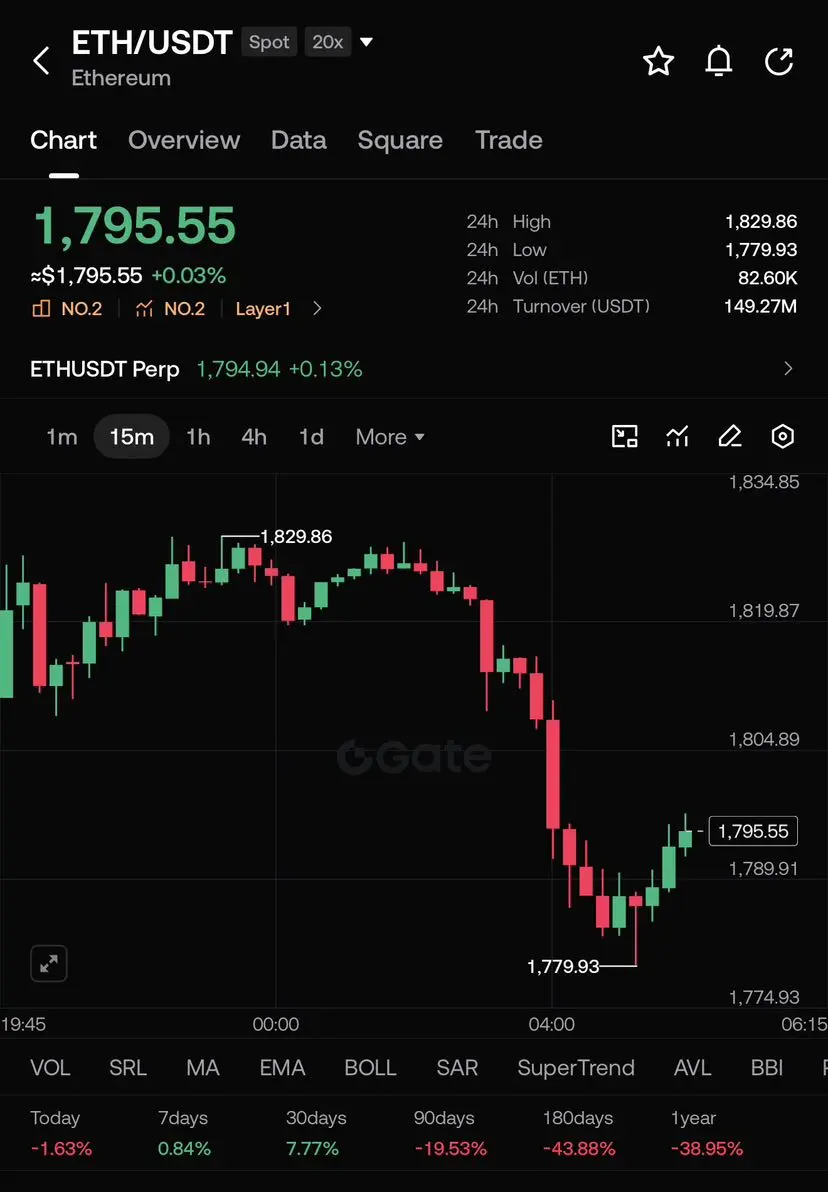
Holding at 1,780 is the bulls’ playbook; follow.
View Original
LedgerBull
$ETH is showing signs of a bullish recovery after sweeping local liquidity.
Buyers have stepped in from the recent low, and price is beginning to print higher lows, suggesting momentum is shifting back in favor of the bulls.
EP
1,792–1,796
TP
TP1: 1,805
TP2: 1,818
TP3: 1,830
SL
1,780
Liquidity is building above the recent swing high, while price continues to hold a strong reaction zone after the sharp impulse down. As long as 1,780 remains protected, continuation toward higher liquidity is the favored scenario.
Let’s go $ETH ‌
repost-content-media
  • Reward
  • Comment
  • Repost
  • Share
Hong Kong SFC finally takes action on OTP; Passkeys are the future, and phishing attacks should be a thing of the past.
View Original
WuSaidBlockchainW
Hong Kong’s Securities and Futures Commission (SFC) today issued a circular requiring internet brokers and virtual asset trading platform operators to cease using one-time passwords (OTPs), which are vulnerable to impersonation and fraud risks, during customer login and device binding processes, and instead adopt stronger authentication methods such as Passkeys and bound devices. Large internet brokers must implement the new authentication scheme immediately, while other institutions must complete implementation within 12 months from the date of the circular. The SFC emphasized that while strengthening preventive monitoring, relevant institutions must also implement effective detection and surveillance measures to identify suspicious login, trading, and withdrawal activities in real time, promptly notify customers of important account changes, and regularly warn about emerging cybersecurity risks.
  • Reward
  • Comment
  • Repost
  • Share
APY looks tempting on the surface, but when you click into the contract, it's a three-layer nested structure, and no one knows who's borrowing from the bottom-level fund pool. I've run scripts to dig through a few aggregators, and some of the underlying protocols have TVL lower than my wallet balance—their risk classification is as good as useless.
Regulatory pressure has been tightening recently around here, and on-ramp/off-ramp channels are narrowing. You stare at the on-chain high yields and jump in, only to find the withdrawal channel blocked when you try to exit—that's what real liquidity
View Original
  • Reward
  • Comment
  • Repost
  • Share
Open-source models can solve math competition problems to this extent, with each problem costing only $4. It feels like the pricing logic of closed-source commercial models needs to be rethought.
View Original
CoinNetwork
CoinWorld News: Mistral’s open-source Leanstral 1.5 model has an estimated problem-solving cost of about $4 per question, with a total parameter count of 119.0 billion and approximately 6.5 billion activated parameters. It uses the Apache-2.0 license and provides free API access. Official evaluations show that Leanstral 1.5 solved 587 out of 672 questions on Putnambench, reaching 87% and 34% on the abstract algebra benchmarks Fate-H and Fate-X, respectively, and setting the best performance among comparable models. In addition, Leanstral 1.5 has also been used for code verification, with the team finding 11 real bugs across 57 open-source Rust repositories, 5 of which had not been previously reported.
  • Reward
  • Comment
  • Repost
  • Share
When the market is searching for direction, projects with real-world use cases are actually more reliable, and the demand for on-chain data will only grow stronger.
View Original
KingAlpha
Chainlink (LINK) Latest
News
Chainlink (LINK) continues to strengthen its position as the leading decentralized oracle network, with growing adoption across DeFi, tokenized real-world assets (RWAs), and blockchain ecosystems.
Analysts believe increasing demand for secure on-chain data and cross-chain
interoperability could support Chainlink's long-term growth.
Trading activity remains active as investors monitor key support and resistance levels while the broader crypto market searches for direction.
Despite short-term market volatility, many analysts remain optimistic about LINK due to its critical role in connecting smart contracts with real-world data.#GateStocksTransferLive #CirclePlunges17% #PredictWorldCup🇵🇹vs🇭🇷 #GateCardPointsSystemLaunched #NFPCountdown $LINK $LINK
repost-content-media
  • Reward
  • Comment
  • Repost
  • Share
Baidu has uncovered a core figure behind MOSS, and the foundational model chessboard is getting bigger and bigger.
View Original
CoinNetwork
CoinWorld news, Sun Tianxiang recently officially joined Baidu as the head of the Basic Model R&D Department (BMU). At the same time, he also entered Baidu's Model Committee (BMC). Sun Tianxiang's technical expertise in the large model field aligns highly with Baidu's strategic direction for basic models. He previously participated in the development of MOSS, proposed MAAS, and then ventured into entrepreneurship.
  • Reward
  • Comment
  • Repost
  • Share
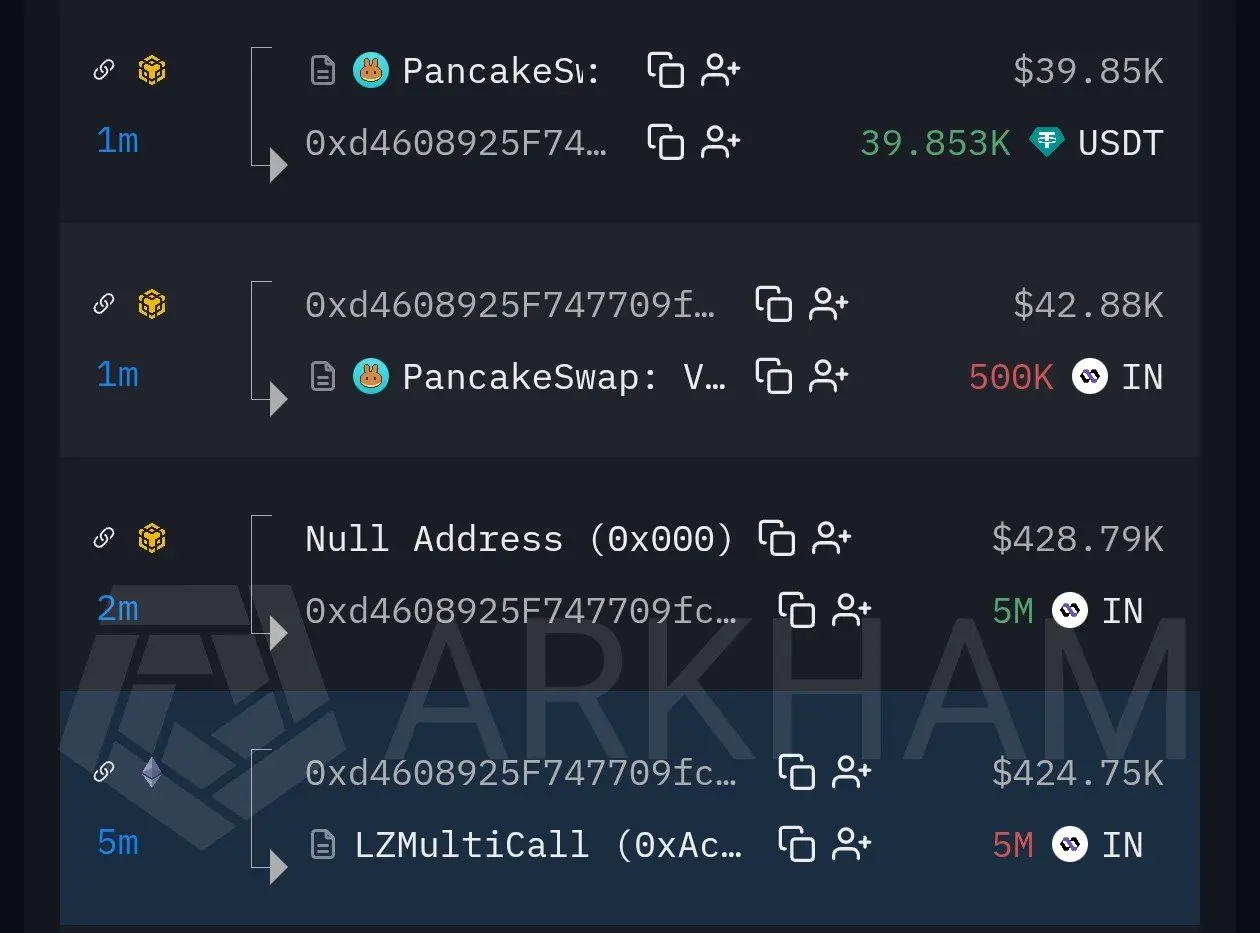
So it turns out to be cross-exchange arbitrage, buying low on ETH and selling high on BSC, and the funding rate difference makes sense.
ETH1.58%
View Original
CryptoZeno
Sharing a breakdown of what's actually happening with $IN right now.
What looks like tokens being burned on Ethereum and minted on BSC is actually a bridge transaction.
Buying on Ethereum-based markets, selling on BSC markets and DEXes.
CEX → ETH bridge → BSC DEX
In other words, arbitrage. Buy cheap, sell expensive. They're exploiting price differences between exchanges. I haven't checked each one individually but deposits and withdrawals are likely disabled on most of them.
This also explains why the funding rate gap exists.
repost-content-media
  • Reward
  • Comment
  • Repost
  • Share
Domyn's project is quite interesting, training from scratch using EuroHPC's public computing power at a cost much lower than serving hundreds of millions of users — essentially proving that Europe can play with cutting-edge AI without clinging to the coattails of U.S. cloud providers. The involvement of G42 and those banks shows that capital also buys into this logic.
View Original
CoinNetwork
CoinWorld News: Italian AI startup Domyn has announced plans to release, within one year, a fully open-source, reproducible large model with more than 400 billion parameters. The project is jointly advanced by Domyn and the Europa Alliance formed in cooperation with Germany’s Fraunhofer Society, has been selected for the European Commission’s Frontier AI Large Challenge project, and has received computing power support from the European public supercomputing network EuroHPC. It is aimed at promoting localized alternative solutions. Domyn CEO Uljan Sharka noted that compared with serving hundreds of millions of users, the computing power required to train a cutting-edge large model from scratch is much lower, and Europe’s public computing network can already meet R&D needs. The project has received support from Abu Dhabi’s G42, Eurizon Capital, Rabobank, and The Bank of New York Mellon.
  • Reward
  • Comment
  • Repost
  • Share
DeepMind loses another key figure; Anthropic's talent acquisition this time is quite aggressive.
View Original
CoinNetwork
CryptoWorld News: Google's DeepMind senior research scientist John Jumper has decided to leave the company and join the artificial intelligence firm Anthropic. This move has garnered widespread attention in the industry, as Jumper's research achievements at DeepMind are highly acclaimed.
  • Reward
  • Comment
  • Repost
  • Share
Bitdeer’s 370% year-over-year growth is too exaggerated; AI Cloud’s annualized $69 million is a new narrative.
View Original
CoinNetwork
CryptoNews reports that, according to The Block, Bitdeer, BitFuFu, Canaan, and CleanSpark have released their unaudited May production data, which totals 1,859 BTC mined. Of that, Bitdeer mined 921 BTC itself, up 370% year over year; its self-held BTC stands at 171 BTC; and its AI Cloud business has an annualized revenue of about $69 million. BitFuFu’s self-mined output rose to 90 BTC. Canaan’s self-mining and managed services combined added 114 BTC, bringing its inventory to 1,867 BTC and 3,952 ETH.
  • Reward
  • Comment
  • Repost
  • Share
BitGo transfers 25k ETH to a new wallet, Bitmine. Is this a big move?
ETH1.54%
BMNR-1.43%
View Original
WuSaidBlockchainW
According to Onchain Lens monitoring, a newly created wallet received 25,000 ETH from BitGo, worth approximately $40.93 million. This wallet may belong to Bitmine.
  • Reward
  • Comment
  • Repost
  • Share
The 10% cap set by the FCA is quite a delicate balance: it lets traditional funds try crypto ETNs through a crack in the door, while also keeping retail investors from getting carried away—British regulatory finesse always walking a tightrope between “embracing innovation” and “don’t mess up pensions.” Unlimited participation for professional players? Sure—that’s the backdoor left for institutions. Let’s wait and see when the July consultation deadline comes.
ETN0.02%
View Original
CoinNetwork
Crypto news, the UK Financial Conduct Authority (FCA) proposes to allow authorized investment funds to allocate up to 10% of their assets to crypto exchange-traded notes (ETNs), with related restrictions set. The public can submit opinions before July 13. In the proposal, professional and qualified investor schemes are not subject to the cap, and some fund types are excluded. The UK Asset Management Association supports the proposal, believing that the 10% limit helps with risk management. FCA stated that they are not currently considering allowing funds to directly hold crypto assets and will decide after evaluating the relevant regulatory framework.
  • Reward
  • Comment
  • Repost
  • Share
These days, everyone is staring at staking unlocks and token unlock calendars until their eyes turn red, all thinking "selling pressure is coming." I instead want to say: Stop. Stop scrolling Twitter, stop clicking on random links, stop looking at those "airdrop claim/unlock query" phishing sites. The mnemonic phrase is a red line: whoever asks you to input it, they are asking for your life. Don't treat signature authorizations as just a "click agree" game; when you see a string of unreadable approve/ unlimited limit, stop and clear old authorizations in your wallet. Data can be tracked, but o
View Original
  • Reward
  • Comment
  • Repost
  • Share
Using a multi-chain wallet for a long time can be summed up in one word: chaos. The most坑 part of asset fragmentation isn’t “you can’t find your money”—it’s that you think you still have spare funds, but everything is scattered across different chains, so you can’t assemble a single usable amount. In the end, you’re forced to make extra transfers and pay fees for nothing.
I’m too lazy to put on an act of lofty ideals anymore: keep 1 main wallet as a “warehouse,” and use 2–3 smaller wallets for different purposes (interactions/airdrops/testing). On each chain, leave only enough gas for the next
View Original
  • Reward
  • Comment
  • Repost
  • Share
These days, whenever the mainnet gas fees spike, I start questioning life.
If I want to save money, I go to L2, but honestly, the experience isn't always smooth: cross-chain confirmations, finding the right network, sometimes even having to top up some ETH on the mainnet as "toll fees."
My current compromise is: small, frequent transactions all on L2, only using the mainnet for two things—large transfers and important authorizations (otherwise I can't sleep).
Don’t tell me “the mainnet is the safest,” the little money in my wallet isn’t worth paying tuition every day…
By the way, it’s
ETH1.54%
View Original
  • Reward
  • Comment
  • Repost
  • Share
  • Pinned