FrenBurner

vip
Active for: 0.5y
Peak Tier 0
SocialFi is like a bonfire: it can keep you warm, but it can also burn your hands. Pay attention to points, mutual following games, and the cost of farming points—complaining out loud, but working hard behind the scenes.
Rotation being defended in the 1.594–1.620 range shows the bulls haven’t given up yet. Take half off at TP1 to lock in profits, then move the stop loss on the remainder to breakeven—textbook risk management.
VF5Trader
$GRAM auction rotation shows buyers absorbing rotation inside value area between 1.594 and 1.620.
🔼 Long setup
📍 Entry: 1.4059
🛑 Stop: 1.284 (-6.0%)
🎯 TP1: 1.631 (+1.9%)
🎯 TP2: 1.647 (+2.9%)
⚖️ Half off at TP1 → stop to entry
#Toncoin #AuctionTheor
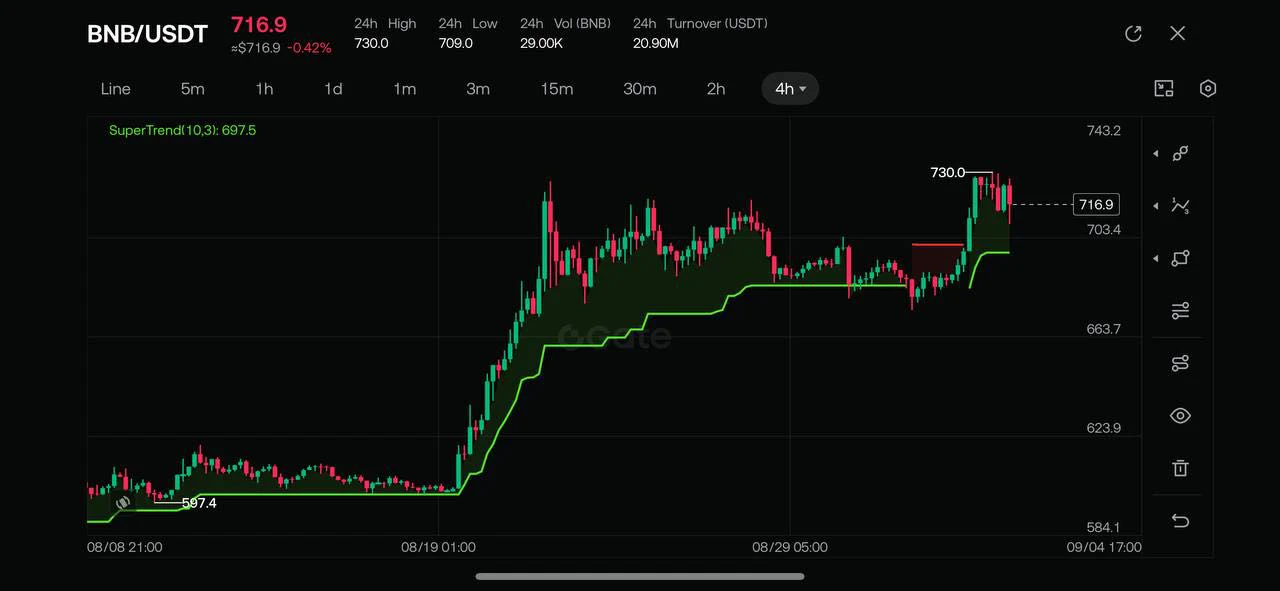
Just woke up and it pumped hard to 730; now it’s in a cooldown at 716. If the 697.5 support holds, the next wave is headed straight for a new high.
CasAbbe
$BNB
Just woke up from a long sleep.
Was compressed in a tight range for weeks, then absolutely exploded to 730 in a single breakout candle.
Now cooling back to 716.9, but that’s exactly what I want to see Supertrend flipped green at 697.5 and it’s holding.
This is a fresh breakout, and I’m watching for a retest of 709–710 to add.
If support holds here, we could see it run back to 730 and beyond.
repost-content-media
Institutional capital is voting with its feet: XRP spot ETF trading volume has hit a record, with monthly inflows exceeding $56 million, suggesting big money is indeed aggressively buying the dip.
Coinstages
🚀 XRP ETF TRADING SURGES TO NEW ATH AS AUGUST FLOWS CROSS $56M! 📈
Institutional appetite for Ripple’s native asset is exploding into new territory. Spot XRP exchange-traded funds (ETFs) officially smashed all-time daily volume records while month-to-date inflows soared past $56 million—confirming that major financial institutions are aggressively accumulating during price recoveries.
XRP-0.33%
I muted the group. Honestly, at first it felt like I was missing out on 100 million, and my finger kept wanting to tap in and take a look. Later I realized that the screenshots of stablecoins depegging and the doubts about reserve audits being circulated were just the same few versions repeated over and over. After reading them, all they did was make me anxious without being of much use. On the contrary, the quiet gave me room to think about what is genuinely wrong on-chain.
I recently came across an MEV case and only then realized who the “front-running” we usually complain about actually aff
To be honest, when I first heard about this concept of re-staking, I really thought it was pretty amazing—an asset can go into multiple ecosystems, earn points there, and when you look at the compounded return rate, it’s undeniably addictive. But recently, during a mainstream-chain upgrade that caused downtime, I suddenly realized that shared security also means shared risk: if protocol A breaks, B and C might fall right along with it. When returns are stacked, don’t stack illusions too—don’t assume you’re the “armor guy” who can take it all.
I don’t really know why, but every time I see those
After going through a round of delegated voting proposals, the more I read, the more it feels like governance tokens—plainly speaking—are just big holders’ internal game. The little bit of votes retail users have is basically the same as having none; they might as well delegate their votes to the project team, so they don’t have to worry about having their airdrop picked/harvested by others and still having to deal with that mind-numbing hassle. But once you’ve delegated them, what then? Power gets even more concentrated, and oligarchization becomes more and more obvious—so in the end, who is
Hey, I just stared at the chain for a bit, and then I saw I got snared. The sandwich literally landed on my head like I’m eating at a buffet—did they really think that’s how it works? I figured this round’s slippage wouldn’t be big, but when I checked, wow—there was a bot right behind me, front-running and back-running me and wrapping my trade up tight. So what even is this? I thought it was a chance to sneak in and get a deal, but turns out it was them raking in the fees.
Forget it. When I was playing SocialFi, I got used to it—mutual-follow games, gaming the points, doing the math on costs
MEME-3.02%
Just bridged a bit of money over to ARB—gas is unbelievably low. But every time I jump to a different chain, it’s still annoying; switching wallets back and forth gets old. Sometimes I even forget where I put things. It saves money, sure, but the experience always feels like I’m playing a cyber maze. Whatever—cheap is king.
Over on the chain gaming side, it’s been breaking down badly lately. It’s an inflation spiral whenever something happens—studios and project teams are fighting each other, and the coin price just turns soft like mud. Basically, as long as you’re more diligent than anyone el
ARB+0.07%
Just saw that cross-chain bridge got hacked, and a few groups are all shouting “wait for confirmation.” Honestly, now that node synchronization has delays, what you see as “on-chain” via the RPC is actually what someone recorded a few seconds earlier. Especially when farming points, if the index lags and you charge ahead, you end up taking the loss. People say “don’t be honest with your body,” but I still quietly switched to a faster RPC—since nobody understands my mindset of “just looking for trouble for no reason.” That’s it for now; I’m going to get back to farming.
I just came across a comment war about NFT royalties and the secondary market. Creators complain that platforms are “sucking blood,” while buyers say the costs are too high. Both sides have some valid points, but to put it bluntly, on-chain transactions are so transparent that even your underwear could be pulled out. No matter how high the royalty fees are, it doesn’t stop someone from creating sockpuppet accounts to wash trades.
What I’m more concerned about is something else: where exactly is the boundary between on-chain privacy and compliance? Lately I’ve been seeing things like points and
Just checked a few wallets for assets, and I’m genuinely cracking up… You have to set up a separate address for each chain, and for some cross-chain transfers you even have to queue up and wait for the refresh. imToken took half a day and still showed no response (facepalm). Lately a whole bunch of AI agents have been shouting about automated interactions, but it’s already annoying to manually retry on-chain a few times yourself—let alone submitting it to a script. Whoever’s selling the narrative is probably the one skimping on security. Anyway, I’m watching contract permissions first. Managin
Someone asked me how to handle funding rates when they get extremely extreme—whether to tough it out and trade against the other side to earn the funding, or just close the position outright to dodge the volatility. Honestly, this kind of market is really hard on people. When the funding rate is pushed sky-high, do you dare to add more? I’m really worried about catching a “flying knife.” And if you’re short, you’re also afraid of getting squeezed—getting taken out by a rally from the long side.
My approach is: if the funding rate becomes so extreme it’s downright ridiculous, I just lie low. I
Just saw another cross-chain bridge get stuck for half a day. Honestly, with cross-chain stuff these days—whether it’s multisig or oracles—waiting for that confirmation step is basically magic. People all talk about security, but in the end you’re still betting on whether the nodes have a conscience.
Over on Layer2, they’re constantly at each other’s throats—arguing about TPS, comparing Gas fees, trading insults over ecosystem subsidies, and looking down on each other. But when you truly need to cross a chain, you still have to wait; it still gets stuck. In short, the so-called “instant settle
Just saw a sandwich trade—gas shot through the roof. The moment the clip (sandwich) was pulled back, it gobbled up all the smooth points. The “fee-farming” guy somehow managed to farm himself into someone else’s fee-cash cow. They say “arbitrage is an opportunity” with a straight face, but most of the time, we’re literally the liquidity itself—by the time you see the price gap, someone else already paid and is waiting.
That whole modular DA layer spiel developers hype up to the heavens—I finished a few points projects and I was still completely clueless. Anyway, in this SocialFi bonfire, eit
I’ve really been getting a bit stressed out from farming the play-to-earn pool lately. When rewards are high, everyone rushes in—one or two weeks later, once inflation kicks in, the output gets diluted straight into nothing. The pool’s liquidity gets drained in an instant, leaving a bunch of people who farm “points” cursing and grumbling as they walk away. In plain terms, “what you’re earning is actually the principal other people deposited.” If you play long enough, someone has to be the one to pick up the bag.
Today I saw that another mainstream public chain is going to upgrade and undergo m
Options—there are really only two kinds of lives, buyer and seller. That thing called time value doesn’t take your money—it eats your patience. Buyers always fantasize that they didn’t buy the call yesterday, and today it’s up so they can make ten times, but every day the theta charge is more cloying than sweetened milk tea.
As for the seller? They just keep smiling and pocket the time value, like guarding a campfire waiting to toast cotton candy, until—one careless moment—and the gamma bites them a little, and then it all goes bad.
Last night the funding rate hit extremes. In the group there
Just sat down to place an order for a sandwich, watching gas skyrocket from 90 to 300 right in front of my eyes. Clipper Bro finished the meat and ran off— I didn’t even get a sip of the soup. You say arbitrage is an opportunity? To me, it’s clearly paying “protection money” to MEV bots. Lately, unlock calendars have been coming one after another— the fear of sell-pressure from staking unlocks has everyone on edge. As for me, I don’t dare chase orders at random anymore; I’ll just grind some points and survive—at least the fees are lower. SocialFi is pretty much the same: even the mutual-follow
Sometimes it’s pretty funny to think about it. An unrealized loss of 100U makes me get up in the middle of the night to watch on-chain records for half an hour; an unrealized profit of 200U, though, makes me sleep like a pig—doesn’t that mean I’m psychologically twisted?
Yesterday I tried a few contracts where AI Agents automatically monitor the market. Gas was saved, but every time I see a bunch of ultra-low-gas “optimization” prompts, I start to suspect it’s stealing my wallet balance instead of helping me save money. 🤡
Anyway, my strategy is: if I’m down on paper, I treat it as buying a “s
I saw a post today saying “Data Availability (DA)” and “ordering finality.” My first reaction was: here we go again with new buzzwords? For someone like me who’s bad at grinding scores in SocialFi, I’m afraid of sounding like I understand jargon, but if I don’t understand it, I’m also afraid of getting ripped off. In the end, it’s really one main thread: when exactly can the trade you place be considered settled? Can someone cut in line or roll it back in the middle? It’s the same logic as how large on-chain transfers are interpreted as “smart money.” You see a whale move tens of thousands of
ETH-1.45%