Alexx0

vip
Active for: 1.7y
Peak Tier 0
No content yet
Here’s some interesting and important data you might have missed.
My partners at @oobit have published an analysis titled “Crypto Spending Moves Further Into Everyday Purchases,” which shows what crypto card users in Colombia, Uruguay, El Salvador, Vietnam, the Philippines, and South Africa are spending their money on.
Grocery stores lead the way in all countries. As I’ve noted in my previous posts, crypto cards are used primarily for everyday expenses - such as in-store purchases of $100 - $200 (and sometimes less), as well as trips to restaurants and cafes. I
t’s also worth highlighting sub
NFLX-0.01%
Imagine a bank that has been profitable five years running, grew revenue 46% last year, adds a million customers every 17 days - and has 96% of those customers in a single region.
That is @Revolut. And the market values it at $75B as a global super-app.
I built a model to 2030 from the group's annual reports and the European bank's financial statements. Here is what it shows.
First, Revolut is quietly turning into a bank. Interest income rises from 22% to 30% of revenue, the loan book grows from $2.9B to $34B, and credit losses reach $1.3B. That is more than all FX revenue today.
Second, Europ
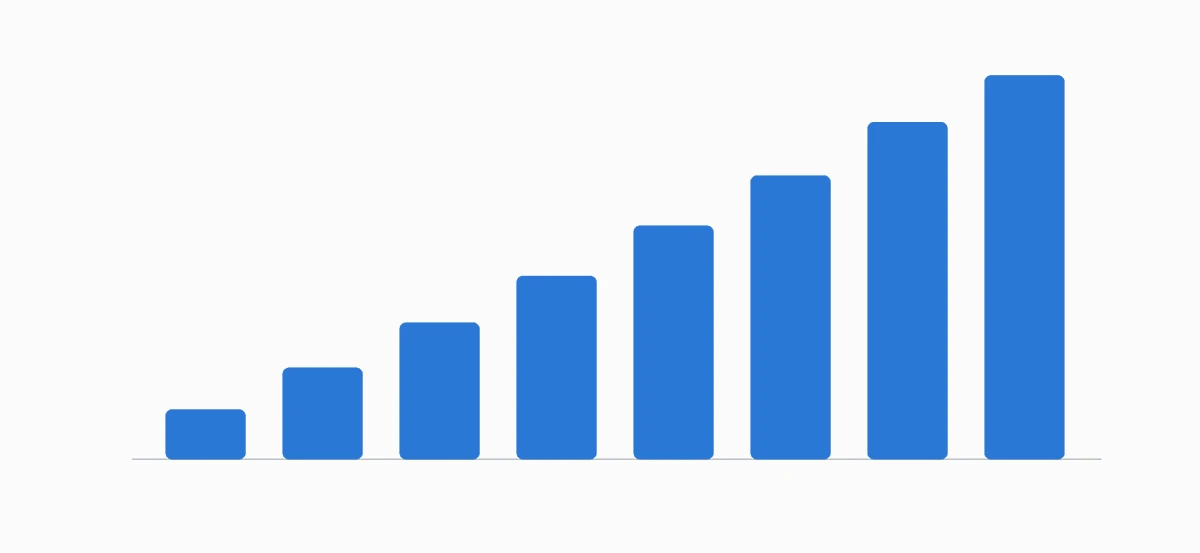
Every self-respecting fintech startup releases this infographic at least once a year:
- a chart showing growth
- a chart with no metrics
- a chart with no decline in any month
- the caption “We continue to grow”
😁
post-image
Stablecoins are not a victory for crypto. They represent the largest voluntary dollarization in history, which crypto has brought about all on its own.
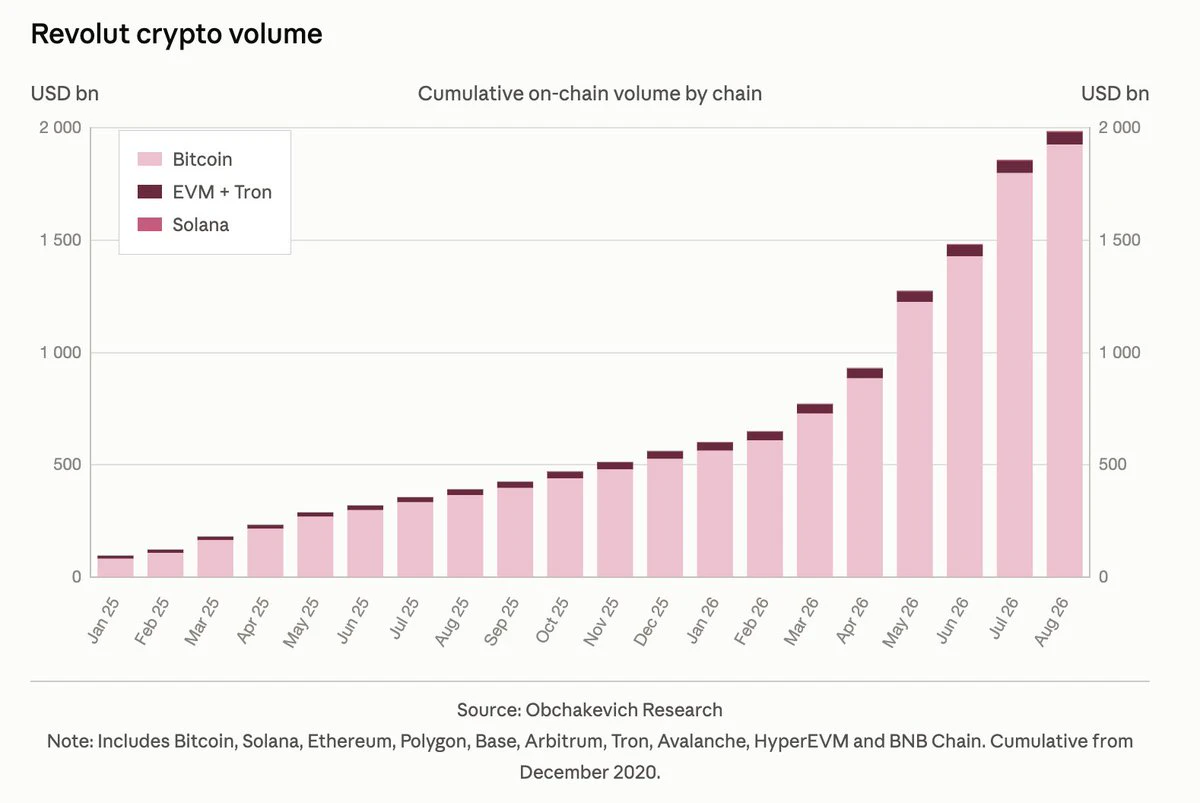
@Revolut approached $2T in cumulative on-chain volume in August 2026.
The $1T milestone was reached in mid-May 2026 - meaning the second trillion was added in ~3 months, compared to ~4.5 years for the first.
post-image
📢 Breaking: Revolut has launched its own euro-pegged stablecoin - $EURR
Today’s market is ideal for building your own product and raising funds for it from ventures.
They, in turn, are actively investing right now, even though the market itself isn’t doing so well.
This is because we’re in a phase of global restructuring, where the main focus is shifting toward sustainable payment products, rather than just trading or speculation.
The market is signaling that everything is changing, and global attention is now on blockchain-based payments. Everyone wants to play this game, but not everyone will win.
Stablecoins have been around since 2014, but their history as a payment method has only just begun. Of the ~$33T in turnover for 2025, actual payments accounted for approximately 1% - about $390B, of which $226B was B2B.
Not much? That’s 30 times more than two years ago. Meanwhile, the supply remains around $313B in mid-2026, even amid a market downturn.
Speculative volume fluctuates with the cycle - payment volume does not.
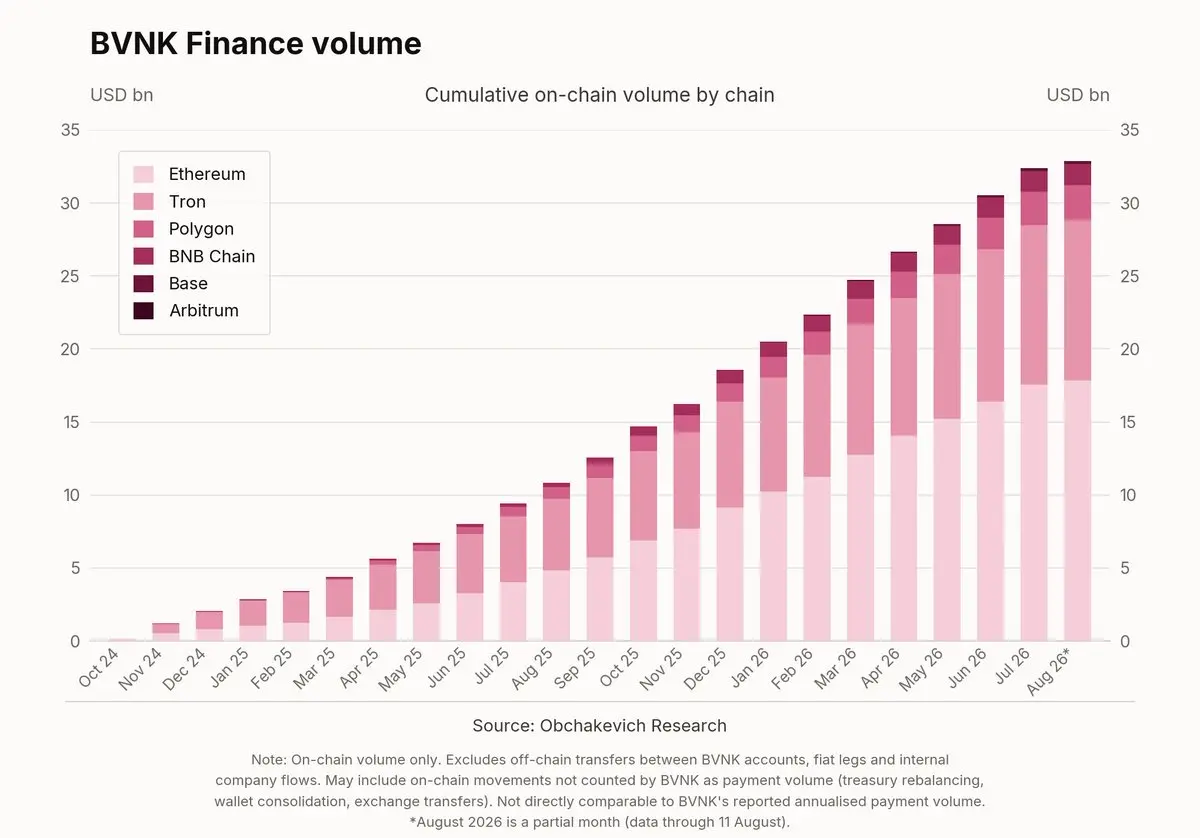
. @Mastercard closed its $1.8B @BVNKFinance acquisition on August 3. On-chain data gives an independent read on what it bought.
BVNK's on-chain footprint totals $32.9B since October 2024. The trailing twelve months come to $23B against $30B in reported annualised volume. The two are not the same metric, but they are close enough to say most of the flow is real settlement rather than internal ledger netting. That already separates BVNK from much of the stablecoin infrastructure cohort.
The curve matters more. Q1 2026 on-chain volume was 2.6x the year before. Q2 was 1.6x, and below Q1 in absolut
post-image
MA-0.42%
ETH-0.59%
TRX-0.29%
ARB-3.62%
Fiat won’t come from coffee shops, but from the B2B sector: payments to contractors, cross-border transactions, and treasury operations.
There, the process costs 3–5% and takes three days, not 30 seconds at the register. A retail stablecoin is a marketing tool; the real substitution is happening in transactions between companies.
Stablecoins are the only technology where “working too well” poses a regulatory risk.
View More