# SpotBTCETFsLogFiveWeekOutflows

6.63K
#SpotBTCETFsLogFiveWeekOutflows Spot Bitcoin ETFs have recorded five straight weeks of net outflows, marking a notable shift in market behavior for one of the crypto world’s most closely watched investment products. Instead of new money flowing into Bitcoin via these funds, investors have been withdrawing capital over several consecutive weeks — a trend that reflects changing sentiment and positioning among institutional and retail players.
Outflows typically signal a reduction in demand for exposure to Bitcoin through regulated investment vehicles. This can happen for several reasons. First,
BTC0.43%
MrFlower_XingChen
#SpotBTCETFsLogFiveWeekOutflows Spot Bitcoin ETFs have recorded five straight weeks of net outflows, marking a notable shift in market behavior for one of the crypto world’s most closely watched investment products. Instead of new money flowing into Bitcoin via these funds, investors have been withdrawing capital over several consecutive weeks — a trend that reflects changing sentiment and positioning among institutional and retail players.
Outflows typically signal a reduction in demand for exposure to Bitcoin through regulated investment vehicles. This can happen for several reasons. First, traders may be reallocating into other assets amid short-term volatility or uncertainty in the crypto market. When prices wobble, ETFs often feel the impact quickly because they are easy for large investors to enter or exit.
Another factor behind sustained outflows could be profit-taking. After periods of price appreciation, some holders choose to realize gains, especially if they believe near-term growth may stall. This rotation can lead to capital leaving Bitcoin ETFs and moving into cash, stablecoins, or alternative investments.
Market psychology also plays a role. Five weeks of outflows can create a feedback loop: as headlines report continued withdrawals, other investors may become cautious or defensive, prompting further outflows. This doesn’t always mean the market is entering a deep bearish phase, but it does highlight that confidence has softened compared with earlier periods of strong inflows.
It’s important to remember that ETF outflows do not necessarily equate to a drop in Bitcoin’s price — though they often correlate. The broader crypto ecosystem, on-chain metrics, miner behavior, and macroeconomic trends all factor into price direction. Still, sustained ETF outflows are a key signal that institutional appetite has temporarily pulled back.
In the coming days and weeks, watch for changes in fund flows, macroeconomic news, and Bitcoin price action. A shift back toward inflows could signal renewed confidence, while continued outflows might reflect ongoing caution among investors.

repost-content-media
  • Reward
  • 2
  • Repost
  • Share
discovery:
LFG 🔥
View More
#SpotBTCETFsLogFiveWeekOutflows
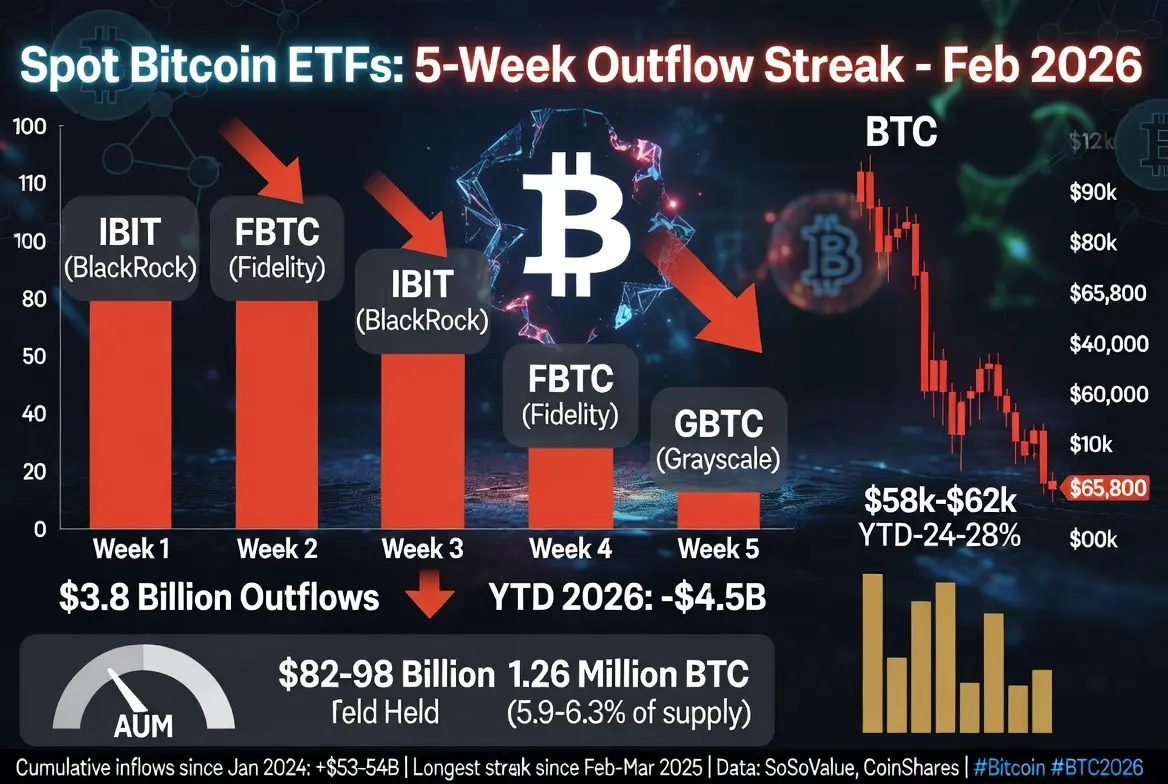
As of February 25, 2026, U.S.-listed spot Bitcoin ETFs have completed their fifth consecutive week of net outflows — the longest streak since February-March 2025. This sustained redemption wave has removed approximately $3.8 billion from the funds over those five weeks, with year-to-date (YTD) 2026 net outflows reaching around $4.5 billion (offset by roughly $1.8 billion in inflows during the first and third weeks of the year). The most recent (Presidents' Day-shortened) week saw outflows of about $316 million to $479 million, depending on the tracker (SoSoValu
BTC0.43%
SOL0.08%
HighAmbition
#SpotBTCETFsLogFiveWeekOutflows
As of February 25, 2026, U.S.-listed spot Bitcoin ETFs have completed their fifth consecutive week of net outflows — the longest streak since February-March 2025. This sustained redemption wave has removed approximately $3.8 billion from the funds over those five weeks, with year-to-date (YTD) 2026 net outflows reaching around $4.5 billion (offset by roughly $1.8 billion in inflows during the first and third weeks of the year). The most recent (Presidents' Day-shortened) week saw outflows of about $316 million to $479 million, depending on the tracker (SoSoValue, CoinShares, etc.).
Cumulative net inflows since the ETFs' January 2024 launch remain solidly positive at roughly $53–54 billion (down from a peak near $63 billion in late 2025). Total assets under management (AUM) now hover between $82–98 billion (sources vary slightly due to real-time BTC price fluctuations and tracking differences), representing about 5.9–6.3% of Bitcoin's total supply (around 1.26 million BTC held across the 12 funds, down from a peak of 1.36 million BTC).
Spot BTC ETFs Recap
These are regulated vehicles (e.g., BlackRock's IBIT, Fidelity's FBTC, Grayscale's GBTC) that hold actual Bitcoin in cold storage. Shares trade on traditional exchanges, giving investors seamless exposure without direct crypto custody. They revolutionized institutional access, but flows now act as a high-frequency sentiment gauge.
Breaking Down the Five-Week Outflow Streak
Week-by-week pattern: Consistent redemptions since late January 2026, with the heaviest single week pulling ~$1.49 billion.
Key contributors: BlackRock's IBIT led with ~$2.1–2.13 billion outflows over the period; Fidelity's FBTC saw ~$954 million.
Broader context: This mirrors a similar (but larger) streak in early 2025 tied to macro shocks. 2026's version aligns with risk-off conditions, including U.S. tariff uncertainties, geopolitical noise, and rotation to safer assets like gold (which saw strong inflows).
Deeper Metrics: Price, Percentage Impact, Liquidity, Volume + More
Price Dynamics
Bitcoin trades around $64,000–$65,800 today (up ~2–3% intraday from recent lows near $63,900), but down roughly 24–28% YTD in 2026 — the steepest January-February drop on record and on track for a fifth straight monthly loss (longest since 2018). ETF outflows directly add selling pressure: managers sell BTC to fulfill redemptions, creating a feedback loop during low-demand periods. Key levels watched: support at $58,000–$62,000; resistance near $68,000. The streak has capped rallies and amplified downside volatility.
Percentage Perspective
Five-week outflows (~$3.8B) equal ~4–5% of current AUM. YTD bleed ($4.5B) is ~5–6% of peak 2025 levels. Relative to lifetime inflows ($53–54B), this is a correction — not a collapse. ETF-held BTC has dropped ~7–8% from peak holdings (87,000 BTC shed since Nov 2025, including ~15,000 in Feb). Still, ETFs control a meaningful slice of supply, so even modest % outflows matter when conviction wanes.
Liquidity Conditions
Outflows thin spot market buy-side depth. Bid-ask spreads widen during volatility spikes, and large orders move price more easily. On-chain and exchange liquidity has declined alongside ETF AUM drawdown. European/Canadian buyers added minor inflows (~$59M recently), offsetting some U.S. selling, but overall market depth remains subdued — increasing tail risk for sharp moves.
Volume Trends
Spot + derivatives weekly volumes hit multi-month lows (~$17 billion), the weakest since July 2025. Low volume on down days indicates measured, conviction-based selling (e.g., institutions rotating) rather than retail panic or cascading liquidations. This "quiet bleed" prolongs consolidation: fewer participants absorb supply, delaying bottoms until volume rebounds with fresh demand.
Additional Layers: Drivers, Rotations, and Sentiment
Macro & Sentiment Drivers: Risk-off mood dominates — Fear & Greed Index in "extreme fear" (8–11 range). Capital rotates to gold ETFs (strong inflows), stablecoins, cash, or altcoins like Solana. U.S. hedge funds trimmed positions sharply (e.g., some 13F filings show 28–86% cuts in Q4 2025–Q1 2026).
Regional Split: U.S. outflows heavy; Europe/Canada sees dip-buying.
On-Chain Angle: Some BTC moves off exchanges or into long-term holds, suggesting rotation rather than full exit.
Comparison: Gold ETFs attracted billions recently while BTC bled — classic flight-to-safety.
What This Means & Outlook Signals
This isn't structural failure — ETFs remain a core bridge for traditional capital, with AUM still massive and inflows historically explosive. But five weeks of red signals caution: institutional conviction is testing, and BTC lacks a strong catalyst (regulatory clarity, macro pivot, or retail resurgence) to flip flows positive. Watch for:
Flow reversal (even small inflows spark momentum).
Volume spike above $20–25B weekly.
BTC holding $60k zone amid macro noise.
repost-content-media
  • Reward
  • Comment
  • Repost
  • Share
#SpotBTCETFsLogFiveWeekOutflows
Over the past five weeks, U.S. spot Bitcoin ETFs have experienced consecutive net outflows totaling approximately $3.8 billion. This streak is the longest observed since early 2025 and has drawn attention because it coincides with a period of heightened macroeconomic uncertainty and market volatility. At first glance, such outflows might suggest waning interest in Bitcoin, but a deeper look reveals a more nuanced picture. Despite these withdrawals, cumulative inflows since the ETFs’ inception remain substantial, around $54 billion, and total assets under manage
BTC0.43%
SOL0.08%
XRP-1.25%
  • Reward
  • 18
  • Repost
  • Share
Luna_Star:
2026 GOGOGO 👊
View More
#SpotBTCETFsLogFiveWeekOutflows
Spot BTC ETFs Log Five Straight Weeks of Outflows — What’s Really Happening?
After months of historic inflows and bullish momentum, Spot Bitcoin ETFs have now recorded five consecutive weeks of outflows — and the market is paying attention.
Is this the start of a structural shift?
Or just a temporary pause in institutional appetite?
Let’s break it down.
The Bigger Picture
When U.S. regulators approved spot Bitcoin ETFs earlier this year, it marked a milestone moment for crypto adoption. Major asset managers entered the space, including:
BlackRock
Fidelity Inves
BTC0.43%
  • Reward
  • 2
  • Repost
  • Share
Pheonixprincess:
2026 GOGOGO 👊
View More
#SpotBTCETFsLogFiveWeekOutflows
U.S. spot Bitcoin ETFs have now recorded five consecutive weeks of net outflows, signaling a noticeable cooling in institutional sentiment.
Roughly $3.8 billion has exited these products during this stretch — the longest redemptions streak in months.
Let’s break this down strategically 💙
🔎 What Does This Really Mean?
ETF flows are often considered a proxy for institutional demand.
When inflows rise → confidence builds.
When outflows extend → risk appetite weakens.
This doesn’t automatically mean a crash is coming — but it does reflect caution.
📊 Why Are Outf
BTC0.43%
  • Reward
  • 9
  • Repost
  • Share
Leeessa:
To The Moon 🌕
View More
#SpotBTCETFsLogFiveWeekOutflows Spot Bitcoin ETFs have recorded five straight weeks of net outflows, marking a notable shift in market behavior for one of the crypto world’s most closely watched investment products. Instead of new money flowing into Bitcoin via these funds, investors have been withdrawing capital over several consecutive weeks — a trend that reflects changing sentiment and positioning among institutional and retail players.
Outflows typically signal a reduction in demand for exposure to Bitcoin through regulated investment vehicles. This can happen for several reasons. First,
BTC0.43%
MrFlower_XingChen
#SpotBTCETFsLogFiveWeekOutflows Spot Bitcoin ETFs have recorded five straight weeks of net outflows, marking a notable shift in market behavior for one of the crypto world’s most closely watched investment products. Instead of new money flowing into Bitcoin via these funds, investors have been withdrawing capital over several consecutive weeks — a trend that reflects changing sentiment and positioning among institutional and retail players.
Outflows typically signal a reduction in demand for exposure to Bitcoin through regulated investment vehicles. This can happen for several reasons. First, traders may be reallocating into other assets amid short-term volatility or uncertainty in the crypto market. When prices wobble, ETFs often feel the impact quickly because they are easy for large investors to enter or exit.
Another factor behind sustained outflows could be profit-taking. After periods of price appreciation, some holders choose to realize gains, especially if they believe near-term growth may stall. This rotation can lead to capital leaving Bitcoin ETFs and moving into cash, stablecoins, or alternative investments.
Market psychology also plays a role. Five weeks of outflows can create a feedback loop: as headlines report continued withdrawals, other investors may become cautious or defensive, prompting further outflows. This doesn’t always mean the market is entering a deep bearish phase, but it does highlight that confidence has softened compared with earlier periods of strong inflows.
It’s important to remember that ETF outflows do not necessarily equate to a drop in Bitcoin’s price — though they often correlate. The broader crypto ecosystem, on-chain metrics, miner behavior, and macroeconomic trends all factor into price direction. Still, sustained ETF outflows are a key signal that institutional appetite has temporarily pulled back.
In the coming days and weeks, watch for changes in fund flows, macroeconomic news, and Bitcoin price action. A shift back toward inflows could signal renewed confidence, while continued outflows might reflect ongoing caution among investors.
repost-content-media
  • Reward
  • 1
  • Repost
  • Share
AmeliaGlow:
Wishing you great wealth in the Year of the Horse 🐴
#SpotBTCETFsLogFiveWeekOutflows
U.S. spot Bitcoin ETFs have now recorded net outflows for five straight weeks — the longest streak since early 2025. This marks a significant shift in institutional flows after the explosive inflows post-launch in 2024.
Latest Data Snapshot (as of Feb 23–24, 2026):
Five-week total outflows: Approximately $3.8 billion (some sources report $4.3B–$4.5B depending on exact tracking periods and inclusions).
Year-to-date 2026 outflows: Around $2.6B–$4.5B net (contrasting sharply with strong inflows in the same period of 2025).
Most recent week: $2.1B–$2.13B over five
BTC0.43%
ETH0.59%
HighAmbition
#SpotBTCETFsLogFiveWeekOutflows
U.S. spot Bitcoin ETFs have now recorded net outflows for five straight weeks — the longest streak since early 2025. This marks a significant shift in institutional flows after the explosive inflows post-launch in 2024.
Latest Data Snapshot (as of Feb 23–24, 2026):
Five-week total outflows: Approximately $3.8 billion (some sources report $4.3B–$4.5B depending on exact tracking periods and inclusions).
Year-to-date 2026 outflows: Around $2.6B–$4.5B net (contrasting sharply with strong inflows in the same period of 2025).
Most recent week: $2.1B–$2.13B over five weeks), followed by Fidelity's FBTC (~$954M).
Cumulative since launch: Still positive at ~$53–$54B net inflows (down from peak ~$63B+ in late 2025), with AUM now around $83–$85B (down from highs near $170B in Oct 2025).
Current BTC price: Hovering around $63,500–$64,800 (recent dips below $65K amid broader risk-off pressure; down ~25% YTD in some reports).
This sustained selling pressure in regulated vehicles signals short-term bearish/institutional caution rather than outright capitulation.
Why the Outflows? Key Drivers in Feb 2026
Macro & Geopolitical Risk-Off Environment
Renewed U.S. tariff uncertainties (Trump admin policies, Section 122 authority) weighing on global risk assets.
Ongoing US–Iran tensions, Middle East volatility → investors derisk from high-beta plays like BTC.
Broader market: Equities/tech under pressure; crypto treated as correlated risk asset in fragile macro.
Profit-Taking & Rebalancing After 2025 Rally
BTC down $5B outflows), which preceded deeper lows — but current scale is smaller, suggesting not yet full panic.
Impact on BTC Price, Volume & Sentiment
Price Pressure:
Direct selling from ETFs adds supply → downward gravity on spot BTC (especially when outflows hit $300M+ weekly).
Current range: $63K–$65K tested multiple times; support at $230M in recent sessions) amplify downside moves.
Market Sentiment:
Short-term bearish: Fear & Greed Index low (e.g., fear levels ~11 in some reports).
Institutional positioning: Reduced exposure signals caution; contrasts with retail holding strong in self-custody.
Broader implication: ETFs no longer pure "buy-and-hold" vehicle — used for tactical allocation in risk-on/off regimes.
Relative Comparison (Current Regime):
BTC: Downside pressure from outflows + macro.
Gold/Oil: Rallying on safe-haven/tensions.
Stablecoins: Inflows for hedging.
ETH ETFs: Similar outflows streak.
What to Watch Next – Roadmap & Scenarios
Short-Term (Next 1–4 Weeks):
Monitor daily/weekly flows (SoSoValue, Bloomberg, Farside Investors). Reversal to inflows = relief signal.
Key catalysts: Macro data (Fed speak, inflation), geopolitics resolution, tariff clarity.
Technicals: Hold $60K–$62K = potential base; break = deeper correction.
Medium-Term (Q2 2026):
If outflows persist → prolonged consolidation/lows.
Reversal drivers: Risk-on shift, adoption news, or macro pivot → inflows could resume fast (ETFs still structurally bullish long-term).
Historical parallel: 2025 outflow streak led to lows, then recovery — possible repeat if macro stabilizes.
My Bias: Cautious near-term (outflows + risk-off = pressure). But structural story intact — ETFs remain major on-ramp; this dip could be accumulation zone for patient holders.
repost-content-media
  • Reward
  • Comment
  • Repost
  • Share
Load More