# STRC跌破面值11%創上市新低

752.09K

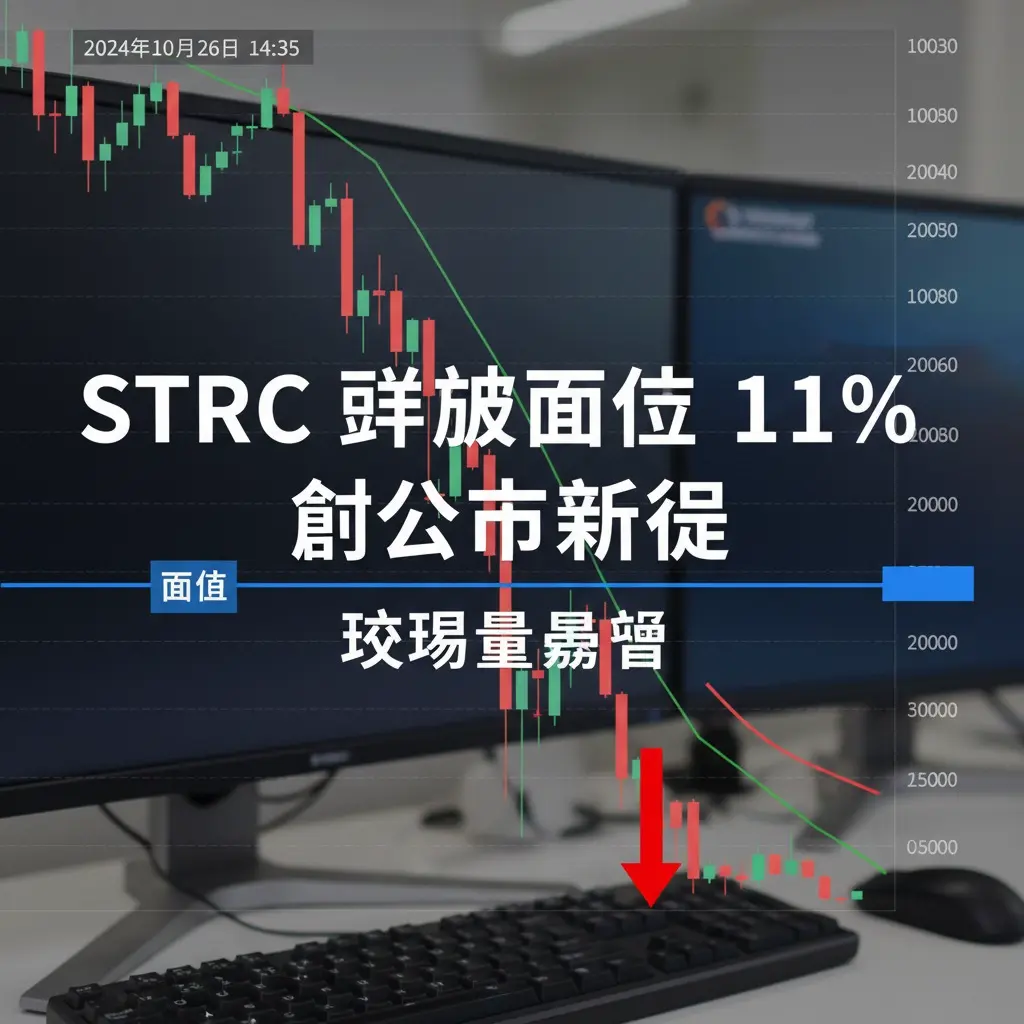
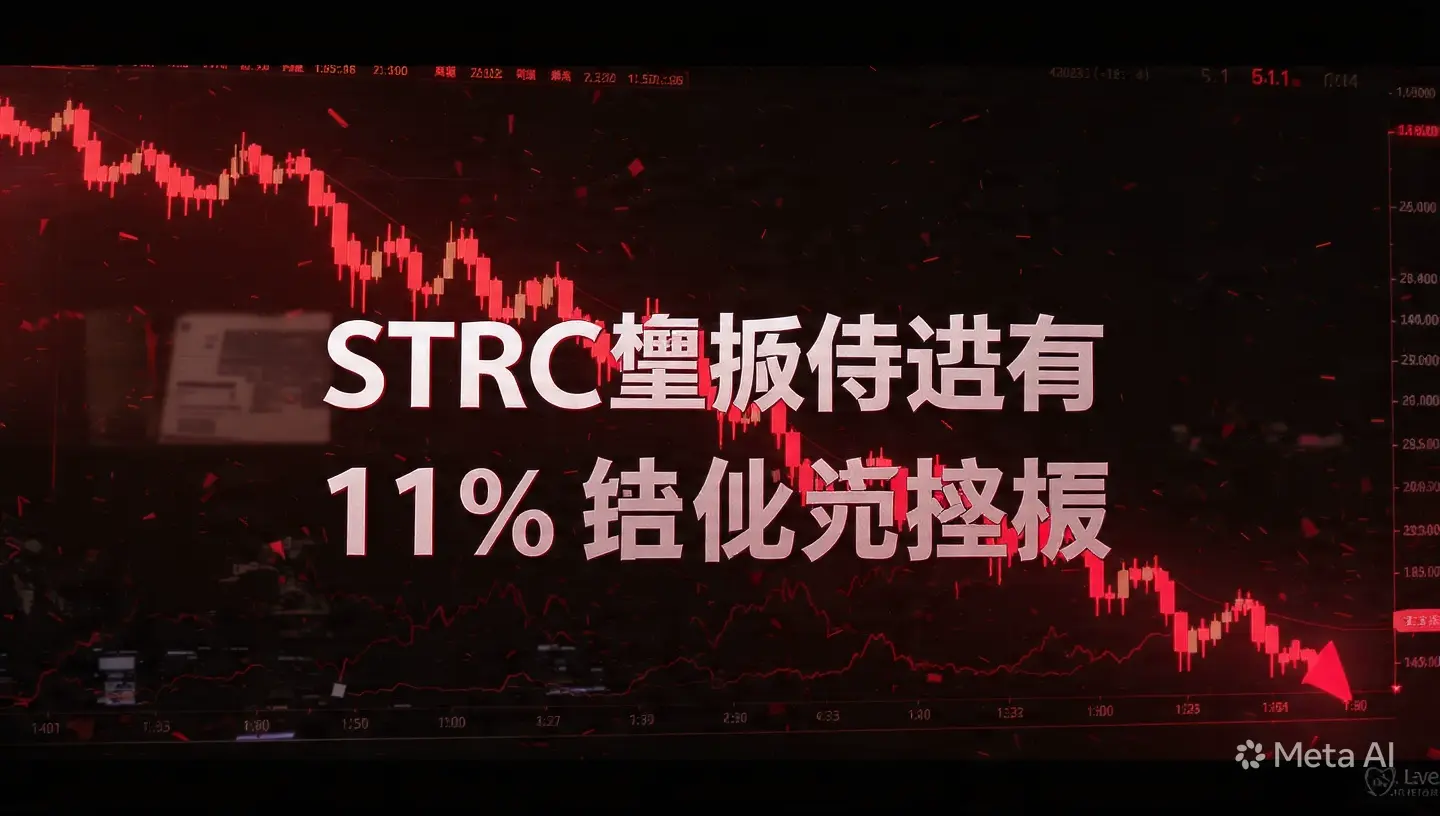
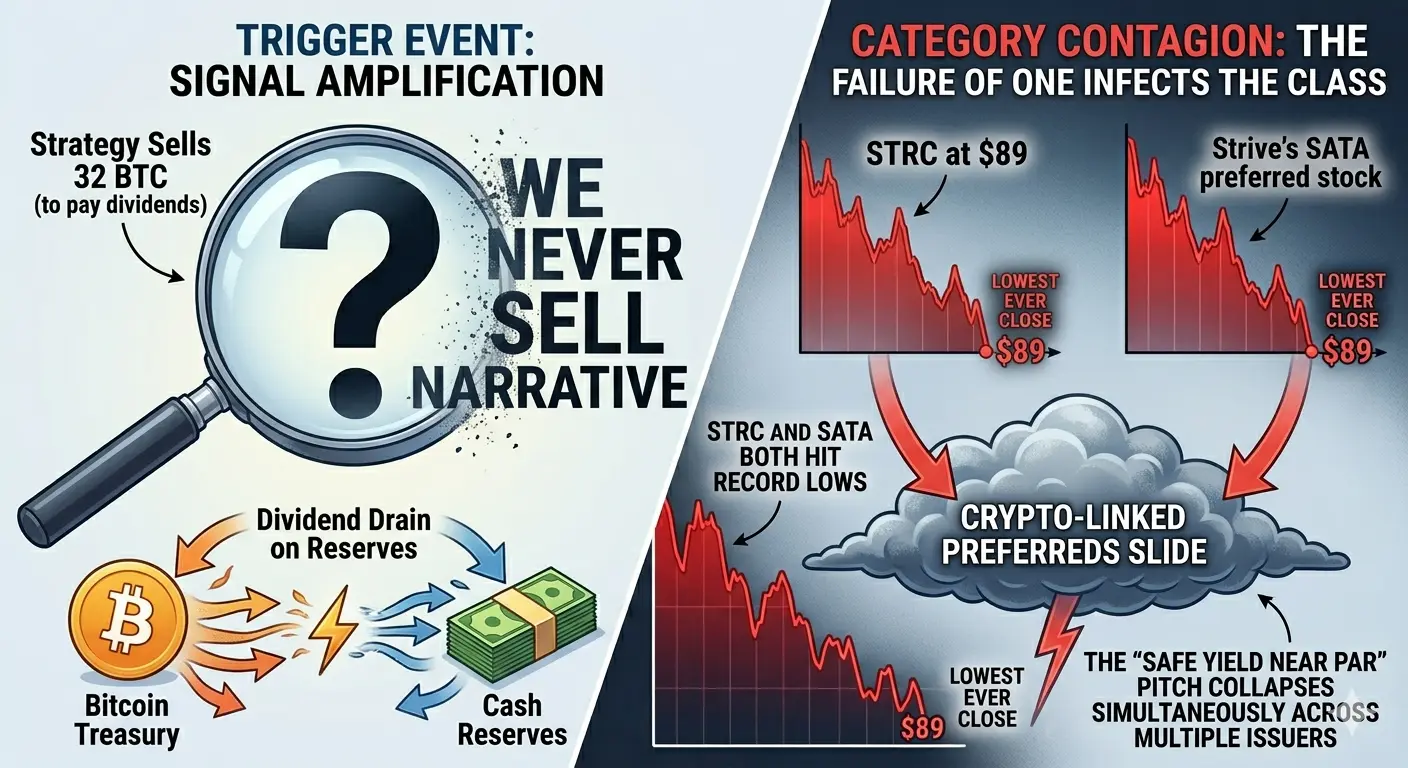
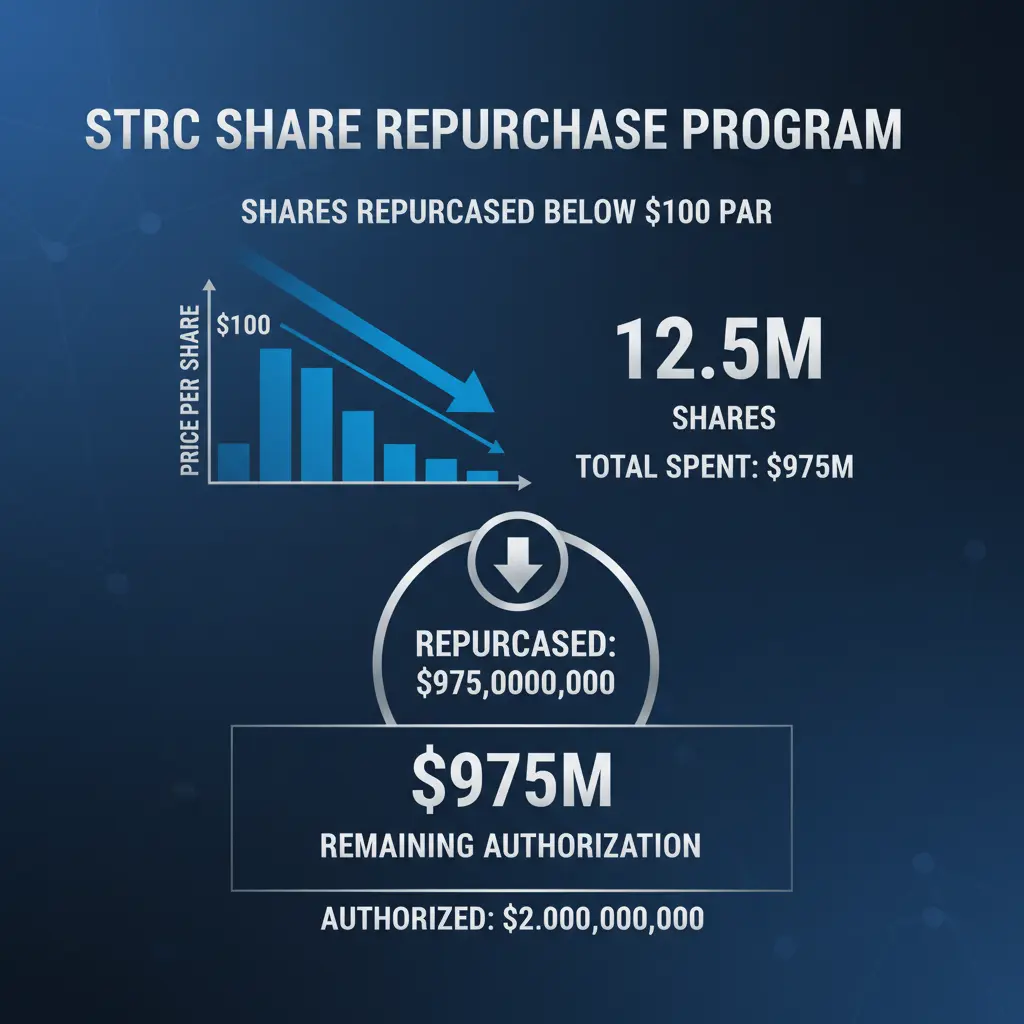
6月17日,Strategy發行的永續優先股STRC收盤跌至89美元,較100美元面值折價11%,盤中最低觸及88.50美元,創2025年7月上市以來最低收盤價。STRC當前有效股息率約12.9%,旨在透過月度利率調整維持價格穩定。此前Strategy於5月出售32枚BTC(約250萬美元)用於支付股息,引發市場對股息結構可持續性的擔憂。當STRC低於面值交易時,Strategy透過發行新股購買比特幣的融資計劃已暫停。

#STRC跌破面值11%創上市新低
When a product built to represent stability starts behaving like a high-volatility asset, markets pay attention.
That is exactly what is happening with STRC.
The variable-rate perpetual preferred stock issued by Strategy, the company formerly known as MicroStrategy under Michael Saylor, has become one of the most closely watched stress indicators in the crypto ecosystem. Designed to trade near its $100 par value while providing investors with dividend income supported by Strategy’s massive Bitcoin treasury, STRC was marketed as a bridge between traditional income investin
BTC-2.81%
post-image
post-image
  • Reward
  • Comment
  • Repost
  • Share
#EthMarket Update: Volatility Watch 📉
​Checking the latest movements on the chart in image.png. The price action shows a sharp decline, testing the $1,650.82 level as of June 23, 2026.
​Given the current market climate—where we are closely monitoring Fed policy and macroeconomic indicators—this kind of volatility isn't unexpected. Staying disciplined with my "barbell" strategy (60% S&P 500 / 40% high-growth tech) remains key to navigating these swings.
​How is everyone else playing these market moves today?
#Trading #MarketAnalysis #Volatility #InvestmentStrategy
post-image
  • Reward
  • 4
  • Repost
  • Share
HighAmbition:
good information
View More
#STRC跌破面值11%創上市新低
STRC DEEP STRUCTURAL MARKET ANALYSIS AND LONG TERM RISK OUTLOOKMARKET BREAKDOWN CONTEXT AND STRUCTURAL SIGNALSTRC trading below its 100 dollar par value and closing at 89 dollars is not just a price move but a structural signal that market confidence in its stabilization mechanism is weakening. In instruments designed to hold near par value, sustained deviation below face value often reflects deeper concerns about liquidity support, redemption expectations, and whether yield alone is sufficient to anchor price behaviorThe fact that price has remained under pressure rather th
BTC-2.81%
Yusfirah
#STRC跌破面值11%創上市新低
STRC DEEP STRUCTURAL MARKET ANALYSIS AND LONG TERM RISK OUTLOOKMARKET BREAKDOWN CONTEXT AND STRUCTURAL SIGNALSTRC trading below its 100 dollar par value and closing at 89 dollars is not just a price move but a structural signal that market confidence in its stabilization mechanism is weakening. In instruments designed to hold near par value, sustained deviation below face value often reflects deeper concerns about liquidity support, redemption expectations, and whether yield alone is sufficient to anchor price behaviorThe fact that price has remained under pressure rather than quickly reverting toward par suggests that buyers are not stepping in aggressively even at discounted levels which implies a shift from opportunistic trading behavior to more cautious long term reassessmentLIQUIDITY DYNAMICS AND SELL PRESSURE ANALYSISThe intraday drop to 88.50 dollars followed by a weak close near 89 dollars indicates persistent sell side pressure throughout the trading session. This type of price action usually appears when liquidity providers are reluctant to absorb large volumes of selling or when market participants are gradually reducing exposure rather than exiting in panicIn stable yield instruments price stability typically relies on arbitrage activity or institutional support mechanisms that pull value back toward par. The absence of strong mean reversion behavior here suggests that those stabilizing forces are currently insufficient or temporarily impairedYIELD PROFILE VS MARKET PERCEPTION GAPThe reported effective yield of around 12.9 percent remains objectively attractive in absolute terms when compared to traditional fixed income instruments. However markets do not price yield in isolation they price risk adjusted returnThe widening gap between high yield appeal and declining price indicates that investors are demanding a significantly higher risk premium due to uncertainty surrounding payout consistency capital structure resilience and long term sustainability of the modelThis divergence is often an early warning sign in structured yield products where headline returns remain strong but underlying confidence deterioratesBITCOIN LINKED CASH FLOW DEPENDENCY RISKOne of the most critical underlying factors is the reliance on Bitcoin related liquidity events to support dividend payments. The earlier sale of 32 BTC to fund distributions highlights that payouts are not entirely independent from asset liquidation cyclesThis introduces a structural dependency where income generation is partially tied to the performance and liquidity conditions of Bitcoin markets rather than stable operational cash flows. In downturn conditions this model becomes more fragile because asset sales may need to occur at less favorable prices which can further weaken balance sheet strength over timeCAPITAL FORMATION MECHANISM PRESSUREA key feature of STRC’s structure is the ability to raise capital through new share issuance to fund Bitcoin accumulation strategies. However when the instrument trades below par value this mechanism becomes inefficientIssuing new equity below face value reduces capital efficiency and increases dilution pressure relative to funds raised. As a result the expansionary strategy effectively slows down or pauses during periods of sustained price weaknessThis creates a feedback loop where weak price conditions reduce funding capacity which in turn limits growth potential and further reduces investor confidenceMARKET PSYCHOLOGY AND SENTIMENT SHIFTInvestor behavior appears to be transitioning from yield chasing to capital preservation. While high yield instruments typically attract strong inflows during stable conditions, once price stability is questioned the focus shifts toward downside protection rather than income maximizationThis shift in psychology is important because it can lead to reduced demand even when yields increase since investors begin prioritizing structural safety over nominal returnIn this environment even relatively high yields may not be sufficient to offset concerns about payout reliability and asset backing strengthSYSTEMIC STRUCTURE COMPARISONCompared to traditional dividend paying equities or fixed income securities, STRC operates in a hybrid structure where yield distribution is partially linked to asset management decisions and capital market conditionsThis hybrid nature increases complexity and introduces multiple risk layers including market volatility exposure liquidity dependency and structural funding sensitivityUnlike traditional bonds where coupon payments are contractually fixed STRC’s yield stability depends on both market conditions and internal asset management outcomesRISK ESCALATION PATHWAYSIf price remains below par for an extended period several risk dynamics can intensifyFirst continued reliance on asset liquidation for payouts could erode underlying reserves over timeSecond reduced capital issuance capability may limit strategic expansion into Bitcoin accumulationThird investor confidence erosion could accelerate outflows increasing selling pressure furtherThese combined effects can create a negative reinforcement cycle where structural stress builds gradually rather than through a single shock eventLONG TERM SCENARIO OUTLOOKIn a stable recovery scenario price would need to return toward par value supported by stronger buyer demand improved confidence in payout sustainability and restored capital formation efficiencyIn a neutral scenario STRC may stabilize in a discounted range where yield remains high but price remains below par reflecting a permanent risk premium embedded by the marketIn a stress scenario prolonged weakness below par could force structural adjustments in payout mechanisms or funding strategy to restore investor confidence and capital accessFINAL DEEP ANALYSIS CONCLUSIONSTRC currently sits at a critical structural inflection point where attractive yield levels are being offset by rising concerns about sustainability liquidity dependence and capital formation constraintsThe market is no longer evaluating the instrument purely on income appeal but increasingly on balance sheet resilience funding flexibility and long term viability of its Bitcoin linked economic modelThis transition from yield focused valuation to risk adjusted structural repricing is the key driver behind current weakness and will likely determine whether STRC stabilizes near par or continues to trade at a persistent discount in future market cycles
  • Reward
  • 3
  • Repost
  • Share
BabaJi:
2026 GOGOGO 👊
View More
#STRC跌破面值11%創上市新低
STRC at $89 — When the Par Mechanism Starts to Break
When a structured yield product designed to constantly orbit around $100 starts closing at $89, the signal is no longer just “market volatility.” It becomes a structural question. STRC was built on a simple assumption: pricing would naturally gravitate back to par through monthly yield adjustments. But when that gravitational pull weakens, the market begins to test whether the mechanism is truly an anchor or just a narrative.
What we are seeing now is not a random deviation. It is a widening gap between design and reality.
BTC-2.81%
MrFlower_XingChen
#STRC跌破面值11%創上市新低
STRC at $89 — When the Par Mechanism Starts to Break
When a structured yield product designed to constantly orbit around $100 starts closing at $89, the signal is no longer just “market volatility.” It becomes a structural question. STRC was built on a simple assumption: pricing would naturally gravitate back to par through monthly yield adjustments. But when that gravitational pull weakens, the market begins to test whether the mechanism is truly an anchor or just a narrative.
What we are seeing now is not a random deviation. It is a widening gap between design and reality.
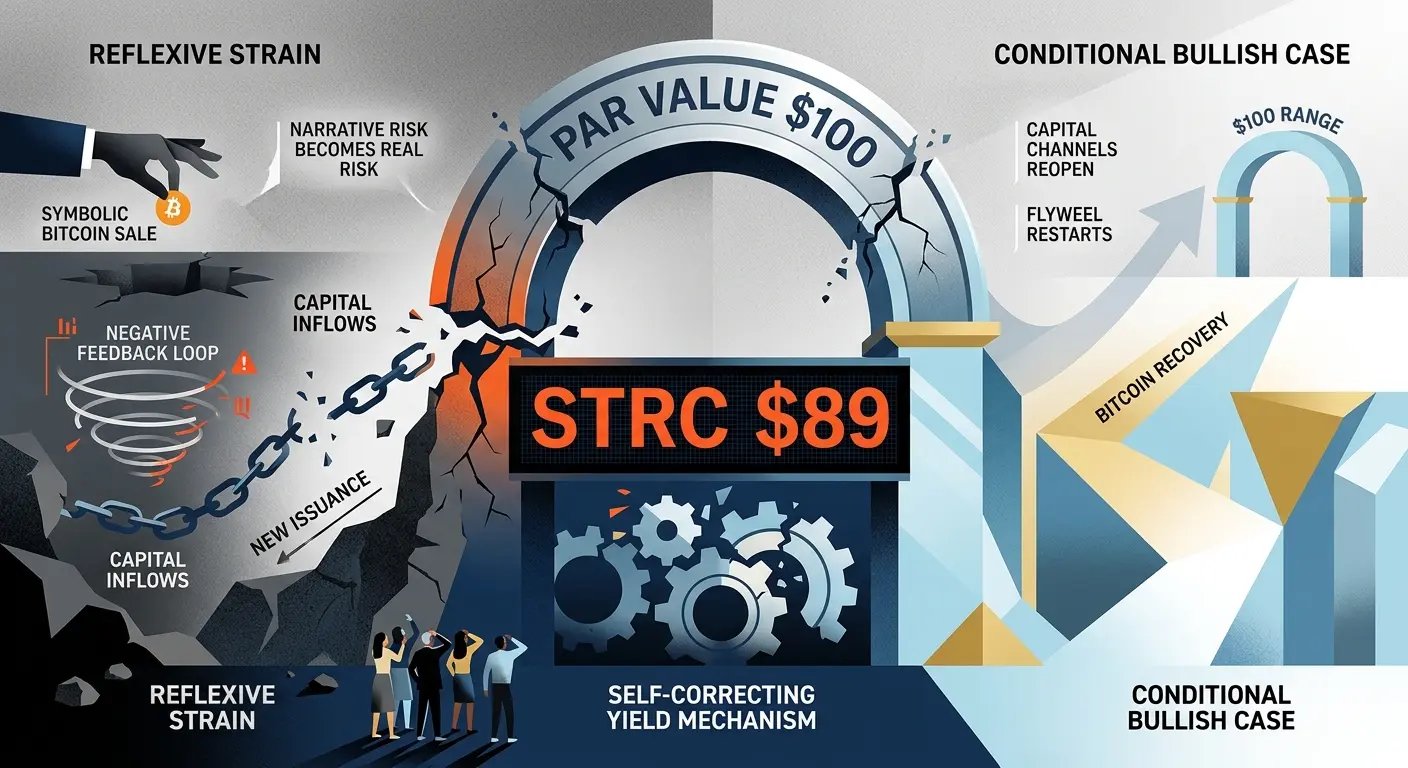
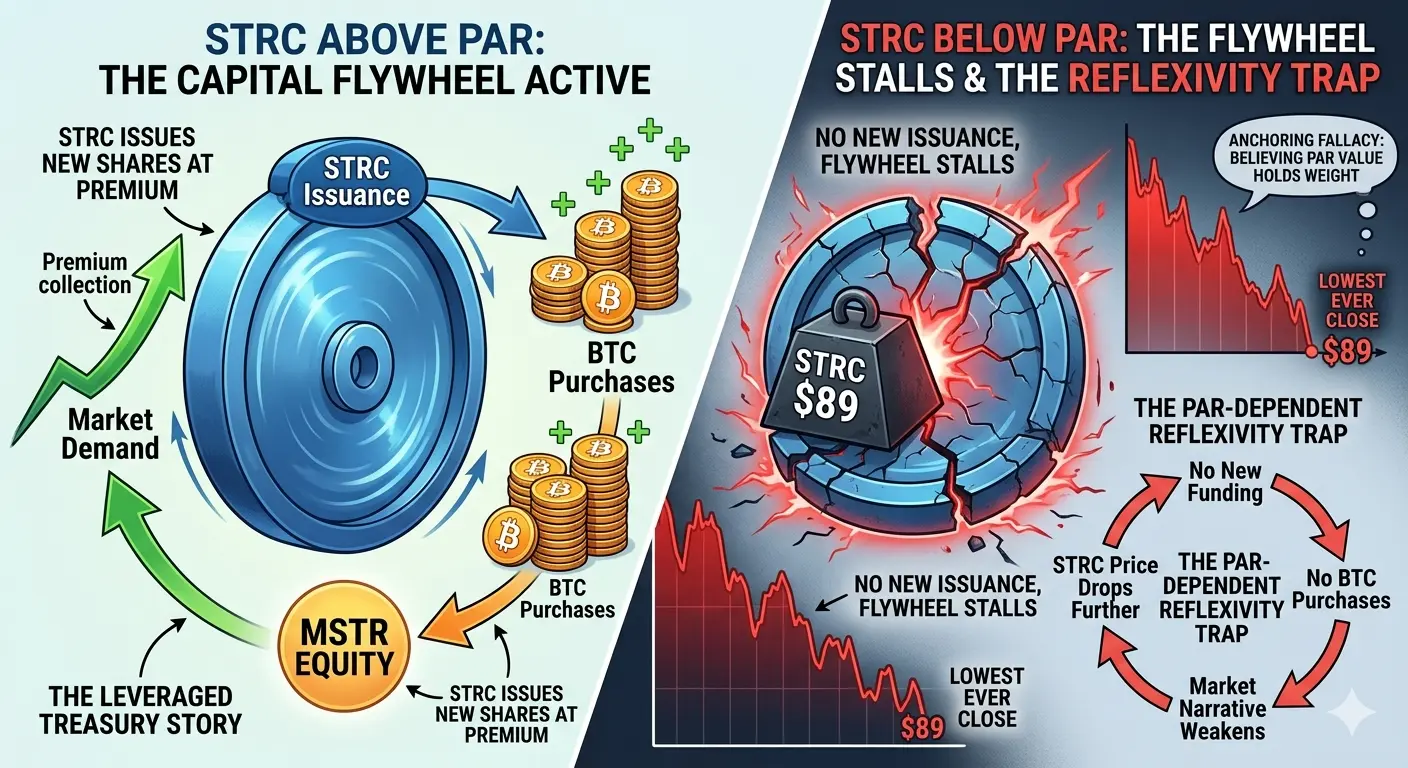
STRC is not just a yield instrument. It sits inside a larger capital system where its price determines whether new capital can be raised. When STRC trades above $100, issuance becomes attractive. Strategy collects premiums, deploys capital into Bitcoin, and reinforces the broader balance sheet narrative. But once the price slips below par, that loop weakens. Issuance slows, capital inflows reduce, and the internal funding engine loses efficiency.
This is where the structure starts to feel reflexive.
The instrument does not just respond to the system — it starts influencing whether the system can function at all.
At the center of this situation is a psychological error that markets repeat often: the belief that “par value” acts as a real floor. In reality, par is only a reference point written in documentation. The market does not respect labels. It respects cash flow, sustainability, and confidence in future funding conditions. When those expectations weaken, par becomes just another number on a screen.
Recent events added another layer of pressure. Strategy’s small Bitcoin sale to support dividend obligations, while minor in size compared to its total holdings, carried significant symbolic weight. Markets rarely react to size alone — they react to meaning. Even a small sale can challenge the “never-sell Bitcoin” perception and shift sentiment from confidence to caution.
This is where narrative risk becomes real risk.
Now the entire preferred ecosystem is under comparative pressure. STRC is no longer being judged in isolation. It is being measured against other crypto-linked yield instruments, where similar discounts and rising yields are appearing across the board. Once that comparison starts, the idea of “stable near-par yield” weakens across the entire category. It becomes less about one instrument and more about trust in the structure of the entire segment.
Still, the bullish case is not broken — but it is conditional.
If Bitcoin stabilizes and recovers, Strategy’s equity strength improves, and capital-raising channels reopen. In that environment, STRC yield becomes attractive again, new issuance restarts, and the system regains its internal balance. Historically, this type of leverage-based structure survives when the underlying asset trends upward long enough to restore confidence.
But the bearish case is equally mechanical.
If Bitcoin remains weak or trends lower, STRC staying below par becomes a prolonged problem. That directly limits funding capacity, which then increases reliance on reserves or equity dilution. In that scenario, the system enters a loop where maintaining payouts requires increasingly difficult capital decisions. Each month below par does not just reflect sentiment — it actively restricts financial flexibility.
This is the core tension: price determines function.
The next phase of this structure will likely depend on whether Bitcoin stabilizes and whether STRC can reclaim its par range with consistent demand. If it does, the flywheel restarts. If it doesn’t, the market may continue reassessing whether the original “self-correcting yield mechanism” is still valid under current conditions.
For now, STRC is no longer just trading below $100.
It is testing whether $100 still means anything.
#MyGateTradeStory
#PredictWorldCupShare20000U #PredictWorldCupWin40000U Gate_Square @GateSquare
repost-content-media
  • Reward
  • 24
  • Repost
  • Share
BlackoutCryptoBoy:
To The Moon 🌕
View More
#STRC跌破面值11%創上市新低
STRC Falls 11% Below Face Value, Hitting Record Low
What is STRC?
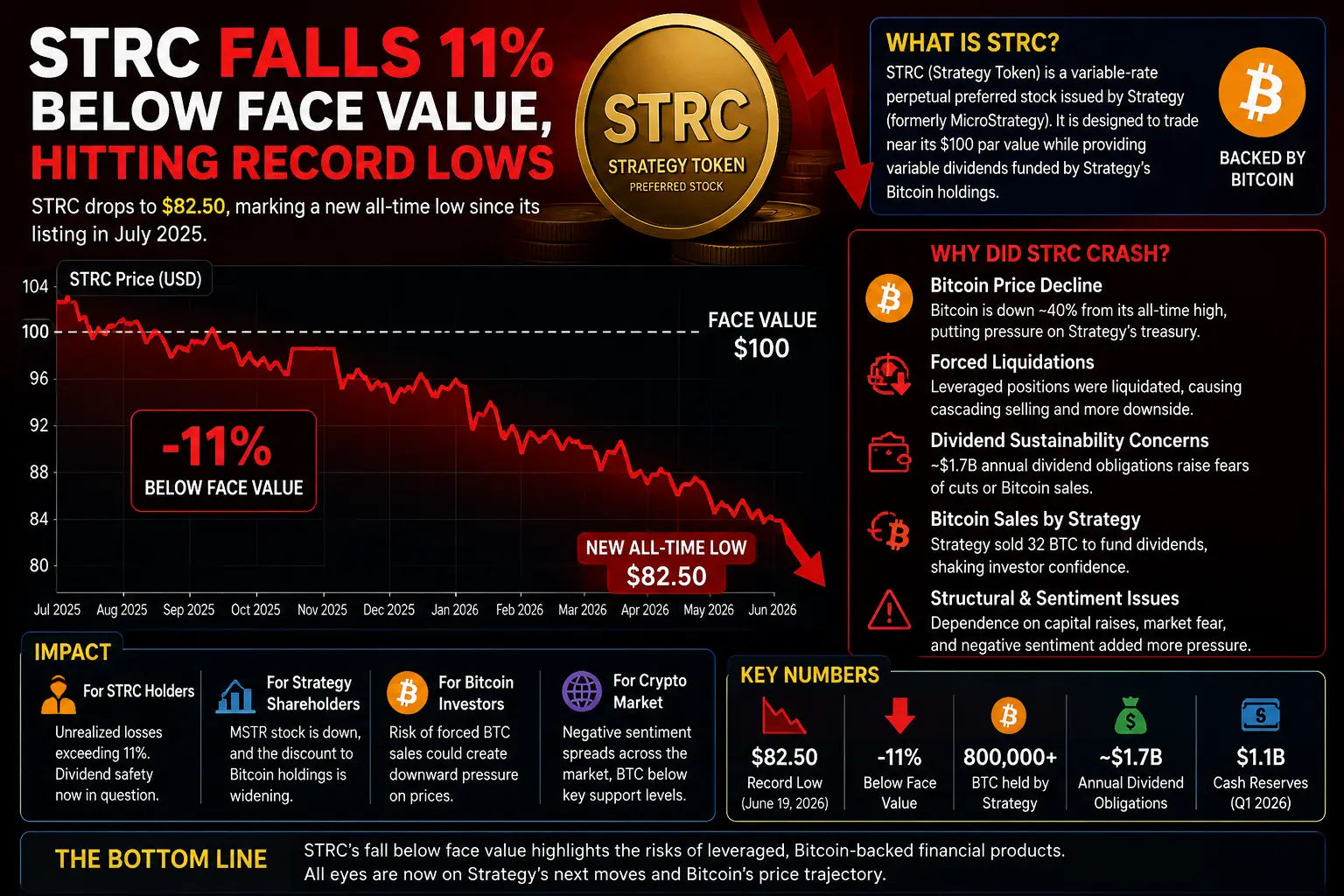
STRC is a variable-rate perpetual preferred stock issued by Strategy (formerly MicroStrategy), led by Michael Saylor. It was designed to trade near its 100 dollar par value while giving holders variable dividends backed by Strategy's massive Bitcoin treasury of over 800,000 coins. The idea was simple: investors get Bitcoin yields without directly holding Bitcoin, with the price staying stable around 100 dollars like a money-market instrument.
The Crash — Key Numbers
STRC crashed to a record low of 82.50 dolla
BTC-2.81%
ETH-5.36%
XRP-2.87%
HighAmbition
#STRC跌破面值11%創上市新低
STRC Falls 11% Below Face Value, Hitting Record Low
What is STRC?
STRC is a variable-rate perpetual preferred stock issued by Strategy (formerly MicroStrategy), led by Michael Saylor. It was designed to trade near its 100 dollar par value while giving holders variable dividends backed by Strategy's massive Bitcoin treasury of over 800,000 coins. The idea was simple: investors get Bitcoin yields without directly holding Bitcoin, with the price staying stable around 100 dollars like a money-market instrument.
The Crash — Key Numbers
STRC crashed to a record low of 82.50 dollars on June 19, 2026, more than 11% below its 100 dollar face value. It has not traded at par since mid-April 2025. Earlier in June it had already hit 88.59 dollars, then continued bleeding through 85.32 and 84 dollars intraday prints. Options traders are now building bearish positions around STRC, adding more downward pressure on an already collapsing instrument.
Why Did It Crash From Its Level?
First, Bitcoin itself dropped roughly 40% from its October 2025 all-time high, recently falling below 63,000 dollars toward the 60,000 level. Since STRC's entire value proposition depends on Strategy's Bitcoin treasury, the BTC decline directly shattered investor confidence in the instrument.
Second, forced liquidations of leveraged positions created a cascade. Many investors had entered STRC with leverage expecting the 100 dollar peg to hold. When prices started falling, margin calls triggered automatic selling, which drove prices even lower in a vicious feedback loop.
Third, dividend sustainability became a serious question. Strategy faces approximately 1.7 billion dollars in annual dividend obligations across its preferred instruments. Cash reserves at the end of Q1 were 1.1 billion dollars — enough for months but not for years. Investors now fear dividend cuts are inevitable.
Fourth, Strategy sold 32 Bitcoin between May 26 and May 31 for about 2.5 million dollars — its first BTC sale since 2022 — to fund STRC dividend distributions. While tiny relative to 800,000 total holdings, the psychological damage was enormous. Saylor had spent years telling holders to never sell Bitcoin, and this small sale shattered that narrative and spooked the market.
Fifth, structural flaws in STRC's design became apparent. The instrument relies on continuous capital raises and Bitcoin appreciation to sustain itself. In a declining Bitcoin market, this structure breaks down. JPMorgan analysts noted Strategy may need to rebuild dollar reserves to restore confidence, and they now see less than a 50% chance of the U.S. crypto market structure bill passing this year.
Effect on Investors and Traders
STRC holders who bought near par are sitting on losses exceeding 11% with potential for more downside. The instrument failed its core promise of stability near 100 dollars. Dividend-focused investors face the real possibility of reduced payments, which would eliminate STRC's primary attraction.
Strategy's common stock MSTR closed at 112.53 dollars, down 3.46%, and the discount between its market cap and Bitcoin holdings value keeps widening — investors are pricing in serious risk to the business model.
Bitcoin investors face indirect but meaningful pressure. If Strategy is forced to sell larger portions of its 800,000+ Bitcoin holdings to meet obligations, that creates substantial selling pressure on BTC prices. The small 32-coin sale already sent shockwaves; a larger liquidation would be far more damaging.
The broader crypto market shed 4% on the day STRC hit its record low. Ethereum and XRP both lost around 5%. Bitcoin broke below the 0.382 Fibonacci at 64,968 dollars, with the next defense at 62,725 dollars before a potential retest of the June low at 59,098 dollars.
Impact on Bitcoin Specifically
The direct price impact is already visible — Bitcoin fell back toward 60,000 dollars as Strategy concerns mounted. Traders are watching STRC as a leading indicator of pressure on Strategy, which could force BTC sales.
The psychological damage is significant too. Saylor was Bitcoin's most visible corporate advocate, and his company's difficulties raise questions about whether the corporate Bitcoin treasury model works during downturns.
Forced selling risk is the biggest threat. Strategy holds over 800,000 coins. Even a small percentage of forced liquidation could create heavy downward pressure on BTC, potentially triggering further cascade liquidations across leveraged crypto positions.
What Happens Next
Strategy attempted to restore confidence by buying 1,550 Bitcoin at an average of 65,332 dollars per coin in early June, funded through selling 1.4 million Class A shares. This signals that the accumulation strategy is still active and the small sale was structural necessity, not lost conviction.
However, the company faces critical dividend policy decisions. Cutting dividends would trigger more STRC selling. Raising fresh capital becomes harder as stock prices drop and investor appetite weakens.
Bitcoin's trajectory will determine STRC's fate. If BTC stabilizes and recovers, STRC may reclaim some value. If Bitcoin keeps falling, pressure intensifies on both fronts. Key technical levels to watch: 62,725 dollars as the last Fibonacci support, and 59,098 dollars as the June floor. Breaking below 59,000 could trigger broader market liquidations.
Conclusion
The STRC crash is a serious stress test for Bitcoin-backed financial instruments and Saylor's corporate treasury model. The 11% drop below par and the slide to 82.50 dollars reflect combined pressure from Bitcoin's decline, forced liquidations, dividend concerns, and structural weaknesses. The impact extends beyond STRC itself — Bitcoin prices and broader crypto sentiment are both affected. Investors should monitor STRC as a stress gauge for Strategy, since it serves as a leading indicator of potential BTC selling pressure. The core lesson: even the most sophisticated structures can break under market stress, and leverage always amplifies downside risk.
@Gate_Square
repost-content-media
  • Reward
  • 4
  • Repost
  • Share
Ai_Power:
To The Moon 🌕
View More
#STRC跌破面值11%創上市新低
STRC DEEP STRUCTURAL MARKET ANALYSIS AND LONG TERM RISK OUTLOOKMARKET BREAKDOWN CONTEXT AND STRUCTURAL SIGNALSTRC trading below its 100 dollar par value and closing at 89 dollars is not just a price move but a structural signal that market confidence in its stabilization mechanism is weakening. In instruments designed to hold near par value, sustained deviation below face value often reflects deeper concerns about liquidity support, redemption expectations, and whether yield alone is sufficient to anchor price behaviorThe fact that price has remained under pressure rather th
BTC-2.81%
  • Reward
  • 7
  • Repost
  • Share
cryptoStylish:
Ape In 🚀
View More
#STRC跌破面值11%創上市新低
When a product built to represent stability starts behaving like a high-volatility asset, markets pay attention.
That is exactly what is happening with STRC.
The variable-rate perpetual preferred stock issued by Strategy, the company formerly known as MicroStrategy under Michael Saylor, has become one of the most closely watched stress indicators in the crypto ecosystem. Designed to trade near its $100 par value while providing investors with dividend income supported by Strategy’s massive Bitcoin treasury, STRC was marketed as a bridge between traditional income investing a
BTC-2.81%
post-image
post-image
  • Reward
  • 6
  • Repost
  • Share
BlackBullion_Alpha:
Ape In 🚀
View More
#STRC跌破面值11%創上市新低
(STRC Breaks Below Par by 11%, Hits New All-Time Low)
STRC (Strategy’s perpetual preferred stock) recently broke below its $100 par value by approximately 11%, hitting a new low since listing. It is currently trading in the $83–88 range, drawing significant market attention amid Bitcoin price pressure.
What triggered this?
STRC was designed to trade near $100 par with a variable dividend rate (currently 11.5% annualized) to attract yield-seeking investors. Dividends are paid monthly. However, when Bitcoin corrects, leverage unwinds occur, and overall risk appetite declines,
BTC-2.81%
discovery
#STRC跌破面值11%創上市新低
(STRC Breaks Below Par by 11%, Hits New All-Time Low)
STRC (Strategy’s perpetual preferred stock) recently broke below its $100 par value by approximately 11%, hitting a new low since listing. It is currently trading in the $83–88 range, drawing significant market attention amid Bitcoin price pressure.
What triggered this?
STRC was designed to trade near $100 par with a variable dividend rate (currently 11.5% annualized) to attract yield-seeking investors. Dividends are paid monthly. However, when Bitcoin corrects, leverage unwinds occur, and overall risk appetite declines, STRC’s price comes under pressure. Recent leverage-driven selling appears to be a key factor.
What does this mean?
Higher effective yield: The price drop has pushed the effective yield up to around 12-13%, making it more attractive to some income-focused investors.
Risk signal: Sustained trading below par reflects growing market concerns about the issuer’s capital structure, Bitcoin holdings performance, and dividend sustainability.
Opportunity vs. risk: For long-term believers in Bitcoin and Strategy’s approach, this could be a discounted entry into a high-yield instrument. However, short-term volatility and liquidity risks remain.
How should investors approach it?
This product combines traditional finance yield characteristics with crypto exposure. Before participating, thoroughly assess leverage risks, the issuer’s Bitcoin reserves, interest rate environment, and your own risk tolerance. Diversification, clear stop-loss or exit rules, and close monitoring of macro and Bitcoin trends are still essential.
This adjustment in STRC once again reminds us that even instruments designed for “stable yield” can experience significant swings under market stress. Opportunities often come with risks — the key lies in rational analysis and disciplined execution.
What’s your take on STRC’s latest move? Buying opportunity or stay on the sidelines? Share your rational thoughts in the comments.
We’ll continue monitoring developments and broader market implications.
repost-content-media
  • Reward
  • 34
  • Repost
  • Share
Engin1979:
2026 GOGOGO 👊
View More
#STRC跌破面值11%創上市新低
STRC at $89: The Par Break That Exposes Strategy's Feedback Loop
When a stock designed to never drift from $100 closes at $89, something deeper than a bad trading day is unfolding. Strategy's STRC — the "Stretch" perpetual preferred engineered to hover around par via monthly rate adjustments — just hit its lowest close ever. The 11% discount to par isn't a pricing anomaly. It's the market telling you the mechanism itself is under strain.
Here's what most coverage misses: STRC isn't just a yield instrument. It's the capital flywheel's exhaust valve. When STRC trades above $10
BTC-2.81%
post-image
post-image
  • Reward
  • 6
  • Repost
  • Share
Raveena:
2026 GOGOGO 👊
View More
#STRC跌破面值11%創上市新低
📉 STRC Falls Below Par: A Warning Sign for Bitcoin-Backed Financial Products?
The crypto market has witnessed another major stress event as STRC, the variable-rate perpetual preferred stock issued by Strategy (formerly MicroStrategy), plunged to a record low and traded more than 11% below its $100 face value. What was once marketed as a relatively stable Bitcoin-linked income product is now facing intense scrutiny from investors and analysts alike.
STRC was designed to provide investors with exposure to Strategy's massive Bitcoin treasury while offering variable dividend in
BTC-2.81%
post-image
  • Reward
  • 5
  • Repost
  • Share
ThisIsTranslateContent::
Steadfast HODL💎
View More
Load More