

# MacroEconomy

4.58K
🇺🇸📊 U.S. Labor Market Surprises to the Upside — Strong Jobs Data Shakes Macro Expectations
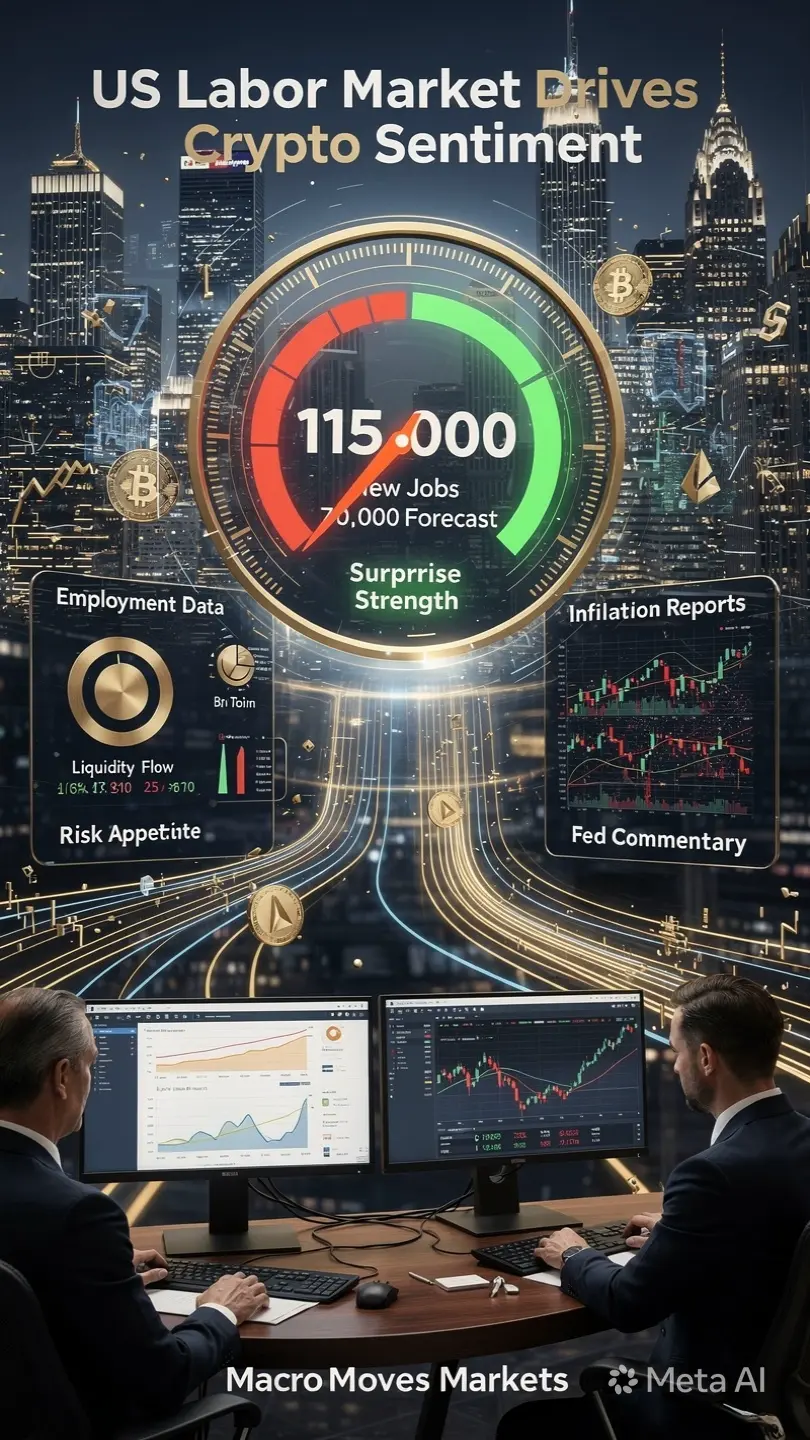
The latest U.S. employment report has come in much stronger than expected, adding 115,000 new jobs in April, compared to the forecast of 70,000. This upside surprise shows that the U.S. economy is still more resilient than many market participants were pricing in.
This kind of data is not just important for traditional markets — it is now a major driver for crypto sentiment as well.
What This Means for the Economy
A stronger labor market generally indicates:
Healthy job creation and business activit
BTC0.7%
post-image
  • Reward
  • Comment
  • Repost
  • Share
🇺🇸 U.S. Labor Market Surprise Strengthens Risk Appetite
The latest U.S. non-farm payrolls data came in significantly above expectations, with 115,000 new jobs added in April compared to the market forecast of 70,000. This stronger-than-expected employment growth signals that the U.S. economy remains more resilient than many analysts anticipated.
For crypto investors, macroeconomic data like this matters more than ever. A strong labor market can influence the Federal Reserve’s future interest rate decisions, liquidity expectations, and overall market sentiment across risk assets including Bit
BTC0.7%
post-image
  • Reward
  • 24
  • Repost
  • Share
MrFlower_XingChen:
To The Moon 🌕
View More
#ADPJobsShock #FedRateCutDelay #CryptoMarketReaction
The latest ADP employment data has once again reminded global markets that the U.S. economy is still running stronger than many analysts expected. Private sector hiring came in above forecasts, showing that businesses continue to expand despite high interest rates, inflation concerns, and ongoing global uncertainty. What many traders expected to be a clear signal for rapid Federal Reserve rate cuts has now turned into the opposite scenario.
A strong labor market usually means the Federal Reserve has less pressure to cut interest rates quickl
BTC0.7%
DOGE-0.99%
ALPH-4.6%
  • Reward
  • 3
  • Repost
  • Share
MasterChuTheOldDemonMasterChu:
Hop on now!🚗
View More
#IranUSConflictEscalates #MiddleEastTensions
#CryptoMarkets
Global financial systems are currently transitioning into a high-intensity macro volatility regime, where geopolitical developments in the Middle East are no longer acting as isolated news events but are instead functioning as system-wide liquidity disruptors that directly influence inflation expectations, capital allocation behavior, and institutional risk models across global markets.
What is increasingly evident is that markets are no longer reacting to events in a linear or technical manner. Instead, we are witnessing a multi-laye
Dubai_Prince
#IranUSConflictEscalates #MiddleEastTensions
#CryptoMarkets
Global financial systems are currently transitioning into a high-intensity macro volatility regime, where geopolitical developments in the Middle East are no longer acting as isolated news events but are instead functioning as system-wide liquidity disruptors that directly influence inflation expectations, capital allocation behavior, and institutional risk models across global markets.
What is increasingly evident is that markets are no longer reacting to events in a linear or technical manner. Instead, we are witnessing a multi-layered repricing cycle, where geopolitical uncertainty is being continuously absorbed into asset pricing through shifts in risk premium, liquidity distribution, and defensive capital rotation.
This is not a short-term reaction phase.
This is a macro structural transition period, where fear-based capital behavior is temporarily overriding traditional valuation logic across nearly all major asset classes.
---
1. OIL IS LEADING THE ENTIRE MACRO NARRATIVE
Crude oil continues to function as the most immediate and sensitive transmission channel for geopolitical instability, particularly in regions connected to strategic energy infrastructure and maritime shipping corridors.
In the current environment, oil is not merely responding to supply and demand fundamentals. Instead, it is actively pricing in forward-looking geopolitical probability scenarios, including disruption risk, shipping route insecurity, insurance cost escalation, and potential constraints on global energy flow continuity.
When geopolitical tension increases in energy-sensitive zones, oil markets rapidly reprice for:
Anticipated supply chain disruption risk
Increased maritime insurance premiums
Elevated shipping and logistics costs
Inflation acceleration expectations
Strategic hedging by institutional participants
Speculative futures positioning amplification
This behavior makes crude oil a leading macro fear indicator, rather than a lagging economic input.
Historically, sustained oil volatility has acted as a precursor to broader macro tightening cycles, as energy inflation directly feeds into consumer price indices, forcing central banks into more restrictive monetary policy stances.
As a result, oil is currently functioning as the primary upstream driver of global macro uncertainty transmission, influencing not only commodities but also equities, crypto assets, and fixed income expectations simultaneously.
---
2. GOLD IS BECOMING THE GLOBAL DEFENSIVE ANCHOR
Gold is once again reinforcing its role as a structural safe-haven asset during periods of macro instability, but the current cycle is notable for the scale and consistency of institutional accumulation behavior.
Unlike cyclical or speculative assets, gold benefits directly from systemic uncertainty through multiple reinforcing channels:
Capital preservation during risk-off rotations
Inflation hedge positioning under energy-driven CPI pressure
Currency instability hedging strategies
Central bank reserve diversification trends
Long-duration defensive capital allocation
In the present macro environment, gold is not merely reacting to volatility; it is acting as a capital gravity center, absorbing liquidity that exits risk-sensitive asset classes.
This reflects a broader structural truth: when macro uncertainty intensifies, capital does not disappear — it rotates toward stability-first instruments, and gold remains the most established global expression of that behavior.
The increasing allocation toward gold indicates that institutional participants are preparing for a prolonged uncertainty window rather than a short-lived shock event.
---
3. BITCOIN IS ENTERING A LIQUIDITY STRESS ENVIRONMENT
Bitcoin is currently operating within a highly sensitive macro liquidity framework, where price behavior is increasingly dictated by external macro shocks rather than internal market structure alone.
The current BTC environment reflects:
Elevated intraday volatility compression and expansion cycles
Increased sensitivity to geopolitical headlines
Reduced leverage confidence among short-term participants
Liquidity fragmentation across order books
Wider execution gaps during fast market movements
Bitcoin is effectively balancing between two competing macro forces:
On one side, a long-term structural bullish narrative driven by institutional adoption, ETF-driven inflows, and finite supply characteristics.
On the other side, a short-term liquidity contraction environment driven by geopolitical instability and tightening global financial conditions.
As long as key structural support zones remain intact, the broader macro trend structure has not been invalidated. However, the persistence of external shock events continues to suppress directional momentum expansion and reinforces range-bound behavior.
In this phase, Bitcoin behaves less like a speculative growth asset and more like a macro liquidity barometer reflecting global risk appetite in real time.
---
4. ETHEREUM IS SHOWING HIGHER VOLATILITY THAN BTC
Ethereum continues to demonstrate structurally higher volatility relative to Bitcoin, primarily due to its deeper exposure to speculative liquidity flows, decentralized application ecosystems, and derivative-driven trading activity.
Current ETH market behavior is characterized by:
Accelerated downside reactions during risk-off phases
Reduced marginal inflows from institutional participants compared to BTC
Higher sensitivity to liquidity contraction cycles
Strong dependence on Bitcoin stabilization for directional clarity
Amplified emotional trading behavior in retail segments
In macro tightening environments, Ethereum typically functions as a high-beta liquidity amplifier, meaning it reacts more aggressively than Bitcoin in both upward and downward movements.
This structural characteristic makes ETH more vulnerable during periods of geopolitical instability, as speculative capital tends to reduce exposure to higher-volatility assets first.
---
5. THE US DOLLAR IS QUIETLY CONTROLLING GLOBAL LIQUIDITY
One of the most underappreciated but dominant forces in the current macro environment is the strengthening role of the US dollar as a global liquidity anchor.
During periods of geopolitical uncertainty, global capital tends to migrate toward assets with the highest liquidity depth and settlement reliability, which positions the US dollar as the primary beneficiary of risk aversion flows.
A stronger dollar creates a cascading liquidity tightening effect across global markets, including:
Pressure on crypto asset valuations
Capital outflows from emerging markets
Reduced risk appetite in equities
Increased cost of dollar-denominated leverage
Constrained global liquidity expansion
This dollar strength effect operates as a hidden macro tightening mechanism, indirectly suppressing risk asset performance even in the absence of direct negative catalysts.
As a result, many of the current market fluctuations in crypto and equities are not isolated asset-specific movements, but rather reflections of global liquidity reallocation toward defensive monetary anchors.
---
6. MARKET PSYCHOLOGY HAS SHIFTED FROM GREED TO DEFENSE
The psychological structure of the market has undergone a clear transition from expansion-driven optimism to uncertainty-driven caution.
Current behavioral characteristics include:
Fear-based decision making replacing breakout chasing behavior
News-driven volatility dominating technical structure reliability
Faster liquidation cycles during downside movements
Declining leverage conviction among participants
Short-term uncertainty overriding long-term positioning logic
This psychological shift is critical because markets in this phase tend to exhibit non-linear price reactions, where small geopolitical developments can trigger disproportionately large short-term price movements.
In such environments, traditional technical analysis frameworks often lose predictive stability, as sentiment becomes the primary driver of liquidity flow rather than structural chart patterns.
---
7. CAPITAL ROTATION IS CLEARLY VISIBLE ACROSS ASSET CLASSES
Current global capital flow behavior demonstrates a clear and structured rotation pattern across major asset classes:
Gold: receiving defensive accumulation inflows
Oil: attracting geopolitical risk premium inflows
US Dollar: strengthening as global liquidity anchor
Bitcoin & Ethereum: experiencing short-term liquidity pressure
Equities: rotating toward defensive sectors over growth exposure
This rotation pattern is highly significant because it reflects not isolated sentiment shifts, but system-wide capital reallocation under uncertainty stress conditions.
Understanding this flow structure is significantly more important than focusing on individual asset price movements, because capital rotation defines the macro trend direction more accurately than technical indicators during volatile regimes.
---
8. FINAL MACRO OUTLOOK
Global markets are currently operating within a dual-layer uncertainty framework:
1. Geopolitical instability creating intermittent shock events
2. Liquidity recalibration driven by monetary tightening expectations and risk repricing
The next directional phase of global markets will depend primarily on two macro variables:
Whether geopolitical tensions escalate into sustained disruption or stabilize into managed containment
Whether global liquidity conditions begin to ease or remain structurally tight under inflation pressure
Until one of these variables shifts decisively, markets are expected to remain:
Structurally volatile
Highly news-sensitive
Liquidity-driven rather than valuation-driven
Emotionally reactive across short timeframes
Range-bound with sharp directional spikes
Historically, environments like this often represent the late accumulation phase of macro cycles, where institutional capital gradually builds positioning during uncertainty rather than during clarity.
Market history consistently shows that major long-term expansion phases rarely begin in comfort conditions.
They begin in periods where uncertainty is high, confidence is fragmented, and liquidity is uneven — exactly the type of environment currently unfolding.
1. Current conflict is not a regional event — it is a global liquidity transmission trigger
2. Oil is functioning as the primary leading indicator of macro stress
3. Gold is absorbing defensive capital as uncertainty rises
4. Bitcoin is transitioning into a macro liquidity sensitivity instrument
5. Ethereum is amplifying risk exposure due to higher beta structure
6. US dollar strength is acting as a silent global tightening mechanism
7. Market psychology has shifted decisively from risk-seeking to risk-defending
8. Capital rotation confirms institutional repositioning rather than retail-driven volatility
9. Market structure remains unstable but not broken — indicating compression phase
10. The next major trend will depend entirely on liquidity normalization or escalation continuation
---
FINAL CONCLUSION
This is not a directional market.
This is a macro compression regime defined by geopolitical uncertainty and liquidity redistribution, where price action is no longer driven by traditional technical structure but by real-time reassessment of global risk probabilities.
Until clarity emerges in either geopolitical stabilization or monetary liquidity expansion, markets will remain in a structurally reactive state, where volatility is persistent, direction is fragmented, and capital allocation is defensive rather than aggressive.
In such environments, survival is not about prediction accuracy.
It is about understanding where liquidity is moving before price fully reflects it.
---
#MacroEconomy #CryptoMarkets
  • Reward
  • Comment
  • Repost
  • Share
#IranUSConflictEscalates #MiddleEastTensions
#CryptoMarkets
Global financial systems are currently transitioning into a high-intensity macro volatility regime, where geopolitical developments in the Middle East are no longer acting as isolated news events but are instead functioning as system-wide liquidity disruptors that directly influence inflation expectations, capital allocation behavior, and institutional risk models across global markets.
What is increasingly evident is that markets are no longer reacting to events in a linear or technical manner. Instead, we are witnessing a multi-laye
  • Reward
  • 4
  • Repost
  • Share
ybaser:
2026 GOGOGO 👊
View More
#BrentOilRises
The movement behind #BrentOilRises is not an isolated commodity event—it is a macro signal with direct implications for crypto liquidity, inflation expectations, and global risk sentiment.
Recent data shows Brent crude pushing back toward the $95–$100 range following renewed geopolitical instability, particularly tied to disruptions around the Strait of Hormuz and escalating US–Iran tensions. At the same time, intraday spikes of 4–6% highlight how sensitive oil markets have become to even minor developments in the region.
The primary driver behind this surge is supply uncertain
post-image
  • Reward
  • 15
  • Repost
  • Share
HighAmbition:
Just charge it 👊
View More
🛢️ Oil prices are gaining attention today as they continue to fluctuate amid global economic and geopolitical developments.
Rising oil prices often signal increasing inflation pressure, which can indirectly impact financial markets—including crypto. When energy costs go up, investors tend to become more cautious, sometimes shifting their strategies between risk assets and safer options.
Interestingly, the crypto market doesn’t always react in a straightforward way. In some cases, Bitcoin is seen as a hedge, while in others it behaves more like a risk asset that follows broader market sentimen
XTIUSD-2.8%
post-image
  • Reward
  • Comment
  • Repost
  • Share
#FedRateHikeExpectationsResurface
Renewed momentum behind #FedRateHikeExpectationsResurface is once again shaping the direction of global financial markets. As inflation concerns linger and economic data remains mixed, expectations of tighter monetary policy are influencing investor sentiment across both traditional and digital assets.
Higher interest rates typically strengthen the appeal of low-risk instruments while reducing liquidity in risk-driven markets like crypto and equities. This shift often leads to cautious positioning, increased volatility, and short-term pullbacks as capital adj
post-image
  • Reward
  • 11
  • Repost
  • Share
Luna_Star:
Ape In 🚀
View More
Global Central Banks’ Decisions in Focus
Investors are closely watching upcoming interest-rate decisions from major central banks. These policies could significantly impact liquidity, inflation expectations, and risk assets including crypto.
If monetary policy turns supportive, digital assets may see stronger capital inflows.
#SevenCentralBanksRateDecision #MacroEconomy #CryptoMarket #GlobalFinance #Gateio
IN0.7%
MAJOR-3.43%
MAY0.83%
  • Reward
  • Comment
  • Repost
  • Share
#FederalReserveRateCutsAndPersonnelChanges
Markets are closely watching the Federal Reserve as expectations grow around potential rate cuts alongside possible personnel changes within the central bank.
Together, these factors could reshape policy direction, market sentiment, and risk appetite in the months ahead.
🏦 What’s Driving the Focus
Rate Cut Expectations: Cooling inflation and softer economic data are increasing speculation about policy easing
Leadership & Personnel Shifts: Any changes in key Fed positions may influence future policy tone
Forward Guidance: Markets are highly sensitive
ETH0.68%
BTC0.7%
  • Reward
  • Comment
  • Repost
  • Share
Load More