#TradFi交易分享挑战
#EthereumMarketWatch #ETHOutlook
Ethereum is entering a highly sensitive phase where market structure, institutional positioning, and macroeconomic pressure are colliding at the same time. After several weeks of unstable price movement, ETH continues trading inside a compressed range near the $2,080 region, reflecting a market that has not yet decided whether it wants to build a recovery structure or prepare for another downside expansion.
Over the last 24 hours, Ethereum briefly tested upper intraday liquidity zones near $2,140 before sellers regained control, pushing price action back toward the lower consolidation area. The reaction confirms that buyers still lack enough momentum to fully reverse the broader bearish structure that has dominated medium-term charts throughout May.
What makes the current setup especially important is the growing disconnect between market participation and price conviction.
Derivatives activity remains elevated, open interest continues holding near multi-week highs, and leveraged traders are still actively positioning around key levels. However, spot demand has weakened considerably compared to earlier phases of the rally. This imbalance often creates unstable trading conditions where volatility expands rapidly once support or resistance zones finally break.
From a technical perspective, Ethereum is currently sitting inside a compression structure that may soon trigger a larger directional move.
Momentum indicators continue showing weakness beneath the surface. RSI remains below the bullish expansion zone, suggesting buyers have not fully regained control. MACD structure has improved slightly compared to previous sessions, yet the overall momentum profile still lacks strong continuation signals. Trend strength indicators remain soft across both short-term and higher-timeframe charts, confirming that the market is still trapped inside a consolidation phase rather than a true trend reversal.
Moving averages also reveal an important detail many traders are watching closely.
Short-term averages are beginning to flatten near current price action, but medium- and long-term moving averages continue leaning downward. ETH remains below several major dynamic resistance levels, meaning every rebound attempt still faces heavy overhead pressure from trapped sellers and defensive positioning.
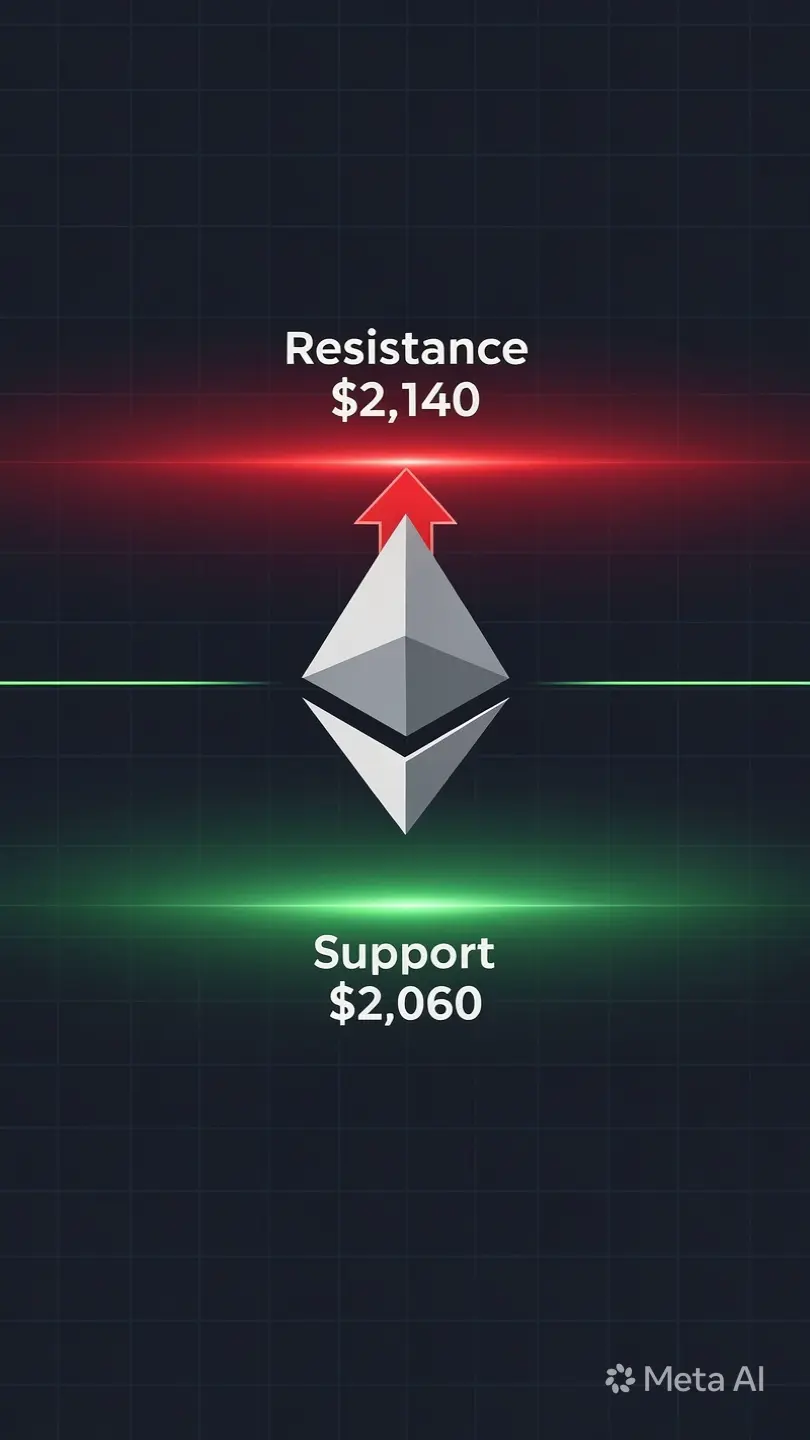
Several key price zones now define Ethereum’s short-term battlefield:
• The $2,060–$2,055 region remains the most important immediate support cluster.
This zone previously attracted dip buyers and aligns closely with short-term liquidity defense levels. A confirmed breakdown could expose ETH to accelerated selling pressure toward the psychological $2,000 area.
• The $2,088–$2,100 range continues acting as the first major resistance barrier.
This area combines upper volatility-band resistance with medium-term moving average pressure. Without strong volume expansion, bullish continuation above this region may remain difficult.
• The $2,140 level represents the primary breakout trigger for bulls.
If buyers reclaim this zone with momentum, short liquidations and renewed speculative participation could fuel a stronger upside recovery phase.
Beyond technical structure, macro conditions remain one of the largest variables influencing Ethereum’s direction.
Financial markets continue reacting aggressively to inflation data, Treasury yield movements, and shifting expectations surrounding monetary policy. Risk-sensitive assets such as crypto remain highly correlated to liquidity conditions, which means upcoming economic data releases may heavily influence Ethereum’s next major move.
At the same time, blockchain fundamentals remain surprisingly resilient.
Layer 2 adoption continues expanding rapidly, staking participation remains elevated, and institutional interest surrounding tokenized assets built on Ethereum infrastructure keeps growing. These long-term structural drivers continue supporting the broader Ethereum ecosystem even while short-term price action remains fragile.
Professional traders are now approaching the market with far more tactical discipline.
Instead of chasing emotional momentum, experienced participants are focusing on liquidity zones, volatility compression patterns, and macroeconomic timing. Many are waiting for confirmation before committing heavily in either direction.
Several strategies currently dominate professional positioning:
• Short-term range trading between compression zones
• Reduced leverage during macro uncertainty
• Watching for breakout confirmation above resistance
• Monitoring whale activity and exchange inflows carefully
• Preparing for increased volatility around upcoming economic reports
The most important reality about Ethereum’s current structure is this:
The market is no longer moving purely on hype.
It is reacting to institutional flows, liquidity conditions, derivatives positioning, macroeconomics, and real blockchain utility simultaneously. That combination creates a far more mature — but also far more demanding — trading environment.
And in phases like this, patience often becomes more valuable than prediction.
#EthereumMarketWatch #ETHOutlook
Ethereum is entering a highly sensitive phase where market structure, institutional positioning, and macroeconomic pressure are colliding at the same time. After several weeks of unstable price movement, ETH continues trading inside a compressed range near the $2,080 region, reflecting a market that has not yet decided whether it wants to build a recovery structure or prepare for another downside expansion.
Over the last 24 hours, Ethereum briefly tested upper intraday liquidity zones near $2,140 before sellers regained control, pushing price action back toward the lower consolidation area. The reaction confirms that buyers still lack enough momentum to fully reverse the broader bearish structure that has dominated medium-term charts throughout May.
What makes the current setup especially important is the growing disconnect between market participation and price conviction.
Derivatives activity remains elevated, open interest continues holding near multi-week highs, and leveraged traders are still actively positioning around key levels. However, spot demand has weakened considerably compared to earlier phases of the rally. This imbalance often creates unstable trading conditions where volatility expands rapidly once support or resistance zones finally break.
From a technical perspective, Ethereum is currently sitting inside a compression structure that may soon trigger a larger directional move.
Momentum indicators continue showing weakness beneath the surface. RSI remains below the bullish expansion zone, suggesting buyers have not fully regained control. MACD structure has improved slightly compared to previous sessions, yet the overall momentum profile still lacks strong continuation signals. Trend strength indicators remain soft across both short-term and higher-timeframe charts, confirming that the market is still trapped inside a consolidation phase rather than a true trend reversal.
Moving averages also reveal an important detail many traders are watching closely.
Short-term averages are beginning to flatten near current price action, but medium- and long-term moving averages continue leaning downward. ETH remains below several major dynamic resistance levels, meaning every rebound attempt still faces heavy overhead pressure from trapped sellers and defensive positioning.
Several key price zones now define Ethereum’s short-term battlefield:
• The $2,060–$2,055 region remains the most important immediate support cluster.
This zone previously attracted dip buyers and aligns closely with short-term liquidity defense levels. A confirmed breakdown could expose ETH to accelerated selling pressure toward the psychological $2,000 area.
• The $2,088–$2,100 range continues acting as the first major resistance barrier.
This area combines upper volatility-band resistance with medium-term moving average pressure. Without strong volume expansion, bullish continuation above this region may remain difficult.
• The $2,140 level represents the primary breakout trigger for bulls.
If buyers reclaim this zone with momentum, short liquidations and renewed speculative participation could fuel a stronger upside recovery phase.
Beyond technical structure, macro conditions remain one of the largest variables influencing Ethereum’s direction.
Financial markets continue reacting aggressively to inflation data, Treasury yield movements, and shifting expectations surrounding monetary policy. Risk-sensitive assets such as crypto remain highly correlated to liquidity conditions, which means upcoming economic data releases may heavily influence Ethereum’s next major move.
At the same time, blockchain fundamentals remain surprisingly resilient.
Layer 2 adoption continues expanding rapidly, staking participation remains elevated, and institutional interest surrounding tokenized assets built on Ethereum infrastructure keeps growing. These long-term structural drivers continue supporting the broader Ethereum ecosystem even while short-term price action remains fragile.
Professional traders are now approaching the market with far more tactical discipline.
Instead of chasing emotional momentum, experienced participants are focusing on liquidity zones, volatility compression patterns, and macroeconomic timing. Many are waiting for confirmation before committing heavily in either direction.
Several strategies currently dominate professional positioning:
• Short-term range trading between compression zones
• Reduced leverage during macro uncertainty
• Watching for breakout confirmation above resistance
• Monitoring whale activity and exchange inflows carefully
• Preparing for increased volatility around upcoming economic reports
The most important reality about Ethereum’s current structure is this:
The market is no longer moving purely on hype.
It is reacting to institutional flows, liquidity conditions, derivatives positioning, macroeconomics, and real blockchain utility simultaneously. That combination creates a far more mature — but also far more demanding — trading environment.
And in phases like this, patience often becomes more valuable than prediction.