


#eslaHolds11509BTCFor4Years
🪙 Tesla Holds 11,509 BTC for 4 Years, Loses $112M in One Quarter — And Still Won't Touch It
In February 2021, Elon Musk's Tesla announced a $1.5 billion Bitcoin purchase that sent BTC soaring 17% to a then-record $44,220 BBC. It was the moment corporate Bitcoin adoption went mainstream. Every S&P 500 fund holder suddenly had indirect BTC exposure. The crypto world celebrated a watershed moment.
Four years later, Tesla's Bitcoin story reads very differently. Q2 2026 results reveal a company still holding exactly 11,509 BTC — no buys, no sells, no moves since 2022. Meanwhile, BTC dropped 14% during Q2 from ~$83,000 to ~$58,000, triggering a $112 million after-tax impairment loss on the balance sheet. And the broader Tesla picture? Revenue beat at $28.2 billion (+26% YoY), but adjusted EPS of $0.33 missed expectations of $0.51 by 35%, operating margin collapsed to 1.4%, and free cash flow turned negative at -$1.092 billion Reuters Futunn.
Musk's BTC strategy has become the corporate equivalent of putting cash in a drawer and walking away.
The Accounting Reality Behind the $112M "Loss"
This impairment loss is an accounting artifact, not a realized loss. Under FASB fair-value accounting rules adopted in 2024, Tesla must mark its BTC holdings to the quarter-end price. Bitcoin closed Q2 at roughly $58,000. That price locked in a $112 million paper decline on the financial statements Cryptonomist. But by the time Tesla reported earnings, BTC had already rebounded to ~$65,840 — a recovery invisible to the quarterly report because accounting rules capture the snapshot, not the movie.
The key point: Tesla didn't sell. It didn't realize this loss in cash terms. The 11,509 BTC remain on the balance sheet, and at current prices (~$65,840), the position is worth approximately $758 million — still substantially above Tesla's average acquisition cost of ~$33,539 per BTC CoinGecko. Despite the headline impairment, Tesla's Bitcoin treasury still shows an unrealized gain of roughly $338 million (+87.5%) on its total investment of $386 million.
That's the paradox of this quarter's report: a $112 million "loss" on paper, while the underlying position remains deeply profitable in absolute terms.
Two Corporate Bitcoin Strategies, Two Completely Different Philosophies
The contrast between Tesla and Strategy (formerly MicroStrategy) is now the defining narrative of corporate BTC adoption.
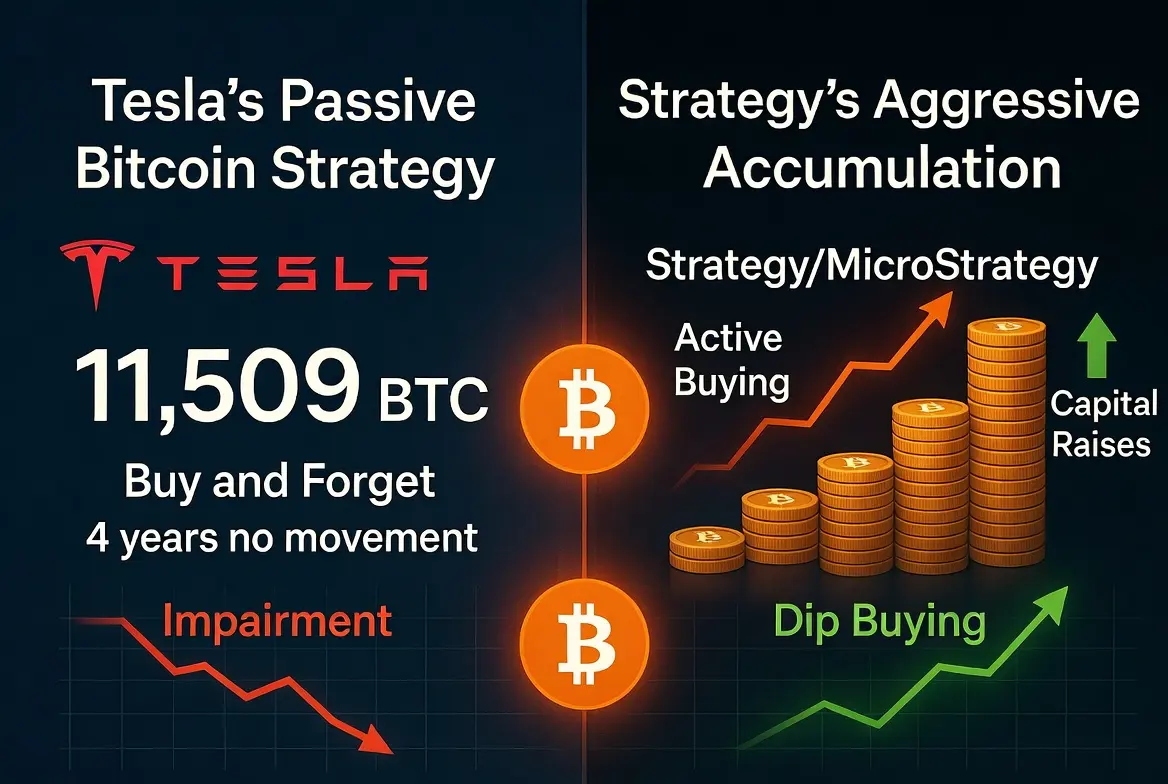
Strategy holds 843,775 BTC as of July 2026 — roughly 73 times Tesla's position. It has raised capital through equity issuances, convertible notes, and preferred stock specifically to accumulate more Bitcoin, treating BTC accumulation as the company's core strategy rather than a treasury diversification play Strategy. Even Strategy's recent sale of 3,588 BTC (less than 0.5% of holdings) was tactical — its first operational sale after years of pure accumulation Yahoo Finance.
Tesla's approach is the opposite end of the spectrum. The original 2021 purchase was framed as treasury diversification — an "alternative reserve asset" strategy to maximize returns on idle cash. Since then, Tesla has treated Bitcoin as a static balance sheet line item. No accumulation. No active management. No hedging. No selling. Just hold.
These aren't just different strategies — they reflect fundamentally different views of what Bitcoin means to a corporation:
Strategy's thesis: Bitcoin is the primary store of value and the best risk-adjusted asset for long-term capital allocation. Accumulate aggressively, fund purchases through capital markets, and let BTC appreciation drive shareholder value.
Tesla's thesis: Bitcoin is a diversification tool for treasury reserves. Buy once, hold passively, and accept the volatility as the cost of maintaining exposure to an alternative asset class.
Why "Buy and Forget" Has Costs
Passive holding avoids the risk of selling at the wrong time, but it also forgoes the benefits of active treasury management. During Q2's 14% BTC decline, Tesla absorbed the full impairment impact with no offset — no hedging, no rebalancing, no incremental accumulation at lower prices. Strategy, by contrast, continued buying through the downturn, adding 2,225 BTC at an average price of $60,773 during the quarter Strategy. That's accumulating at the dip while Tesla sat still.
The result: Strategy lowered its average cost and increased its BTC per share metric (7.8% BTC yield YTD), while Tesla's per-share BTC exposure remained flat. When BTC recovers — as it has, rebounding from $58,000 to $65,840 — Strategy captures amplified upside from the additional position. Tesla captures only the recovery on its static holdings.
There's also a signaling cost. Four years of zero activity communicates indifference, not conviction. Markets interpret active accumulation as institutional confidence in the asset. Tesla's silence communicates that Bitcoin is a sidelight, not a strategic priority — and that perception matters for how other corporations evaluate their own potential BTC allocations.
The Broader Tesla Financial Picture
Tesla's Bitcoin position is a sideshow to the company's main financial narrative. The Q2 results reveal a business spending aggressively on AI infrastructure, battery production, semiconductor development, and humanoid robot production lines — capex surged 142% YoY to $5.789 billion, driving FCF to -$1.092 billion. Operating margin collapsed to 1.4%. The CFO signaled that negative FCF will continue through the rest of 2026 Reuters.
Tesla is making its own version of the Big Tech AI capex bet — burning cash to build infrastructure before the revenue materializes. The $112 million BTC impairment is noise relative to the $1.1 billion core business cash burn. But both stories share a common thread: Tesla is investing (or holding investments) in long-term bets while short-term cash generation deteriorates.
Investment and Capital Efficiency Analysis
For Tesla shareholders, the Bitcoin holding represents about $758 million of value on a company with trailing 12-month revenue exceeding $100 billion. BTC exposure constitutes less than 1% of Tesla's market cap at current prices. The position is too small to materially drive shareholder value on its own — it's a treasury footnote, not a value driver.
For Bitcoin market participants, Tesla's 11,509 BTC holding matters more as a signal than as a position. At ~0.055% of Bitcoin's total supply, the direct market impact of Tesla selling would be manageable. But the psychological impact of a Musk-led corporate exit would be significant — it would undermine the narrative of institutional conviction that supports Bitcoin's premium valuation.
The unrealized gain of ~$338 million (87.5% return on $386 million invested) is solid but unremarkable for a four-year hold in a asset that went from $34,722 to $65,840. The same capital deployed in Tesla's own stock over that period would have generated very different returns depending on entry point. The Bitcoin allocation has outperformed cash but hasn't transformed Tesla's financial trajectory.
Short-Term Outlook
BTC's recovery to ~$65,840 already reverses a portion of the Q2 impairment. If BTC sustains current levels or continues recovering, Q3 2026 will show a reversal of the impairment loss on Tesla's balance sheet. But the broader crypto market remains fragile — Q2 2026 marked the third consecutive quarterly decline in total crypto market cap, which fell from $2.4 trillion to $2.1 trillion CoinGecko via Bitcoin Foundation. BTC at $58,000 in late June was less than half its 2025 record highs. The recovery is real but the downtrend isn't definitively broken.
Tesla's continued passive stance means the BTC position will continue generating quarterly volatility in reported earnings — gains when BTC rises, impairments when it falls — without any active management to smooth that impact.
Long-Term Outlook
The divergence between Strategy and Tesla will likely widen further. Strategy has committed to continuous accumulation through structured capital market programs. Tesla has committed to doing nothing. If BTC appreciates substantially over the next 3-5 years — as many analysts project, with targets ranging from $140K-$220K — Strategy's amplified position will generate outsized returns. Tesla's static 11,509 BTC position will appreciate in absolute terms but represent an increasingly small share of the company's total value as the core business (hopefully) grows.
The question for Tesla isn't whether to sell Bitcoin — selling at a gain after four years of volatile holding would signal poor conviction. The question is whether the current passive stance is optimal, or whether incremental accumulation during downturns (like Q2's $58K lows) would enhance long-term shareholder value. Musk hasn't answered that question, and the silence itself is a strategic position.
⚠️ Risk Considerations
Impairment volatility: Quarterly BTC price swings will continue creating volatile reported earnings impacts. With no hedging or active management, Tesla absorbs full price movement on its balance sheet.
Opportunity cost: Foregoing incremental accumulation during dips means missing the compounding benefit that Strategy captures through systematic buying.
Signaling risk: Prolonged inactivity communicates lack of conviction, potentially weakening the institutional BTC adoption narrative that Tesla's original 2021 purchase helped create.
Core business risk: Tesla's -$1.1B FCF and 1.4% operating margin are far more consequential than the BTC impairment. The AI/robotics investment thesis has no proven revenue model yet.
Market risk: BTC's Q2 decline and partial recovery occurred amid broader macro uncertainty. Another significant downturn could push the impairment far beyond $112 million in future quarters.
Liquidity risk: Tesla's 11,509 BTC are worth ~$758 million — a significant liquidity reserve that could theoretically be deployed for core business needs if FCF remains negative, but selling would carry reputational and market impact costs.
💬 Tesla's Bitcoin has been frozen for four years. Is "buy and forget" the right corporate treasury strategy — or does Strategy's relentless accumulation prove that active conviction creates more value? Should Musk add to the position at current prices, or is the BTC chapter of Tesla's story effectively closed? Let's debate this below.
#TeslaHolds11509BTCFor4Years
🪙 Tesla Holds 11,509 BTC for 4 Years, Loses $112M in One Quarter — And Still Won't Touch It
In February 2021, Elon Musk's Tesla announced a $1.5 billion Bitcoin purchase that sent BTC soaring 17% to a then-record $44,220 BBC. It was the moment corporate Bitcoin adoption went mainstream. Every S&P 500 fund holder suddenly had indirect BTC exposure. The crypto world celebrated a watershed moment.
Four years later, Tesla's Bitcoin story reads very differently. Q2 2026 results reveal a company still holding exactly 11,509 BTC — no buys, no sells, no moves since 2022. Meanwhile, BTC dropped 14% during Q2 from ~$83,000 to ~$58,000, triggering a $112 million after-tax impairment loss on the balance sheet. And the broader Tesla picture? Revenue beat at $28.2 billion (+26% YoY), but adjusted EPS of $0.33 missed expectations of $0.51 by 35%, operating margin collapsed to 1.4%, and free cash flow turned negative at -$1.092 billion Reuters Futunn.
Musk's BTC strategy has become the corporate equivalent of putting cash in a drawer and walking away.
The Accounting Reality Behind the $112M "Loss"
This impairment loss is an accounting artifact, not a realized loss. Under FASB fair-value accounting rules adopted in 2024, Tesla must mark its BTC holdings to the quarter-end price. Bitcoin closed Q2 at roughly $58,000. That price locked in a $112 million paper decline on the financial statements Cryptonomist. But by the time Tesla reported earnings, BTC had already rebounded to ~$65,840 — a recovery invisible to the quarterly report because accounting rules capture the snapshot, not the movie.
The key point: Tesla didn't sell. It didn't realize this loss in cash terms. The 11,509 BTC remain on the balance sheet, and at current prices (~$65,840), the position is worth approximately $758 million — still substantially above Tesla's average acquisition cost of ~$33,539 per BTC CoinGecko. Despite the headline impairment, Tesla's Bitcoin treasury still shows an unrealized gain of roughly $338 million (+87.5%) on its total investment of $386 million.
That's the paradox of this quarter's report: a $112 million "loss" on paper, while the underlying position remains deeply profitable in absolute terms.
Two Corporate Bitcoin Strategies, Two Completely Different Philosophies
The contrast between Tesla and Strategy (formerly MicroStrategy) is now the defining narrative of corporate BTC adoption.
Strategy holds 843,775 BTC as of July 2026 — roughly 73 times Tesla's position. It has raised capital through equity issuances, convertible notes, and preferred stock specifically to accumulate more Bitcoin, treating BTC accumulation as the company's core strategy rather than a treasury diversification play Strategy. Even Strategy's recent sale of 3,588 BTC (less than 0.5% of holdings) was tactical — its first operational sale after years of pure accumulation Yahoo Finance.
Tesla's approach is the opposite end of the spectrum. The original 2021 purchase was framed as treasury diversification — an "alternative reserve asset" strategy to maximize returns on idle cash. Since then, Tesla has treated Bitcoin as a static balance sheet line item. No accumulation. No active management. No hedging. No selling. Just hold.
These aren't just different strategies — they reflect fundamentally different views of what Bitcoin means to a corporation:
Strategy's thesis: Bitcoin is the primary store of value and the best risk-adjusted asset for long-term capital allocation. Accumulate aggressively, fund purchases through capital markets, and let BTC appreciation drive shareholder value.
Tesla's thesis: Bitcoin is a diversification tool for treasury reserves. Buy once, hold passively, and accept the volatility as the cost of maintaining exposure to an alternative asset class.
Why "Buy and Forget" Has Costs
Passive holding avoids the risk of selling at the wrong time, but it also forgoes the benefits of active treasury management. During Q2's 14% BTC decline, Tesla absorbed the full impairment impact with no offset — no hedging, no rebalancing, no incremental accumulation at lower prices. Strategy, by contrast, continued buying through the downturn, adding 2,225 BTC at an average price of $60,773 during the quarter Strategy. That's accumulating at the dip while Tesla sat still.
The result: Strategy lowered its average cost and increased its BTC per share metric (7.8% BTC yield YTD), while Tesla's per-share BTC exposure remained flat. When BTC recovers — as it has, rebounding from $58,000 to $65,840 — Strategy captures amplified upside from the additional position. Tesla captures only the recovery on its static holdings.
There's also a signaling cost. Four years of zero activity communicates indifference, not conviction. Markets interpret active accumulation as institutional confidence in the asset. Tesla's silence communicates that Bitcoin is a sidelight, not a strategic priority — and that perception matters for how other corporations evaluate their own potential BTC allocations.
The Broader Tesla Financial Picture
Tesla's Bitcoin position is a sideshow to the company's main financial narrative. The Q2 results reveal a business spending aggressively on AI infrastructure, battery production, semiconductor development, and humanoid robot production lines — capex surged 142% YoY to $5.789 billion, driving FCF to -$1.092 billion. Operating margin collapsed to 1.4%. The CFO signaled that negative FCF will continue through the rest of 2026 Reuters.
Tesla is making its own version of the Big Tech AI capex bet — burning cash to build infrastructure before the revenue materializes. The $112 million BTC impairment is noise relative to the $1.1 billion core business cash burn. But both stories share a common thread: Tesla is investing (or holding investments) in long-term bets while short-term cash generation deteriorates.
Investment and Capital Efficiency Analysis
For Tesla shareholders, the Bitcoin holding represents about $758 million of value on a company with trailing 12-month revenue exceeding $100 billion. BTC exposure constitutes less than 1% of Tesla's market cap at current prices. The position is too small to materially drive shareholder value on its own — it's a treasury footnote, not a value driver.
For Bitcoin market participants, Tesla's 11,509 BTC holding matters more as a signal than as a position. At ~0.055% of Bitcoin's total supply, the direct market impact of Tesla selling would be manageable. But the psychological impact of a Musk-led corporate exit would be significant — it would undermine the narrative of institutional conviction that supports Bitcoin's premium valuation.
The unrealized gain of ~$338 million (87.5% return on $386 million invested) is solid but unremarkable for a four-year hold in a asset that went from $34,722 to $65,840. The same capital deployed in Tesla's own stock over that period would have generated very different returns depending on entry point. The Bitcoin allocation has outperformed cash but hasn't transformed Tesla's financial trajectory.
Short-Term Outlook
BTC's recovery to ~$65,840 already reverses a portion of the Q2 impairment. If BTC sustains current levels or continues recovering, Q3 2026 will show a reversal of the impairment loss on Tesla's balance sheet. But the broader crypto market remains fragile — Q2 2026 marked the third consecutive quarterly decline in total crypto market cap, which fell from $2.4 trillion to $2.1 trillion CoinGecko via Bitcoin Foundation. BTC at $58,000 in late June was less than half its 2025 record highs. The recovery is real but the downtrend isn't definitively broken.
Tesla's continued passive stance means the BTC position will continue generating quarterly volatility in reported earnings — gains when BTC rises, impairments when it falls — without any active management to smooth that impact.
Long-Term Outlook
The divergence between Strategy and Tesla will likely widen further. Strategy has committed to continuous accumulation through structured capital market programs. Tesla has committed to doing nothing. If BTC appreciates substantially over the next 3-5 years — as many analysts project, with targets ranging from $140K-$220K — Strategy's amplified position will generate outsized returns. Tesla's static 11,509 BTC position will appreciate in absolute terms but represent an increasingly small share of the company's total value as the core business (hopefully) grows.
The question for Tesla isn't whether to sell Bitcoin — selling at a gain after four years of volatile holding would signal poor conviction. The question is whether the current passive stance is optimal, or whether incremental accumulation during downturns (like Q2's $58K lows) would enhance long-term shareholder value. Musk hasn't answered that question, and the silence itself is a strategic position.
⚠️ Risk Considerations
Impairment volatility: Quarterly BTC price swings will continue creating volatile reported earnings impacts. With no hedging or active management, Tesla absorbs full price movement on its balance sheet.
Opportunity cost: Foregoing incremental accumulation during dips means missing the compounding benefit that Strategy captures through systematic buying.
Signaling risk: Prolonged inactivity communicates lack of conviction, potentially weakening the institutional BTC adoption narrative that Tesla's original 2021 purchase helped create.
Core business risk: Tesla's -$1.1B FCF and 1.4% operating margin are far more consequential than the BTC impairment. The AI/robotics investment thesis has no proven revenue model yet.
Market risk: BTC's Q2 decline and partial recovery occurred amid broader macro uncertainty. Another significant downturn could push the impairment far beyond $112 million in future quarters.
Liquidity risk: Tesla's 11,509 BTC are worth ~$758 million — a significant liquidity reserve that could theoretically be deployed for core business needs if FCF remains negative, but selling would carry reputational and market impact costs.
💬 Tesla's Bitcoin has been frozen for four years. Is "buy and forget" the right corporate treasury strategy — or does Strategy's relentless accumulation prove that active conviction creates more value? Should Musk add to the position at current prices, or is the BTC chapter of Tesla's story effectively closed? Let's debate this below.
#TeslaHolds11509BTCFor4Years