Users who have completed KYC 2, reached a security score of 80 or above, and keep a normal account status can follow the App and Web activation steps to join for free. Activation does not move the plan straight into Protection Active; a 30-day Security Hardening Period comes first. Status can later shift among Protection Active, Plan Suspended, and Plan Ended as the security score changes. The sections below cover coverage boundaries, the status flow, activation requirements, how Gate Guard differs from Gate SAFU, and what to check before applying for reimbursement.
Key Takeaways
- Gate Guard and the Gate Account Protection Plan refer to the same mechanism; coverage targets verifiable direct losses from unauthorized transfers. Eligibility to apply for reimbursement does not mean reimbursement is confirmed.
- It is not an insurance product: it does not create an insurance contract, insurance arrangement, or promise of reimbursement; review follows the Plan Rules and Gate’s investigation.
- After activation, the plan enters the Security Hardening Period; Protection Active begins only after the security score stays at 80 or above for 30 consecutive days.
- If the score falls below 80, the plan becomes Plan Suspended; restoring 80 or above within 48 hours restarts Security Hardening, while failure to restore ends the plan.
- Per-event reimbursement ceilings follow VIP level at the time of the event; a ceiling is not a guaranteed amount. Lifetime cumulative cover is 2× the per-event ceiling, shared by main and sub-accounts under the same KYC.
What Is Gate Guard?
Gate Guard is Gate’s account protection mechanism. Product and rules pages use the formal name Gate Account Protection Plan. Gate Guard is the common product label; Gate Account Protection Plan is the formal name in rules and agreements—both refer to the same plan.
The loss type in scope is direct loss when another party transfers assets from a Gate account without authorization. Qualifying security events may be submitted for reimbursement review; the ability to apply is not confirmation of payment. Announcements and the product page also stress free activation for eligible users, plus security score, KYC, and account-status prerequisites, so the plan is not read as a paid policy or automatic payout.
Gate Guard is a supplementary layer above everyday account controls: passkeys, authenticators, and withdrawal limits reduce theft risk first, then plan status decides which events can enter review. Day-to-day settings follow the account security settings checklist; the full rule text is the Gate Account Protection Plan Rules.
What Does It Cover? Applicable vs Not Applicable
The applicability boundary centers on another party controlling the account and moving assets out—not on whether the user simply “felt scammed.” Product-page examples include phishing, malware, or remote control that compromises account information, and a lost phone, SIM theft, or fraudulent SIM replacement that lets someone else control the account. The rules page adds that related transfers may occur via on-chain withdrawal, GatePush, or GateCode, and that losses must be verifiable direct asset losses.
Not-applicable cases are equally explicit: transfers the user initiated, authorized, or confirmed; transfers authorized after deception or inducement; operational mistakes; and market-fluctuation losses. The rules page also excludes whitelist or password-free withdrawals, assets in Web3 wallets or cross-exchange accounts, API or Agent withdrawals or trades, red packets, tips, C2C (P2P) and similar channels, and cases where only trading, conversion, or price change occurs without assets leaving the platform.
| Dimension |
Typically within review discussion |
Typically not applicable |
| Control |
Another party logs in or controls the account without authorization and transfers assets |
User-initiated, authorized, confirmed, or actively participated transfers |
| Common scenarios |
Phishing, malware, or remote control; lost phone, SIM theft, or fraudulent SIM replacement |
User confirmation after social engineering; operational errors; market volatility |
| Loss type |
Verifiable direct net asset loss |
Indirect loss, expected profit, or opportunity cost |
| Plan status |
Protection Active when the event occurs |
Security Hardening Period, Plan Suspended, Plan Ended, or not yet effective |
The table is a scan aid only; final applicability follows the service agreement, Plan Rules, and Gate’s review. If the user still completes OTP, face check, or other confirmation after being induced, the rules page treats that as user-authorized activity, not unauthorized third-party control.
Why Is Protection Not Active Immediately? How Plan Status Changes
Successful activation does not mean protection is already active. Announcements and the product page state that activation starts the Security Hardening Period, during which protection is not yet in force. The security score must remain at 80 or above for 30 consecutive days, and related conditions must be met, before Protection Active. Only events that occur while Protection Active and that meet the rules may be submitted; events during Security Hardening, Plan Suspended, or Plan Ended cannot.
The four statuses form a readable state machine: Activate → Security Hardening → Protection Active; a score below 80 moves the plan to Plan Suspended; if the score is still below 80 after 48 hours, the plan becomes Plan Ended. Restoring 80 or above within 48 hours re-enters Security Hardening and resets consecutive qualifying days to zero. Changes that weaken security protections reset the consecutive-day counter; changes that strengthen protections do not.
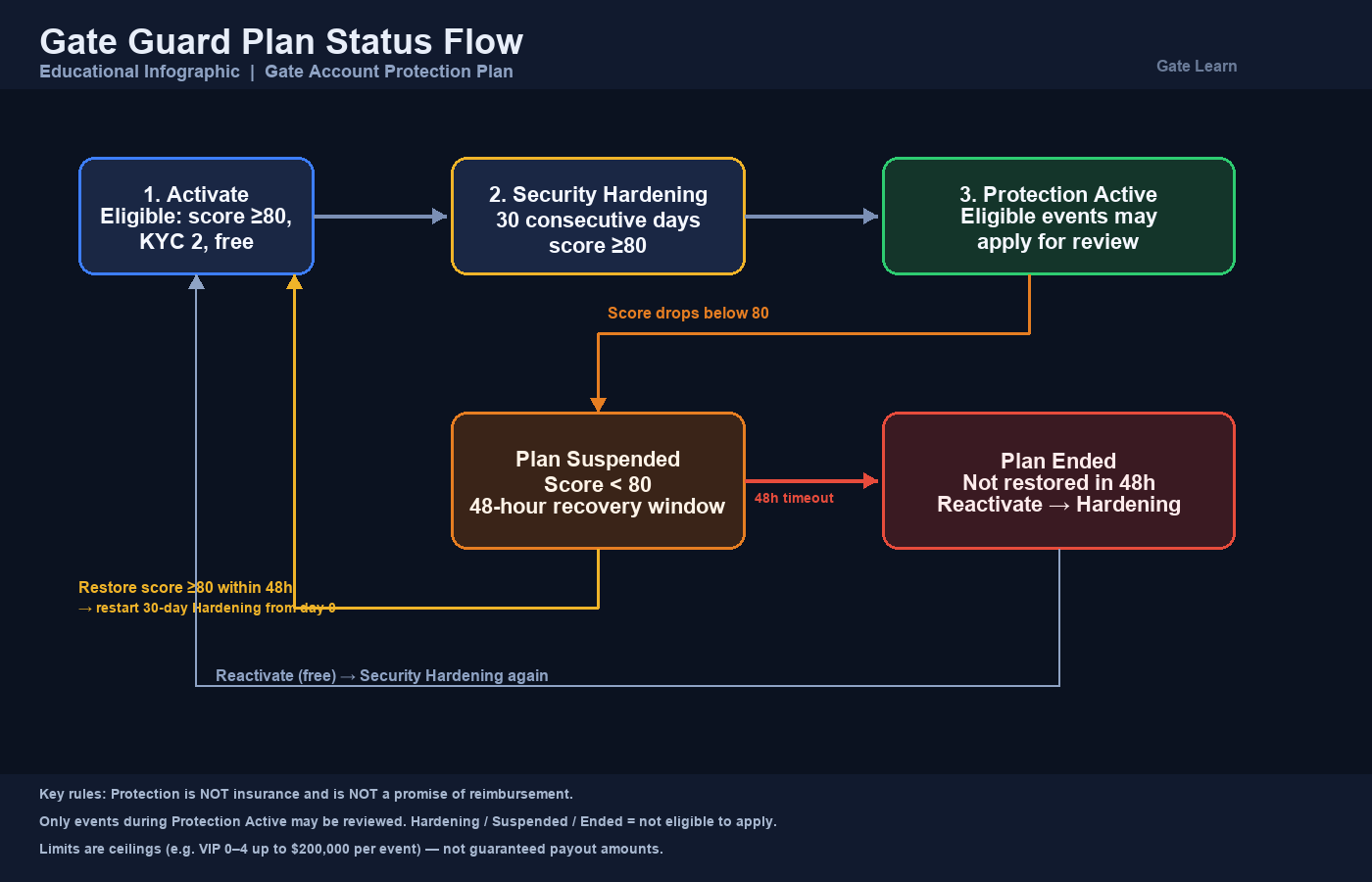
Figure 1. Gate Guard plan status flow: Activate → Security Hardening → Protection Active; a score drop suspends the plan; restore within 48 hours to restart hardening, or the plan ends.
Practically, users must keep the security score and key settings intact rather than treat a single activation click as permanent cover. The plan has no fixed calendar term; continuity depends on the score staying at 80 or above, with suspension and end rules when it falls. The Gate Guard product page shows the current plan status.
What Are the Requirements to Activate?
Activation requirements match across the announcement and rules pages: a security score of 80 or above; completed KYC 2 identity verification; required security verifications with normal account status; and other platform risk-control, regional, and eligibility conditions. If the score is below 80, users can improve settings in Security Center and apply once the threshold is met.
Eligible users can activate free of charge on the Gate App or Web—no paid purchase is required. App/Web entry points and “boost security score” paths are operational detail; this article locks eligibility and the boundary that activation is not immediate Protection Active.
Main and sub-accounts are assessed separately for activation and plan status: a main account in Protection Active does not automatically activate a sub-account. The account that actually transferred assets must itself be Protection Active when the event occurs. Reimbursement ceilings are shared across the main account and all sub-accounts under the same KYC, as in the limit table below.
How Is Gate Guard Different from Gate SAFU?
Gate SAFU (Secure Asset Fund for Users) is a platform-level user asset security fund, mainly an extra financial buffer for major or extreme scenarios such as cyberattacks or liquidity crises; users generally do not need to “buy” the fund itself. Gate Guard is an account-level protection mechanism for qualifying unauthorized account transfers. Eligible users must activate it, and coverage follows the security score, hardening period, and plan status.
| Comparison |
Gate Guard (Account Protection Plan) |
Gate SAFU |
| Layer |
Account-level protection mechanism |
Platform-level security fund |
| Primary scenarios |
Qualifying unauthorized account transfers |
Major platform security or extreme events |
| Activation |
Free activation for eligible users |
Fund itself usually needs no separate purchase |
| Effective logic |
Protection Active after a 30-day Security Hardening Period |
Follows SAFU disclosures and incident review |
| Insurance |
Explicitly not insurance and not a promise of reimbursement |
Should not be read as a traditional insurance policy either |
The two can coexist in Gate’s broader security stack but do not replace each other. For platform-level extreme-event buffers, look to SAFU; for individual unauthorized-transfer review entry, look to Gate Guard. App and Web steps follow the Gate Guard Activation Guide.
What Should You Know Before Applying for Reimbursement?
Before applying, check eligibility points—do not treat the ceiling table as a promised payout. When the event occurs, the account must be Protection Active; for the prior 30 consecutive days the security score must stay at 80 or above and key settings must continue to meet requirements; the event must be in scope; the loss must be a verifiable direct asset loss; the application must be filed within 45 days; and within 45 days the user must file a local police report and provide Gate an English copy. The rules page also requires truthful KYC identity, normal account status, accurate materials and cooperation with investigation, plus timely steps after anomalies to limit further loss.
Per-event reimbursement ceilings follow VIP level at the time of the event (experience-card VIP levels excluded). The figures below are maximum ceilings and do not mean a user will receive that amount:
| VIP level |
Per-event reimbursement ceiling |
| VIP 0–4 |
Up to $200,000 |
| VIP 5–10 |
Up to $300,000 |
| VIP 11–14 |
Up to $500,000 |
| VIP 15–16 |
Up to $1,000,000 |
Main and all sub-accounts under the same KYC share the per-event ceiling; the lifetime cumulative ceiling is 2× the per-event ceiling. Multiple abnormal transfers from the same cause, attack chain, or related activity may be combined as one event. Actual reimbursement is the lowest of verified direct net asset loss, remaining per-event headroom, and remaining lifetime headroom; recovered, frozen, returned, or restorable assets are excluded from net loss. Submitting an application does not guarantee payment; Gate’s final review controls the outcome.
Summary
Gate Guard is the Gate Account Protection Plan: an account-level mechanism that opens a review path for direct losses from unauthorized transfers, while stating clearly that it is not insurance and not a promise of reimbursement. Activation is free for users who meet security-score, KYC 2, and account-status requirements, but Protection Active only follows a 30-day Security Hardening Period. A score below 80 suspends the plan; the 48-hour window decides whether hardening restarts or the plan ends. Coverage boundaries, VIP ceiling tables, and the 45-day application and police-report clocks form the pre-claim checklist. Gate Guard and Gate SAFU sit at account and platform-fund layers and should not be treated as the same product.
FAQ
What is Gate Guard, and is it the same as the Account Protection Plan?
Yes. Gate Guard is the common product name, and Gate Account Protection Plan is the formal name used in rules and agreements. Both refer to Gate’s account protection mechanism.
Is Gate Guard insurance? Does activation guarantee reimbursement?
No. Gate Guard is not an insurance product and does not constitute an insurance contract, any form of insurance arrangement, or a promise of reimbursement. Qualifying events may be submitted for review; whether reimbursement is granted and at what amount depends on Gate’s final review. The right to apply is not a guarantee of payment.
Does protection become active immediately after activation? Can losses during Security Hardening be claimed?
No. After activation the plan enters the Security Hardening Period; Protection Active requires the security score to stay at 80 or above for 30 consecutive days. Events during Security Hardening, Plan Suspended, or Plan Ended cannot be submitted for reimbursement.
How does Gate Guard differ from Gate SAFU?
Gate Guard is account-level cover for qualifying unauthorized transfers and requires eligible users to activate and complete hardening. SAFU is a platform-level security fund mainly for major or extreme platform security scenarios and generally does not require a separate fund purchase. The two should not share the same expectations.
If someone is tricked into confirming a transfer, or the plan is still in Security Hardening, can they receive reimbursement?
Transfers the user initiates, authorizes, or confirms—including after deception or inducement—are outside unauthorized third-party control and are not applicable. Events that occur while the plan is in Security Hardening, Plan Suspended, or Plan Ended also cannot be submitted; only Protection Active events that meet the rules enter the application path.