Gate established SAFU in 2019 and has continued to build the fund over time. According to Gate’s current SAFU page, the fund was valued at $500 million as of August 8, 2025. Its assets include regularly allocated trading-fee revenue, GT, stablecoins, and other major crypto assets, and the composition may be adjusted for risk-management purposes and user protection.
SAFU should not be understood as insurance that automatically compensates every user loss. It is one layer within a broader asset-security framework. Gate’s 100% Proof of Reserves is designed to demonstrate asset coverage, while SAFU provides an additional pool of funds for extreme events. Separate account-level security programs and operational security controls provide additional layers of protection.
Key Takeaways
-
Gate SAFU is a dedicated user asset protection fund that has been in operation since 2019.
-
Gate currently discloses a SAFU value of $500 million, based on data dated August 8, 2025.
-
The fund is supported in part by regularly allocated trading-fee revenue and includes GT, stablecoins, and other major crypto assets.
-
SAFU is intended mainly for extreme situations such as cyberattacks, liquidity crises, and major security incidents rather than normal trading losses or user mistakes.
-
Eligible SAFU claims should be submitted to Gate Support within 90 days of the qualifying loss.
-
SAFU and 100% Proof of Reserves serve different purposes: reserves demonstrate asset coverage, while SAFU provides an additional financial buffer.
-
As of August 19, 2026, Gate’s latest disclosed overall reserve ratio was 127%, forming a separate layer of asset protection alongside SAFU.
-
Gate’s 2026 Account Protection Plan is also separate from SAFU and should not be treated as the same mechanism.
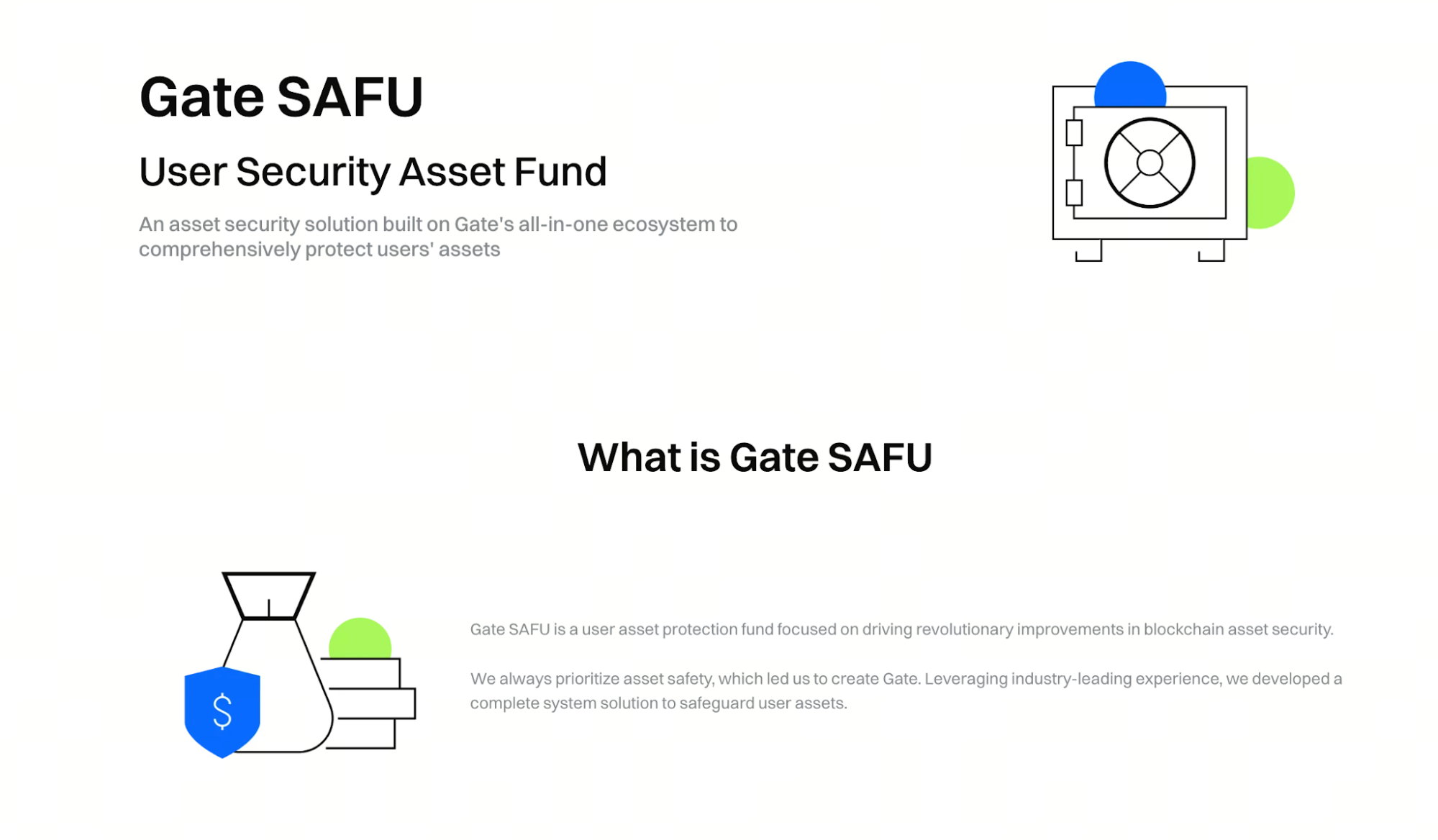
What Is the Gate Secure Asset Fund for Users (SAFU)?
Gate SAFU is a dedicated reserve created to support user asset security. SAFU stands for Secure Asset Fund for Users and can be viewed as an additional financial buffer beyond the platform’s ordinary reserves and security controls.
Gate began building the fund in 2019. Early disclosures placed the fund above $100 million, and it has since expanded. Gate’s current SAFU page states that the fund was worth $500 million as of August 8, 2025.
SAFU does not mean that user balances are held in a single “compensation account.” User assets, platform reserves, and SAFU serve different purposes. SAFU is better understood as an emergency fund that can provide additional support when major events exceed normal risk-management capacity.
For that reason, the term “Gate User Protection Fund” is more accurately understood as the Gate Secure Asset Fund for Users (SAFU) rather than as a conventional investment insurance policy or guaranteed compensation product.
Why Did Gate Create SAFU?
Centralized crypto platforms face multiple layers of risk, including custody, cybersecurity, liquidity, and system-operation risk. Even with cold and hot wallet management, authentication systems, and risk controls, platforms still need to prepare for low-probability but high-impact events.
SAFU exists to provide an additional layer beyond preventative controls. Gate’s current disclosures identify cyberattacks, liquidity crises, and major security incidents as examples of the types of events that SAFU is designed to help address.
These situations are fundamentally different from ordinary market losses. A user losing money because a spot asset falls in price or a leveraged position is liquidated is taking market risk, which is not the primary purpose of SAFU.
The fund therefore complements technical security. Security systems aim to reduce the probability of an incident, while SAFU provides financial capacity if an extreme event still occurs.
Where Does Gate SAFU Funding Come From?
Gate SAFU is designed as an ongoing reserve rather than a fund raised only after a security incident occurs.
According to Gate’s current SAFU information, one of the fund’s main funding sources is regular allocation from trading-fee revenue. This allows SAFU to be replenished over time as the platform operates. For comparison, Binance funds SAFU as an emergency insurance fund and exchange insurance fund by directing a portion equal to 10% of its trading fees to that reserve.
The fund is not limited to a single asset. Its disclosed composition includes:
| SAFU Component |
Role |
| Allocated trading-fee revenue |
Ongoing funding source |
| GT |
Part of the reserve and potentially convertible at market value |
| Stablecoins |
Provide relatively stable liquidity |
| Major crypto assets |
Diversify the digital-asset reserve |
Gate also states that it may adjust the token composition of SAFU when appropriate and in users’ interests.
Because the fund includes crypto assets, its USD value can fluctuate with market prices. The disclosed $500 million figure should therefore be treated as a point-in-time valuation rather than a permanently fixed cash balance.
How Large Is Gate SAFU?
Gate’s current SAFU page states that the fund was worth $500 million as of August 8, 2025. For comparison, Binance disclosed roughly $1 billion in safu assets as of April 2024.
The date matters. SAFU includes stablecoins, GT, and other digital assets, and its portfolio may change over time. As a result, its USD-denominated value can rise or fall with the market and with portfolio adjustments.
This is why the $500 million figure is better described as the fund value disclosed on the stated reference date rather than a permanent “$500 million compensation limit.”
The total fund size also does not mean each user has a fixed individual coverage amount. SAFU is a platform-level emergency reserve, and whether a specific event qualifies for compensation depends on the nature of the incident and the result of the review process.
When Can Gate SAFU Potentially Be Used?
Gate SAFU is mainly intended for major or extreme platform-level security events rather than normal trading losses.
The current SAFU materials specifically refer to scenarios such as cyberattacks, liquidity crises, and major security incidents. Under normal conditions, Gate’s reserve and security systems form the first layer of protection. SAFU is designed to provide additional financial support when an event exceeds ordinary risk-handling capacity. A comparable example is Binance using SAFU after a 2019 breach to cover losses of 7,000 BTC, showing how such funds can support affected users after major hacks involving Bitcoin.
A simple way to understand the structure is:
**Layer 1: Prevention.**Login controls, withdrawal security, hot and cold wallet management, system security, and network protection aim to reduce the likelihood of incidents.
**Layer 2: Asset coverage.**Proof of Reserves is designed to show whether the platform holds sufficient assets to cover user balances.
**Layer 3: Extreme-event buffer.**SAFU provides an additional pool of funds for major events that may go beyond ordinary protections.
This layered approach is more accurate than treating SAFU as a blanket guarantee for any account loss.
What Types of Losses Should Not Be Assumed to Be Covered by SAFU?
SAFU is not a general-purpose insurance pool covering every type of loss.
Normal market losses should not be confused with asset-security incidents. Losses caused by stock, spot, futures, or crypto price movements are market risks and are not the core purpose of SAFU.
Likewise, user-initiated actions do not automatically become SAFU events simply because the outcome is unfavorable. Examples include making a poor trade, buying an asset that later falls in price, or sending assets to the wrong address.
Gate does not describe SAFU as a policy that automatically provides full compensation for every loss. Whether a case qualifies depends on the specific circumstances and review.
Users should therefore avoid interpreting “User Protection Fund” as meaning that the platform absorbs all user asset risk. SAFU is designed for specific security and extreme-event scenarios, not as a replacement for individual risk management.
How Can Users Submit a SAFU Claim?
Gate’s current SAFU page provides a clear claim window.
If a user experiences a qualifying loss, they can contact Gate Support to submit a SAFU claim. The claim should be made within 90 days of the qualifying loss.
Users may need to provide information that helps verify the incident and the loss, such as account records, transaction history, details of the security event, and any other documentation requested during the review.
Submitting a claim does not guarantee compensation. Gate still needs to determine whether the loss falls within the SAFU framework and what response is appropriate.
If a user suspects unusual account activity or a security incident, preserving records and contacting official support quickly is important, particularly because of the 90-day submission requirement.
What Is the Difference Between Gate SAFU and 100% Proof of Reserves?
SAFU and Proof of Reserves are often discussed together, but they solve different problems.
100% Proof of Reserves addresses the question:
Does Gate hold enough assets to cover user balances?
SAFU addresses a different question:
If a major security incident occurs, is there an additional dedicated pool of funds available as a financial buffer?
| Category |
Gate 100% Proof of Reserves |
Gate SAFU |
| Main purpose |
Demonstrate asset coverage |
Provide an additional buffer for extreme events |
| Main form |
Platform reserve assets |
Dedicated security fund |
| User verification |
Users can verify inclusion through reserve-verification mechanisms |
Primarily based on SAFU fund disclosures |
| Main technology |
Merkle Tree, zero-knowledge proofs, wallet verification, and related methods |
Dedicated reserve and asset allocation |
| Main question addressed |
Are user assets covered? |
Is there an extra financial buffer after a major incident? |
Gate’s latest disclosed reserve report, dated August 19, 2026, showed $8.215 billion in total reserves and an overall reserve ratio of 127%.
SAFU does not replace reserves, and reserves do not replace SAFU. They are separate mechanisms addressing different layers of asset security.
What Is the Difference Between Gate SAFU and the Account Protection Plan?
Gate introduced an Account Protection Plan in 2026, and its name can easily be confused with SAFU. The two are different mechanisms.
The Account Protection Plan is focused more specifically on certain qualifying direct losses caused by unauthorized transactions or transfers from a user’s Gate account. Users need to activate the plan and meet applicable requirements related to security score, KYC level, verification settings, account status, region, and risk controls. Gate explicitly states that the plan is not insurance and does not guarantee compensation for every loss.
SAFU is a platform-level dedicated security fund designed primarily to provide additional financial capacity during cyberattacks, liquidity crises, and other major security events. Users do not need to purchase SAFU as a separate product for the fund itself to exist.
| Category |
Gate SAFU |
Account Protection Plan |
| Type |
Platform-level dedicated security fund |
User account protection mechanism |
| Main scenario |
Major platform security or extreme events |
Certain qualifying unauthorized account losses |
| User activation required |
No separate purchase required for SAFU itself |
Eligible users need to activate the plan |
| Insurance |
Should not be treated as traditional insurance |
Gate explicitly states it is not insurance |
| Review |
Based on the specific security incident |
Reviewed under the terms of the protection plan |
If the concern is whether Gate has an additional buffer for a major exchange-level security event, SAFU is the relevant mechanism. If the concern is a specific unauthorized transaction on an individual account, the Account Protection Plan may be more relevant.
How Does SAFU Fit Into Gate’s Broader Security Framework?
SAFU is only one part of Gate’s asset-security structure.
On the transparency side, Gate uses Proof of Reserves together with mechanisms such as wallet verification, Merkle Trees, user-balance snapshots, and zero-knowledge proofs. Gate’s corporate security materials describe 100% reserves, SAFU, and multiple technical security measures as separate components of the overall protection system.
At the account and system level, Gate also uses multi-layer security controls for login, trading, and withdrawals, as well as infrastructure protections such as DDoS defense, WAF, DNS security, and encrypted communications.
These measures perform different functions. Technical controls try to prevent incidents, reserve mechanisms provide evidence of asset coverage, and SAFU provides a financial buffer for extreme situations.
User asset security should therefore not be evaluated based only on whether a platform has a protection fund. Reserve transparency, custody, account security, risk controls, and user security practices all matter.
What Account Security Measures Should Users Still Take?
The existence of SAFU does not remove the need for individual account security.
Users should still use strong, unique passwords, enable two-factor authentication, protect their email accounts and authentication devices, and monitor unusual login attempts, withdrawal-address changes, and suspicious messages.
Any message asking for a password, verification code, private key, or seed phrase should be treated with caution. Users should also verify the source of the Gate website and app instead of following unknown links that could lead to phishing pages.
If unauthorized login, unfamiliar orders, or suspicious withdrawals are detected, users should secure the account and contact official Gate Support as quickly as possible rather than relying on SAFU as a post-event solution.
From a risk-management perspective, SAFU is better viewed as an additional last-resort buffer, not the first line of account defense.
What Are the Limitations of Gate SAFU?
First, SAFU is not a traditional insurance product and should not be interpreted as providing every user with a fixed coverage amount, even if it can improve confidence.
Second, the fund value is dynamic. Gate currently discloses a value of $500 million, but the fund contains multiple digital assets and its composition can change, so its USD value can fluctuate rather than remain completely safe.
Third, the existence of the fund does not mean every loss automatically qualifies for compensation. Eligibility, loss calculation, and the final response depend on the specific incident and review process affecting user funds.
Finally, SAFU cannot eliminate the normal market risks of digital assets. Crypto prices can still fall sharply, and leveraged futures trading can still result in liquidation regardless of the existence of a security fund.
Understanding these boundaries helps prevent users from treating the term “User Protection Fund” as a guarantee of returns or unlimited compensation. Operational safety also depends on regulatory compliance and cannot rely only on a protection fund, especially without formal regulatory oversight.
Summary
The Gate Secure Asset Fund for Users (SAFU) is a dedicated security reserve created to provide an additional layer of protection for user assets. Gate has operated the fund since 2019, and the current SAFU page discloses a value of $500 million as of August 8, 2025. The fund is supported in part by allocated trading-fee revenue and includes GT, stablecoins, and other major digital assets.
SAFU is mainly designed to provide an additional financial buffer during extreme situations such as cyberattacks, liquidity crises, and major security incidents. It is not intended to compensate ordinary market losses and should not be treated as insurance that automatically covers every user loss.
Gate’s wider asset-security framework also includes 100% Proof of Reserves, reserve-verification mechanisms, and multiple account and system security controls. As of August 19, 2026, Gate’s latest disclosed overall reserve ratio was 127%, serving a different role from SAFU.
The most important way to understand SAFU is not simply by looking at the fund size, but by understanding where it sits in the broader protection structure: prevent incidents, demonstrate asset coverage, and maintain an additional financial buffer for extreme scenarios.
FAQ
Is SAFU money part of an individual user’s account balance?
No. SAFU is a platform-level dedicated security fund. It is not an amount individually allocated to each user account, and users do not have a separate personal SAFU balance.
Will the disclosed $500 million SAFU value always remain the same?
No. The $500 million figure is the value disclosed by Gate as of August 8, 2025. Because SAFU holds multiple digital assets and the portfolio can change, its USD value may fluctuate.
No separate SAFU insurance purchase is required. The fund is supported through mechanisms including regular allocations from platform trading-fee revenue and other reserve assets.
How long do users have to submit a SAFU claim after a qualifying incident?
Under Gate’s current SAFU rules, eligible claims should be submitted to Gate Support within 90 days of the qualifying loss.