The “consumer entry + on-chain execution” framework, as detailed in Robinhood Chain Architecture and Use Cases, sets the stage for comparison: Robinhood Chain, Base, and Arbitrum differ in three core aspects—target users, product integration depth, and ecosystem maturity trajectory. For most users, the real question isn’t “which chain is superior,” but “which chain aligns best with my operational objectives and risk tolerance.”
How Are Robinhood Chain, Base, and Arbitrum Positioned?
Robinhood Chain, developed as an extension of a consumer-grade financial product, prioritizes integrating accounts, trading, risk control, and audit processes into a single, traceable flow. Base, as Coinbase’s Ethereum Layer 2, focuses on lowering barriers to development and use, making it easier for mainstream applications to operate within the Ethereum environment. Arbitrum, an early mover in large-scale Ethereum Layer 2 applications, is designed to support a broad range of DeFi, trading, and on-chain infrastructure scenarios.
These strategic differences define each chain’s default user profile: Robinhood Chain is geared toward low-friction, everyday users; Base targets teams launching new applications that need distribution and growth; Arbitrum serves on-chain participants who prioritize liquidity depth and comprehensive tooling.
How Does Robinhood Chain Differ from Base?
Both Robinhood Chain and Base aim to reduce barriers for mainstream users to interact with blockchain, but their approaches diverge. Robinhood Chain emphasizes a unified, in-platform experience, while Base focuses on supporting an open ecosystem of applications. This distinction directly impacts account management, on-chain workflows, and how users perceive trading fees.
| Comparison Dimension |
Robinhood Chain |
Base |
| Entry Path |
Strong platform-based entry, emphasizing seamless in-app experience |
More open wallet and app entry, prioritizing developer integration |
| Product Objective |
Consumer asset interaction and compliance collaboration |
Onboarding mainstream apps and expanding the ecosystem |
| Account Model |
“Product account + on-chain execution” |
“Wallet account + L2 interaction” |
| Fee Perception |
Stable, predictable fee presentation |
Distinctly low fees, but dependent on network conditions |
| Application Distribution |
Focused on trading, payments, and capital flow scenarios |
Focused on social, content, consumer apps, and general-purpose dApps |
For everyday users, the key takeaway isn’t the technical jargon, but the trade-off between operational coherence and ecosystem openness—one feels like an “in-product on-chain service,” the other like an “open L2 application marketplace.”
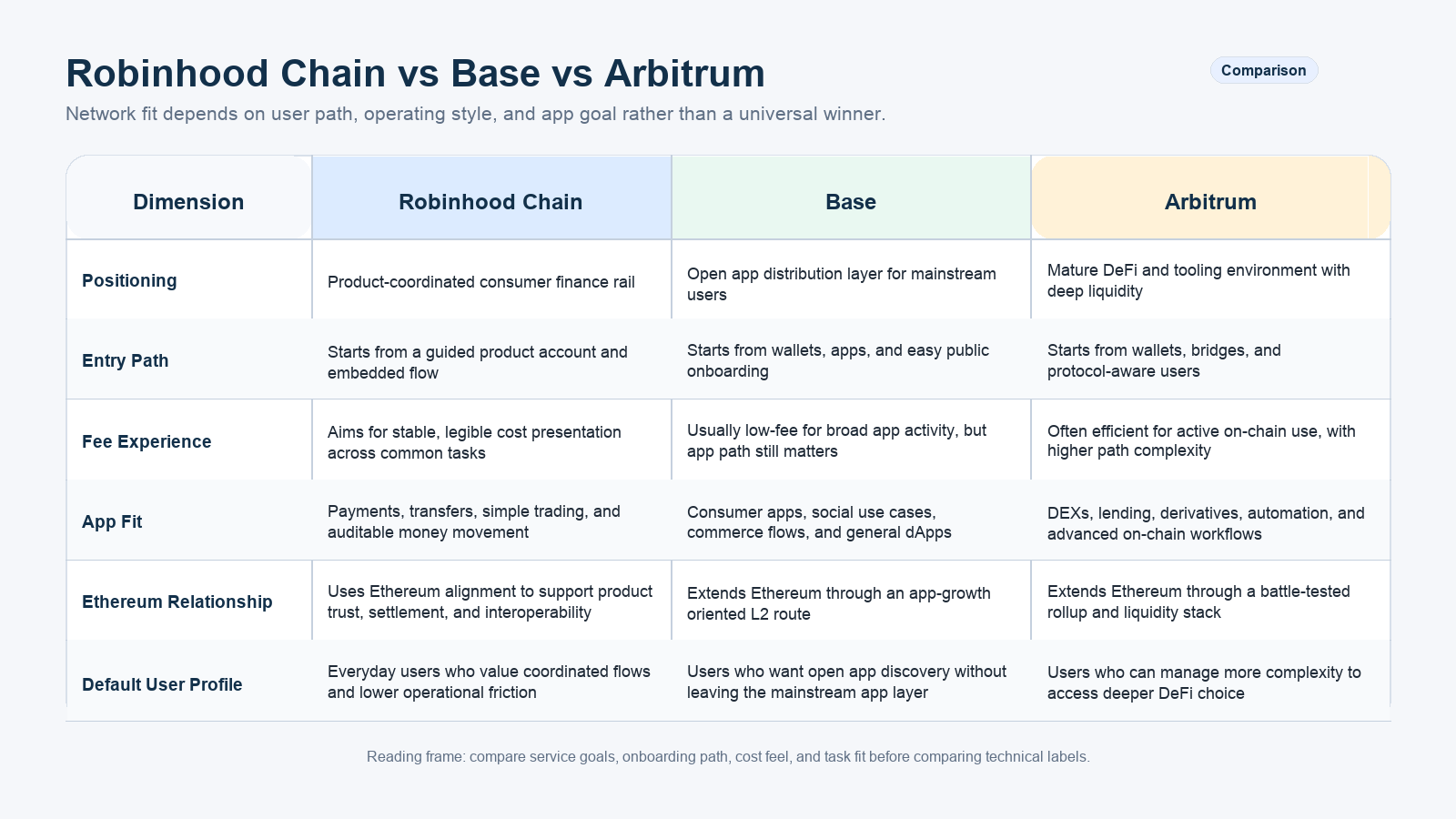
Multi-dimensional comparison infographic: Robinhood Chain, Base, and Arbitrum.
Is Robinhood Chain an L1 or L2? How Does It Relate to Arbitrum?
When users ask “Is Robinhood Chain L1 or L2?” they’re really asking about settlement dependency and security boundaries. If a chain’s final state is anchored to or settled on Ethereum, it’s typically considered L2; if it achieves consensus and settlement independently, it’s closer to L1. Robinhood Chain is best understood as part of the “Ethereum scaling ecosystem,” serving as an extension layer for Ethereum collaboration.
Arbitrum’s strengths are its mature rollup system, developer tooling, bridging solutions, and DeFi composability, all of which have strong network effects. The key distinction for Robinhood Chain isn’t functional parity with Arbitrum, but how deeply on-chain capabilities are embedded into the product’s entry point.
How Does Robinhood Chain Relate to Ethereum? How Do All Three Chains Leverage Ethereum’s Security and Ecosystem?
Robinhood Chain, Base, and Arbitrum are all deeply integrated with the Ethereum ecosystem, though at different levels. All three leverage Ethereum’s foundational asset standards, settlement semantics, and interoperability. Their differences lie in product strategies for account abstraction, transaction ordering, fee presentation, and application distribution.
| Observation Point |
Robinhood Chain |
Base |
Arbitrum |
| Ethereum Relationship |
Expansion and collaboration for consumer finance |
OP Stack for mainstream app expansion |
Rollup for DeFi and general-purpose app expansion |
| Asset Interoperability Focus |
Asset flows within and outside the platform |
Cross-app liquidity among dApps and users |
Liquidity and trading composability across protocols |
| User Perception Focus |
Account and process consistency |
Application accessibility and usability |
Tool depth and ecosystem maturity |
For most users, the Ethereum relationship can be summed up simply: all three chains are built on Ethereum’s value, but each delivers that value through a distinct product experience.
Are Robinhood Chain’s Trading Fees High? How Should Users Compare Fee Experiences?
Trading fees shouldn’t be evaluated solely by a single gas number, but by total operational cost, which typically includes: on-chain execution fees, cross-chain bridging fees, slippage and transaction costs, and failed retry costs. If Robinhood Chain reduces user errors and retries through robust productization, the actual experience may be cost-effective. Base and Arbitrum also offer low fees for high-frequency use, but require users to understand wallets, bridging, and network conditions.
For non-technical users, the most practical approach is to test the same task across chains—transferring the same amount, bridging the same asset, or interacting with the same application—and record confirmation time, failure rate, and total fees, rather than just comparing a single gas snapshot.
What Applications Suit Robinhood Chain? How Do Its Opportunities Differ from Base and Arbitrum?
Robinhood Chain is ideal for applications that require process consistency, such as on-chain payments, custody-based asset transfers, simplified trading for everyday users, and accounting scenarios with compliance audits. In these areas, ecosystem and application opportunities focus on user journey design, settlement verifiability, and sustainable operations.
Base is well-suited for distributing consumer internet-style apps, while Arbitrum excels in DeFi scenarios that demand capital efficiency and protocol composability. If you need to assess both auditability and platform risk boundaries, security, compliance, and transparency offers a detailed framework; for differences in on-chain account experiences, account models and execution mechanisms directly explain why each chain feels different for the same operation.
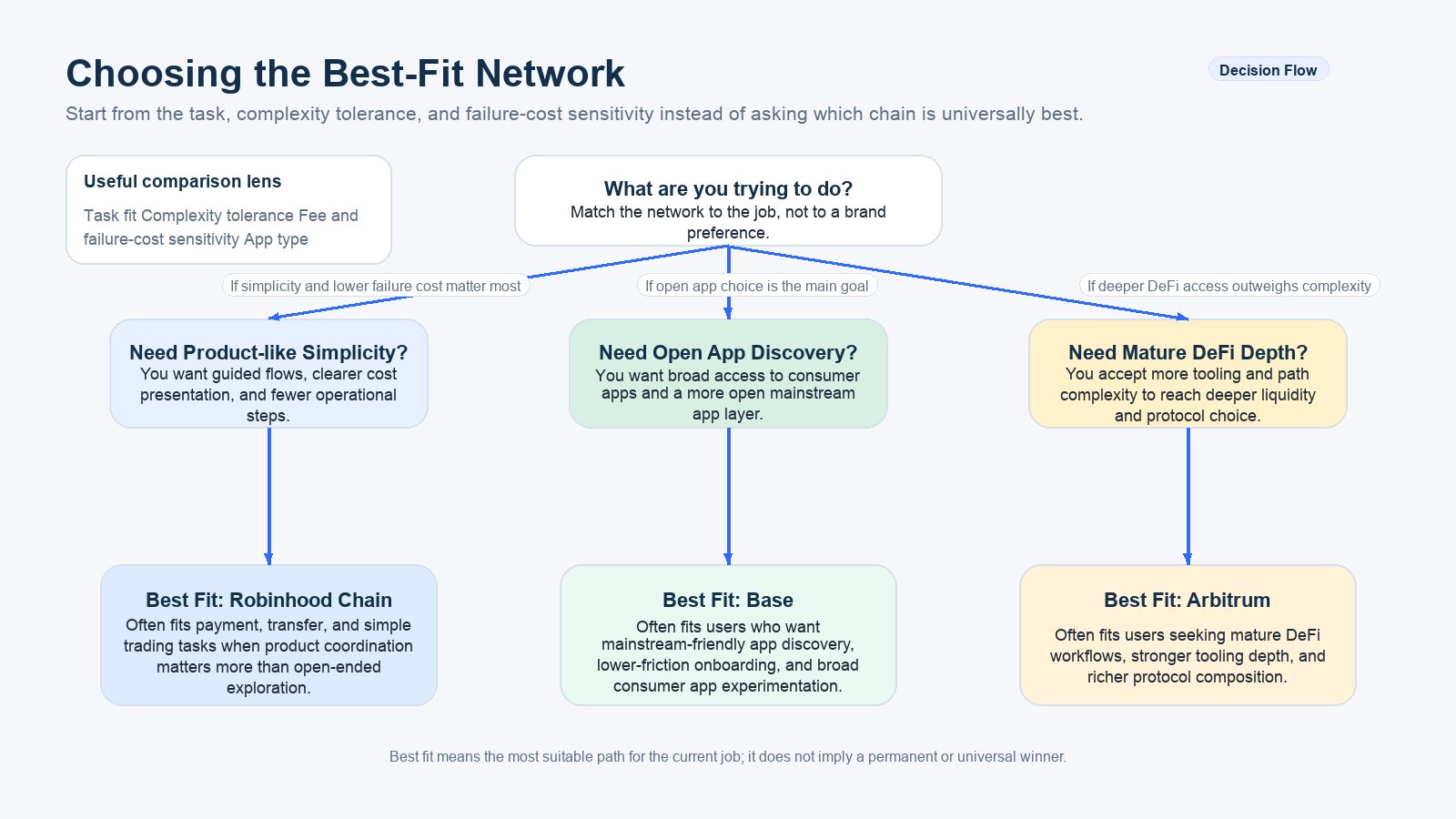
User decision flow for choosing among Robinhood Chain, Base, and Arbitrum.
Summary
Robinhood Chain, Base, and Arbitrum represent three distinct paths for Ethereum scaling and productization: platform collaboration, application distribution, and ecosystem maturity. When comparing options, users should prioritize task objectives, account complexity tolerance, fees and failure costs, and available application types. This decision framework is more robust and realistic than simply comparing TPS or one-off gas metrics.
FAQ
What’s the difference between Robinhood Chain and Base?
Both lower the barrier to blockchain entry, but Robinhood Chain emphasizes integrated, in-platform workflows, while Base focuses on expanding an open application ecosystem. The former prioritizes seamless experience; the latter, open access. Decide based on whether your main need is routine asset management or multi-app exploration.
Is Robinhood Chain L1 or L2?
This depends on settlement and security dependencies. If settlement is anchored to Ethereum, it’s L2; if independent, it’s closer to L1. Don’t get hung up on labels—focus on whether asset paths, fee structures, and risk boundaries are clearly defined.
How does Robinhood Chain relate to Ethereum?
Robinhood Chain is a productization initiative within the Ethereum scaling ecosystem, leveraging Ethereum’s asset standards and interoperability. It complements Ethereum by providing consumer-oriented interaction flows, not by replacing it.
Are Robinhood Chain’s trading fees high?
Fee experience depends on total task cost, not just a single gas value. If the chain’s design reduces failures and retries, overall costs remain manageable. For an accurate comparison, perform the same task on different chains and evaluate actual fee differences.
What applications can Robinhood Chain support?
Robinhood Chain is suited for payments, asset transfers, simplified trading, and auditable accounting—applications that demand process consistency. Base is oriented toward mainstream app distribution, while Arbitrum excels in mature DeFi and high-composability scenarios. Let your application goals and user profile—not just technical labels—guide your choice.







