Building on the Robinhood Chain Architecture and Use Cases Overview, the account and transaction mechanism serves as an execution pipeline that translates user intent into on-chain state changes. While users observe wallet confirmations and balance updates, the system processes signature policies, fee estimations, transaction bundling and execution, and finality confirmations internally.
Is Robinhood Chain an L1 or L2? Why Is the Account Model the Key Entry Point?
Robinhood Chain is often described as an execution layer focused on optimizing consumer experience, with the primary discussion revolving around the collaboration between account and execution, rather than the label itself. Solely classifying by network layer risks overlooking critical friction points in the user journey: key management, signature frequency, fee prediction, and failure rollbacks.
The account model is key because it bridges wallet interaction and on-chain execution. Traditional externally owned accounts (EOAs) require users to manage all signature details themselves, whereas account abstraction allows the strategy system to handle repetitive actions. Once account abstraction is integrated with the execution layer, users are relieved from dealing with complex on-chain parameters at every step, while on-chain records remain fully auditable.
| Account Model Dimension |
Traditional EOA Path |
Robinhood Chain Preferred Path |
| Signature Management |
Multiple manual signatures |
Policy-driven signatures and session authorization |
| Fee Handling |
User bears and estimates directly |
System estimates and minimizes exposure to complex parameters |
| Exception Handling |
User determines reason for failure |
Platform-based receipts and rollback notifications |
| Audit Visibility |
Relies on block explorer literacy |
Dual presentation via account interface and on-chain records |
This table demonstrates that Robinhood Chain’s distinction lies not just in its “layer,” but in whether the account experience and execution flow are integrated by design. This is also a core comparative factor in Robinhood Chain vs Base vs Arbitrum.
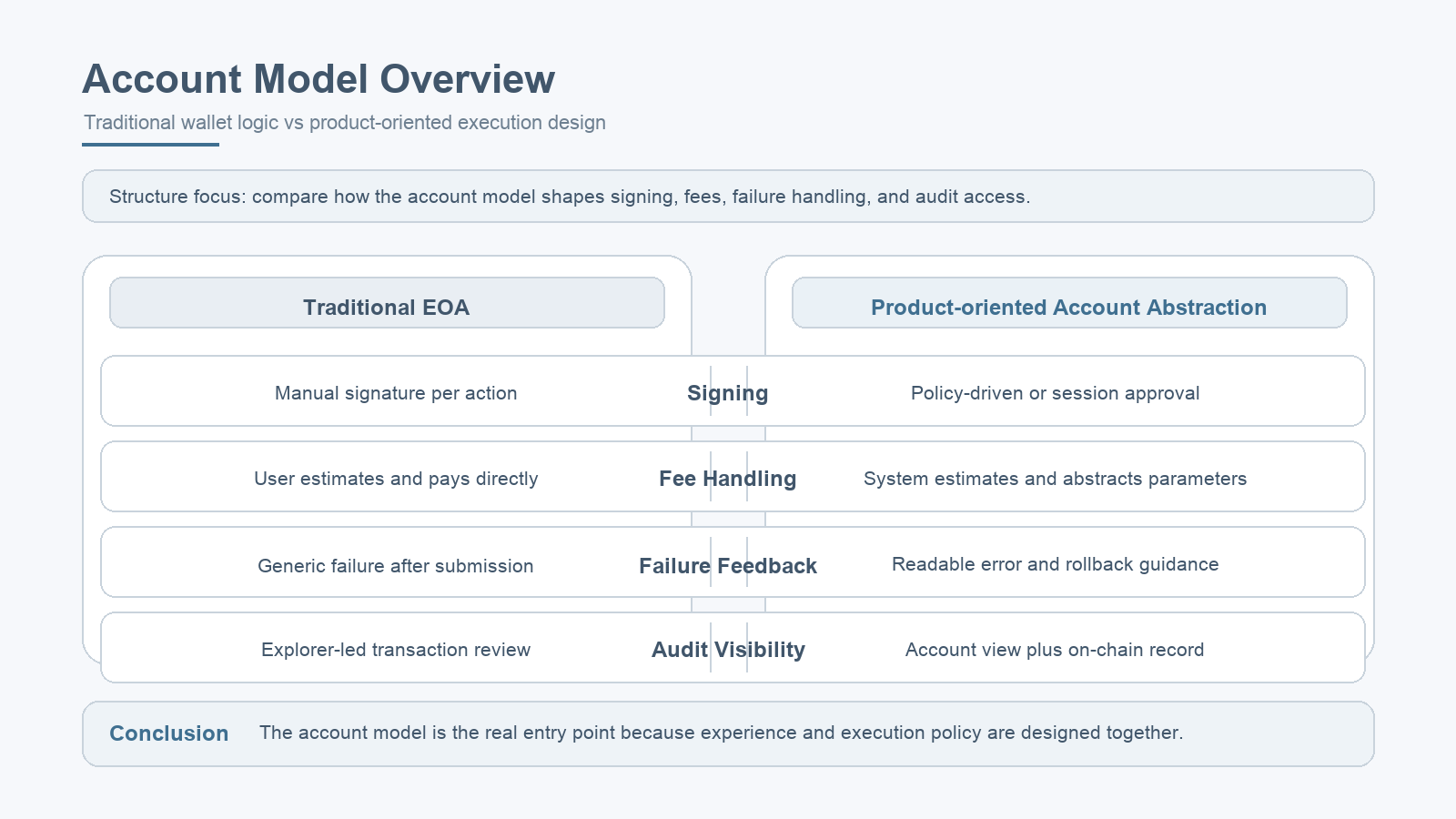
Layered structure of the Robinhood Chain account model, from interface to execution layer.
From Wallet Click to On-Chain Confirmation: How Does Transaction Execution Work?
A transaction typically passes through six stages from intent to settlement: wallet initiation, pre-check and signature policy, bundling or relaying, on-chain execution, state update, and receipt confirmation. Each stage must balance usability and security; oversimplifying any step can introduce risk blind spots.
Pre-check is especially crucial. It verifies balance sufficiency, permission matches, nonce availability, and whether the target contract is on the allowlist. Only after passing pre-check does the transaction proceed to bundling and execution; if it fails, the system returns a clear error and avoids unnecessary on-chain costs.
| Execution Step |
System Action |
User-Perceived Result |
| Wallet Intent |
Generates transaction intent and parameters |
Enter amount, target address, or contract |
| Pre-check |
Validates permissions, balance, and policy |
Displays success probability and estimated fees |
| Bundler/Relayer |
Organizes and submits transaction to execution layer |
Lowers the threshold for on-chain parameter configuration |
| On-chain Execution |
State transition and event logging |
Transaction hash generated and traceable |
| State Update |
Account balance and state update |
Position or balance updates in real time |
| Confirmation |
Finality and receipt confirmation |
See completion, failure, or rollback notification |
This process is designed to make technical details transparent and understandable. For most users, the key criteria are traceable failures, predictable fees, and verifiable receipts.
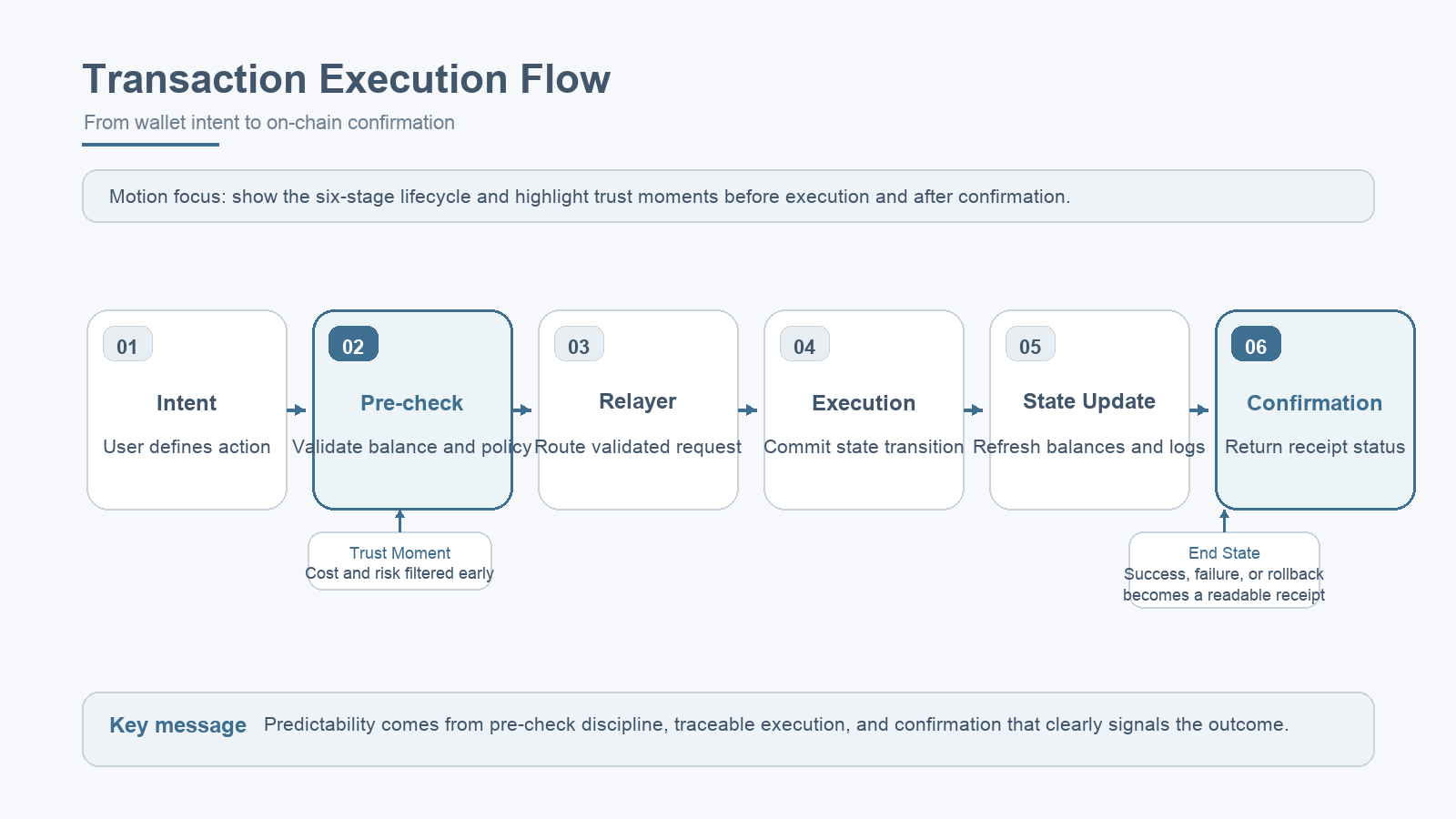
Robinhood Chain’s transaction flow, from wallet intent to on-chain receipt.
Are Robinhood Chain’s Fees High? What Determines the Cost?
Whether fees are “high” depends on the context and the type of operation. Transfers, contract calls, and cross-chain bridging each consume different resources, so focusing on a single number can be misleading. A more accurate approach is to examine fee components: base execution fee, complexity surcharge, and cross-chain or gateway service fee.
Robinhood Chain is designed for fee predictability, not necessarily the lowest cost in every scenario. When the system provides a stable estimate range, users can better decide whether to proceed. If the execution layer is congested or cross-chain proof costs rise, fees will adjust accordingly.
Fee experience is also influenced by batching. If the platform bundles repetitive actions, marginal transaction costs decrease; if a transaction requires high-priority confirmation, fees may increase. For developers, optimizing contract call paths and minimizing invalid state writes are direct ways to control users’ overall costs.
What Is the Relationship Between Robinhood Chain and Ethereum? Where Does Compatibility Come In?
Robinhood Chain and Ethereum are best seen as collaborators rather than substitutes. Ethereum provides broad settlement semantics and ecosystem standards, while Robinhood Chain focuses on account interactions and execution orchestration for consumer use cases. Their relationship is reflected in asset standards, contract interfaces, and cross-chain interoperability.
For compatibility, developers care about EVM semantics, toolchain support, and event log readability. If compatibility is robust, existing Solidity contracts and audit processes can migrate at low cost; if limited, adaptations are needed for account permissions and transaction lifecycles. Compatibility impacts deployment efficiency and the stable circulation of ecosystem assets.
How Are Assets Deposited or Withdrawn on Robinhood Chain? How Are On-Chain and Cross-Chain Processes Connected?
Asset transfers are divided into intra-chain transfers and cross-chain flows. Intra-chain transfers focus on account balance changes and finality; cross-chain flows add gateways, proof verification, and minting or unlocking on the target chain. The greater the process transparency, the easier it is for users to confirm assets follow the official path.
A typical cross-chain process includes: source chain lock or burn, proof submission, target chain verification, asset mapping, and receipt confirmation. If any step is delayed, the system should provide status tracking and exception alerts. For risk control and audit details, see Security, Compliance, and Transparency Balance to distinguish between “temporary waiting” and “path abnormality” risks.
How Do Developers Deploy Applications on Robinhood Chain? What Should Be Considered from Contract to Launch?
Application deployment follows four stages: environment preparation, contract deployment, account integration, and monitoring/rollback. Environment setup includes confirming RPC, chain ID, gas policy, and signature policy; contract deployment covers permissions, upgrade paths, and event log design; account integration manages session authorization, transaction batching, and error prompts; post-launch relies on monitoring and rollback plans for stability.
For consumer-facing apps, the interaction layer should show more than just “success/failure”—it should provide failure types and next steps. For commercial expansion, see Ecosystem and Application Opportunities for further scenario analysis.
What Are the Advantages, Risks, and Limitations of Robinhood Chain’s Account and Execution Mechanisms?
Advantages include path consistency: account strategy, execution flow, and receipt mechanisms operate within a unified system, reducing user learning costs. For operations, unified logs and verifiable event streams support auditing and issue tracing. For developers, stable interfaces and clear processes accelerate time to market.
Risks center on three areas: misconfigured account abstraction strategies can amplify permission issues; cross-chain gateways and proof systems introduce dependencies; and execution layer congestion can cause fee and confirmation time volatility. Limitations involve ecosystem openness and composability—limited external protocol access can constrain innovation.
Ongoing mechanism evaluation should track failed transaction explainability, cross-chain operation traceability, and account permission misconfiguration rates to ensure both low-barrier experience and verifiable execution.
Summary
Robinhood Chain’s account and transaction mechanism fundamentally connects the wallet experience layer to the on-chain execution layer through policy-driven accounts. Users value smoothness and receipt transparency, while the system focuses on verifiability and traceability. Mechanism maturity is defined by transaction lifecycle stability and auditability.
FAQ
Is Robinhood Chain an L1 or L2?
Discussions focus on collaboration between execution and product layers, not just label definitions. Regardless of classification, the account model and execution path are the core factors shaping user experience—pay attention to signature policy, fee estimation, and receipt verifiability.
Are Robinhood Chain’s Fees High?
Fee levels depend on transaction type, execution complexity, and network resource usage. Robinhood Chain prioritizes predictable and transparent fees, not the absolute lowest in all scenarios. Distinguish between intra-chain and cross-chain operations when comparing costs.
What Is the Relationship Between Robinhood Chain and Ethereum?
The two are collaborative: Ethereum provides broad standards and an ecosystem foundation, while Robinhood Chain focuses on consumer account experience and execution orchestration. Compatibility appears in contract interfaces, asset standards, and cross-chain capabilities. Effective collaboration depends on specific implementation and gateway strategies.
How Are Assets Deposited or Withdrawn on Robinhood Chain?
Deposits and withdrawals typically involve four key steps: source confirmation, proof verification, mapping or unlocking, and receipt. Intra-chain transfers focus on finality and state updates; cross-chain transfers emphasize proof and gateway reliability. Traceable process status is essential for security assessment.
How Do Developers Deploy Applications on Robinhood Chain?
Deployment starts with environment setup, followed by contract deployment, account integration, and monitoring. Developers should design for both normal and failure rollback flows, ensuring users receive actionable feedback during exceptions. Application usability depends on permission boundaries and error handling quality, not just contract execution.







