Stage 2 Output:
Against the backdrop of the evolving decentralized derivatives market, different protocols are exploring distinct trading models. GMX has emerged as a key player in the crypto-native perpetual futures space, while Levare seeks to push the boundaries of DeFi through a multi-asset and cross-chain liquidity architecture.
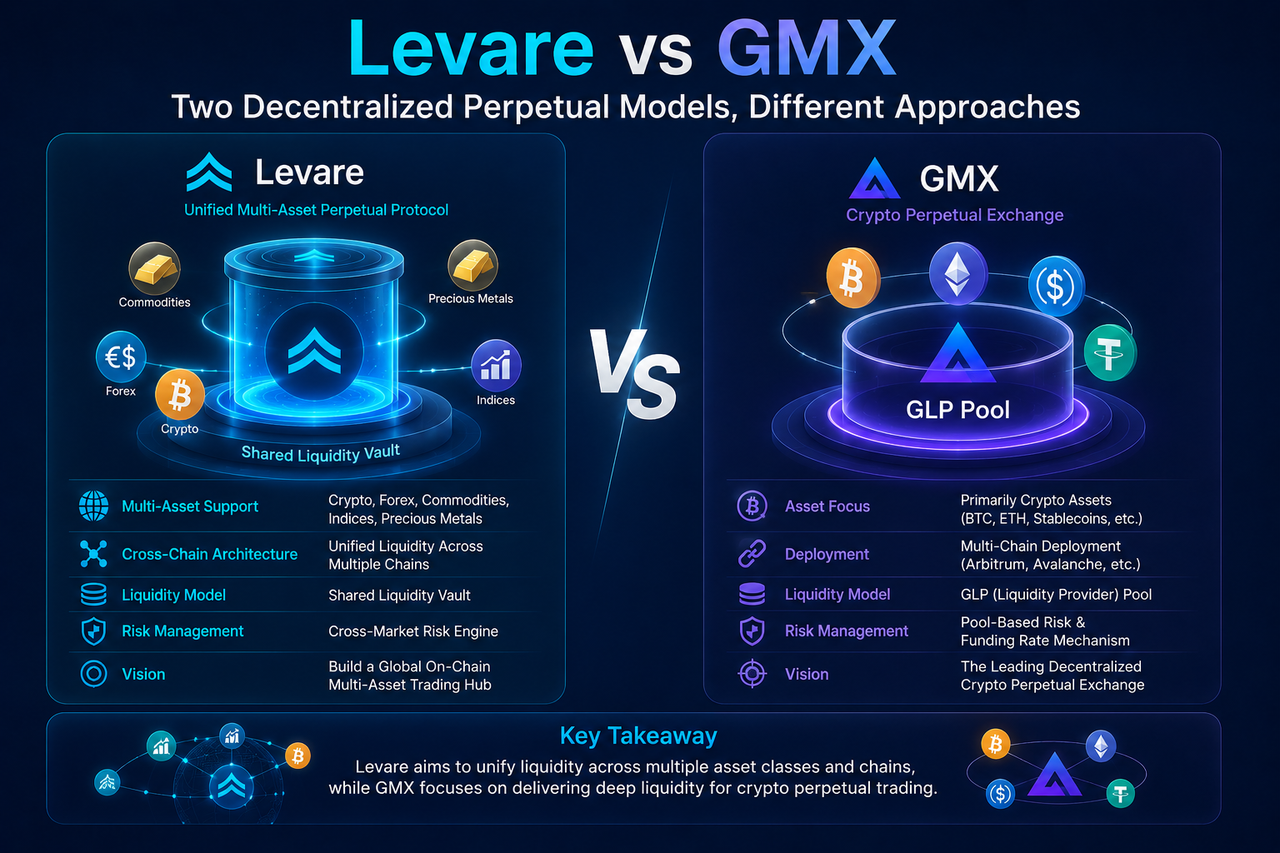
What Is Levare?
Levare is a decentralized perpetual futures protocol built for multi-asset markets. It uses a shared Liquidity Vault to power the entire system's liquidity. The protocol covers not only cryptocurrencies but also plans to support traditional financial assets such as forex, precious metals, commodities, and indices, allowing users to gain exposure to multiple markets in one place.
Levare's core design philosophy centers on unified liquidity and cross-chain expansion. By leveraging a shared capital pool and cross-chain settlement architecture, the protocol aims to reduce liquidity fragmentation and improve capital efficiency. This positions Levare more as a multi-asset derivatives infrastructure than a simple crypto trading platform.
What Is GMX?
GMX is a decentralized perpetual futures trading protocol built on networks like Arbitrum and Avalanche. It utilizes a unique GLP liquidity pool model, where liquidity providers deposit a variety of assets to support traders.
GMX focuses primarily on cryptocurrency assets, including major digital assets like BTC and ETH. The protocol relies on oracles for price feeds and enables users to execute on-chain leveraged trades with minimal slippage. With a mature product design and strong market activity, GMX has become a flagship project in the DeFi perpetual futures space.
How Do Levare and GMX Differ in Market Positioning?
Market positioning is one of the clearest distinctions between Levare and GMX. GMX is designed specifically around the cryptocurrency derivatives market, catering to digital asset traders. It meets user demand for leveraged crypto trading through on-chain perpetual futures.
Levare, by contrast, targets a much broader market. It aims to build a multi-asset trading platform that spans both crypto and traditional financial assets. In addition to digital assets, the protocol incorporates forex, gold, commodities, and indices. This means Levare focuses not only on crypto market liquidity but also on delivering a unified trading experience across diverse asset classes.
How Do Levare and GMX Differ in Their Liquidity Models?
The liquidity model is one of the most fundamental differences between the two. GMX uses the GLP (GMX Liquidity Provider) pool as the counterparty for trades. The pool typically holds multiple digital assets including BTC, ETH, and stablecoins. When traders profit, the GLP pool absorbs the cost; when traders incur losses, the pool captures the yield.
Levare, on the other hand, employs a shared Liquidity Vault design, with plans to unify different asset markets under a single liquidity system. Instead of creating separate pools for each asset, the shared Vault emphasizes centralized capital management and cross-market liquidity. This approach boosts capital utilization and minimizes the fragmentation of liquidity across multiple markets.
How Do Levare and GMX Differ in Cross-Chain Capabilities?
GMX has been deployed on several blockchain networks, but liquidity across those networks remains largely independent. While users can access GMX on different chains, the architecture is essentially a multi-chain deployment model.
Levare, however, treats unified liquidity and cross-chain settlement as core protocol features. By using cross-chain messaging and a shared Liquidity Vault, users on different blockchains can theoretically tap into the same pool of liquidity. This architecture prioritizes cross-chain synergy rather than simply replicating the protocol across chains.
How Do Levare and GMX Manage Risk?
Both protocols must address trader profits, market volatility, and liquidity risk, but they go about it differently.
GMX's risk is concentrated in the GLP liquidity pool. Since trader gains and losses directly affect GLP holder returns, asset allocation and market structure have a significant impact on liquidity providers. The protocol manages overall risk through funding rates and risk parameters.
Levare's shared Liquidity Vault must handle the combined risks of a multi-asset market. Beyond crypto volatility, it may also face risks from forex, commodity, and index markets. As a result, Levare relies on a unified risk management framework and cross-market exposure controls to maintain the stability of its capital pool.
Which Offers Higher Capital Efficiency: Levare or GMX?
Capital efficiency is a key metric for evaluating derivatives protocols. GMX improves liquidity utilization over the traditional order book model and reduces dependency on professional market makers.
Levare aims to push capital efficiency even further with its unified liquidity architecture. In the shared Liquidity Vault model, a single capital pool can serve multiple markets and multiple blockchain networks simultaneously. Theoretically, this reduces the need for duplicate capital allocation and makes more efficient use of liquidity resources.
However, capital efficiency depends not only on the liquidity model but also on factors like trading volume, market structure, and risk management mechanisms.
Which Scenarios Are Best Suited for Levare and GMX?
GMX is ideal for on-chain traders focused on the cryptocurrency market. It offers a mature trading infrastructure for users who want to trade digital assets like BTC and ETH and engage in decentralized leveraged trading.
Levare, in contrast, is designed for a broader financial market. For users who want to access a range of asset classes—including crypto, forex, gold, and indices—through a single platform, its multi-asset architecture offers greater potential. Rather than direct competitors, the two protocols represent different development trajectories.
Core Differences Between Levare and GMX
| Comparison Dimension |
Levare |
GMX |
| Protocol Positioning |
Multi-asset perpetual futures protocol |
Crypto perpetual futures protocol |
| Supported Assets |
Crypto, forex, commodities, indices |
Primarily crypto |
| Liquidity Structure |
Shared Liquidity Vault |
GLP liquidity pool |
| Liquidity Objective |
Unified multi-market liquidity |
Crypto asset liquidity |
| Cross-Chain Architecture |
Unified liquidity and cross-chain settlement |
Multi-chain deployment |
| Risk Sources |
Multi-asset market risk |
Crypto asset market risk |
| Capital Efficiency Logic |
Shared capital pool |
GLP pool mechanism |
| Long-Term Direction |
Multi-asset financial infrastructure |
Crypto derivatives ecosystem |
Conclusion
Levare and GMX are both decentralized perpetual futures protocols, but they represent different paths forward. GMX focuses on the cryptocurrency derivatives market, using the GLP liquidity pool to offer on-chain leveraged trading. Levare, meanwhile, aims to build a unified trading infrastructure that spans multiple asset markets via a shared Liquidity Vault and cross-chain architecture.
From an industry perspective, GMX prioritizes crypto-native market efficiency, while Levare emphasizes the convergence of traditional finance and on-chain finance. These two models reflect different explorations of decentralized derivatives markets toward specialization and comprehensiveness.
FAQs
What is the biggest difference between Levare and GMX?
The main difference lies in their supported asset range and liquidity architecture. GMX primarily serves the cryptocurrency market, while Levare targets a multi-asset market including crypto, forex, precious metals, commodities, and indices, and uses a unified liquidity model.
Are both Levare and GMX perpetual futures protocols?
Yes. Both Levare and GMX are decentralized perpetual futures protocols that allow users to open long or short positions with leverage and settle trades through liquidity pools.
What is the difference between Levare's Liquidity Vault and GMX's GLP?
GLP is GMX's liquidity pool mechanism, primarily serving crypto assets. Levare's Liquidity Vault uses a shared liquidity design aimed at supporting multiple asset classes and multiple blockchain networks under one unified system.
Which is better for multi-asset trading: Levare or GMX?
From a design perspective, Levare targets a wide range of markets including crypto, forex, precious metals, commodities, and indices, making it more suited to multi-asset trading. GMX, on the other hand, is primarily focused on cryptocurrency derivatives.