As decentralized finance expands from spot trading into derivatives markets, the demand for unified liquidity, cross-chain transactions, and multi-asset support continues to grow. Levare aims to solve the fragmentation, limited asset coverage, and inefficient cross-chain operations that plague traditional DeFi derivatives protocols, building a more complete trading infrastructure for on-chain financial markets.
Levare stands out in the decentralized derivatives space with its multi-asset trading framework and shared liquidity design. Unlike perpetual contract protocols limited to crypto assets, Levare merges traditional financial market assets with on-chain instruments, giving users broader market exposure while using DAO governance to drive long-term protocol growth.
What Are Levare's Origins and Development Goals?
DeFi has enabled more financial activities on-chain, but most protocols still revolve around cryptocurrencies. For users seeking exposure to forex, gold, commodities, or global indices, on-chain options remain limited.
Levare aims to build a unified multi-asset derivatives trading platform where different asset classes can be traded and settled under one roof. By combining cross-chain liquidity, perpetual contracts, and decentralized governance, Levare reduces efficiency losses from fragmented markets.
Industry trends show multi-asset trading is becoming a key bridge between DeFi and traditional finance. Levare's model represents an evolution of on-chain derivatives protocols toward comprehensive financial infrastructure.
How Does Levare Work?
Levare's core function is perpetual contract trading with no expiration date. Users deposit stablecoins as margin, then open long or short positions based on market expectations, using leverage to amplify exposure.
Price data comes from external oracles, and the system calculates real-time PnL as prices move. When margin levels fall below the protocol's threshold, automatic liquidation kicks in to protect the liquidity pool and system security.
Smart contracts handle everything—position management, PnL settlement, risk control—all on-chain. This design cuts reliance on centralized entities while boosting transparency.
What Is Levare's Liquidity Vault?
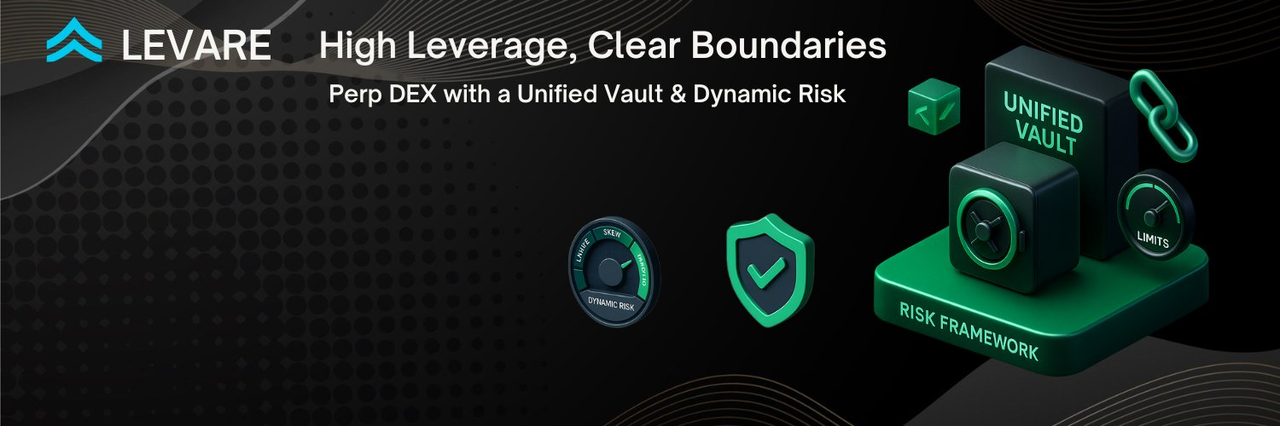
The Liquidity Vault is Levare's core liquidity infrastructure. Unlike traditional order books, Levare uses a shared liquidity vault as the primary counterparty for all trades.
Liquidity providers (LPs) deposit funds into the Vault, which the protocol uses to back user trades. All trader PnL is settled within the pool, so the Vault acts as both liquidity source and risk absorber.
This model prevents liquidity fragmentation across trading pairs, improving capital efficiency. LPs earn fees and backflows from trader losses, but also bear market volatility risk.
How Does Levare's Cross-Chain Architecture Unify Liquidity?
Multi-chain ecosystems have scattered liquidity across blockchains. Many protocols run on multiple chains but keep independent pools and silos.
Levare uses a unified liquidity model to pool funds from multiple blockchains into one shared settlement system. No matter which chain users enter from, they tap the same liquidity resources.
Cross-chain communication protocols sync state and trade data across blockchains, while central settlement logic manages positions and assets uniformly. This design boosts market depth and cuts costs from liquidity fragmentation.
What Role Does the LVR Token Play?
LVR is Levare's native token, handling governance, incentives, and ecosystem coordination.
For governance, LVR holders vote on protocol parameters, feature upgrades, and community proposals. The DAO model lets the community steer the protocol's direction, not a single centralized entity.
Economically, LVR can be staked for incentives and used in ecosystem activities. As the protocol grows, the token may take on more governance and value capture functions.
How Is Levare Different from Other Decentralized Perpetual Protocols?
The on-chain perpetual market has protocols like GMX, Gains Network, and dYdX. All offer leveraged trading, but their underlying mechanisms differ.
Levare's key differentiator is support for a wider range of assets—not just crypto but also forex, precious metals, indices, and commodities, giving users multi-market access from one platform.
For liquidity, Levare uses a shared Vault with cross-chain unified architecture. Compared to single-chain or single-asset protocols, this design emphasizes capital efficiency and broader market coverage.
| Dimension |
Levare |
GMX |
Gains Network |
| Core Positioning |
Multi-asset perpetual protocol |
Crypto asset perpetual protocol |
Synthetic asset perpetual protocol |
| Supported Assets |
Crypto, forex, commodities, indices |
Mainly crypto |
Crypto and some traditional assets |
| Liquidity Source |
Shared Vault |
GLP liquidity pool |
gDAI liquidity pool |
| Cross-Chain Capability |
Unified cross-chain liquidity |
Multi-chain deployment |
Multi-chain deployment |
| Governance Model |
DAO |
DAO |
DAO |
Levare's Advantages and Potential Risks
Levare's main strengths are multi-asset support, unified liquidity, and cross-chain expansion. By integrating markets and blockchains, it improves capital utilization and user reach.
However, multi-asset and cross-chain design adds complexity. The protocol depends on price oracles for market data, and cross-chain communication systems carry technical and security risks.
For LPs, the shared pool model boosts efficiency but also means bearing combined risks from multiple markets. Strong risk controls are critical for long-term stability.
Conclusion
Levare (LVR) is a decentralized perpetual contract protocol targeting multi-asset markets. It builds on-chain derivatives infrastructure with a shared liquidity vault, cross-chain unified liquidity, and DAO governance. Unlike traditional perpetual platforms focused on crypto, Levare extends trading to forex, precious metals, commodities, and indices, aiming for a more complete on-chain financial ecosystem.
FAQs
What is Levare (LVR)?
Levare (LVR) is a decentralized multi-asset perpetual contract protocol. Users trade crypto, forex, precious metals, commodities, and indices by depositing stablecoins as margin, with settlement through a shared liquidity vault.
Which asset classes does Levare support?
Levare supports crypto, forex, gold, commodities, and market indices, offering a unified on-chain trading experience.
What role does the Liquidity Vault play?
The Liquidity Vault is the shared pool that provides liquidity and acts as the counterparty. All trade PnL is settled internally within the pool.
What is the LVR Token used for?
LVR powers DAO governance, community voting, staking incentives, and ecosystem participation. Holders influence protocol decisions through governance.
How is Levare different from traditional DEXs?
Levare specializes in perpetual contracts and multi-asset derivatives, while standard DEXs offer spot trading. It also uses shared liquidity and cross-chain architecture for better efficiency and coverage.
What are Levare's potential risks?
Risks include oracle dependency, liquidity issues, smart contract bugs, and cross-chain communication failures. As with all DeFi protocols, security and robust risk management are vital for long-term success.