This paper trading guide helps beginners practice trading strategies, manage positions, and evaluate performance without risking real money. Gate.com's documented demo trading service primarily supports futures rather than general spot trading.
Key Takeaways
-
Gate.com's futures Testnet allows paper trading with simulated money and a trading interface similar to live trading.
-
Beginners can practice market and limit orders, leverage settings, stop-loss placement, and position management.
-
Virtual funds allow traders to test strategies without exposing real capital to trading losses.
-
Successful paper trading requires realistic risk parameters, consistent execution, and performance tracking.
-
Simulated profits don't guarantee success when trading with real money.
What Is Paper Trading, and How Does It Build Trading Skills?
Paper trading is simulated trading that allows investors to practice buying and selling financial instruments using virtual money instead of actual capital.
Modern paper trading platforms often use live market data or real-time market feeds to reproduce price movements. A paper trading account records hypothetical positions, profits, and losses within a simulated environment.
The approach is common among stock investors, forex traders, and crypto market participants. Many online brokers provide simulation tools, although supported assets and order functionality differ.
For crypto traders, the main benefits include learning order execution, developing trading skills, and testing different strategies under changing market conditions.
Unlike technical analysis, which studies market behavior through charts and indicators, paper trading tests how those ideas translate into actual trading decisions.
It's particularly useful for day traders learning position sizing, entry timing, and exits. Experienced traders also use simulated environments to evaluate a new strategy before committing capital.
How to Start Paper Trading Crypto on Gate.com
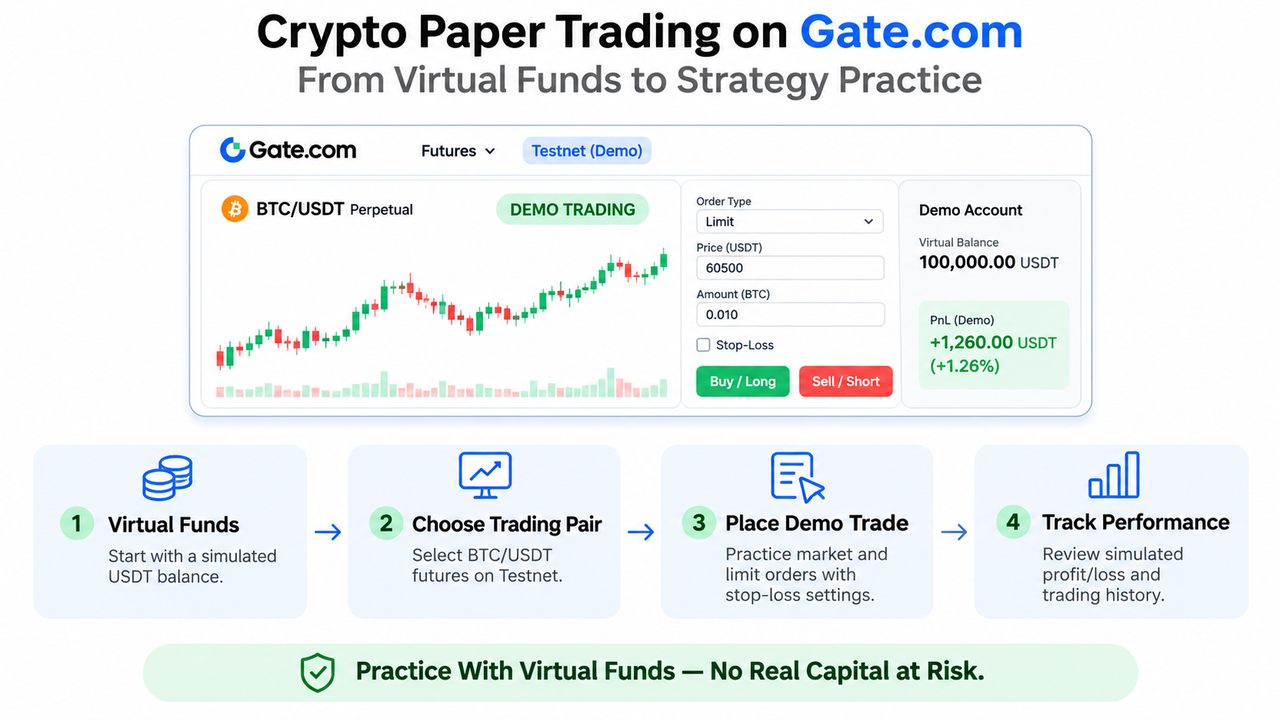
Gate.com's futures Testnet provides a demo trading environment with trading controls similar to its live futures interface.
The system uses virtual funds, so simulated gains cannot be withdrawn as real money. Market movements remain relevant to practice, but demo execution shouldn't be assumed to reproduce every live-market condition.
Step 1: Create a Gate.com Account
Visit Gate.com and create an account using the available registration process. Existing users can access eligible trading services through their accounts.
Account verification requirements, derivatives availability, and access restrictions depend on jurisdiction and platform policies.
Before proceeding, check that the futures Testnet is available in your region.
Step 2: Open the Futures Demo Trading Environment
On the website:
-
Open the Futures menu.
-
Select Perpetual Futures.
-
Choose Testnet or the available demo trading option.
-
Confirm that the interface identifies the simulated trading environment.
The Gate.com futures interface can provide a reference for understanding live market layouts, but real trading and Testnet balances must remain separate.
Step 3: Add Virtual Funds to Your Paper Trading Account
Within Testnet, locate the futures account assets section and select Transfer.
Transfer the available simulated USDT or BTC into the demo futures account.
Gate.com's published Testnet instructions describe virtual-fund allocations, eligibility conditions, and claim intervals. Some official help pages show different allocation amounts, so check the current account interface instead of assuming a fixed allowance.
Choose a realistic virtual portfolio size. Practicing with $100,000 when your intended live capital is $1,000 may distort position sizing and risk tolerance.
Step 4: Select a Trading Pair and Configure Risk
Choose a supported futures contract, such as BTC/USDT.
Next, select the margin mode:
-
Isolated margin: Margin is allocated to a particular position, limiting the funds directly assigned to that position.
-
Cross margin: Eligible account margin is shared across positions, potentially exposing more account equity to losses.
Set leverage carefully. Gate.com's live futures documentation describes leverage settings up to 125x for applicable contracts, but availability varies by market, account, and jurisdiction. High leverage isn't necessary for learning.
A beginner can practice with low leverage while understanding liquidation prices, margin requirements, and the effects of volatility.
Step 5: Place Your First Simulated Trade
Gate.com's demo interface supports order controls used in futures trading, including market and limit orders.
| Order Type |
How It Works |
Paper Trading Purpose |
| Market order |
Attempts execution at available market prices |
Practice immediate entries and exits |
| Limit order |
Executes at the specified price or better when matched |
Practice planned entry levels |
| Stop-loss |
Triggers an exit according to configured conditions |
Practice loss control |
| Take-profit |
Triggers an exit at a planned target |
Practice disciplined exits |
For example, suppose BTC trades at an illustrative price of $60,000. A trader expects a breakout above $60,500 and plans a simulated long position.
Instead of entering immediately, the trader waits for breakout confirmation and a retest.
They then configure the entry, position size, stop-loss, and profit target before submitting the demo order.
All prices are for illustrative purposes, not current market quotations.
Step 6: Monitor Positions and Review Trading History
After placing an order, monitor the open position, unrealized profit or loss, margin usage, and liquidation price.
Gate.com's Testnet includes history tools for reviewing simulated transactions. On the web interface, the Close History section displays closed trading records.
The dashboard helps traders evaluate trading performance, review execution decisions, and identify repeated mistakes.
On the Gate mobile app, the Testnet option is documented within futures settings, with trade records accessible through transaction and order history. Interface labels may change with updates.
How Can Day Traders Achieve Successful Paper Trading?
Successful paper trading depends less on generating virtual profits and more on following a repeatable trading plan.
Start with one strategy. For example, a trader might combine session breakout trading with dynamic support and resistance levels.
Before each position, document the entry condition, invalidation level, risk amount, and intended exit.
A practical framework might use these illustrative parameters:
| Risk Parameter |
Example |
| Starting virtual capital |
$1,000 |
| Risk per trade |
1%, or $10 |
| Entry condition |
Breakout followed by retest |
| Stop-loss distance |
Based on market structure |
| Minimum planned reward-to-risk |
2:01 |
| Review frequency |
Every 20 completed trades |
These settings are practice assumptions, not a formula that ensures success.
A trader can also use multiple timeframe analysis to check whether shorter-term entries align with broader market direction.
Fundamental analysis may add context around economic releases or market events, while technical analysis determines specific execution levels.
How to Evaluate Paper Trading Performance Before Live Trading
Tracking profit alone gives an incomplete picture of trading skills.
Record the entry price, exit price, planned risk, realized simulated outcome, and whether the trade followed the strategy.
Useful performance measurements include:
-
Win rate: Percentage of completed trades that were profitable.
-
Average reward-to-risk: Average winning outcome relative to average losing outcome.
-
Maximum drawdown: Largest decline from a portfolio peak.
-
Profit factor: Gross simulated profit divided by gross simulated losses.
-
Rule adherence: Percentage of trades executed according to the original plan.
Consider practicing for 30–90 days as a learning framework, not a mandatory or scientifically established threshold. The number of trades, variety of market conditions, and consistency of decisions matter more than elapsed time.
A strategy might perform well during trending markets but struggle when prices move sideways.
Testing different conditions helps identify that weakness before transitioning to a live account.
Is Paper Trading Really Risk Free Compared With Live Trading?
Paper trading is financially risk-free with respect to simulated positions because trades use virtual funds. It doesn't eliminate the risks of eventually trading real money.
The main limitations involve execution differences, emotional pressure, and unrealistic assumptions.
The National Futures Association explains that hypothetical performance cannot fully account for liquidity, slippage, or the psychological effects of actual financial losses.
Demo trading may also exclude actual transaction charges, even though live futures trading involves fees and potentially funding payments.
The Commodity Futures Trading Commission identifies leverage and the possibility of substantial losses as major futures-market risks.
A simulated strategy showing consistent gains could experience a sharp fall in performance when exposed to live execution costs, rapid volatility, and emotional decision-making.
This is why paper trading should be approached with the same seriousness as real trading, without treating virtual success as proof of future profitability.
Conclusion
Gate.com's futures Testnet gives beginners a structured way to practice crypto trading with simulated funds, market-based price information, and familiar order controls.
The strongest paper trading experience comes from realistic capital assumptions, consistent risk management, and regular performance evaluation.
Paper trading can build confidence and discipline, but it cannot reproduce every cost, execution condition, or psychological challenge of live markets. Moving to real capital remains a separate financial decision.
Frequently Asked Questions
Is paper trading on Gate.com free?
Gate.com's documented futures Testnet uses virtual funds and does not charge actual trading fees for simulated orders. Availability, account conditions, and product functionality may change.
Can beginners practice spot trading on Gate.com?
Gate.com's documented Testnet primarily focuses on perpetual futures. Beginners wanting to practice spot trading should distinguish simulated futures positions from directly buying and holding cryptocurrencies.
Can you make real money from paper trading?
No. Profits generated within a paper trading account are simulated and cannot be withdrawn as real money. The purpose is to practice strategies and evaluate decisions.
How long should beginners paper trade before live trading?
A 30–90-day practice period can provide an initial learning structure, but there is no universal minimum. Trading consistency, market exposure, and risk discipline are more meaningful than the number of days completed.
Does successful paper trading ensure success with real money?
No. Live trading introduces psychological pressure, slippage, transaction costs, and the possibility of actual financial loss. The SEC's investor guidance on performance claims cautions against treating hypothetical or historical results as reliable predictions.
Can traders use the same strategy for paper trading and live trading?
Yes, the same entry, exit, and risk rules can be tested in both environments. Actual results may differ because live market execution, fees, liquidity, and trader behavior affect performance.
Disclaimer
This content is provided for educational and informational purposes only and does not constitute financial, investment, legal, or trading advice. Investing involves risk, including the possible loss of capital. Futures and leveraged trading can produce substantial losses. Simulated results do not guarantee future gains, and product availability differs across jurisdictions.