As more applications choose to deploy independent Rollups, providing these networks with shared security and decentralized validation has become a key challenge in the modular blockchain ecosystem.
AltLayer sits in the modular Rollup ecosystem as something closer to a shared security and Rollup infrastructure provider. Through restaking mechanisms, AVS, and Rollup-as-a-Service, or RaaS, the protocol gives appchains additional validation capabilities and fast finality support.
What Is a Restaked Rollup?
Restaked Rollup is the Rollup security model proposed by AltLayer. Its core goal is to use restaked assets to provide Layer2 networks with additional security and validation capabilities. Traditional Rollups usually rely on a limited number of sequencers and validator nodes, while a Restaked Rollup introduces an additional validation layer to check transaction states and block results.
This mechanism is built on EigenLayer’s restaking model. Validators can reuse already staked ETH or LSDs, liquid staking derivatives, to secure other protocols, thereby providing shared security for Rollups.
AltLayer combines this shared security model with Rollup scaling architecture, allowing appchains to gain extra security support without having to build a large independent validator network.
What Is the Overall Workflow of a Restaked Rollup?
AltLayer’s Restaked Rollup is mainly composed of user transactions, a Sequencer, the Rollup network, AVS, and the restaked validation layer.
Users first submit transactions to the Rollup, and the Sequencer is responsible for ordering them and generating blocks. After that, AltLayer’s AVS network performs additional validation on block states, transaction results, and final confirmation.
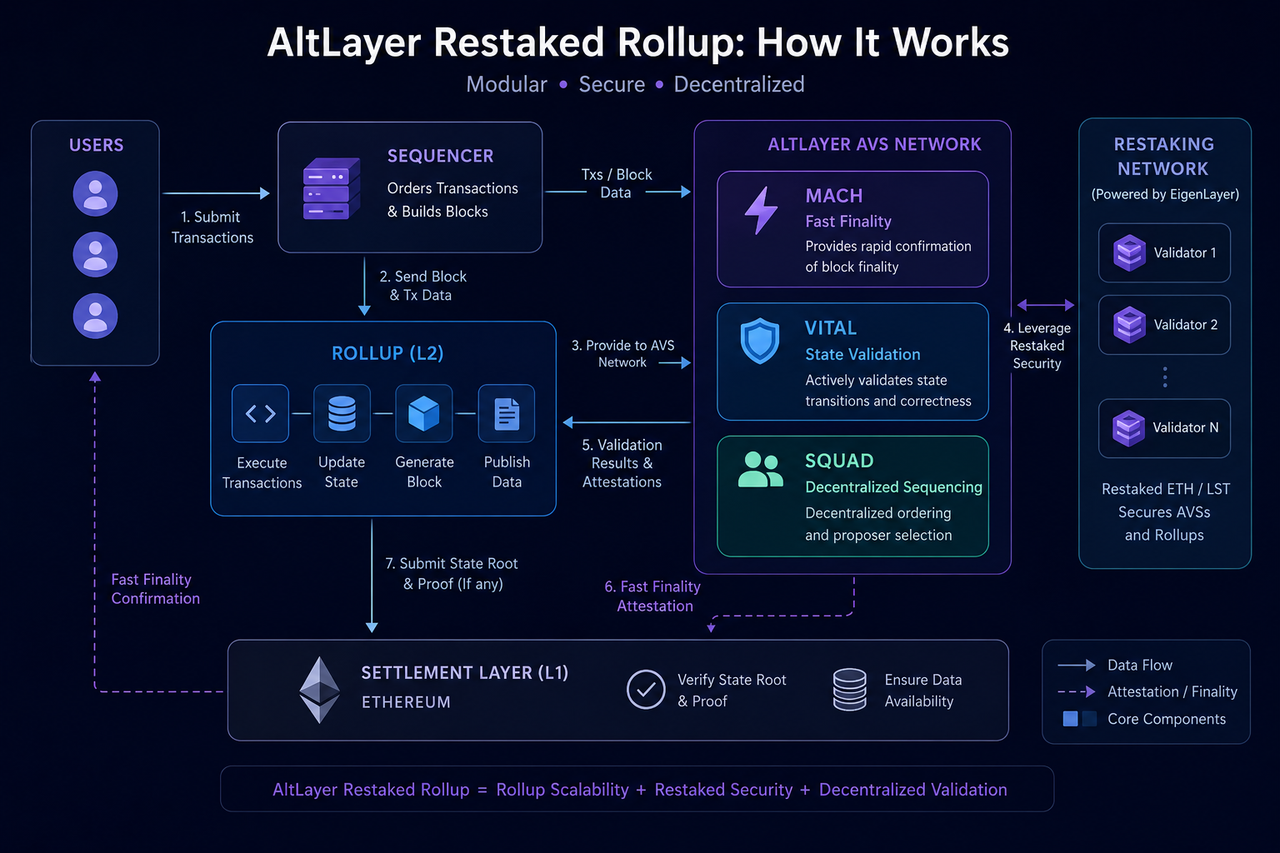
The full process can be summarized in the following stages:
-
Users submit transactions
-
The Sequencer orders the transactions
-
The Rollup executes transactions and generates state updates
-
MACH provides fast finality
-
VITAL verifies state correctness
-
SQUAD provides decentralized sequencing support
-
The final state is submitted to Ethereum or the settlement layer
This structure allows a Rollup to maintain high performance while gaining additional shared security capabilities.
What Role Does the Sequencer Play in a Restaked Rollup?
The Sequencer is the core component in a Rollup responsible for transaction ordering and block generation. After users send transactions, the Sequencer determines their order and generates the new block state.
In traditional Rollups, the Sequencer is often controlled by a single entity, which creates centralization risk. Malicious ordering, transaction censorship, or service outages could all affect network operations.
AltLayer does not remove the Sequencer. Instead, it adds an additional supervision layer through AVS and decentralized sequencing mechanisms, reducing the risk of a single point of failure.
How Does MACH Enable Fast Finality?
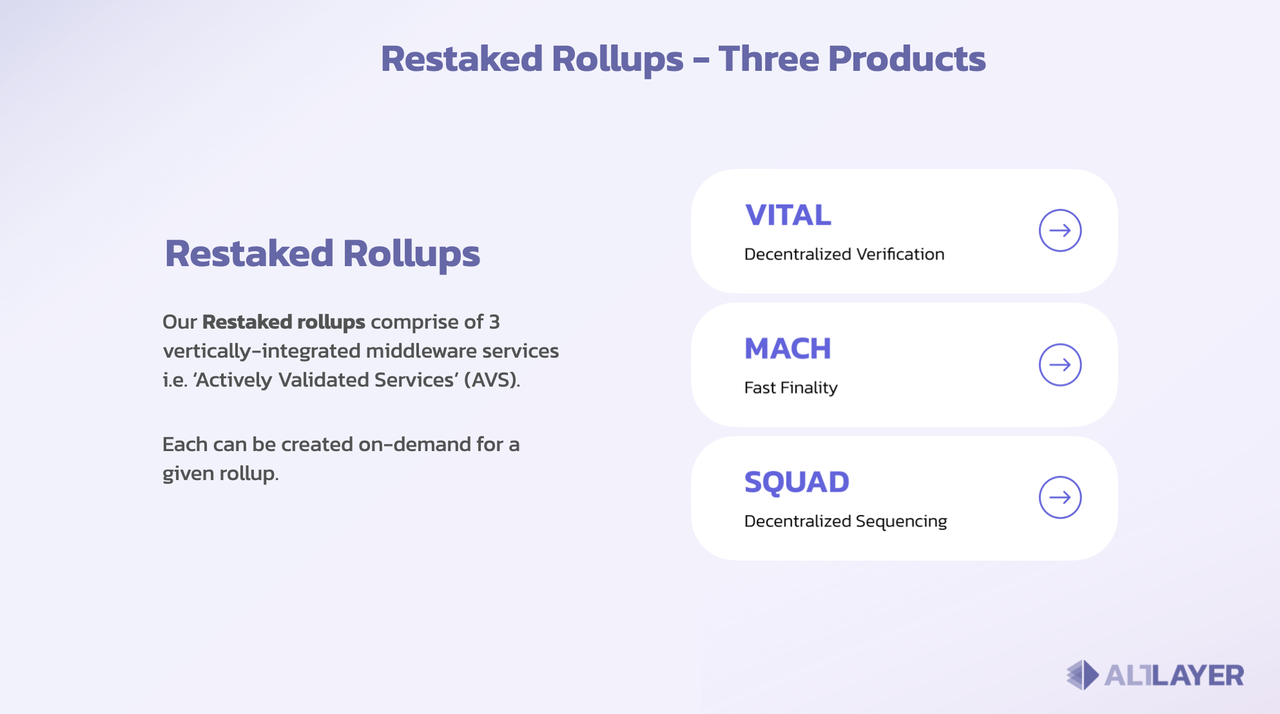
MACH is AltLayer’s fast finality AVS, designed to shorten Rollup confirmation times.
In a traditional Optimistic Rollup, users usually need to wait through a longer challenge period before a transaction can be considered final. While this mechanism improves security, it can weaken the user experience for cross-chain bridges, high-frequency trading, and real-time applications.
MACH uses restaked validators to quickly confirm block results, giving the network faster finality. For use cases such as on-chain gaming and AI Agents, where low-latency interaction is essential, fast finality is especially important.
How Does VITAL Verify Rollup State?
VITAL is AltLayer’s state validation AVS, mainly used to check whether a Rollup’s state transitions are correct.
After the Sequencer generates a new block, VITAL validators independently verify the state update. If they detect an abnormal state, incorrect computation, or malicious behavior, validators can issue an alert and prevent the faulty state from being confirmed.
This mechanism can reduce the risk of incorrect state propagation and improve the credibility of the Rollup.
Compared with a structure that relies solely on Fraud Proofs, VITAL places more emphasis on active validation and additional security checks.
How Does SQUAD Enable Decentralized Sequencing?
SQUAD is AltLayer’s decentralized sequencing AVS, designed to reduce the problem of a single Sequencer controlling transaction ordering.
In a traditional structure, a single sequencer can decide the order in which transactions enter a block, which may create censorship risks and MEV issues. SQUAD allows multiple nodes to participate in sequencing, improving network transparency and censorship resistance.
Decentralized sequencing is considered one of the important directions for the long-term development of modular Rollups because it can strengthen network credibility and fairness.
How Does Restaking Work in This Process?
Restaking is one of the core foundations of a Restaked Rollup.
In the Ethereum PoS network, validators already secure the main chain by staking ETH. EigenLayer’s Restaking model allows these assets to be reused to provide shared security for other protocols.
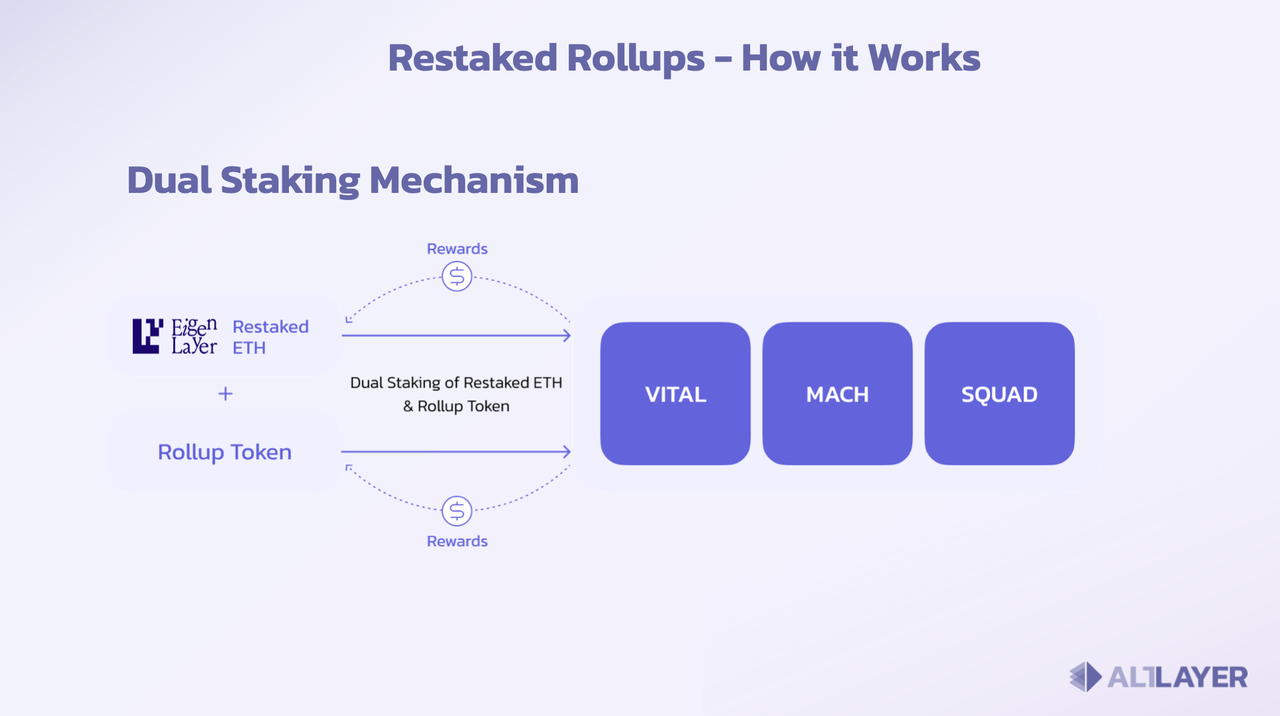
AltLayer uses these restaked assets to support AVS services such as MACH, VITAL, and SQUAD. As a result, Rollups can gain additional security without building a large validation network of their own.
This structure improves capital efficiency while lowering the launch barrier for new Rollups.
What Is the Difference Between a Restaked Rollup and a Regular Rollup?
| Comparison Dimension |
Regular Rollup |
Restaked Rollup |
| Security source |
Native validation mechanism |
Restaked shared security |
| Sequencer |
Usually centralized |
Can add decentralized sequencing |
| Finality speed |
May be slow |
Supports fast finality |
| Validation structure |
Basic Fraud Proof/ZK Proof |
Additional AVS validation layer |
| Deployment model |
Independent network |
Modular shared security |
The focus of a Restaked Rollup is not only scaling. It is also about strengthening the long-term security and scalability of Rollups within modular architecture.
Which Use Cases Are Restaked Rollups Suitable For?
Restaked Rollups are mainly suited to applications that need high performance and shared security.
On-chain games usually require low latency and fast confirmation, so they can benefit from MACH’s fast finality. AI Agent scenarios involve large volumes of automated interactions and real-time state updates, which require efficient sequencing and fast validation.
In DeFi, high-frequency trading and cross-chain bridges also need faster confirmation and a more stable security layer. For short-term event chains and Ephemeral Rollups, Restaked Rollups can provide flexible scaling capabilities.
What Challenges Do Restaked Rollups Face?
Although modular architecture improves flexibility, it also increases system complexity.
AVS, restaking, data availability layers, and Rollups need to coordinate closely, which may introduce more technical dependency issues. At the same time, the shared security model may also create cascading risks.
If multiple protocols rely on the same restaked assets, the stability of the entire modular ecosystem could be affected under extreme conditions.
In addition, decentralized sequencing and cross-Rollup coordination mechanisms are still in an early stage of development, and interoperability between different networks continues to evolve.
Conclusion
AltLayer’s Restaked Rollup is a new modular architecture that combines Rollup scaling with restaked shared security. Through AVS such as MACH, VITAL, and SQUAD, it provides fast finality, state validation, and decentralized sequencing capabilities.
Compared with traditional Rollups, Restaked Rollups place greater emphasis on shared security and modular collaboration, allowing appchains to gain additional security support without having to build a large independent validator network.
FAQs
Why Does AltLayer Need AVS?
AVS, or actively validated services, can provide Rollups with additional validation and security support, including fast finality, state checks, and decentralized sequencing.
What Is the Main Role of MACH?
MACH is AltLayer’s fast finality AVS. It is used to shorten Rollup confirmation times and improve interaction efficiency for cross-chain bridges, on-chain games, and high-frequency trading.
What Is the Difference Between VITAL and Fraud Proofs?
Fraud Proofs are more challenge-based, while VITAL emphasizes active validation and additional state checks, allowing abnormal states to be detected earlier.
Why Is Restaking Important?
Restaking allows already staked ETH to be reused to provide shared security for multiple protocols, improving capital efficiency and network security.
Are Restaked Rollups Only Suitable for Optimistic Rollups?
Restaked Rollups are not limited to Optimistic Rollups. AltLayer also supports different Rollup architectures, including those compatible with ZK Stack.







