As Rollup becomes an important path for blockchain scaling, more applications need modular infrastructure that can be deployed quickly, scale flexibly, and benefit from shared security. This is why AltLayer has become a key part of the modular ecosystem.
The blockchain industry is gradually moving away from monolithic chain structures and toward modular architectures. Traditional public blockchains usually keep execution, data availability, consensus, and settlement within the same network. Modular blockchains, by contrast, try to separate these functions to improve scalability and flexibility. Within this trend, AltLayer provides developers with a lower barrier to application chain deployment through Rollup-as-a-Service, restaked security, and AVS services, while also strengthening Rollup decentralization and security.
What Is AltLayer?
As a modular protocol focused on Rollup infrastructure, AltLayer’s core goal is to help developers quickly create, deploy, and scale application-specific Rollups. AltLayer supports major Rollup frameworks such as OP Stack, Arbitrum Orbit, Polygon CDK, and ZK Stack, and adds shared security and fast finality capabilities to these networks through its Restaked Rollup model.

Unlike a traditional Layer2, AltLayer does not focus on a single Rollup network. It is better understood as an infrastructure provider. Developers can use AltLayer to create appchains for gaming, AI, DeFi, or enterprise use cases, while flexibly choosing the data availability layer, sequencer, and settlement layer according to their needs.
What Is a Restaked Rollup?
Restaked Rollup is the Rollup security model proposed by AltLayer. Its core idea is to use restaked assets to provide shared security and validation capabilities for Rollups. This mechanism combines Rollup scaling with EigenLayer’s restaking architecture, allowing Layer2 networks to obtain additional security support through AVS.
In traditional Rollups, state validation and sequencing are usually handled by a limited set of nodes. A Restaked Rollup introduces an additional validation layer to check transaction states, sequencing results, and final confirmation. This design can reduce centralization risk and improve network credibility.
AltLayer’s Restaked Rollup mainly consists of three core AVS modules: MACH, VITAL, and SQUAD. Each module is responsible for a different function, including fast finality, state validation, and decentralized sequencing.
What Is Rollup-as-a-Service, or RaaS?
Rollup-as-a-Service, or RaaS, is an infrastructure service that allows developers to quickly deploy Rollups. Through modular tools and a visual console, AltLayer enables developers to create appchains without having to build complex networks from scratch.
Developers can choose different execution layers, data availability layers, and settlement layers, then configure Rollup parameters based on business needs. This model lowers the barrier to appchain development while improving deployment efficiency.
AltLayer’s RaaS supports multiple major Rollup technology stacks, including OP Stack, Arbitrum Orbit, Polygon CDK, and ZK Stack, giving it strong compatibility.
What Is an Ephemeral Rollup?
An Ephemeral Rollup is a temporary Rollup architecture that can be launched quickly for a specific need and shut down once the task is complete. AltLayer brings this concept into the modular blockchain ecosystem to meet peak demand from applications.
For example, during a major on-chain gaming event, NFT mint, DAO vote, or AI Agent collaboration process, a network may need to process a large number of transactions in a short period of time. An Ephemeral Rollup can provide an independent execution environment and prevent congestion on the main network.
Unlike long-running Rollups, Ephemeral Rollups place more emphasis on flexibility and instant scalability, making them suitable for event-driven applications.
What Is the ALT Token Used For?
ALT is the core token of the AltLayer network and is mainly used for governance, economic incentives, and security mechanisms. Holders can participate in protocol governance and vote on network upgrades and parameter changes.
ALT can also be used to pay for AVS services and take part in restaking-related mechanisms. As the Restaked Rollup ecosystem expands, ALT’s role in the shared security model is gradually becoming more important.
In addition, ALT is used to incentivize nodes and network participants, helping sustain the long-term operation of the protocol.
What Are the Use Cases for AltLayer?
AltLayer’s use cases are mainly concentrated in areas with strong performance and modularity requirements, including on-chain gaming, AI Agents, DeFi, and enterprise applications.
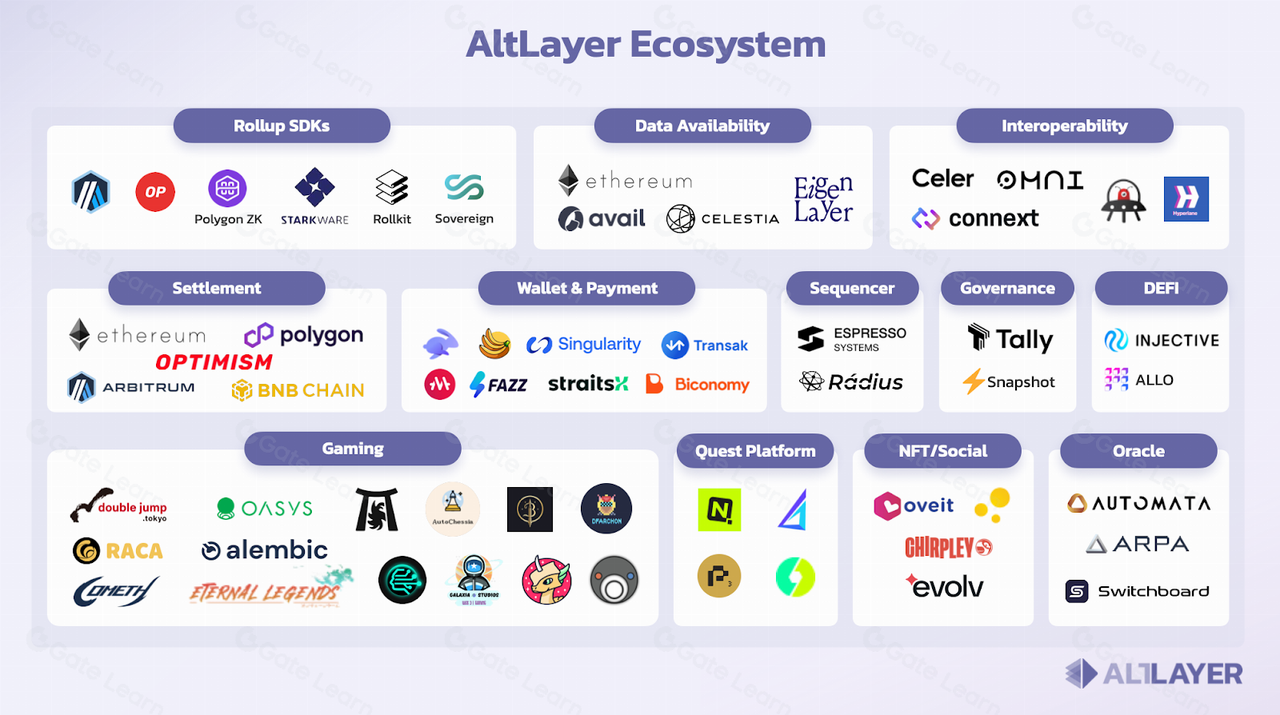
On-chain games usually need an independent execution environment and high throughput, while AltLayer can provide a more stable on-chain experience through application-specific Rollups. AI Agent use cases require low latency and fast finality to support automated interactions and machine collaboration.
In DeFi, AltLayer can be used for high-frequency trading and cross-chain liquidity applications. For enterprise use cases, modular Rollups allow the network structure to be configured flexibly according to business needs.
How Is AltLayer Different from Other Rollup Infrastructure?
AltLayer is often discussed alongside EigenLayer, Celestia, Arbitrum Orbit, and Optimism Superchain, but each has a different role.
| Protocol |
Core Positioning |
Main Functions |
| AltLayer |
Rollup infrastructure |
Restaked Rollup, RaaS, AVS |
| EigenLayer |
Restaking protocol |
Shared security and AVS |
| Celestia |
Data availability layer |
Modular DA |
| Arbitrum Orbit |
Appchain framework |
Orbit Rollup deployment |
| Optimism Superchain |
Rollup network alliance |
OP Stack ecosystem interconnection |
AltLayer stands out because it integrates restaked security, AVS, and Rollup deployment capabilities at the same time, making it closer to a complete Rollup infrastructure layer.
Potential Limitations and Challenges of AltLayer
Although modular architecture improves flexibility, it also increases system complexity. Rollups, AVS, restaking, and data availability layers need to work closely together, which may create additional technical challenges.
The restaking model may also increase economic risk. If multiple protocols share the same security layer, cascading effects could occur in extreme situations.
In addition, the modular ecosystem is still at an early stage. Interoperability between different Rollup standards and the developer experience are still evolving.
Conclusion
AltLayer is a Rollup infrastructure protocol built for the modular blockchain ecosystem. Through Restaked Rollups, AVS, and Rollup-as-a-Service, it provides shared security, fast finality, and flexible scaling capabilities. As modular blockchains and application-specific Rollups continue to develop, AltLayer is becoming important infrastructure that connects restaked security with Rollup scaling.
Compared with traditional Layer2 solutions, AltLayer places greater emphasis on composability, modularity, and shared security. Its Restaked Rollup architecture also reflects the broader trend of blockchain scaling moving from standalone networks toward multilayer collaboration.
FAQs
What Is the Difference Between a Restaked Rollup and a Regular Rollup?
A regular Rollup mainly relies on its own sequencer and validation mechanism, while a Restaked Rollup uses restaked assets and AVS to provide additional security, decentralized validation, and fast finality.
What Is the Relationship Between AltLayer and EigenLayer?
AltLayer’s Restaked Rollup architecture is built on EigenLayer’s restaking model. EigenLayer provides shared security infrastructure, while AltLayer focuses more on Rollup deployment and scaling capabilities.
What Is the ALT Token Used For?
ALT is mainly used for governance, network incentives, AVS service payments, and restaking-related security mechanisms. It is an important part of the AltLayer ecosystem.
Does AltLayer Support ZK Rollups?
AltLayer supports multiple Rollup technology stacks, including ZK Stack, so it can be compatible with some ZK Rollup architectures.
What Is an Ephemeral Rollup?
An Ephemeral Rollup is a temporary Rollup that can be quickly deployed for short-term needs and shut down after the task is complete. It is suitable for on-chain gaming events, AI Agents, and peak transaction scenarios.







