With the growth of online trading platforms and digital asset markets, leveraged trading has gradually become an important part of the derivatives market. Compared with traditional spot trading, the leverage structure of CFDs can improve capital efficiency, which is why it is widely used across stocks, forex, commodities, and cryptocurrency markets.
Because leverage can magnify both gains and losses, understanding CFD margin structures, risk control mechanisms, and forced liquidation logic is essential for building a complete understanding of derivatives trading.
What Is the CFD Leverage Mechanism?
CFD, short for contract for difference, is a financial derivative settled based on price differences. Leverage is one of the core structures of the CFD market. Through leverage, traders do not need to pay the full value of an asset. Instead, they only need to provide a certain percentage as margin to establish a larger market exposure.
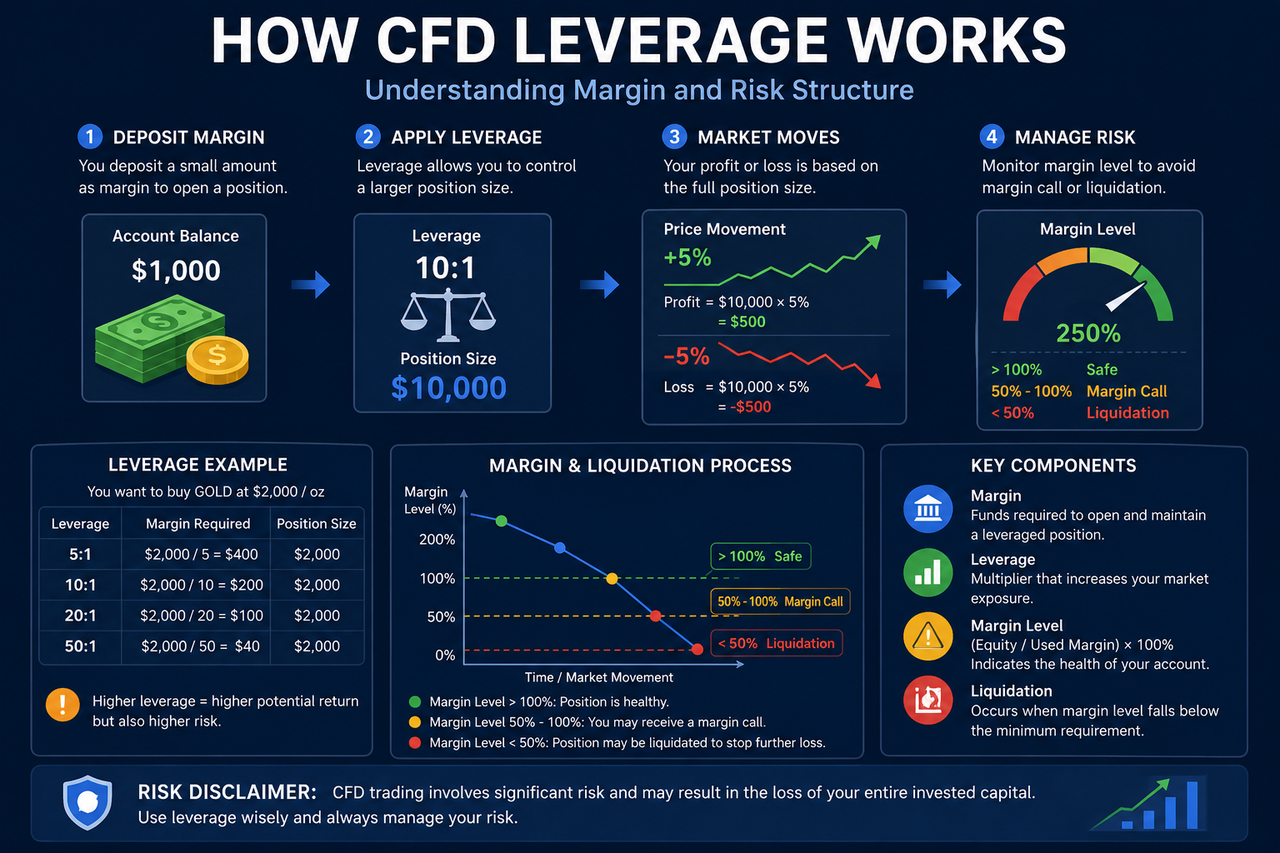
How Does CFD Leverage Work?
The core logic of CFD leverage is to use a relatively small amount of margin to control a larger asset position.
For example, with 10x leverage, a trader only needs to provide $1,000 in margin to open a position worth $10,000. This means that market price movements are calculated based on the $10,000 position, rather than only on the capital actually committed from the account.
Leverage levels are usually determined by the trading platform or regulatory rules, and leverage limits can vary across markets. For instance, the forex market often allows higher leverage, while stock CFDs or cryptocurrency CFDs may have relatively lower leverage ratios.
The calculation logic for CFD leverage can usually be expressed as:
Leverage = Margin / Position Size
The higher the leverage ratio, the more noticeable the impact of market price movements on account equity.
What Is Margin?
Margin is the capital used in CFD trading to cover potential loss risk.
When a position is opened, the platform freezes a certain percentage of account funds as initial margin. Margin is not a trading fee. It is a risk reserve required to keep a leveraged position active.
For example, when a platform requires 10% margin, the trader only needs to pay 10% of the asset’s total value to open a full position.
The margin mechanism allows traders to participate in larger market movements without holding the full amount of capital.
What Is Maintenance Margin?
In addition to initial margin, the CFD market also uses a maintenance margin mechanism.
Maintenance margin refers to the minimum level of funds required for an account to maintain its current position. When the market moves against the position and account equity declines, the account’s margin ratio also falls.
If account equity drops below the maintenance margin requirement, the platform may issue a margin call, restrict further position opening, or automatically trigger forced liquidation. Therefore, the core purpose of the maintenance margin system is to control systemic risk in leveraged trading.
Why Do CFDs Magnify Both Gains and Losses?
Because CFD profits and losses are calculated based on the full position size rather than the capital actually invested, leverage can magnify both gains and losses.
For example:
-
A user provides $1,000 in margin
-
Opens a position worth $10,000
-
The market rises by 5%
The theoretical profit is calculated based on $10,000, not $1,000.
Likewise, if the market falls by 5%, the loss is magnified in the same way.
The calculation logic for CFD profit and loss can usually be expressed as:
$$Profit/Loss=(Closing Price−Opening Price)×Position Siz$$
Therefore, while high leverage can improve capital efficiency, it also means higher risk exposure.
How Is CFD Forced Liquidation Triggered?
Forced liquidation is an important part of the CFD risk control system.
When the market continues to move in an unfavorable direction, account equity may gradually fall below the maintenance margin requirement. To prevent losses from expanding further, the platform may automatically close part or all of the position.
Forced liquidation is usually related to the following factors:
-
Leverage ratio
-
Market volatility
-
Position size
-
Account equity level
Under high leverage, even a relatively small price movement may quickly trigger forced liquidation.
In highly volatile markets, such as cryptocurrency CFDs or crude oil CFDs, liquidation risk is usually more pronounced.
What Are the Risks of CFD Leverage?
The greatest risk of CFD leverage comes from the effect of magnified losses.
Because the position size controlled by the trader is far greater than the account principal, even small market movements can cause account funds to change rapidly.
In addition, leveraged trading may involve forced liquidation risk, market gap risk, high volatility risk, overnight financing fees, and liquidity risk.
Under extreme market conditions, prices may change rapidly, leaving the account unable to adjust positions in time.
How Does CFD Leverage Differ Across Markets?
CFD leverage ratios often vary significantly across different markets.
Because the forex market is highly liquid, some platforms allow higher leverage ratios. Stock CFDs usually have relatively lower leverage because individual stock prices may fluctuate more sharply.
Leverage for commodity CFDs and cryptocurrency CFDs is often affected by market volatility. For example, because the cryptocurrency market is highly volatile, regulators in some regions place limits on crypto CFD leverage.
In recent years, regulators in many parts of the world have also gradually strengthened risk oversight of retail leveraged trading to reduce systemic risk caused by high leverage.
How Is CFD Leverage Different from Traditional Margin Trading?
Although both CFD leverage and traditional margin trading can increase market exposure, their underlying structures are not exactly the same.
Traditional margin trading usually involves the buying and selling of real assets and a borrowing relationship, while CFDs use a derivative structure based on settlement of price differences. During CFD trading, asset ownership is not transferred.
In addition, CFDs place greater emphasis on trading price movements themselves, so they are more commonly used in short term trading and derivatives market scenarios.
Summary
The CFD leverage mechanism allows traders to use a margin system to open larger market positions with less capital, improving capital efficiency.
At the same time, however, leverage also magnifies the potential gains and losses caused by price movements. Margin, maintenance margin, overnight financing fees, and forced liquidation mechanisms together form the risk control structure of CFDs.
FAQs
Why Do CFDs Require Margin?
Margin is used to cover potential loss risk and serves as the basis for leveraged trading to create larger market exposure.
Why Is High Leverage Riskier?
Because leverage magnifies changes in profits and losses caused by market movements, even small price fluctuations may lead to large losses.
Why Does CFD Forced Liquidation Occur?
When account equity falls below the maintenance margin requirement, the platform may automatically close positions to control risk.
Is CFD Leverage the Same as Margin Trading?
Both can increase market exposure, but CFDs use a derivative structure based on price difference settlement, while margin trading usually involves borrowing real assets.
Why Is Leverage for Cryptocurrency CFDs Usually Lower?
Because the cryptocurrency market is highly volatile, some platforms and regulators restrict leverage ratios to reduce risk.