As the digital asset market has developed, cryptocurrency CFDs have gradually become an important part of online derivatives trading. Compared with traditional spot crypto trading, Crypto CFDs place more emphasis on trading price movements themselves rather than holding and transferring on chain assets, so they are widely used in short term trading, hedging, and leveraged trading scenarios.
Against the backdrop of continued global digital asset market expansion, cryptocurrency CFDs have also become one of the important tools linking traditional financial derivative logic with crypto market structures.
What Is Cryptocurrency CFD?
Cryptocurrency CFD, or Crypto Contract for Difference, is a financial derivative that allows traders to settle price differences based on rises and falls in digital asset prices. Users do not need to actually hold cryptocurrencies such as Bitcoin or Ethereum. Instead, profit and loss are calculated from the difference between the opening price and the closing price.
How Does Cryptocurrency CFD Work?
The core logic of cryptocurrency CFD is “settlement by price difference.”
After a trader opens a position, the platform records the opening price. When the user closes the position, the system calculates profit or loss based on the difference between the opening price and the closing price, without any real transfer of digital assets.
If a trader expects the price of Bitcoin to rise, they can open a long position. If they expect the price to fall, they can open a short position. Since CFDs support two way trading, both rising and falling markets may create trading opportunities.
Crypto CFDs are usually used together with a leverage mechanism, so traders only need to provide a certain percentage of margin to establish a larger market position.
How Is Cryptocurrency CFD Different from Traditional CFDs?
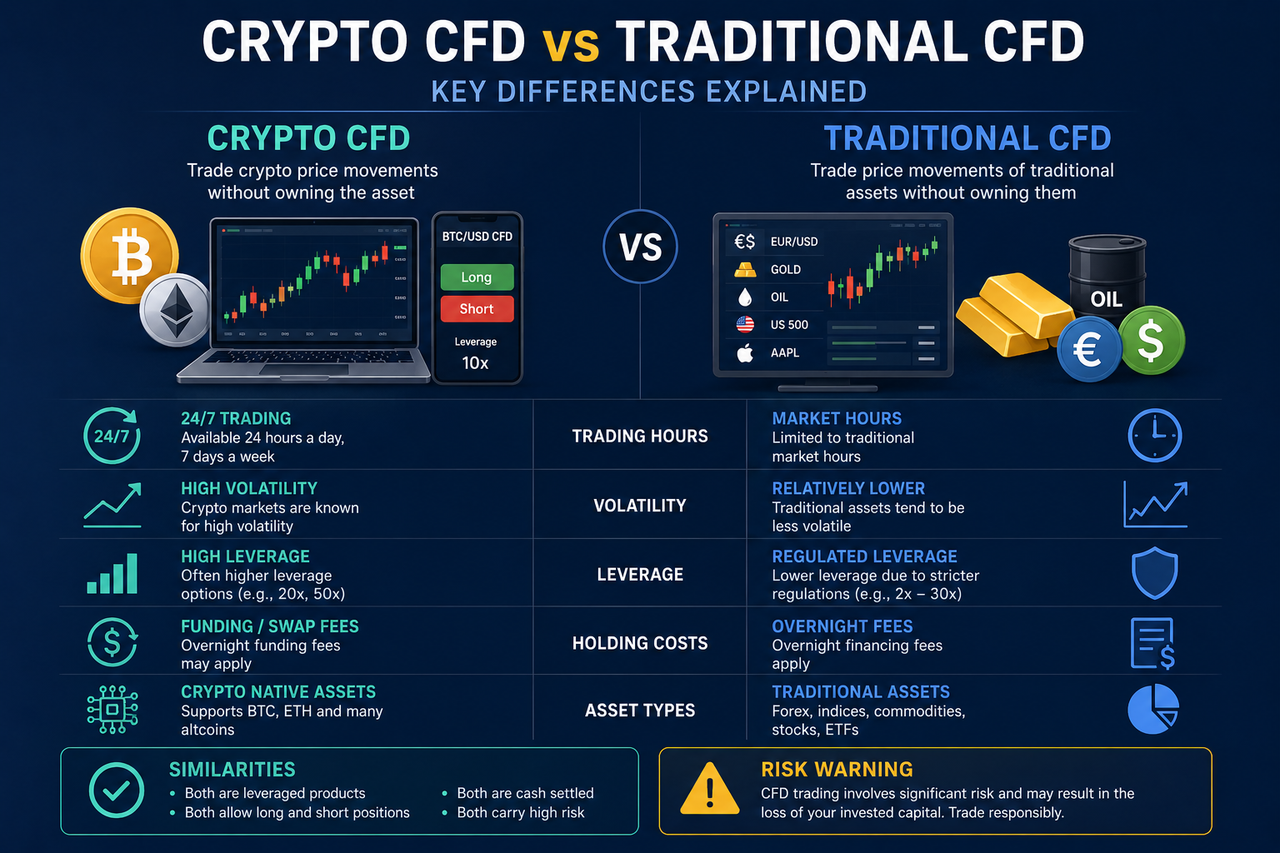
Cryptocurrency CFD is still a type of CFD derivative in nature. However, because its underlying assets are digital assets, it differs clearly from traditional CFDs in market structure and risk model.
Traditional CFDs usually cover stocks, foreign exchange, indexes, or commodity markets, while Crypto CFDs are directly linked to the prices of digital assets such as Bitcoin and Ethereum.
In addition, the crypto market features 24 hour continuous trading, higher price volatility, a faster market pace, and more noticeable liquidity changes. As a result, the risk profile of Crypto CFDs is usually more pronounced than that of traditional CFDs.
How Is Cryptocurrency CFD Different from Spot Crypto Trading?
Spot crypto trading involves the actual buying and selling of digital assets. Users usually need to hold on chain assets and complete asset transfers and storage through wallets.
Cryptocurrency CFD, by contrast, does not involve real asset ownership. Traders only seek price difference returns based on price changes, so they do not need to manage private keys or on chain wallets.
The core differences include:
| Comparison Dimension |
Cryptocurrency CFD |
Crypto Spot Trading |
| Holds real assets |
No |
Yes |
| Supports leverage |
Usually yes |
Some markets do |
| Supports short selling |
Yes |
Some markets do |
| Involves on chain transfers |
No |
Yes |
| Core trading logic |
Price difference settlement |
Asset buying and selling |
Compared with spot trading, Crypto CFD places greater emphasis on price movement trading and leverage structure.
How Is Cryptocurrency CFD Different from Perpetual Contracts?
Cryptocurrency CFDs and perpetual contracts both support leverage and two way trading, so users often confuse them.
However, they still differ clearly in market structure.
Crypto CFDs are usually quoted and supplied with liquidity by brokers, and trading is more often based on a market maker model. Perpetual contracts, by contrast, mainly use an order book matching mechanism, with prices jointly formed by market participants.
In addition:
At present, perpetual contracts usually have higher liquidity and trading scale than traditional Crypto CFDs in the crypto market.
Why Is Cryptocurrency CFD More Volatile?
The digital asset market itself is highly volatile, so cryptocurrency CFDs usually experience much more noticeable price swings than traditional stock or forex CFDs.
Factors that affect Crypto CFD volatility include:
Because Crypto CFDs are often combined with leveraged trading, price movements may further amplify changes in account profit and loss.
During extreme market conditions, sharp moves over a short period may even trigger cascading liquidations.
What Are the Main Risks of Cryptocurrency CFD?
Crypto CFD is a high risk leveraged derivative, and its risk is usually higher than that of traditional CFDs.
The main risks include:
Since the crypto market operates around the clock, market volatility may occur at any time.
In addition, regulatory policies for crypto CFDs vary greatly across countries and regions. Some markets even restrict retail users from participating in high leverage digital asset CFD trading.
The Role of Cryptocurrency CFD in the Digital Asset Market
Cryptocurrency CFDs give users a way to participate in market movements without holding real digital assets.
For some traders, Crypto CFDs can be used for short term trading, trend trading, hedging spot risk, and participating in leveraged markets.
At the same time, Crypto CFDs have also helped extend traditional financial derivative logic into the digital asset market, allowing more traditional trading structures to enter the crypto ecosystem.
As the digital asset market gradually matures, Crypto CFDs, together with perpetual contracts, options, and other products, have become an important part of the crypto derivatives market.
Key Differences Between Cryptocurrency CFDs and Traditional CFDs
| Comparison Dimension |
Cryptocurrency CFD |
Traditional CFD |
| Underlying asset |
Digital assets |
Stocks, forex, commodities, etc. |
| Market trading hours |
24 hours |
Usually limited by trading sessions |
| Volatility |
Higher |
Relatively lower |
| Market maturity |
Newer |
More mature |
| Main risks |
High volatility and liquidity risk |
Macro and market risk |
| Common trading scenario |
Crypto market |
Traditional financial markets |
| Liquidity changes |
More noticeable |
Relatively stable |
Conclusion
Cryptocurrency CFD is a financial derivative settled based on changes in digital asset prices, allowing traders to participate in market movements without holding real crypto assets.
Compared with traditional CFDs, Crypto CFDs are more easily affected by high volatility, 24 hour markets, and changes in digital asset liquidity, so their risk structure is also more complex.
FAQs
Do cryptocurrency CFDs require holding real digital assets?
No. Crypto CFD is a derivative settled by price difference, and no real asset transfer occurs during the trading process.
Why do cryptocurrency CFDs support short selling?
Because CFDs are essentially traded based on price movements, traders can participate in both rising and falling markets.
What is the difference between Crypto CFD and crypto spot trading?
Spot trading involves ownership of real digital assets, while Crypto CFD is settled only based on price changes.
Are cryptocurrency CFDs the same as perpetual contracts?
Both support leverage and two way trading, but Crypto CFDs more often use a broker quote model, while perpetual contracts are mainly based on order book matching.
Why is cryptocurrency CFD risk higher?
Because the digital asset market is highly volatile and leverage may amplify profit and loss, the risk is usually higher than that of traditional CFDs.
Can cryptocurrency CFDs be traded 24 hours a day?
Usually yes. Since the crypto market itself operates around the clock, most Crypto CFD products also support continuous trading.