#CLARITYActEntersFinalCriticalStage THE COUNTDOWN HAS BEGUN
The Digital Asset Market Clarity Act has entered one of its most decisive phases, with the opportunity for Senate approval narrowing as the 2026 legislative calendar rapidly fills. Supporters view this period as the final opportunity to move comprehensive crypto market legislation forward before congressional scheduling and political negotiations potentially delay action beyond this year.
LEGISLATIVE PROGRESS SO FAR
The proposal has already cleared several major hurdles. The U.S. House of Representatives approved its version of the legislation, while the Senate Banking Committee advanced an amended bill through a 15-9 vote on May 14, 2026. At the same time, the Senate Agriculture Committee developed its own framework covering digital assets classified as commodities.
The next objective is to combine both committee proposals into a unified Senate bill capable of attracting enough bipartisan support for a full Senate vote.
THE BIGGEST ROADBLOCK
Although negotiations continue, several important disagreements remain unresolved. The primary issue centers on ethics provisions requested by Senate Democrats.
Reports surrounding President Trump's estimated $1.4 billion crypto-related windfall have intensified debate, with Democrats seeking stronger safeguards to prevent the president and family members from benefiting from digital asset ventures while the administration oversees industry regulation.
Republican lawmakers recently introduced a revised proposal aimed at advancing negotiations, but Democrats and consumer advocacy organizations argued that the updated language still fails to address potential conflicts of interest, leaving bipartisan agreement out of reach.
WHAT THE BILL WOULD CHANGE
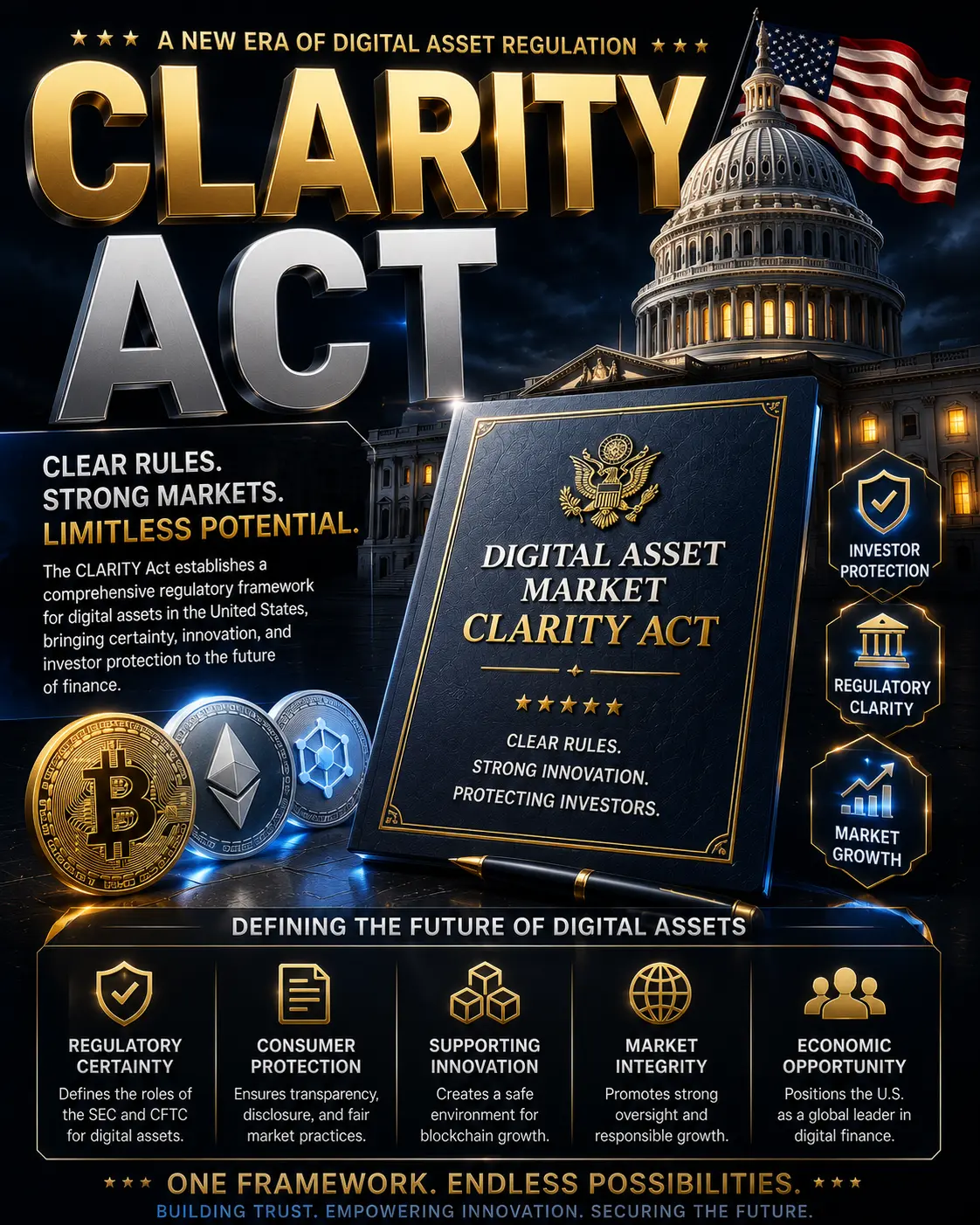
Beyond the political debate, the Clarity Act proposes one of the most significant regulatory restructurings in U.S. crypto history.
The legislation would establish a formal division of authority between the Securities and Exchange Commission (SEC) and the Commodity Futures Trading Commission (CFTC) by determining whether individual digital assets should be regulated as securities or commodities.
This framework would replace years of enforcement-driven uncertainty with a unified federal classification system designed to provide clearer rules for issuers, exchanges, custodians, and institutional participants.
A KEY PROVISION UNDER DEBATE
One of the most closely watched sections of the Senate Banking Committee draft would prohibit cryptocurrency platforms from paying yield or reward programs on stablecoin deposits.
If retained in the final legislation, this provision could significantly affect yield-bearing stablecoin products and reshape how exchanges structure passive income opportunities for users.
TIME IS RUNNING SHORT
Congressional scheduling has added urgency to negotiations.
The Senate is scheduled to begin its state work period on August 10, remaining away from Washington until the middle of September. This leaves only a limited window for lawmakers to finalize negotiations, introduce a consolidated bill, and secure enough floor time for debate and voting.
With several competing legislative priorities already on the calendar, additional delays could make comprehensive action during 2026 increasingly difficult.
WHY THE INDUSTRY IS WATCHING
The outcome carries major implications for the entire digital asset sector.
Approval would establish the first comprehensive federal framework covering token classification, exchange operations, custody standards, and institutional participation. Greater regulatory certainty could encourage broader institutional investment and accelerate mainstream adoption.
Failure, however, would extend the current environment of regulatory uncertainty, leaving businesses to navigate inconsistent enforcement approaches while delaying greater institutional participation.
GLOBAL SIGNIFICANCE
The Clarity Act is being closely monitored beyond the United States. Governments developing their own digital asset regulations are watching whether the U.S. can successfully implement a comprehensive legal framework. Whatever the final outcome, the decision is expected to influence future crypto regulation well beyond American borders.
#SummerCreationCamp @Gate_Square