Side-by-side comparisons often include Crypto.com Card, Coinbase Card, Nexo Card, Gate Card, MetaMask Card, and Gemini Credit Card, but those names do not share one funding model: some are prepaid or exchange-linked debit, some are collateral-backed credit lines, and some are fiat credit cards that only pay rewards in crypto. A useful comparison starts with issuer fee schedules and KYC country lists—not headline cashback alone. How a crypto card works and mainstream crypto card types explain settlement mechanics and product forms that any ranked list should rest on.
Key Takeaways
-
Regional eligibility and KYC support decide whether any ranked card can issue; cashback is secondary until that passes.
-
Conversion spread, non-local FX markup, and ATM issuer plus operator fees usually dominate total cost more than annual fees.
-
Headline “up to X%” cashback is almost always banded by spend caps, VIP tiers, or native-token staking with opportunity cost.
-
Custodial exchange cards and self-custody wallet cards change counterparty risk and recovery paths even when both show a Visa or Mastercard logo.
-
Gate Card is one debit-style option for eligible Gate users; it is not a default for every jurisdiction.
What Criteria Matter When Ranking Crypto Cards?
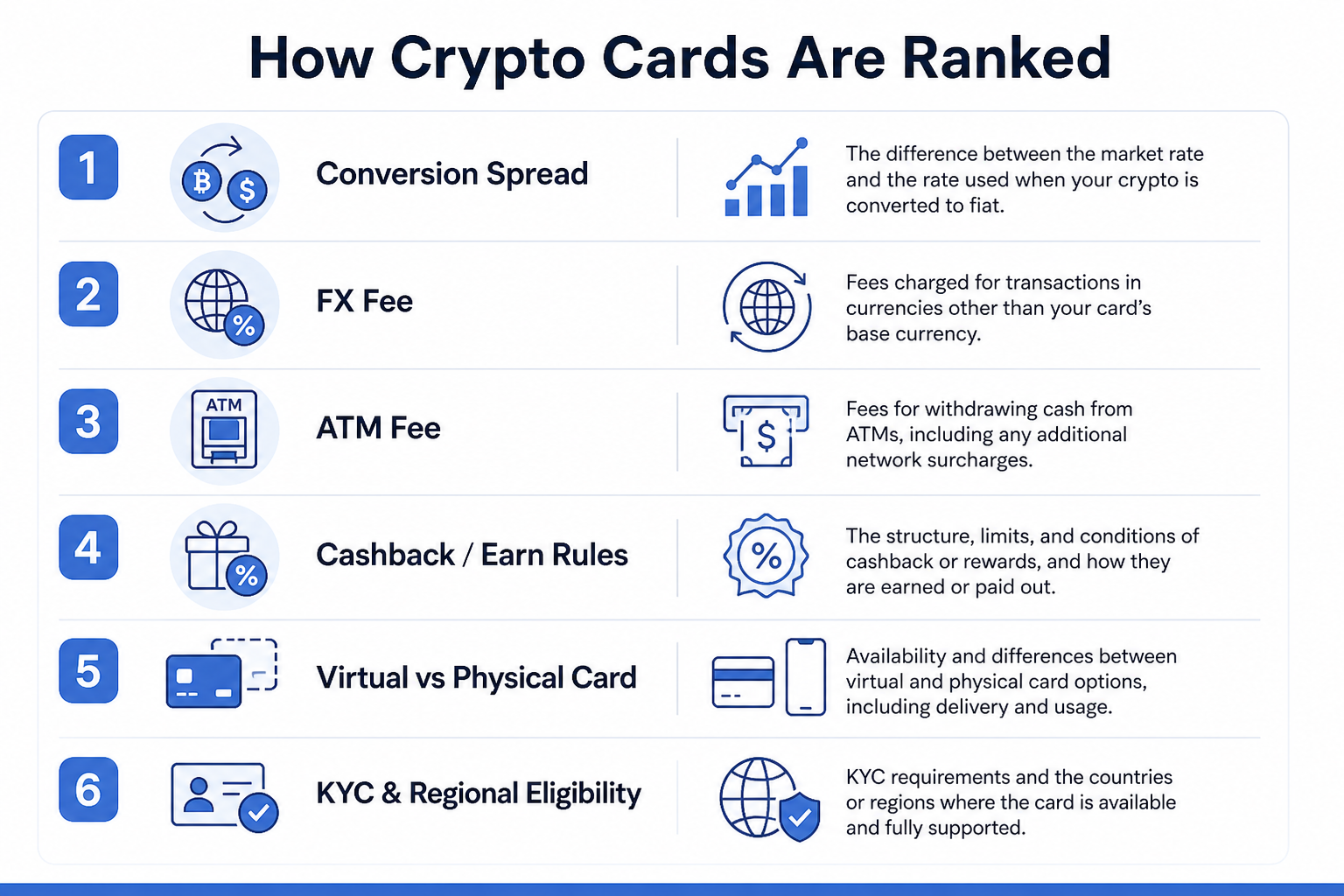
Figure 1. Ranking dimensions: conversion spread, FX, ATM, cashback rules, virtual vs physical form factors, and KYC eligibility.
Crypto cards are an increasingly popular way to spend digital assets, but the best crypto card is not the same for everyone. The right pick depends first on whether the issuer supports your country and ID document, then on whether you accept custodial balances or want self-custody until the moment of spend, and only after that on the real cost of use once conversion spreads, FX fees, ATM charges, and realistic cashback are factored in. Many cards are tied to centralized exchange platforms because they reduce technical hurdles for mainstream users, but that convenience changes the custody, security, and compliance trade-offs you accept.
| Ranking dimension |
What to verify |
Why it affects total cost |
| Regional eligibility |
KYC jurisdiction, blocked countries |
Unavailable cards score zero for you |
| Custody model |
Exchange custody vs wallet self-custody |
Counterparty and recovery risk |
| Conversion spread |
Crypto-to-fiat rate at POS vs a mid-market index |
Hidden cost on every purchase |
| FX fee |
Non-domestic currency spend and DCC prompts |
Travel and cross-border shopping |
| ATM fees |
Issuer fee, free limit, operator surcharge |
Cash access vs card spend |
| Cashback reality |
Base band, monthly cap, staking lock |
Headline rate rarely equals take-home |
| Form factor |
Virtual vs physical, Apple Pay / Google Pay |
Online speed vs ATM and POS needs |
Treat published fee pages as primary evidence. Marketing slogans such as “swipe anywhere, earn everywhere” do not replace spread and FX rows. When lists still recommend programs that have already stopped issuing, prefer currently active products with live schedules—comparison pages go stale when issuers shut down card services. Readers comparing debit, prepaid, and credit-style cards should weigh fees, rewards, custody, eligibility, and card type before applying. Ranking criteria, type differences, mainstream fee and reward patterns, Gate Card fit, and fee or risk checks decide whether a ranking holds up; everyday, travel, and stablecoin priorities belong in the use-case section below.
What Types of Crypto Cards Exist—Debit, Prepaid, and Collateral Credit?
Three funding models explain most products people call crypto cards. Prepaid and debit-style cards authorize against a loaded or linked balance and decline when funds are short. A crypto debit card works much like a traditional debit card, except the crypto is converted at the point of payment to complete the transaction. Collateral credit products extend a line backed by pledged crypto; repayment, interest, and liquidation rules apply if collateral values move. A fourth nearby product—fiat credit cards that only pay rewards in Bitcoin or other assets—does not convert crypto at checkout and should not be mixed into the same fee table without a label. For beginners, the most accessible options usually combine ease of use with clear fee schedules and supported assets.
Visa versus Mastercard branding mainly affects where you can spend digital assets through a familiar payment method. Issuer programs still differ on FX, ATM, chargebacks, and wallet tokenization. Crypto debit vs credit cards differ in funding path, settlement, and liquidation risk; types stay a short premise so ranking can focus on cost and eligibility.
How Do Mainstream Crypto Cards Compare on Fees and Rewards?
Use the table as an educational map of mechanisms—not a permanent league table. Confirm live terms on each issuer site before relying on any cell.
| Card |
Network and style |
Funding / conversion |
Rewards pattern (verify live) |
Availability notes |
| Crypto.com Card |
Visa debit tiers |
Exchange wallet; CRO staking tiers in many markets |
Tiered cashback with five tiers, reaching up to 6% back depending on tier |
KYC and tiers vary by country |
| Coinbase Card |
Visa debit |
Coinbase balances; purchases convert selected crypto to US Dollars |
Cashback on spend where offered; no annual or spending fees |
Available for US users and select markets |
| Nexo Card |
Mastercard debit / credit modes |
Wallet collateral or credit-line mechanics |
Cashback bands tied to account tiers, with up to 2% crypto cashback on purchases depending on level |
Region and account status dependent |
| Gate Card |
Visa debit-style |
Gate account balances |
Cashback or rebate per Gate Card terms |
Eligibility-dependent; often EEA-focused programs |
| MetaMask Card |
Debit via wallet rails |
Self-custody wallet spend paths where offered; supports nine tokens for spending |
Cashback bands vary; 1% to 3% mUSD back on transactions where available |
Country list and pilot limits apply |
| Gemini Credit Card |
Fiat credit with crypto rewards |
Traditional credit repayment; rewards in crypto |
Category rewards paid in crypto, including 4% back on gas and EV charging |
Primarily US credit underwriting |
Cashback “up to” figures collapse when you read the band: monthly spend ceilings, VIP unlocks, or large native-token locks. Staking CRO, NEXO, or similar assets to unlock a higher rate adds price and lock-period risk that can erase the advertised edge. Coinbase One Card rates can range from 2% to 4% based on balance. The Coinbase Card setup is also relatively straightforward because eligible users can qualify without a credit check, though other charges can still apply, including crypto purchase, conversion, transfer, or ATM operator fees. Adjacent products such as Coinbase One Card packaging or Venmo rewards cards often show up in crypto-rewards credit comparisons—treat them as separate paths with their own KYC and reward-payout rules, and note that Coinbase Card availability is for US users excluding Hawaii. Reward programs for cryptocurrency cards can change frequently, so verify live terms before you apply.
Where Does Gate Card Fit Among Crypto Debit Options?
Gate Card is Gate’s Visa debit-style product. Live program rules sit on the Gate Card product page; spend modes and card groups align with the Gate Card product structure. A virtual card and physical card let eligible users start online with a virtual number while plastic ships where support exists, and balances plus card settings are typically managed in the app. Availability is eligibility-dependent and commonly discussed for eligible EEA users plus other region-specific rollouts—not universal global issuance.
Spend draws from Gate account balances under the product’s conversion rules, with balance tracking, spending controls, and card management commonly handled in the app. Verify conversion spreads, non-local FX, ATM charges, and physical delivery fees on Gate’s help materials before heavy use. Gate Card fits users who already hold assets on Gate and want to spend crypto through a Visa path without moving funds elsewhere; it remains one option among Crypto.com Card, Coinbase Card, and Nexo Card, not a default for every jurisdiction.
How Should You Choose by Everyday, Travel, or Stablecoin Spend?
After the ranking table narrows issuers you can actually open, map the shortlist to spend intent—not the other way around. Everyday spend prioritizes low domestic conversion spread and simple top-ups; travel prioritizes FX transparency, ATM caps, and refusing DCC at the terminal; stablecoin spend prioritizes USDC/USDT quote timing and minimum spread at authorization.
| Use case |
Prioritize |
Watch for |
| Everyday |
Low spread, fast top-up |
Hidden FX on “domestic” checkouts; balance freezes |
| Travel |
Network acceptance, ATM caps, FX disclosure |
DCC prompts; weekend markups; country blocks |
| Stablecoin |
Pegged-asset support, quote freshness |
Auto-fallback into volatile assets |
Decision order stays: country eligibility → custody preference → fee rows on a realistic basket → cashback band you can unlock. Choose a crypto card by use case expands everyday vs travel vs stablecoin checklists, Gate Card as an exchange-debit example, and a pre-apply matrix. Once a product is shortlisted, how to get and use a crypto card walks through apply, top-up, and first-spend checks.
What Fees and Risks Should Card Users Check First?
Read issuer schedules for conversion, FX, ATM, inactivity, card delivery, ATM withdrawal fees, transaction fees, foreign transaction fees, and any hidden fees before scaling spend. Measure conversion spread empirically when possible: note a small purchase, compare the implied rate to a mid-market index at the same timestamp, and repeat when markets are volatile because spreads often widen then. ATM cash-out can stack an issuer fee with a machine operator surcharge even when marketing mentions “free ATM” inside a monthly cap, and extra bank-side charges can apply depending on the financial institution. Those free ATM withdrawals usually apply only up to a set allowance per month, with extra charges after the threshold. For example, MetaMask Card charges a 2% fee for ATM withdrawals, while Bitget Wallet Card has a monthly 0-fee allowance of $400.
Each purchase that converts cryptocurrency into fiat can create a taxable disposal under some local rules—treatment depends on jurisdiction and is not investment advice. Custodial balances sit with the issuer platform; self-custody cards shift key-management risk instead, and some wallet-linked products rely on the wallet’s private keys for non-custodial security. Many issuers also use two-factor authentication, suspicious-activity monitoring, PIN change, and instant card freezing if a card is lost, while the app may give you full control over spending limits, card locks, and ATM withdrawals. Failed authorizations during volatility, limited dispute windows, tier changes when staking rules adjust, and discontinued card programs are operational risks. Prefer active products with published schedules over stale ranked lists.
Summary
The best crypto cards are the programs that clear your KYC region, match your custody preference, and minimize conversion, FX, and ATM costs on the spend you actually run—while treating cashback headlines as capped, tiered, and sometimes staking-gated. Gate Card, Crypto.com Card, Coinbase Card, Nexo Card, and wallet-linked options occupy different cells in that matrix. Re-check live fee pages before relying on any ranked comparison.
FAQ
What is the best crypto card?
There is no universal best crypto card. Rank candidates by regional eligibility, custody model, conversion and FX costs, ATM rules, and the cashback band you can unlock without heavy token locks—then confirm the issuer’s current fee schedule.
Are crypto debit cards and crypto credit cards the same?
No. Debit and prepaid-style crypto cards spend available balances and decline when funding is short. Credit-style products extend collateral-backed lines with repayment and liquidation rules—for example, a Nexo account may borrow against collateral instead of selling assets, which keeps market exposure but adds liquidation risk. Fiat credit cards that only pay crypto rewards are a third path and should be labeled separately. Issuer perks such as loyalty tiers, free ATM allowances, or biometric locks still follow each program’s live schedule.
Do crypto cards work on Visa and Mastercard networks?
Most major crypto cards are Visa or Mastercard products that settle on standard merchant rails. Acceptance follows network rules while each authorization still funds from cryptocurrency, stablecoins, or linked balances under issuer terms. Wallet-linked options such as MetaMask Card keep keys with the user until authorization; coverage, tokenization, and whether a bank account is required still depend on the issuer and region.
How is cashback on crypto cards calculated?
Issuers publish rates tied to spend categories, monthly caps, VIP status, or staking tiers. Some cards advertise zero annual or spending fees while still charging conversion, transfer, or ATM fees elsewhere. Effective rewards net out conversion spreads, FX fees, and the opportunity cost of any required token lock—so the take-home rate is often below the marketing “up to” figure.
Is Gate Card available outside the EEA?
Gate Card availability is eligibility-dependent and often discussed for eligible European Economic Area (EEA) users plus other region-specific programs. Confirm current supported countries on Gate’s card page and help center before applying or treating the product as a travel primary. Rollouts can expand, and some issuers issue a virtual card before wider physical-card support; availability is not a fixed global promise.