Square
Following
Hot
News
Notifications
Profile

Frost-ColoredCubeCity

vip
Focus on modularity and the rollup ecosystem puzzle, enjoy mapping out project relationships; not chasing hype, but pursuing structure.
Peak Tier VIP 00.6 Year(s)
87
Following
12
Followers
3
Liked
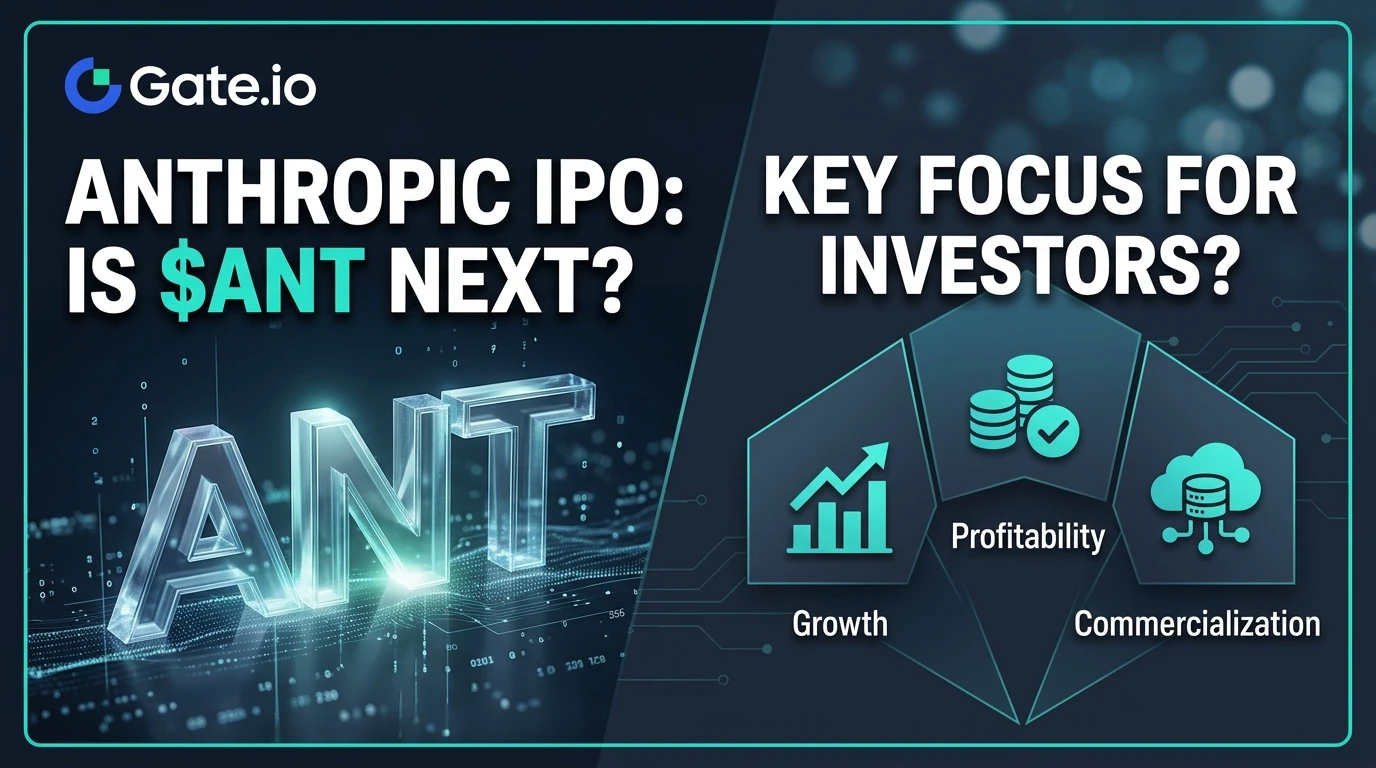
$ANT When it comes to going public, three things matter most: whether growth can outpace compute costs, when profits will turn positive, and whether enterprise customers can be retained. As AI commercialization reaches the IPO stage, it finally has to face the discipline of traditional capital markets head-on. I’m quite curious to see how the S-1 tells the unit economics story.
CryptoSquad
🚀 The AI Public Market Era: What Anthropic’s $ANT S-1 Filing Means for Tech & Crypto Investors

The artificial intelligence sector is officially entering a monumental new phase. With reports confirming that Anthropic has officially filed its S-1 registration statement with the SEC for a planned Nasdaq listing under the ticker $ANT, the spotlight is back on how foundational AI companies transition from private capital heavyweights to publicly traded giants.

As traditional capital markets gear up for this blockbuster offering, investors are dissecting every line of the S-1 filing. But beyond the headline valuation, three core pillars are dominating community discussions: Growth, Profitability, and AI Commercialization.

📊 1. Growth vs. Scale: Can the Topline Outpace Infrastructure Costs?
The sheer demand for frontier AI models has driven unprecedented revenue expansion. However, scaling infrastructure—training clusters, specialized compute, and massive data centers—requires extraordinary capital expenditure.

The Key Question: How sustainable is Anthropic's growth rate against escalating compute overheads?

Market Impact: Public markets will scrutinize whether top-line acceleration can comfortably outpace operational burn.

💰 2. Path to Profitability: The Margin Reality Check

Unlike historical software IPOs that boasted high gross margins out of the gate, AI infrastructure and inference come with steep recurring variable costs.

The Key Question: How close is the company to achieving sustainable operating margins?

Market Impact: In an environment where investors heavily reward capital efficiency and clear paths to profitability, cost-per-token economics and unit margins will face intense scrutiny.

🧠 3. AI Commercialization: Enterprise Monetization vs. Consumer Hype
From Claude enterprise integrations to developer ecosystems, the ultimate test is how effectively advanced research translates into sticky, high-retention commercial products.

The Key Question: Which sectors are driving the highest conversion rates—enterprise cloud partnerships, specialized APIs, or developer tooling?

Market Impact: Demonstrating enterprise lock-in and diversified revenue streams will be the ultimate differentiator for long-term equity valuation.

🌐 The Ripple Effect Across Tech & Web3
The public debut of foundational AI leaders like $ANT also creates profound cross-market narratives. As AI agents, autonomous compute workflows, and decentralized compute networks converge, traditional equity listings set valuation benchmarks that ripple across tech-adjacent ecosystems.

What's your take? As Anthropic steps onto the public stage under $ANT, which metric matters most to your investment thesis: raw hyper-growth, a clear bottom-line path to profitability, or aggressive enterprise AI commercialization? Let’s discuss below! 👇

#ShareWeekly #AnthropicFilesForUSIPO
#GateSquareHalloween #WCTCS9

$NAS100 ‌
repost-content-media
When I was a beginner, I thought setting slippage meant “paying a bit more in fees for peace of mind.” Now I know that’s not the case at all—when liquidity is insufficient, setting it to 1% or 5% won’t stop a price spike; you’ll get hit either way.

I got burned by one yesterday. The on-chain liquidity looked fine, but the actual order book was paper-thin. I was in a rush placing the order, and by the time I realized what was happening, I had already slipped a long way. Put bluntly, I wasn’t trading then—the bots were picking over my corpse.

Now I first scan the pool distribution, split up la
The U.S. stock market has closed, but on-chain markets haven’t—this hits too close to home.
Original content no longer visible
When your hands are itching to chase a rally, it’s actually pretty hard to resist. At least that’s how it is for me: don’t rush to click buy; stop and ask yourself one question: Is this position being driven by information, or by emotion? I’ve set a rule for myself called “wait”—wait for confirmation, wait for a pullback, wait until I’ve thought it through.

Looking around today, I saw another group of people complaining about miner and validator revenue, saying that MEV is all about competing for ordering and that retail traders have no fairness. To be honest, mechanism design is a structural
Just saw an address that deposited some funds into a protocol as collateral before transferring them to an exchange, then borrowed some stablecoins afterward. My first instinct was that it was “buying the dip,” but after pulling up the address and tracing the structure, I realized that wasn’t right—it looked more like a hedge, lowering the cost basis while locking in the risk exposure. Anyway, I couldn’t figure out what this move was actually betting on.

The discussion around modularity and DA has been heating up again recently. Developers are having a blast, while users are still completely
ETH-1.26%
Sandwiching, bluntly put, is front-running. What you see is one transaction going through; what others see is the ordering space across the dozens of blocks before and after your trade. I used to agonize over whether to learn arbitrage, but eventually realized that arbitrage isn’t a technical issue—it’s a structural one. You’re competing with mining pools and builders to see who is closer to the block, and you can’t win.

Recently, new L1s/L2s have been rolling out incentives. In the groups, veteran users curse “mine, withdraw, and sell” while farming more diligently than anyone else. It’s act
Three in the morning, still can't sleep, so I pulled up the diagrams for a few restaking projects again. Kind of funny.

Others see restaking as yield stacking; I see contract-layer stacking. Every extra layer looks like extra yield, but it’s really another failure point. We’re all seasoned crypto players, so no need to spell it out. I saw some data yesterday: a major node’s state transition was delayed for more than ten hours, and no one across the network mentioned it. That’s the problem with hot sectors: everyone’s busy counting money, while no one cares whether the structure is stable.

Ho
Hey, the testnet points really feel like they’ve changed a bit lately. In the past, it was just practice—testing functions. But the moment you see “points can be redeemed,” people start calculating the time cost: how many interactions, how many bridges you need to cross, how much it costs… it ends up feeling just like clocking in for work. To be honest, the time you put in is pretty expensive. The real question is whether the project team will ultimately count it—and how they compare TPS between Layer2s and what kind of subsidies they offer. Those factors make people hesitate about whether the
The liquidity has indeed been quite poor recently—many pools are almost dried up. In the charts and diagrams I drew earlier, a lot of projects have seen their TVL drop so much that I don’t even want to look anymore. To be honest, when people are shouting “bottom-fishing” at this point, I don’t really believe it—staying alive matters more than anything else. In any case, what I’m doing now is to collect whatever I can from what I have on hand; also, I’m unstaking part of my positions to free up some ammunition, then waiting for real structural opportunities rather than blindly running with atte
MEME-0.94%
Late at night, I glanced at a certain whale address—it was pretty interesting. On one side, he has a pile of ETH stored in Aave; on the other, he has also opened a sizeable short position. In plain terms, this kind of structure is collateral plus hedging—not simply being bullish or bearish.

A lot of people hear that whales have entered and rush to follow, only to find out the whale is actually doing arbitrage or locking positions, while the bag ends up on everyone else.

Recently, the pledged-unlock and token-unlock calendar has been mentioned over and over again, and anxiety about selling pr
ETH-1.26%
The old DeFi tool that's been in use since 2019 is shutting down just like that. After August 3rd, on-chain holdings will have to be viewed elsewhere.
Original content no longer visible
Busan's speed is something else: 1-second settlement + full-chain operation, a dual-track experiment with policy local currency + programmable payments. The tech stack of Kaia and Lambda256 finally has a real-world use case, and the groundwork for a Korean won stablecoin has been laid.
Original content no longer visible
KAIA-4.44%
This whale made over 20 million from swing trading before, but now their short position is trapped. Should they keep holding or cut losses? The market humbles all who defy it.
Original content no longer visible
After market making for almost half a year, I finally admit one thing: the AMM curve looks elegant, but when you actually use it, it’s a different story. Impermanent loss isn’t “might lose”—it’s “will definitely lose,” just a question of how much.

Recently, the group has been spreading rumors about stablecoin depegs again. Some people post screenshots of audit reports and analyze them line by line; others just say, “run first.” I’m the opposite—I end up staring blankly at the curve parameters. In the same pool, why can some people withstand volatility, while others get washed out? At the end
Lagarde’s hawkish signals are clear. This time, Walsh’s combination of not providing forward guidance and emphasizing independence may be enough to flip the table at the July meeting.
XiuHu_charts
I listened to the livestream, but couldn’t get through it halfway!
Lagarde is taking a more hawkish stance,
Walsh reiterated his view that there would be no forward guidance and that the Federal Reserve must remain independent!
Walsh also gave a warning shot: the upcoming July meeting is likely to bring more and more serious disagreements, highlighting tensions within the Fed—most likely related to Walsh’s reforms.
Bailey looks quite troubled, but it’s not that important!

The unified view of Lagarde and Walsh is that monetary policy should be based on more economic data.
repost-content-media
Turning a Ponzi scheme into a luxury car collection exhibition—$328 million to get 11 supercars—this ROI is even more exciting than DeFi mining.
WuSaidBlockchainW
Goliath Ventures CEO arrested for allegedly operating a $328 million Ponzi scheme.
The U.S. Department of Justice announced that Christopher Delgado, CEO of Goliath Ventures, has been charged with wire fraud and money laundering. He is accused of running a Ponzi scheme disguised as a cryptocurrency liquidity pool from January 2023 to January 2026, promising high returns and illegally obtaining at least $328 million. The funds were not invested in the liquidity pool but were used to pay fake returns, fund a lavish social lifestyle, and purchase a residence and 11 luxury cars. Delgado has pleaded guilty to three charges, and the sentencing hearing is set for October 8, 2026.
After reading Wintermute's report, I can only sigh. With the double blow of the AI downturn and a strengthening US dollar, BTC can't even hold 60k. ETFs are still bleeding. This isn't just a correction; it's a vacuum zone where liquidity has been drained.
Original content no longer visible
BTC-0.88%
Sovereignty is not a giveaway. Parliament says no. Confidence is harder than agreement.
Original content no longer visible
Illinois' bill is pretty tough, requiring service providers to withhold and pay taxes on behalf of others. The industry organizations' collective opposition didn't stop it, and the governor signed it into law. It seems like U.S. states are about to start a tax competition.
Original content no longer visible
Load More