EchoesOfRollup

vip
Active for: 0.5y
Peak Tier 0
Rollup ecosystem enthusiast, focused on data availability and user experience. Doesn’t post long threads often, but tries to make every post clear and understandable.
Recently, the more I look at a DAO vote, the more I feel that what appears on the surface to be a technical proposal is really all about competing interests underneath. Some votes seem to be merely adjusting a parameter, but in fact they are redistributing the power to shape decisions. No one really cares much about retail investors’ votes anyway; what matters is how a few whales and the project team line up. I’ve always thought the governance mechanism itself is more interesting than the outcome—how voting power is distributed, who gets to submit proposals, and how the voting window is set al
I just saw someone in the group share that screenshot of a stablecoin depeg again, with “Run” attached. The replies were all question marks and exclamation marks, and the reposts spread faster than I could check the on-chain data myself. Honestly, at times like this, I take my hand off the mouse and ask myself one question first: if I want to add to my position now, has the on-chain data actually changed, or has the mood in the group simply reached a boiling point?
I’ve probably lost money on too many positions where “the sentiment was just right.” I used to review my trades, but eventually I
Write a couple of simple sentences about LSTs and restaking.
When it comes to returns, to be honest, many people may be overcomplicating things. The foundation of LSTs is staking rewards, which are real, on-chain base yield; liquidization simply makes capital more efficient. Restaking is more like adding another layer on top—you use the same asset to secure other networks or services, and collect a security service fee in return. So essentially, it’s not printing money out of thin air; it’s just “making fuller use” of the assets you hold.
But the risks are hidden in that “fuller use.” The more
When I was looking at on-chain data just now, it also lagged a bit—the indexer didn’t update for a long time. In fact, this kind of “sticking for a moment” is pretty common: basically the indexer can’t keep up, the Subgraph has to replay the block queue, or the RPC you’re calling got rate-limited. Anyway, once the data source stalls, the frontend will either show a blank screen or have random symbols floating around—it’s quite annoying. But then again, it’s somewhat similar to the discussions back when a certain blockchain was under maintenance, when everyone speculated whether the ecosystem m
Just saw someone discussing AMM curves. Honestly, when I first started providing liquidity (LP), I didn’t really take this seriously—I just thought, “It’s fine, on-chain automated market making will do it automatically; I’ll just post an order and earn fees while I sleep.”
Turns out I ran a route/LP position for half a year. The numbers went up and down, and in the end I checked: all those pools I tinkered with impulsively were used to fill the holes caused by impermanent loss.
To put it bluntly, this thing uses a constant product to force the price curve into place. While you provide liqu
ETH-0.82%
USDC0.00%
$83 is indeed a tough hurdle; there’s no rush to chase it—wait until it’s stable first. Why be in such a hurry?
DanniéX
$SOL delivered an impressive rally over the past week, but the $83 resistance proved too strong for the bulls.
Here's how I'm approaching it:
A confirmed breakout and close above $83 would signal renewed strength and put $98 in play as the next major target.
If price gets rejected and retraces toward the $67 support zone, I'll be looking to accumulate in the spot market for a longer-term position.
For now, patience is key. Let the market confirm the next move before chasing price.
#WorldCupChampionPrediction
Miner shift to AI infrastructure is a bold move. Terawulf signs a 20-year lease, locking in $19 billion in revenue, and its stock price jumps 12.8% on the day. Compass Point raises target to $40. Wall Street clearly has strong confidence in this transformation.
CoinNetwork
Bitcoin miners pivot to AI, Terawulf, IREN and Hut 8 stocks rise 13%
CoinWorld reports that Terawulf, IREN, and Hut 8 are pivoting toward AI infrastructure, with their stocks collectively rising on July 8. Terawulf surged over 12.8% after signing a 20-year lease with Anthropic. Its planned 401 MW facility is set to begin operations in early 2028, with analysts estimating revenue exceeding $19 billion over the lease period. Compass Point raised its target from $28 to $40 and maintained a Buy rating. Hut 8 climbed 9.69% in a single day after being included in multiple Russell indices, with a 383% gain over the past year. The market is responding strongly to miners' transformation.
Once geopolitical games escalate, the negotiation table directly turns into a poker table.
CoinNetwork
Coin World News: EU High Representative for Foreign Policy—Fighting between the US and Iran has made negotiations to end the war even more complicated.
UNIfication has been burned into the v4 pool, and the proceeds are used to buy back UNI. The community cheers, but LPs complain. It begins taking allocations on the 7th—this time, the hook system is really about to cash out.
WuSaidBlockchainW
Uniswap proposes to extend the UNIfication burn program to v4 liquidity pools
Uniswap Labs proposes extending the UNIfication burn to v4 liquidity pools, allowing protocol fees to be charged on certain v4 pools and using part of the revenue to buy back and burn UNI. Voting period is 7/7–7/12, with on-chain voting in the week of 7/13. v4 introduces a hook system, allowing dynamic fee adjustments, and adds V4FeePolicy and V4FeeAdapter to manage fees and collection. The community response is positive, but some liquidity providers are concerned about liquidity loss.
UNI+0.95%
When Saylor sells and Tom buys, and the big shots trade insults with each other calling each other “SB,” my wallet is trembling.
CryptoZeno
SAYLOR SOLD - BUT TOM LEE BOUGHT.
repost-content-media
Historical data shows that long-term negative premium and pullback pressure are basically bound together. This 49-day period broke the record set earlier this year, and the signal of U.S. institutional funds exiting is becoming increasingly clear. In the short term, we need to fasten our seatbelts.
CoinNetwork
CoinWorld News: according to CoinWorld’s data, the Coinbase Bitcoin Premium Index has been in negative premium territory for 49 consecutive days (from May 19 to date), with the latest value at -0.1072%. Previously, this index was in negative premium territory for 40 consecutive days from January 16 to February 24 this year, setting a record for the longest “consecutive negative” streak since the indicator was launched, surpassing the roughly 30 days of consecutive negative premiums during the “1011 crash.” Historical data shows that prolonged negative premiums often coincide with U.S. institutional capital moving out, so investors should be alert to short-term pullback pressure.
An Israeli military drone bombed near a hospital. Is this a precision strike or an indiscriminate attack?
CoinNetwork
CoinWorld news, according to Lebanon's National News Agency: An Israeli drone attacked near a hospital in the southern Lebanese town of Nabatieh.
$6 billion unfrozen, can Iran's procurement spree stabilize inflation?
CoinNetwork
Coin World News, according to the Islamic Republic News Agency (IRNA): Iran's Deputy Foreign Minister said that in the meeting with Qatar, it has been decided to use part of the $6 billion frozen funds to purchase supplies according to Iran's needs.
Position management, put simply, is one sentence: first figure out whether you can sleep easy.
If you can’t hold spot positions, it’s usually because you didn’t think clearly at the time of buying about how long you planned to hold. When it rises, you’re afraid it will fall; when it falls, you’re afraid you’ll be wiped out. Either way, you’re panicking. Contract liquidation is even simpler—once you apply leverage, your “position” isn’t really yours anymore; it belongs to the liquidation machine.
Lately, rate-cut expectations have been swinging back and forth. The U.S. Dollar Index and risk ass
USIDX0.00%
IMF's report is quite straightforward; suppression is useless, and we need to learn to find a balance in on-chain regulation.
CoinNetwork
Crypto World News reports that the IMF says the adoption of Nigeria’s US dollar stablecoins is rising rapidly, “testing” the boundaries of existing monetary and regulatory frameworks. Since 2019, Nigeria has accounted for about 60% of stablecoin inflows in Sub-Saharan Africa. The IMF states that stablecoins are widely used by households and small businesses because they enable faster cross-border remittances and lower costs, as well as because the Naira’s depreciation, inflation, and limited access to foreign exchange. However, the growing popularity of US dollar stablecoins may lead to “digital dollarization,” weakening demand for the local currency and the transmission of monetary policy, while increasing financial integrity risks such as money laundering. The IMF believes that simply suppressing the use of stablecoins is of limited effectiveness; instead, it recommends strengthening issuer regulation, on-chain data monitoring, and local payment infrastructure while allowing innovation.
Saylor's words are harsh, but the data is indeed eye-catching — Bitcoin's market share has quickly reached 70%, while ETH and SOL are still competing and tearing each other apart. The currency premium has disappeared, and from now on, it's only a matter of who is more practical.
CoinNetwork
CoinJie News reports that Michael Saylor said at the Bitcoin Corporate Day event on June 12, 2026 that, after excluding stablecoins, Bitcoin’s market share in the crypto market has risen from 41% in 2021 to nearly 70%. He believes that market confidence in Ethereum has collapsed, and Ethereum is now deeply embroiled in a fierce inventory battle with other tokens such as Solana and BNB. This chaotic melee has drained their monetary premium, and in the future these tokens can only survive by relying on practicality. The market evolution over the past 12 months further established Bitcoin’s position as the dominant digital currency network, reinforcing its attributes as digital capital, and also proving that digital credit is a feasible concept.
BTC+0.09%
ETH-0.82%
SOL-1.10%
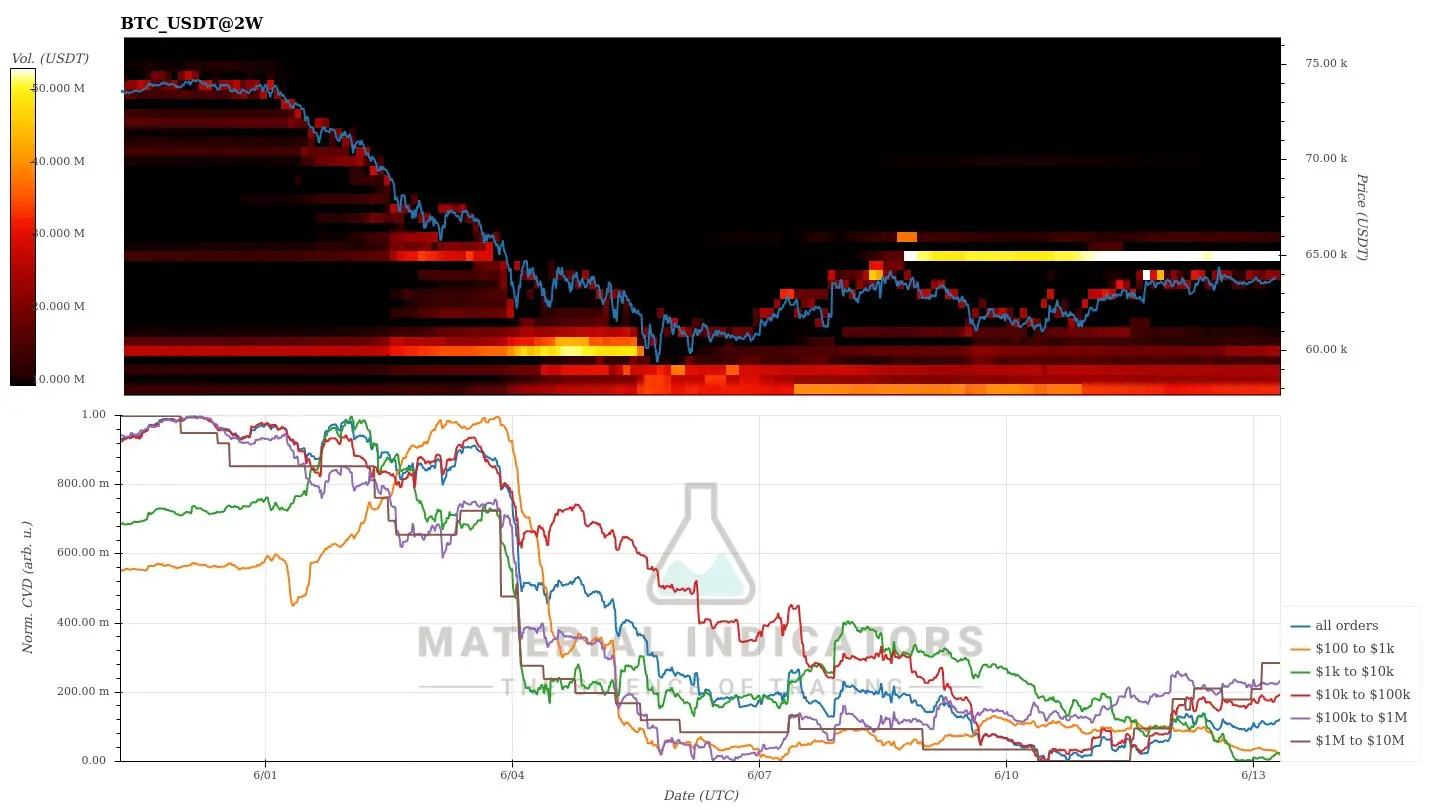
The biggest whale’s buying—there’s only a 65k sell-wall hurdle left, and I know the ropes.
CryptoZeno
The $BTC CVD indicator shows brown whale buying.
The largest whale is buying again.
The sell wall at 65k is the only resistance.
repost-content-media
Retail giants prop up their financial reports with interest and options income, treating Bitcoin staking like wealth management. The new strike price range suggests they genuinely think they can push to 110k by the end of the year—this isn’t a gaming company; it’s clearly a crypto hedge fund.
CoinNetwork
GameStop Again Limits Bitcoin’s Rally, Coinbase Contract Renews
GameStop and Coinbase renew Bitcoin options contracts. The initial unexercised contracts retain a $5.8 million premium, with an exercise price of $80,000. The contracts that expire before May 29 are not exercised, and with almost all Bitcoin still staked, Coinbase profits when the coin price exceeds the strike price. The new contracts’ exercise price is below the $105,000 to $110,000 range. During the quarter, Bitcoin contributed approximately $1 million in digital asset gains, for net income of about $390 million, mainly from interest on cash reserves and unrealized gains related to eBay options, rather than from retail business.
BTC+0.09%
Trump says the deal is almost done, and Warsh is about to let the market set its own price—only for crypto ETFs to see $400 million in outflows in a week. This signal is so muddled it feels like the eve of a long-short double kill.
CoinNetwork
CryptoWorld News reports that Trump states the US-Iran agreement is close to completion, and the market is beginning to price in a cooling of regional tensions. Federal Reserve Chair Kevin Warsh may downplay forward guidance and hand back pricing power to the market. Cryptocurrency ETFs have experienced a net outflow of $405 million in the past week, with a total outflow of $5.49 billion over the past month.
v2 handshake failure falls back to v1, this downgrade design is a bit problematic. Using Tor for exit or simply disabling -privatebroadcast is more stable, hurry up with 31.1.
WuSaidBlockchainW
Bitcoin Core 31.0 - privatebroadcast feature has a privacy vulnerability
Bitcoin Core 31.0's -privatebroadcast has a privacy vulnerability: when IPv4/IPv6 node handshake fails with BIP324 v2 enabled, it falls back to v1 direct connection, exposing the transaction originator's IP without Tor. Affected are nodes that enable -privatebroadcast and broadcast via sendrawtransaction, as well as nodes capable of outbound IPv4/IPv6 connections; wallet RPC, onion, and I2P are unaffected. The fix will be released with 31.1; it is recommended to disable -privatebroadcast, disable v2, or route outbound traffic through Tor before upgrading.