Square
Following
Hot
News
Notifications
Profile

Phoenix77

vip
No content yet
Peak Tier VIP 21.9 Year(s)
0
Following
10
Followers
69
Liked
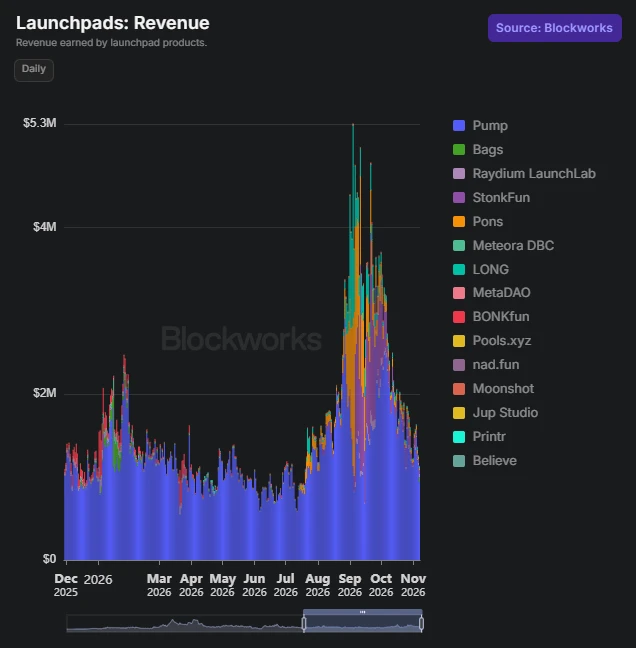
Launchpad revenue peaked above $5M/day in September.
Two months later, it's back near $1M–$1.5M/day.
The launchpad wars is very competitive
In September, @Pumpfun faced growing competition from StonkFun and @ponsdotfamily.
@LaunchOnSF even reached $2.48M in daily revenue, briefly outperforming Pump.
By late October, Pump had reclaimed 94% of combined revenue against StonkFun, even as overall launchpad activity continued to cool.
Two things stand out to me:
> New launchpads can capture significant volume during speculative periods, but retaining that activity is much harder.
> Pump's recovery
post-image
PUMP-1.06%
  • 1
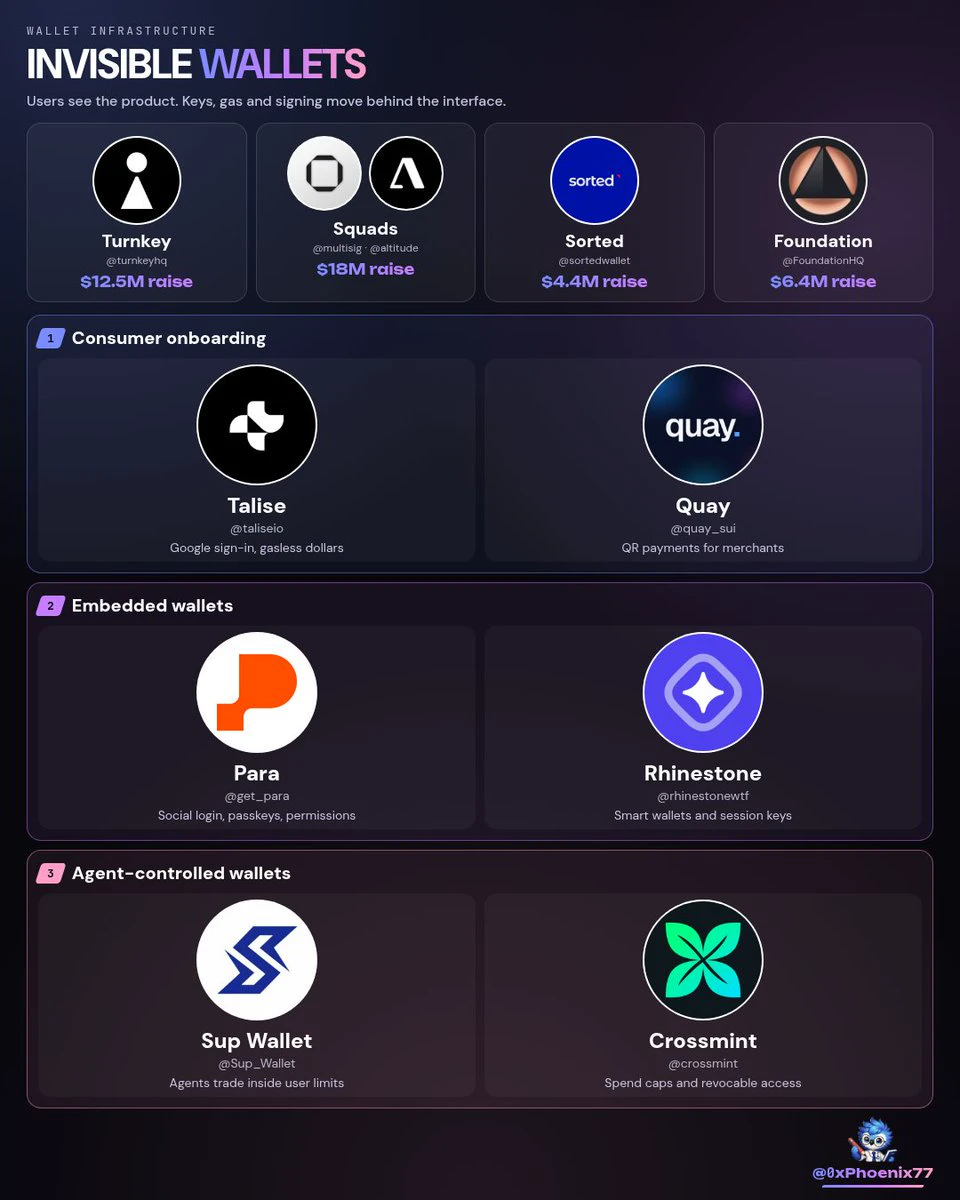
Crypto wallets are becoming invisible infrastructure.
In 2026, we're seeing a different approach to wallet UX: users increasingly interact with financial products, while keys, gas, transaction routing, and signing logic move behind the interface.
Several funding rounds and new products highlight this:
@turnkeyhq raised $12.5M to expand its secure signing and wallet infrastructure.
@multisig raised $18M to scale @altitude, bringing stablecoin payments and treasury management into business workflows.
@sortedwallet raised $4.4M to expand accessible crypto wallets across emerging markets.
@Foundat
post-image
SUI-1.05%
  • 1
Duo at midnight means trouble
Where is crypto capital flowing in 2026?
DeFi and infrastructure are leading the funding landscape, but the bigger story is what these startups are building.
Looking across funding rounds this year, five areas stand out:
1. RWA Infrastructure
@MidasRWA raised $50M to expand tokenized investment products.
@NUVAFinance and @3f_xyz are building around RWA distribution and leveraged exposure.
Capital is moving toward making tokenized assets more usable across DeFi.
2. Onchain Credit
@Morpho raised $175M, while @BirchHill_io, @twynexyz and tenka are developing different approaches to credit.
From l
post-image
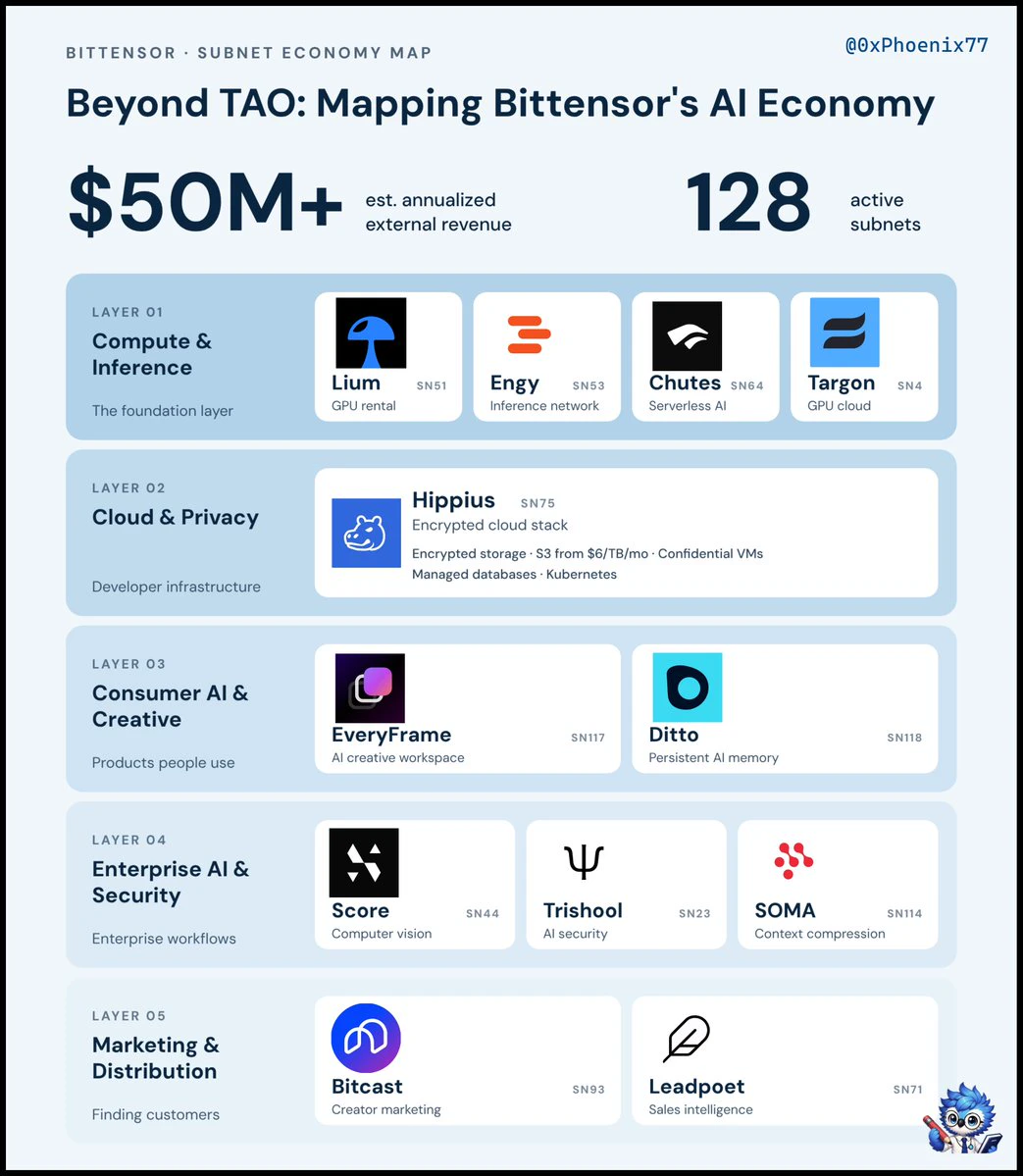
Bittensor's AI economy is starting to show real commercial traction.
A growing number of subnets on @opentensor are turning machine intelligence into products people actually pay for.
From GPU compute to consumer apps, security and sales tools, these are the subnets leading it.
Layer 1: GPU compute and AI inference
Compute is still Bittensor's strongest commercial vertical.
- @lium_io (SN51) rents out GPU capacity to developers and AI teams.
- @engyai (SN53) runs verifiable inference across a distributed miner network.
- @chutes_ai (SN64) has earned roughly $3.6M in inference revenue across Q1
post-image
TAO+0.41%
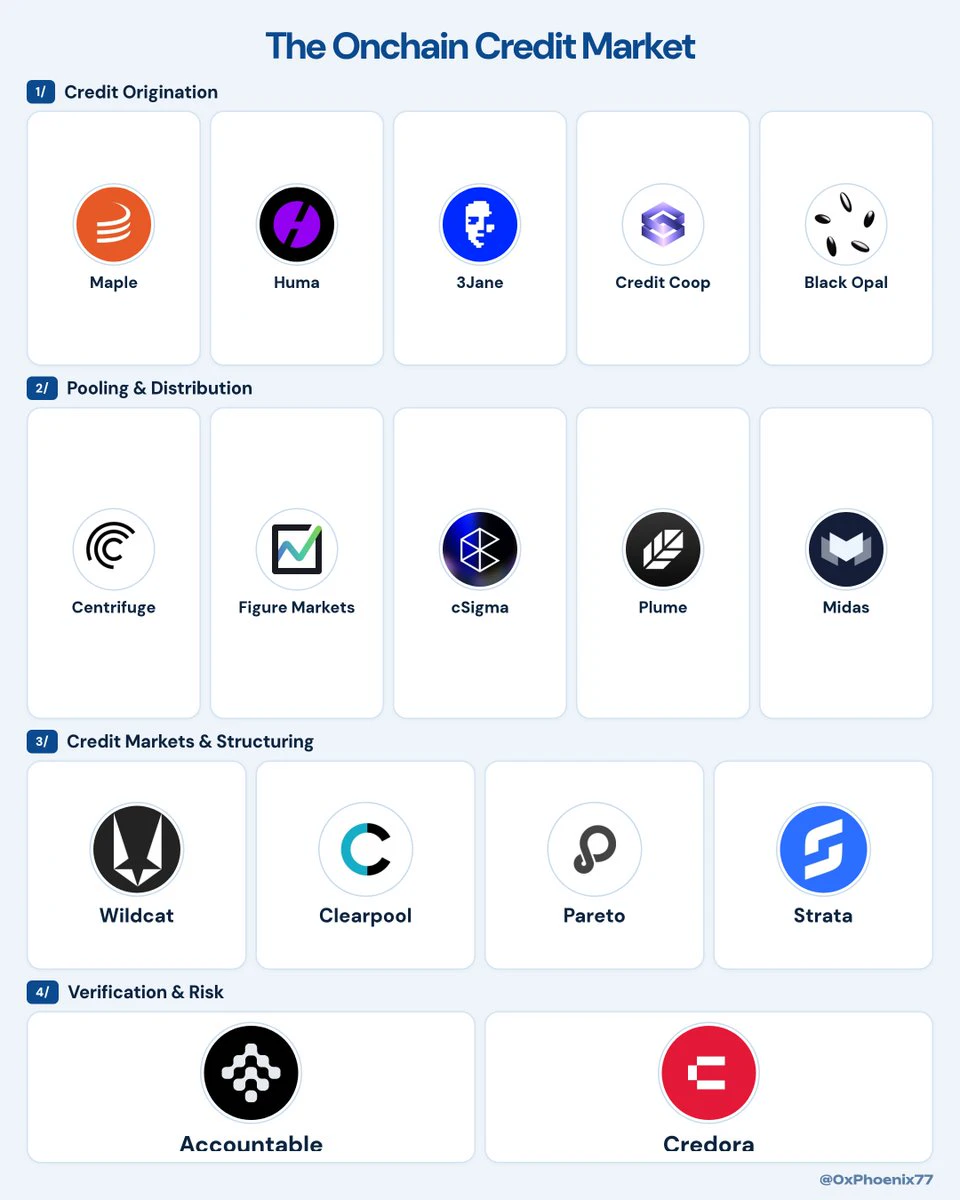
The Onchain Credit Market Is Taking Shape
Private credit is moving onchain.
16 projects are building the market across four key areas:
1/ Credit Origination
Where lending opportunities begin.
@maplefinance: Institutional lending and asset management.
@humafinance: Payment financing through PayFi.
@3janexyz: Crypto-native credit and USD3.
@creditcoop_xyz: Receivables-backed settlement financing.
@blackopal_fi: Brazilian credit card receivables.
2/ Pooling & Distribution
Turning credit exposure into investable products.
@centrifuge: Tokenized institutional credit pools.
@FigureMarkets: Loan trad
post-image
CFG+0.52%
RWA-0.39%
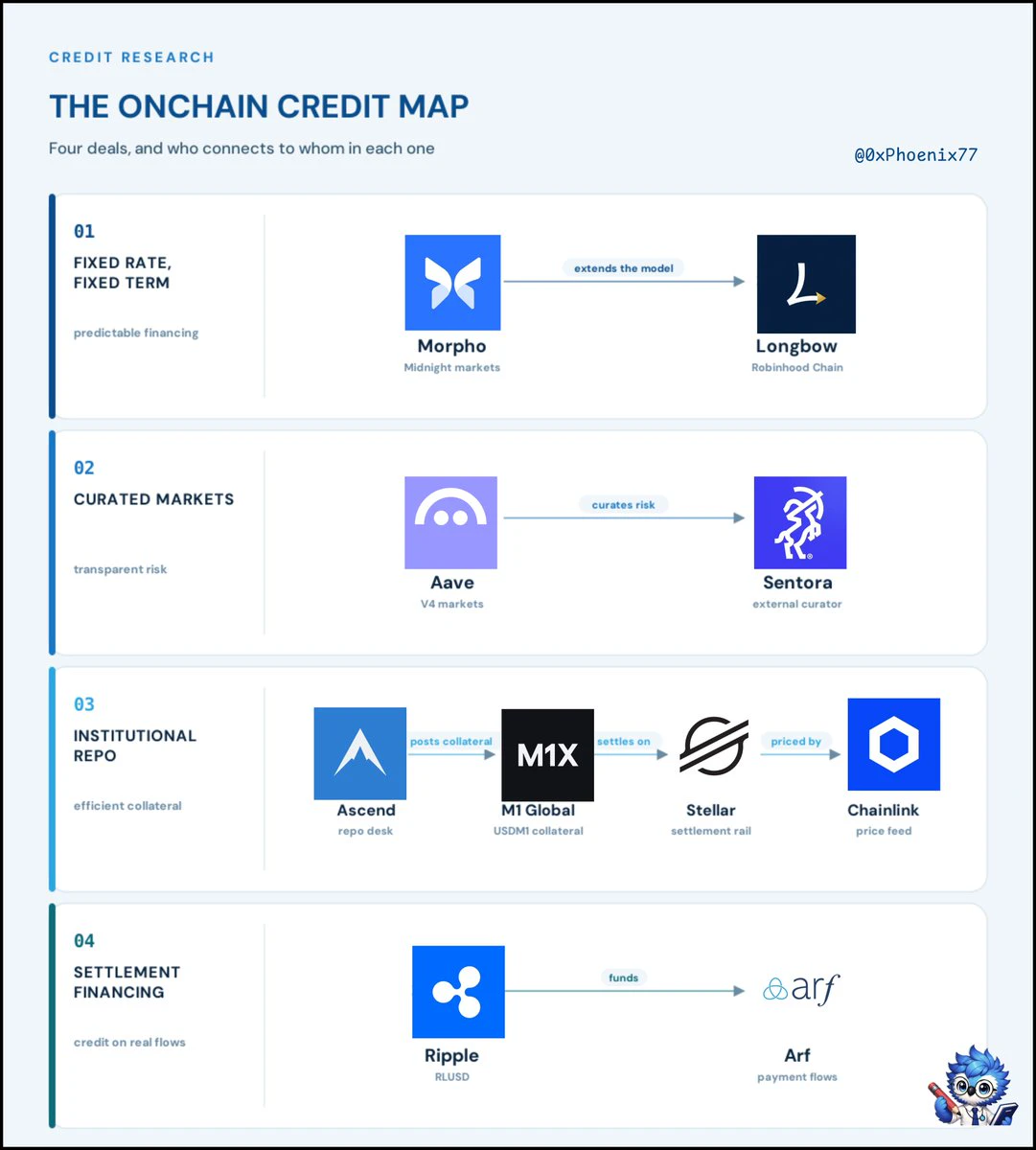
Onchain Credit Is Entering a New Phase
DeFi lending is evolving beyond floating rates and liquidity pools.
The next competitive edge lies in financing terms, collateral management and credit risk.
Recent developments show this shift:
- @Morpho Midnight crossed $100M in reported deposits, bringing fixed-rate, fixed-term lending.
- @longbowlend is extending this model to Robinhood Chain.
- @aave V4 introduced externally curated markets with @SentoraHQ, supporting RLUSD @Ripple PYUSD and OUSD - @openstandard.
Professional risk management is becoming part of the lending infrastructure.
- @AscendFi
post-image
MORPHO-4.33%
NIGHT-3.10%
AAVE-1.22%
RLUSD+0.00%
PYUSD-0.09%
Every chain says it is quantum-ready.
A holder can check it in one step: sign with a post-quantum key.
I sorted 18 teams by how far a holder can go with that key today.
Layer 1 · Post-quantum from genesis
@QRLedger: post-quantum native.
@QuantusNetwork: every mainnet transaction is post-quantum signed.
@PQabelian: lattice-based, quantum-secure from day one.
@cellframenet: built to protect funds from quantum threats.
Layer 2 · Upgraded and live
@Algorand: Falcon-1024 accounts, 2.7M+ post-quantum transactions.
@PeraAlgoWallet: rekey an existing account to post-quantum.
@LuteWallet: Falcon accoun
post-image
ALGO+0.50%
SOL-0.77%
XTZ-2.61%
QANX+9.99%
STRK-3.55%
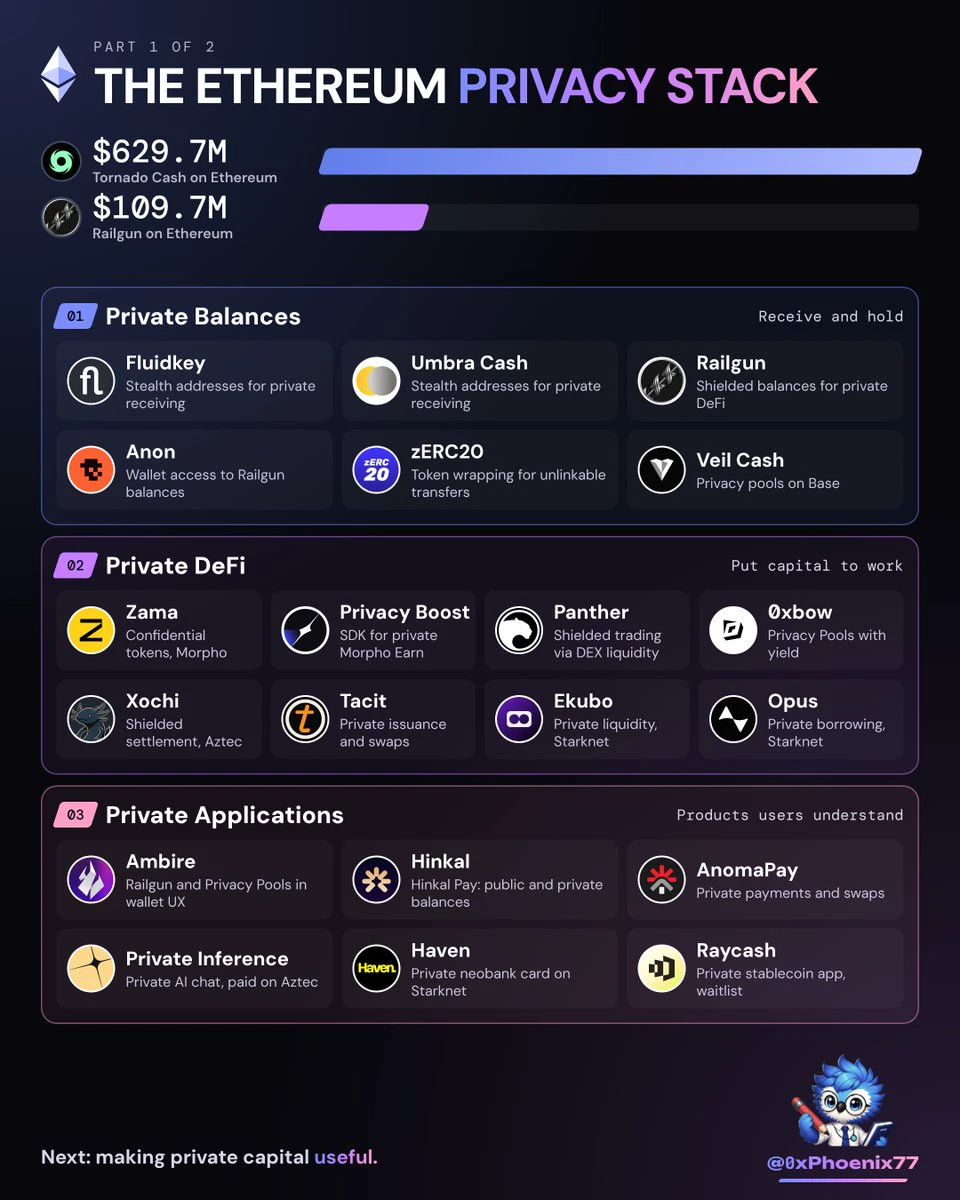
Tornado Cash holds $629.7M on Ethereum.
Railgun holds another $109.7M.
Privacy on Ethereum is leaving the vault for apps people already use.
1/ Private Balances
The foundation is letting users receive and hold assets without exposing their entire financial history.
- @fluidkey and @UmbraCash: Stealth addresses for private receiving.
- @RAILGUN_Project: Shielded balances for private DeFi, accessible through wallets like @anondotinc.
- @zERC20io: Token wrapping for unlinkable transfers.
- @Veildotcash: Privacy pools on Base.
2/ Private DeFi
Once assets are shielded, the next step is putting cap
post-image
ETH-1.26%
ZAMA+2.26%
MORPHO-4.33%
AZTEC-2.30%
STRK-3.55%
  • 3
Prediction markets traded $76B in September.
All of it answers one question: will it happen?
The bigger money sits in the questions that come next.
Picture planning a trip with a weather app.
You ask four questions, and each one now has its own market.
❱ Will it rain?
The odds market, already huge.
@Kalshi: $60.85B in Sept
@Polymarket: $13.12B
@opinionlabsxyz: $610M
@HyperliquidX HIP-4: $81M, up 3.7x, with @Outcomexyz as a front end
❱ Which plan do we pick?
Every option gets a market, and the highest price wins. DAOs use this to vote.
@MetaDAOProject: 21 of 22 market-run DAOs, ~$39M
@umia_fina
KALSHI+0.00%
BTC-0.67%
AI AGENTS ARE BECOMING ONCHAIN CAPITAL ALLOCATORS.
Wallets, inference, vaults
All three layers shipped in one week.
20+ teams building the stack
❱ Agent Apps & Execution
- @virtuals_io: Personal AI agents with wallets and group chats
- @bankrbot: Financial agents, token launches and fee infrastructure
- @gizatechxyz: Autonomous onchain capital management
- @almanak: Quant strategies and automated execution
❱ Inference: four layers, four value pools
Every agent pays for inference. Each layer captures a different slice.
Supply
- @chutes_ai: Decentralized inference supply
- @togethercompute: Inf
LINK-0.18%
AAVE-1.22%
VVV+0.37%
The VALIDATOR CLIENT landscape is growing.
I mapped the teams building across Solana, Ethereum, and other L1s ↓
❱ Solana Validator Client Ecosystem
Solana has 5 major client development groups, each taking a different approach.
@anza_xyz | Agave: Core Rust-based validator implementation, also developing Alpenglow consensus through Votor.
@jump_firedancer | Firedancer: Independent client written in C by Jump, focused on performance and client diversity.
@jito_labs | Jito-Solana / BAM: Agave fork with MEV infrastructure. BAM reported ~164M SOL delegated across 385 validators, representing ~37% o
SOL-0.77%
ETH-1.26%
JTO-0.68%
MON+2.58%
SUI-1.05%
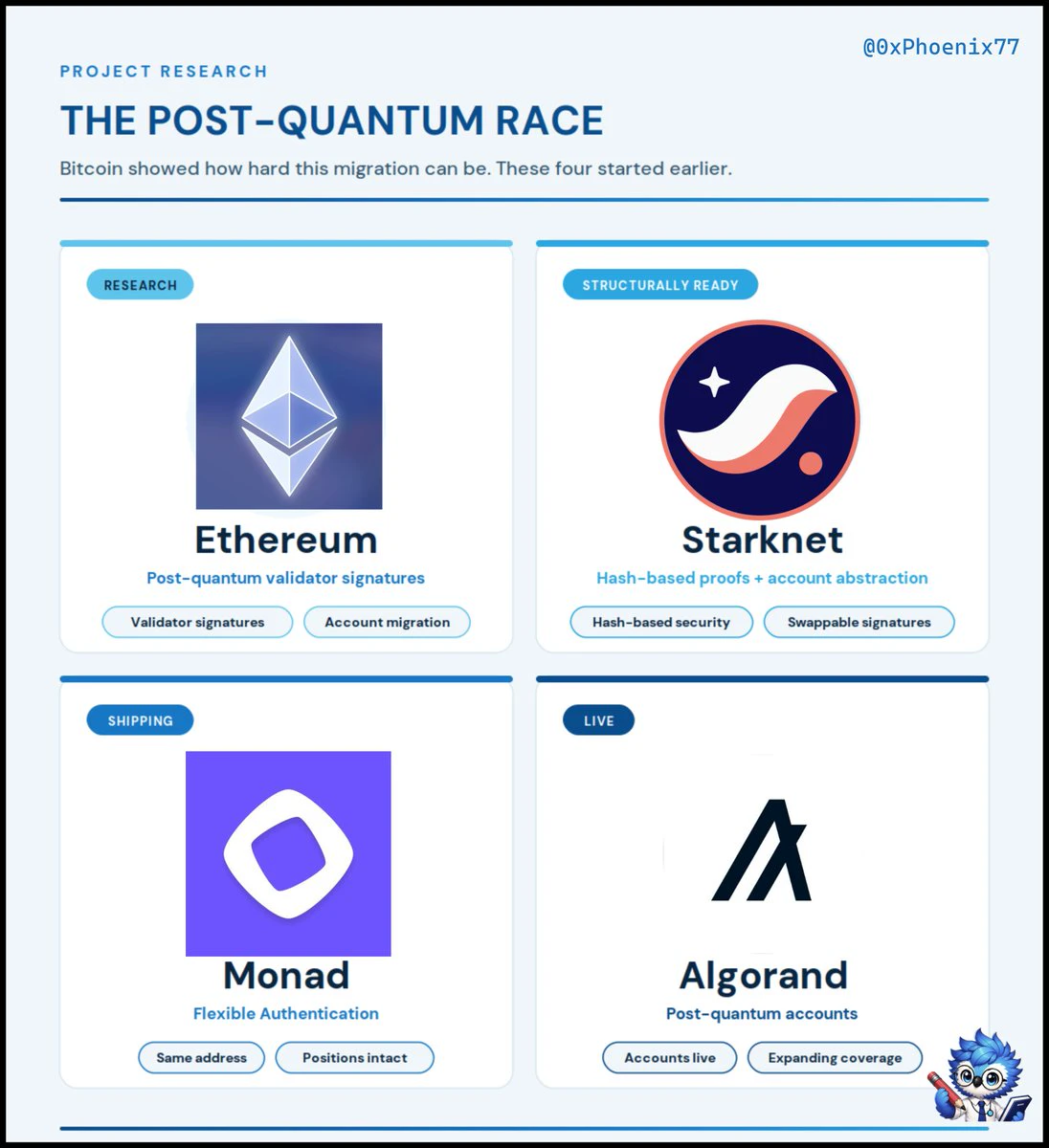
The post-quantum race has already started.
Bitcoin showed how hard that migration can be.
Other chains are preparing earlier.
I researched what they’re doing next:
❱ @Starknet roadmap
STARK proofs already rely on hash-based security, while account abstraction makes it easier to adopt new signature schemes.
❱ @monad roadmap
Flexible Authentication is designed to let users switch to post-quantum credentials while keeping the same address and existing DeFi positions.
❱ @Algorand roadmap
Post-quantum accounts are already live, with protection expanding across more parts of the protocol.
❱ @ethereu
post-image
BTC-0.67%
STRK-3.55%
MON+2.58%
ALGO+0.50%
ETH-1.26%
  • 1
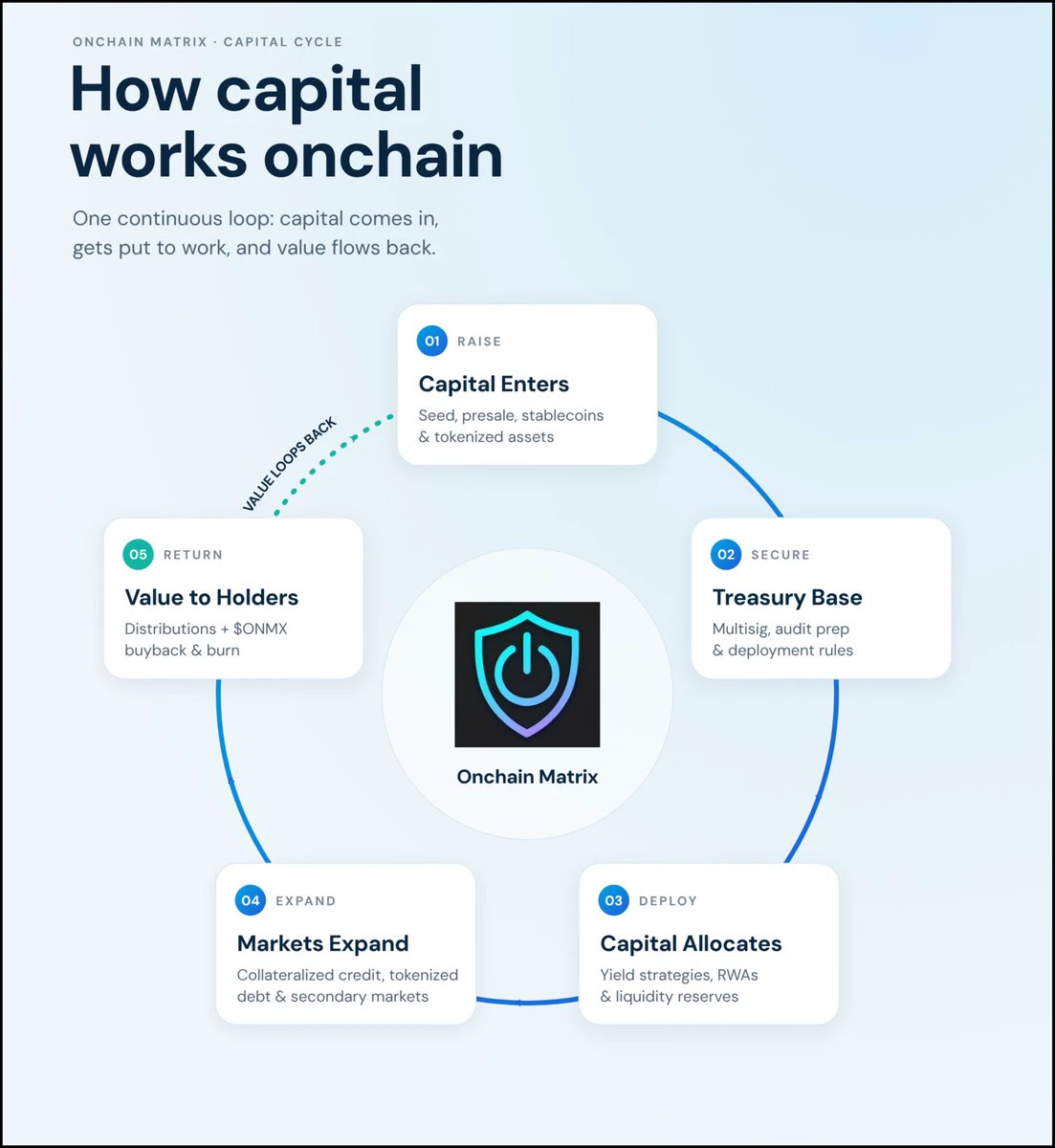
Capital needs a system.
@Onchain_Matrix maps that system as one continuous capital cycle.
Instead of treating treasury, credit, and tokenized assets as separate pieces, it connects them into one capital cycle.
Capital first enters through seed, presale, stablecoins, and tokenized assets.
Then the treasury layer sets the operating base with multisig controls, audit prep, and deployment rules.
From there, capital gets allocated into yield strategies, RWAs, and liquidity reserves.
Those assets can then support collateralized credit, tokenized debt, and secondary markets.
Finally, treasury yield
post-image
FLOW-3.76%
Load More