TacoTreasury

vip
Active for: 0.4y
Peak Tier 0
A DAO treasury is like a taco platter: the ingredients need to be balanced. Pay attention to capital efficiency and avoid excessive incentive issuance, and use everyday analogies to explain governance.
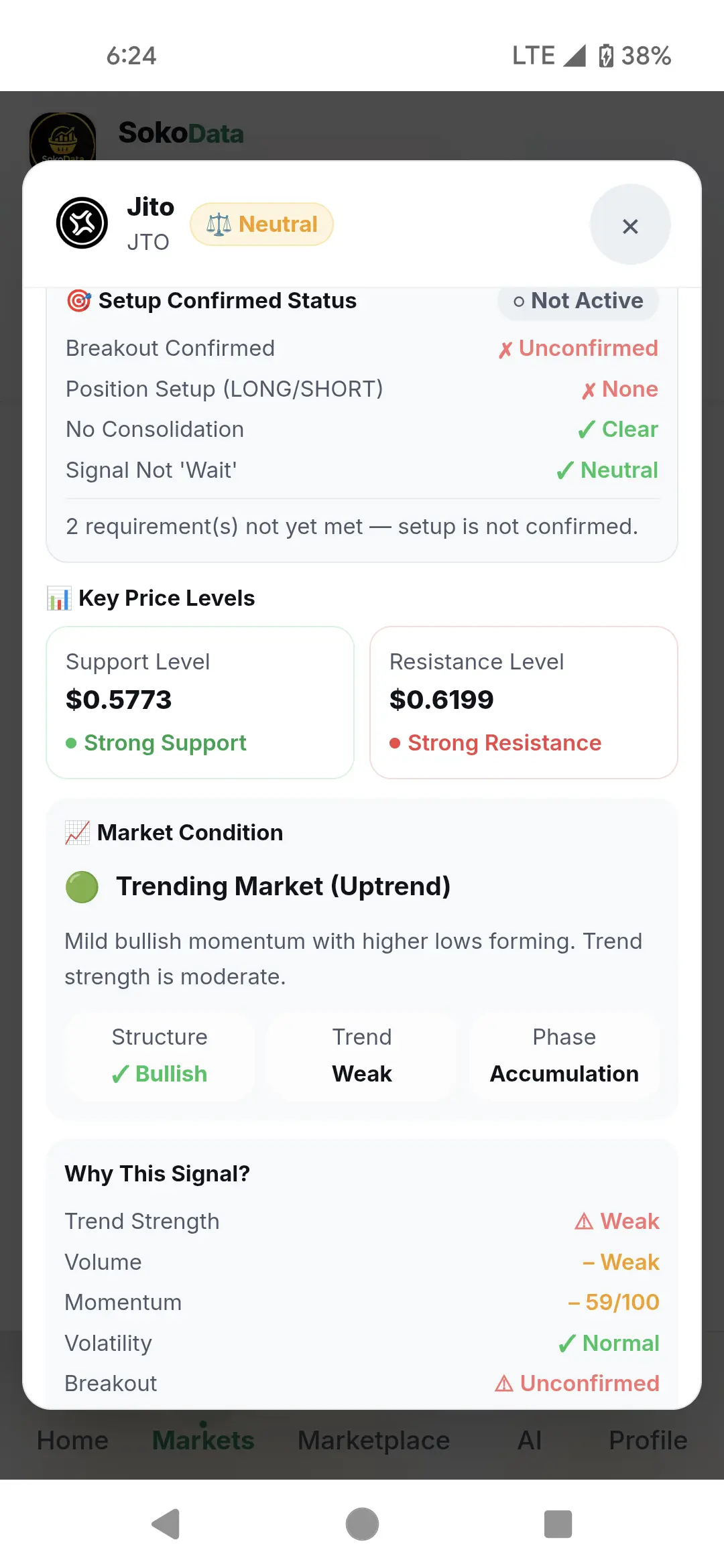
The structure is bullish, but volume is insufficient; for now, anything above 0.5773 is merely noise. Wait for a 4H close above 0.6199 or a break below 0.5773 before acting. Stay out and wait for confirmation—patience is more important than frequent trading.
BLSH3.31%
View Original
CryptoJourney1
$JTO is in a bullish structure but with weak momentum. Price is sitting above strong support at $0.5773, with resistance at $0.6199. Momentum is at 59/100, and volume is weak. Two requirements are still missing, so there's no active setup right now. This is a classic accumulation phase — but without volume and confirmation, it's just noise.
Entry zone: Wait for 4H close above $0.6199 or below $0.5773
Targets: TBD after confirmation
Stop loss: TBD
No setup — no trade. Stay patient. Always DYOR.
#EventPointsAddSOLAndXRP
repost-content-media
  • Reward
  • Comment
  • Repost
  • Share
Just now I was reading what people in the group were talking about—re-staking and shared security. The image that popped into my head was a taco puzzle: the more layers you stack, the more you have to put a question mark over stability. Stacking yields on top of each other really does sound great, but don’t stack the hallucinations too—thinking that security automatically doubles.
To put it plainly, the logic of re-staking is to have the underlying assets serve multiple networks, but every additional layer of trust assumptions adds one more potential vulnerability. Everyone has also seen those
View Original
  • Reward
  • Comment
  • Repost
  • Share
Forget it—no need to overthink. Let’s just say it outright: the mainnet has its own advantages—the grounded, trustworthy feeling of big on-chain settlements. Even if the L2 experience is smoother, it can’t fully replace that. But gas—recently it keeps “taking off” at random. It’s gotten to the point where someone like me, a small retail trader, has to calculate the costs for half a day before making even a small trade. It’s driving me crazy.
Recently I’ve been watching expectations for interest rate cuts get pulled back and forth. The U.S. dollar index and risk assets have been rising and fall
USIDX0.02%
View Original
  • Reward
  • Comment
  • Repost
  • Share
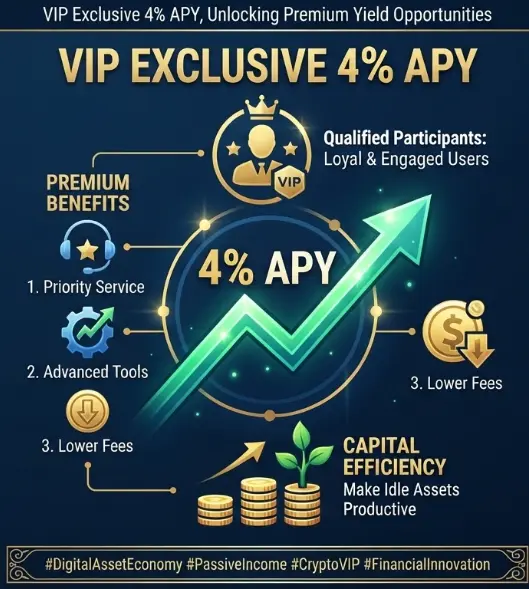
VIP-exclusive earnings of 4% APY—steady and worry-free; this is what it should look like for long-term holding. #GateSquare
View Original
Ai_Power
#VIPExclusive4%APY
VIP Exclusive 4% APY, Unlocking Premium Yield Opportunities in the Digital Asset Economy
As the cryptocurrency industry continues to mature, platforms are introducing more sophisticated products designed to reward loyal users and provide sustainable earning opportunities. The launch of a VIP Exclusive 4% APY program represents another step in this evolution, offering qualified participants the chance to generate stable returns while remaining active within the digital asset ecosystem. In an environment where investors increasingly seek a balance between growth, security, and predictable income, premium yield programs are becoming an important component of modern portfolio strategies.
Annual Percentage Yield, commonly known as APY, is one of the most widely used metrics for evaluating earning opportunities. Unlike simple interest rates, APY takes compounding into account, allowing users to better understand the potential long-term benefits of holding assets within yield-generating programs. A 4% APY may appear moderate compared with high-risk speculative products, but its appeal lies in the combination of stability, accessibility, and risk-adjusted returns.
VIP programs are designed to recognize active users and provide enhanced benefits that go beyond standard platform features. These benefits may include higher earning rates, priority services, lower transaction fees, exclusive promotions, advanced trading tools, and early access to new products. The introduction of an exclusive 4% APY adds another layer of value, encouraging users to maintain long-term participation while benefiting from predictable rewards.
One of the primary advantages of yield programs is capital efficiency. Instead of leaving digital assets idle, investors can place them into earning products that generate passive income over time. This approach aligns with one of the broader goals of digital finance, making assets productive while preserving flexibility and accessibility.
The increasing popularity of yield opportunities reflects a major shift in investor behavior. Early cryptocurrency markets were largely driven by speculation and short-term price movements. Today, investors are paying greater attention to sustainable returns, portfolio diversification, and disciplined wealth management strategies. Yield products, staking services, and passive income programs are becoming important tools for individuals seeking long-term financial growth.
Institutional interest has also contributed to this trend. Professional investors often evaluate digital assets using frameworks similar to traditional finance, where yield, risk, liquidity, and capital preservation play essential roles. Products offering transparent returns can attract users who prioritize consistency over aggressive speculation.
Risk management remains an essential consideration. Investors should understand how returns are generated, whether through lending, staking, treasury management, liquidity allocation, or other mechanisms. Transparency, platform security, and sustainability are key factors that determine the long-term success of any earning program.
The broader digital asset industry continues moving toward greater maturity and professionalism. Yield-generating products illustrate how cryptocurrencies are expanding beyond trading and speculation into practical financial tools capable of supporting savings, investment, and long-term wealth creation.
Competition among platforms is also increasing. As more services introduce premium earning opportunities, users gain access to a wider range of options that can be tailored to different risk profiles and investment objectives. This competitive environment encourages innovation while improving products and services across the industry.
From a strategic perspective, a 4% APY can play an important role within a diversified portfolio. Investors often combine growth-oriented assets with stable income opportunities to balance potential rewards and manage market volatility. Such an approach supports long-term planning while reducing dependence on short-term price fluctuations.
The introduction of VIP Exclusive 4% APY reflects the continuing transformation of digital finance. It demonstrates how platforms are building ecosystems that reward participation, strengthen user engagement, and create sustainable value beyond traditional trading activities.
Looking ahead, earning products are likely to become an even more important part of the cryptocurrency landscape. As regulation improves, institutional participation grows, and technology advances, investors may increasingly seek reliable income-generating opportunities alongside capital appreciation.
Ultimately, VIP Exclusive 4% APY is more than a promotional feature. It represents a broader trend toward financial innovation, smarter asset utilization, and the development of more balanced investment strategies. For users seeking a combination of stability, passive income, and long-term participation in digital markets, such opportunities may become valuable components of a modern investment approach.
#GateSqaure
repost-content-media
  • Reward
  • Comment
  • Repost
  • Share
Just saw a post saying arbitrage is like a sandwich attack—lol, and honestly it’s pretty spot on. You rush in thinking you’re licking blood off the blade, but then you get clamped from both ends by robots, and the fees chew you up so badly it hurts. Plain and simple: you think you’re “pulling in a free lunch,” but it might really be a fight between someone else’s liquidity and that little “opportunity cost” in your head.
With a few new L1/L2s rolling out incentives lately, the old “mine, sell, cycle” routine is back. You watch TVL climb, fast and furious—but how much of the money actually stay
View Original
  • Reward
  • Comment
  • Repost
  • Share
Just saw an address label that says “smart money.” I clicked in and found that recently it’s been nothing but people claiming airdrops and then selling them off in seconds—the Gas was still burned quite a bit 😂. Now new L1/L2 networks are rolling out incentives to pull TVL, and even old users are grumbling about “buy-for-claim-and-sell,” but honestly, how much can you really trust on-chain address tags? The fund-flow trend looks all shiny, but behind the scenes it’s just loot-chasing guys calculating slippage gains—there’s no way to tell any real governance intent. Either way, I feel like add
View Original
  • Reward
  • Comment
  • Repost
  • Share
Recently, I muted a few testnet groups—honestly, I feel a lot clearer.
I used to always think that if I didn’t keep staring, I’d miss the departure, miss the whitelist. As a result, every day I’d get spammed by “Testnet Episode X,” “interaction tutorials,” and “must-do checklists.” When I actually followed them, I found that most of it is just tapping a few times—gas fees are even higher than the returns. Especially now that hardware wallets are out of stock and phishing links are everywhere. Safety comes first. There’s really no need to get anxious over the expectation of a “possible air drop
View Original
  • Reward
  • Comment
  • Repost
  • Share
Just got asked—“Where exactly are those on-chain transaction records you’ve got?”—and I froze for a while. I said, “They’re in my head, but my brain is refusing to work right now”…😅
With the year almost over, I really recommend you put your transaction records into a table—by chain, by protocol, and by time. Don’t trust your memory. Last year, that’s what I did: I thought I could get by with screenshots. But then the chain-game collapse hit—and after that one big liquidation and everything got settled, I realized there were a bunch of pools with APRs that were insanely high. I couldn’t calcul
View Original
  • Reward
  • Comment
  • Repost
  • Share
I’ve been a bit confused lately—how on earth are on-chain privacy and compliance supposed to be balanced? I originally thought that having anonymous wallet addresses would be enough to stay safe, but I found that once big transfers happen too often, the whole network starts watching and interpreting them as “smart money.” People who follow the trend end up losing so badly that there’s nothing left, not even their underwear. Anyway, for ordinary people who want to keep a bit of privacy, this really isn’t something you can fix just by switching to a new address. Compliance requirements feel like
View Original
  • Reward
  • Comment
  • Repost
  • Share
Recently, social mining and fan tokens are popping up again, and everyone’s charging pretty hard. Honestly, attention really is valuable, but the trend cycle spins faster than a fan. If you chase it, you’re afraid of getting cut; if you don’t, you’re afraid of missing out. I’ve learned my lesson now—I’ll first see whether this wave has real demand or if it’s just emotion being stacked up. Anyway, the wallet is yours; no matter how expensive attention is, it can’t fill your stomach. Forget it—I won’t talk about it for now.
View Original
  • Reward
  • Comment
  • Repost
  • Share
I just came across a bunch of people praising modular blockchains, and they make it sound so mystical. I’m thinking—doesn’t this basically compare to how our DAO treasury’s ingredients are set up? The underlying layer is split into consensus, execution, and data availability, with each part handled separately. In theory, it should be more efficient. But honestly, for regular users like us… when you send a transfer or mess around with a meme, can you actually feel the difference? At least I can’t.
Recently, I’ve been seeing old-timers telling newcomers not to take the last shift, and that seems
View Original
  • Reward
  • Comment
  • Repost
  • Share
Just saw that yet again people are talking about cross-chain bridges going wrong. Put simply, it all comes down to whether the multi-signature people are reliable, and whether the oracle is being manipulated in terms of the quoted price. Anyway, every time I do a cross-chain transfer, I monitor and confirm the confirmation count, then wait for a dozen or twenty blocks before moving the funds. Why the rush?
And the NFT royalties drama is basically the same—there’s a back-and-forth shouting match too. Creators complain that platforms are taking fees, and the secondary market’s liquidity is also
View Original
  • Reward
  • Comment
  • Repost
  • Share
Hey, modular blockchains—put simply, it’s “turning what used to be one big stew into separate cold dishes, hot dishes, and desserts that are cooked separately, and then finally putting them together on one plate for serving.” Sounds pretty cool, right? But as a regular user, my fucking feeling is—maybe nothing really changes? 😅
Anyway, trades still have slippage and cross-chain still involves waiting. But if you think about it, the underlying layer is more flexible. In the future, when new projects do governance and incentive distribution, it might feel smoother—like at a self-serve restauran
View Original
  • Reward
  • Comment
  • Repost
  • Share
Just saw the funding rate again—it’s gotten extremely wild. The group chat is in an all-out argument; some people are calling for a reversal, others are saying it’s a bubble squeeze. Anyway, I’m one of those old hands who’s already gone Buddhist about it—why not take a look at what proposals are up for voting in the DAO today?
Honestly, reading proposals now is like looking at a taco platter—on the surface it’s about ingredients and combinations, but underneath it’s all about power structures. For example, some project posts an “incentive program.” The rewards get passed around, but in the end
View Original
  • Reward
  • Comment
  • Repost
  • Share
I just saw a few discussions about sharding and parallel EVM. It’s lively—really lively—the technical narrative is blown up like it’s a brand-new world. But honestly, I’ve always been watching the line about asset safety. No matter how cool the architecture is, once liquidity disperses and the exit path gets fuzzy, no matter how many “L2/sharding is rock-solid, for sure” jokes there are in the group chat, they can’t drown out the panic that got swept around when that depeg rumor started trending.
Basically, it’s like a taco platter: with more and fancier fillings, and if the sauce is too heavy
View Original
  • Reward
  • Comment
  • Repost
  • Share
Just saw a whale address massively buying an old DeFi coin. I almost wanted to follow up—wait, I clicked in and took a look: it’s also shorting tokens related to that ecosystem. Wow—this isn’t building a position; it’s hedging and risk-locking.
To put it plainly, when many people see a big player buying, they rush in. But maybe the whale is locking risk, and you end up as the bag holder. Personally, I’ll look a bit more closely now: are its orders a net inflow or a net outflow? Is it also moving in the derivatives market at the same time?—so the answer is: when a whale moves, you think it’s ti
View Original
  • Reward
  • Comment
  • Repost
  • Share
My wrist aches from grinding tasks over the weekend. Then it suddenly hit me: “farming rewards” isn’t any different from going to work. Every day there’s a fixed set of “things to do.” Missing the time-limited tasks feels just as anxious as failing to meet monthly performance requirements. Where is the “free wool-pulling” that was promised? Now it feels more like I’m doing unpaid labor for the protocol.
In the gap during the chain upgrade, I took a look at the group chat and saw everyone arguing about whether the projects might migrate. People listed data to guess that ecosystem tokens are goi
View Original
  • Reward
  • Comment
  • Repost
  • Share
I just came across a re-staking project that stacks three layers of returns. At first glance, it looks downright delicious—but think it through and it’s basically the same as queueing up to refresh: you never know how many more layers of gas fees are waiting for you up ahead. Social mining is the same too. Fan tokens are propped up by attention, but attention is fickle—turn around and it’s already grabbed onto some other plate. Once liquidity gets pulled, it’s like they strip you down to nothing—your protection is gone, fully exposed. Put simply, return stacking isn’t real; it’s just an illusi
View Original
  • Reward
  • Comment
  • Repost
  • Share
Someone asked me how to choose a yield aggregator. Honestly, even if the APY looks tempting, what it really comes down to is whether the underlying batch of contracts and the counterparties are trustworthy. Like tacos—no matter how fancy the sauces are piled on, what matters is whether the meat filling is fresh. Lately I keep seeing people talk about crypto price moves by referencing ETF fund flows and the risk appetite in the US stock market, but I think it’s just for entertainment. Behind the returns are the contract code, the liquidation logic, and even whether there are miner MEV “clamps”
View Original
  • Reward
  • Comment
  • Repost
  • Share
Just as I was watching the board, I got a little itchy and wanted to chase—I’m going to hold myself back quickly.
Anyway, with this kind of market, if you talk about rate-cut expectations, the US Dollar Index and risk assets both go up and down together, making people feel like they’re having split personalities. In plain terms, many of these trades are being driven by emotions, not a problem of information asymmetry.
Before you chase in, ask yourself one question:
Is this leg a rate-cut logic trade, or is it just FOMO acting up?
I don’t know either. But every time I try to figure it out clear
View Original
  • Reward
  • Comment
  • Repost
  • Share
  • Pinned