Malik1124

vip
Age 1.3 Year
Peak Tier 0
No content yet
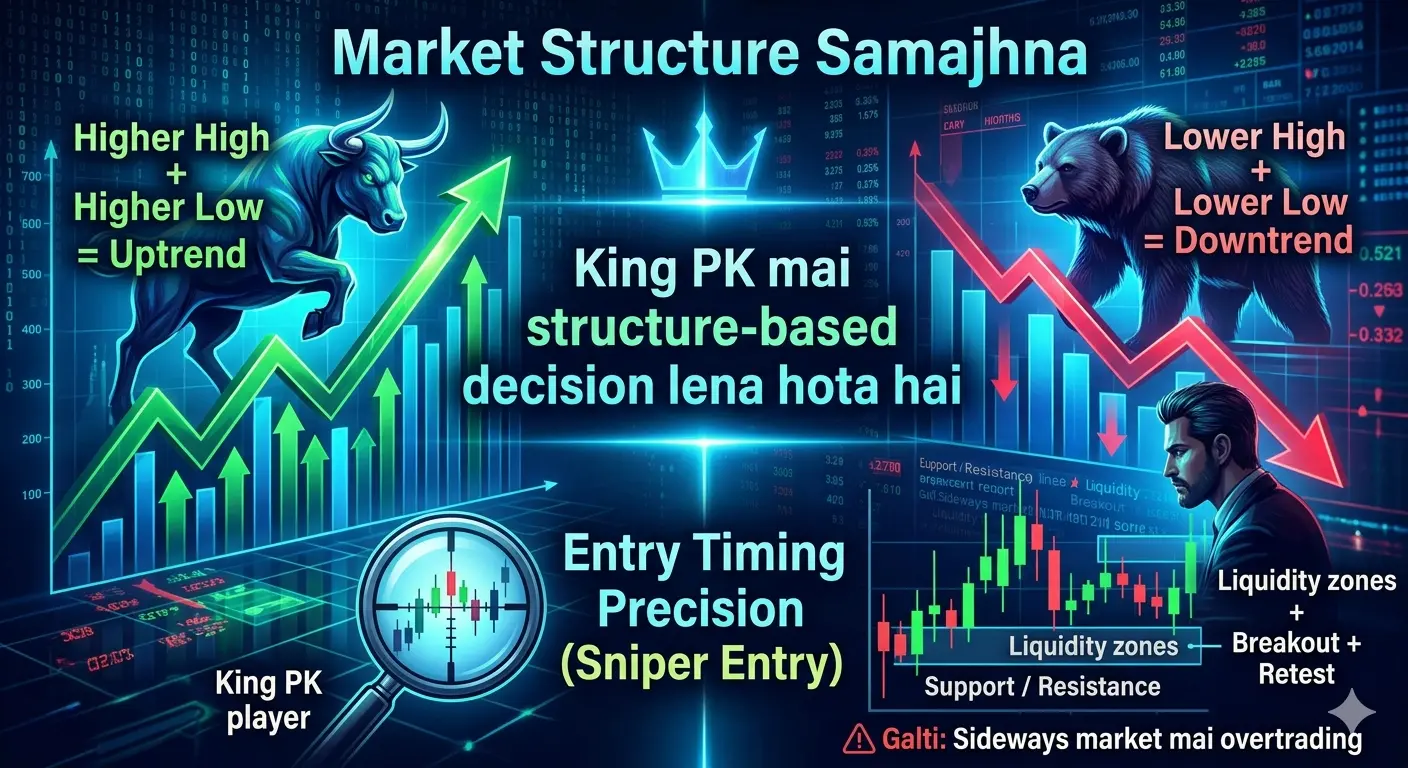
#WCTCTradingKingPK 1. Market Structure Samajhna (Foundation)
Sab se pehla kaam: trend identify karo
Higher High + Higher Low = Uptrend
Lower High + Lower Low = Downtrend
King PK mai random trade nahi — structure-based decision lena hota hai
➡️ Galti: Sideways market mai overtrading
2. Entry Timing Precision (Sniper Entry)
Entry blindly nahi
Use:
Support / Resistance
Liquidity zones
Breakout + Retest
➡️ Best entry = confirmation + volume support
3. Risk Management (Survival Rule)
Golden rule:
1 trade = 1–2% risk
Stop Loss MUST
PK battles mai ek galat trade = game over
➡️ Focus: Capital protecti
ShainingMoon
#WCTCTradingKingPK 1. Market Structure Samajhna (Foundation)
Sab se pehla kaam: trend identify karo
Higher High + Higher Low = Uptrend
Lower High + Lower Low = Downtrend
King PK mai random trade nahi — structure-based decision lena hota hai
➡️ Galti: Sideways market mai overtrading
2. Entry Timing Precision (Sniper Entry)
Entry blindly nahi
Use:
Support / Resistance
Liquidity zones
Breakout + Retest
➡️ Best entry = confirmation + volume support
3. Risk Management (Survival Rule)
Golden rule:
1 trade = 1–2% risk
Stop Loss MUST
PK battles mai ek galat trade = game over
➡️ Focus: Capital protection > profit
4. Leverage Control (Smart Use)
High leverage = high risk
Beginners: 5x–10x
Experts: situation-based
➡️ Over leverage = liquidation trap
5. Emotion Control (Psychology Game)
Fear & Greed = biggest enemies
Loss ke baad revenge trade ❌
Profit ke baad overconfidence ❌
➡️ Discipline = long-term win
6. Trade Setup Clarity (No Confusion)
Har trade se pehle:
Entry
Stop Loss
Take Profit
Defined hona chahiye
➡️ Random trade = gambling
7. Volume Analysis (Smart Money Signal)
Price move + Volume confirmation = strong signal
High volume breakout = valid
Low volume move = fake
➡️ Volume = market truth
8. Speed Execution (PK Advantage)
King PK fast format hai
Delay = missed opportunity
Fast execution = edge
➡️ Practice: quick decision making
9. Adaptability (Market Change Reaction)
Market static nahi hota
Trend change = strategy change
News impact = volatility spike
➡️ Flexible trader hi jeet ta hai
10. Consistency Over Hype (Real Winner Mindset)
Ek win kuch nahi
Consistency sab kuch hai
Small profits repeat karo
Loss control karo
➡️ Goal: Stable ROI, not lucky trade
🔥 Final Insight
King PK jeetne ke liye:
Strategy + Discipline + Speed = Success
Random trading se nahi
Systematic execution se win hoti hai
repost-content-media
  • Reward
  • Comment
  • Repost
  • Share
#WCTCTradingKingPK
This concept represents a disciplined trading identity built around structure, patience, risk control, and market intelligence. It is not just a name or tag; it reflects a trading philosophy focused on survival first, consistency second, and profit as a result—not a goal. Below is a complete 10-step breakdown of the mindset, strategy approach, and market behavior understanding behind it.
---
🔹 Step 1: Trading Identity Foundation
The core of #WCTCTradingKingPK is identity discipline. In trading, identity determines behavior. A trader without structure reacts emotionally, wh
ShainingMoon
#WCTCTradingKingPK
This concept represents a disciplined trading identity built around structure, patience, risk control, and market intelligence. It is not just a name or tag; it reflects a trading philosophy focused on survival first, consistency second, and profit as a result—not a goal. Below is a complete 10-step breakdown of the mindset, strategy approach, and market behavior understanding behind it.
---
🔹 Step 1: Trading Identity Foundation
The core of #WCTCTradingKingPK is identity discipline. In trading, identity determines behavior. A trader without structure reacts emotionally, while a structured trader reacts strategically. This step focuses on building a mindset where every decision is guided by rules, not emotions. It emphasizes becoming a “system-based trader” rather than a “signal-based follower.” This foundation separates long-term survivors from short-term participants.
---
🔹 Step 2: Market Understanding First
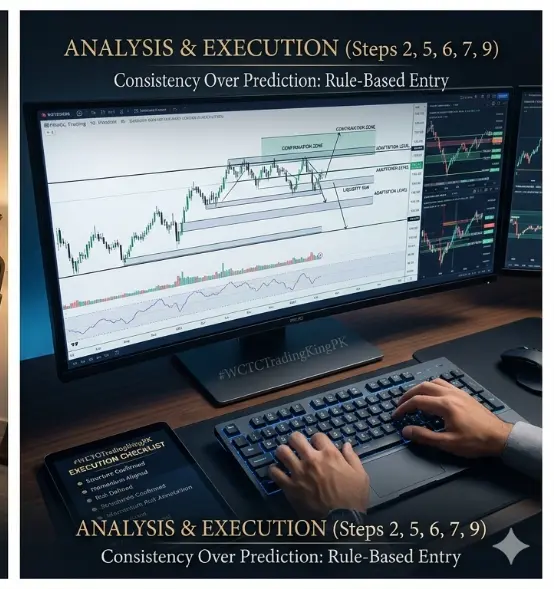
Before execution, market understanding is critical. Every chart represents liquidity movement, not random price action. Price is driven by participation, order flow, and institutional positioning. A trader under this system studies structure—support, resistance, volatility zones, and momentum shifts—before entering any position. The goal is not prediction, but interpretation of probability zones.
---
🔹 Step 3: Risk Management Core
Risk management is the backbone of survival. No strategy works without controlled exposure. This approach prioritizes capital protection over profit chasing. Each trade must have defined risk limits, controlled leverage, and pre-planned exit levels. The philosophy is simple: losing small consistently is acceptable; losing big once is unacceptable. This mindset ensures longevity in volatile markets.
---
🔹 Step 4: Emotional Control System
Emotions are the biggest enemy of trading performance. Fear leads to early exits, greed leads to over-leveraging, and revenge trading destroys capital. This step focuses on emotional neutrality. A trader must treat wins and losses as data, not identity shifts. The goal is psychological stability even during high volatility conditions.
---
🔹 Step 5: Entry Precision Strategy
Entries are not random decisions—they are confirmation-based executions. A trade is only taken when multiple conditions align: structure confirmation, momentum direction, and liquidity validation. The system avoids overtrading by waiting for high-probability setups. Patience becomes a strategic weapon rather than a passive behavior.
---
🔹 Step 6: Position Management Discipline
Once a trade is active, management becomes more important than entry. This includes partial profit-taking, stop-loss adjustment, and monitoring market reaction. A structured trader does not “hope” for outcomes; they manage outcomes dynamically. Position sizing is adjusted based on volatility and market behavior rather than fixed assumptions.
---
🔹 Step 7: Market Behavior Adaptation
Markets are not static—they evolve. This step emphasizes adaptability. Sometimes markets trend strongly, sometimes they consolidate, and sometimes they manipulate liquidity zones. A disciplined trader adapts strategies based on current conditions instead of forcing one strategy in all environments. Flexibility increases survival probability.
---
🔹 Step 8: Psychological Pressure Handling
Trading introduces psychological pressure through uncertainty and rapid changes. This system trains the trader to remain stable under stress. It involves accepting losses without emotional damage and avoiding overconfidence after wins. The goal is mental consistency, where no single trade affects long-term decision-making quality.
---
🔹 Step 9: Consistency Over Profit Chasing
The focus shifts from making money quickly to executing consistently. Consistency creates compounding results over time. A trader under this system understands that irregular profits are unstable, while structured consistency builds long-term growth. The goal is not to win every trade, but to maintain a positive system outcome over a large number of trades.
---
🔹 Step 10: Final Mastery Mindset
The final stage is mastery of discipline. At this level, trading becomes mechanical and structured. Decisions are no longer emotional but rule-based. Losses are accepted as part of statistical probability, and wins are treated as expected outcomes of a system. The trader evolves into a strategist, not a gambler.
This is the core philosophy behind #WCTCTradingKingPK—a structured approach to markets where survival, discipline, and system control define success more than prediction or luck.
---
Final Insight:
Trading is not about being right every time. It is about staying consistent long enough for probability to work in your favor.
SHAININGMOON
repost-content-media
  • Reward
  • Comment
  • Repost
  • Share
#DailyPolymarketHotspot Step 1: Global Market Environment Overview
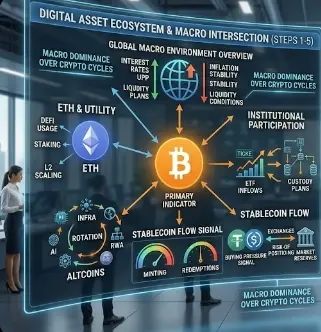
The global financial market is currently shaped by uncertainty in interest rate expectations, inflation stability signals, and liquidity conditions. Investors are closely monitoring central bank commentary and macroeconomic indicators. Equity markets show mixed momentum, while crypto remains highly sensitive to risk sentiment shifts. Bitcoin and major altcoins are reacting more strongly to liquidity expectations than to internal blockchain developments, which highlights macro dominance over crypto cycles.
Step 2: Bitcoin Struct
BTC0.97%
ETH0.86%
ShainingMoon
#DailyPolymarketHotspot Step 1: Global Market Environment Overview
The global financial market is currently shaped by uncertainty in interest rate expectations, inflation stability signals, and liquidity conditions. Investors are closely monitoring central bank commentary and macroeconomic indicators. Equity markets show mixed momentum, while crypto remains highly sensitive to risk sentiment shifts. Bitcoin and major altcoins are reacting more strongly to liquidity expectations than to internal blockchain developments, which highlights macro dominance over crypto cycles.
Step 2: Bitcoin Structural Position
Bitcoin continues to act as the primary market indicator for digital assets. Its price behavior reflects institutional participation patterns and liquidity inflows from ETFs and large funds. Market structure shows phases of accumulation and distribution rather than strong directional breakout. Traders are observing whether Bitcoin can sustain support levels during periods of macro pressure, as this determines broader market confidence.
Step 3: Ethereum Network Activity and Utility Demand
Ethereum maintains its role as the leading smart contract ecosystem. Network activity remains stable with fluctuations in DeFi usage, staking participation, and Layer 2 scaling adoption. Gas fee efficiency improvements and rollup expansion continue to support long-term scalability. However, price movement remains correlated with Bitcoin trends, showing limited independent momentum in the short term.
Step 4: Altcoin Market Liquidity Conditions
Altcoins are experiencing selective liquidity rotation rather than broad market expansion. Capital flow is concentrated in narratives such as AI tokens, infrastructure protocols, and real-world asset tokenization. Smaller assets remain highly volatile and sensitive to sentiment shifts. Market participants are prioritizing projects with strong utility, sustainable tokenomics, and active development pipelines.
Step 5: Stablecoin Flow and Market Liquidity Signal
Stablecoin movement is a key indicator of incoming or exiting capital in crypto markets. Increased minting activity suggests potential future buying pressure, while redemptions indicate risk-off positioning. Exchanges are closely monitoring stablecoin reserves as a leading signal for liquidity cycles. This metric is often used by professional traders to anticipate market direction before price confirmation.
Step 6: Institutional Participation Trend
Institutional involvement continues to shape long-term crypto structure. ETF exposure, custody solutions, and regulated derivatives are increasing access for large capital pools. This creates more stable but slower-moving price behavior compared to retail-driven cycles. Institutions are generally focused on long-term positioning rather than short-term speculation, which reduces extreme volatility but increases structural support zones.
Step 7: DeFi Sector Health and Capital Flow
Decentralized Finance remains a core innovation layer within crypto ecosystems. Lending protocols, staking platforms, and decentralized exchanges continue to evolve. However, total value locked fluctuates based on market sentiment and yield attractiveness. Risk management has become more important after previous liquidation events, leading to stronger emphasis on protocol security and sustainable yield models.
Step 8: Regulatory Environment Impact
Regulatory developments are shaping market expectations across major jurisdictions. Compliance frameworks, taxation clarity, and exchange licensing requirements influence investor confidence. Markets tend to react strongly to regulatory announcements, especially those involving stablecoins, trading platforms, or institutional custody rules. Long-term clarity is generally viewed as positive for capital inflow.
Step 9: Sentiment and Trader Behavior Analysis
Market sentiment is currently balanced between optimism and caution. Traders are reacting quickly to macro headlines, leading to shorter holding periods and increased volatility. Fear and greed cycles are compressed compared to previous years due to faster information flow and algorithmic trading influence. Social sentiment remains an important but secondary indicator compared to liquidity and macro data.
Step 10: Forward Market Outlook
The near-term outlook depends on three primary drivers: liquidity conditions, institutional inflow strength, and macroeconomic stability. If liquidity improves, crypto markets may enter a new expansion phase led by Bitcoin and followed by selective altcoin growth. If uncertainty increases, consolidation phases are expected with range-bound movement. The market remains structurally active but not fully directional, requiring disciplined risk management.
repost-content-media
  • Reward
  • Comment
  • Repost
  • Share
#TreasuryYieldBreaks5PercentCryptoUnderPressure Step 1: What is Treasury Yield?
U.S. Treasury yield is the return investors get by buying U.S. government bonds.
It is considered one of the safest investments in the world.
When the yield rises, it means:
Government bonds are paying more profit
Investors get safer returns without risk
So rising yield = stronger “safe investment” appeal
Step 2: Why 5% Level is Important
The 5% level is psychologically and financially very strong.
Because:
It is a high return for a risk-free asset
It competes directly with stocks and crypto
It attracts global inve
BTC0.97%
ShainingMoon
#TreasuryYieldBreaks5PercentCryptoUnderPressure Step 1: What is Treasury Yield?
U.S. Treasury yield is the return investors get by buying U.S. government bonds.
It is considered one of the safest investments in the world.
When the yield rises, it means:
Government bonds are paying more profit
Investors get safer returns without risk
So rising yield = stronger “safe investment” appeal
Step 2: Why 5% Level is Important
The 5% level is psychologically and financially very strong.
Because:
It is a high return for a risk-free asset
It competes directly with stocks and crypto
It attracts global investors back to safe assets
When yields cross 5%, markets often become cautious.
Step 3: Why Yields Are Rising
Main reasons behind rising Treasury yields:
Inflation is still not fully controlled
U.S. central bank keeps interest rates high
Government is issuing more debt
Investors demand higher return to hold bonds
This creates strong upward pressure on yields.
Step 4: Connection Between Bonds and Crypto
Crypto is a “risk asset”, while bonds are “safe assets”.
When bonds give high return:
Investors leave risky markets
Capital moves out of crypto
Liquidity in crypto decreases
So crypto often reacts negatively when yields rise.
Step 5: Impact on Bitcoin
Bitcoin reacts strongly to macro conditions.
When yields rise:
Bitcoin buying pressure reduces
Short-term selling increases
Market volatility increases
This does not always mean long-term trend is bearish, but short-term pressure increases.
Step 6: Impact on Altcoins
Altcoins are even more sensitive than Bitcoin.
Effects include:
Faster price drops compared to BTC
Lower trading volume
Reduced investor interest
Higher fear in retail traders
Small-cap coins feel the most pressure.
Step 7: Liquidity Drain from Market
High Treasury yields reduce market liquidity.
Why?
Investors prefer safe bonds over risky assets
Banks and funds reduce exposure to crypto
Less new money enters trading markets
Result: Market becomes “slow and heavy”
Step 8: Dollar Strength Effect
When yields rise:
U.S. dollar usually becomes stronger
Global currencies weaken compared to USD
Stronger dollar leads to:
Lower crypto demand worldwide
Expensive entry for international investors
Reduced speculative buying
Step 9: Market Sentiment Shift
Investor psychology changes quickly:
Before:
“Crypto can give higher profit”
Now:
“Safe bonds give guaranteed return”
This shift causes:
Fear in short-term traders
Profit-taking from long positions
Lower risk appetite in the market
Sentiment becomes cautious.
Step 10: Future Outlook for Crypto
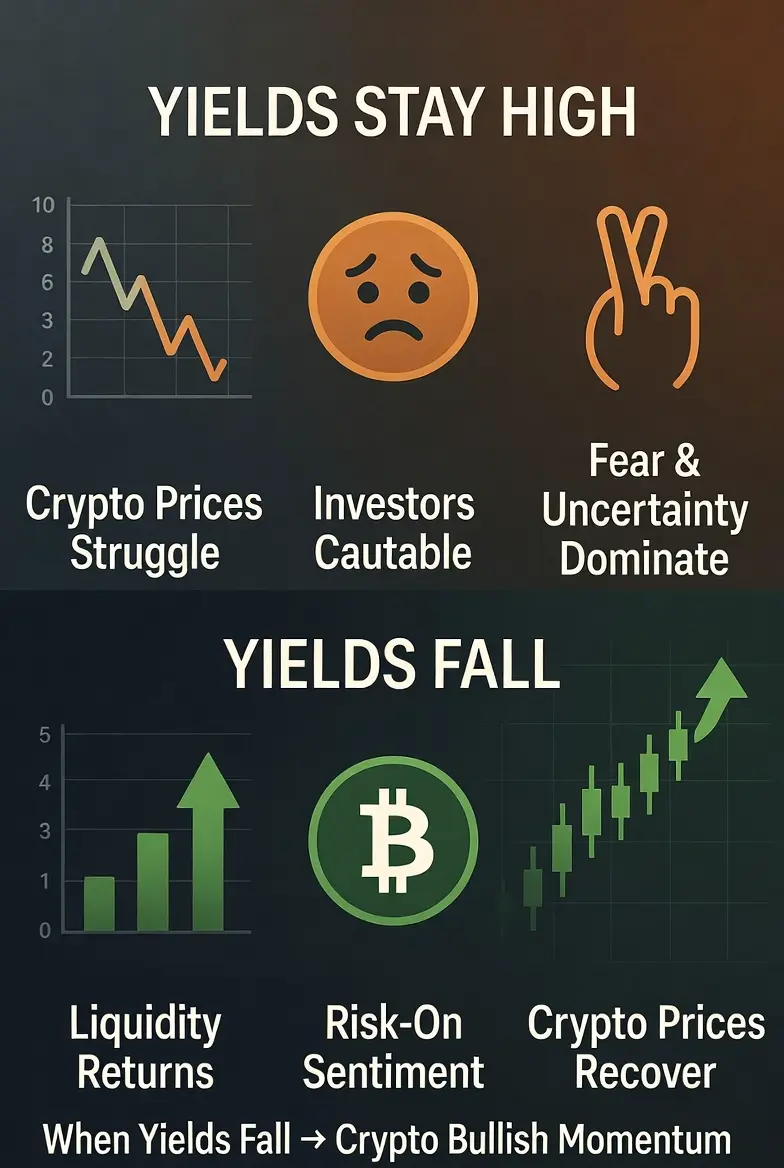
Two possible scenarios:
If yields stay above 5%
Crypto remains under pressure
Slow price growth
More sideways movement
Weak liquidity environment
If yields start falling
Liquidity returns to crypto
Risk assets recover
Strong bullish momentum possible
Final Conclusion
Rising Treasury yields above 5% are not just a bond market issue.
They are a global financial signal.
They show:
Money is moving toward safety
Risk appetite is decreasing
Crypto faces short-term pressure
But crypto is still a long-term innovation market.
When macro conditions ease, momentum can return quickly.
repost-content-media
  • Reward
  • Comment
  • Repost
  • Share
#BitcoinSpotVolumeNewLow Step 1: Market Signal Definition
A Bitcoin spot volume new low means trading activity in the real Bitcoin spot market has dropped to its lowest recent level. In simple terms, fewer people are actively buying or selling Bitcoin on exchanges. This is not about price—it is about participation level in the market.
Step 2: What Spot Volume Actually Represents
Spot volume reflects real transactions, not leveraged bets. It shows:
Actual BTC being bought
Actual BTC being sold
Low spot volume means real market participation is weak, even if price is moving.
Step 3: Liquidity Co
BTC0.97%
ShainingMoon
#BitcoinSpotVolumeNewLow Step 1: Market Signal Definition
A Bitcoin spot volume new low means trading activity in the real Bitcoin spot market has dropped to its lowest recent level. In simple terms, fewer people are actively buying or selling Bitcoin on exchanges. This is not about price—it is about participation level in the market.
Step 2: What Spot Volume Actually Represents
Spot volume reflects real transactions, not leveraged bets. It shows:
Actual BTC being bought
Actual BTC being sold
Low spot volume means real market participation is weak, even if price is moving.
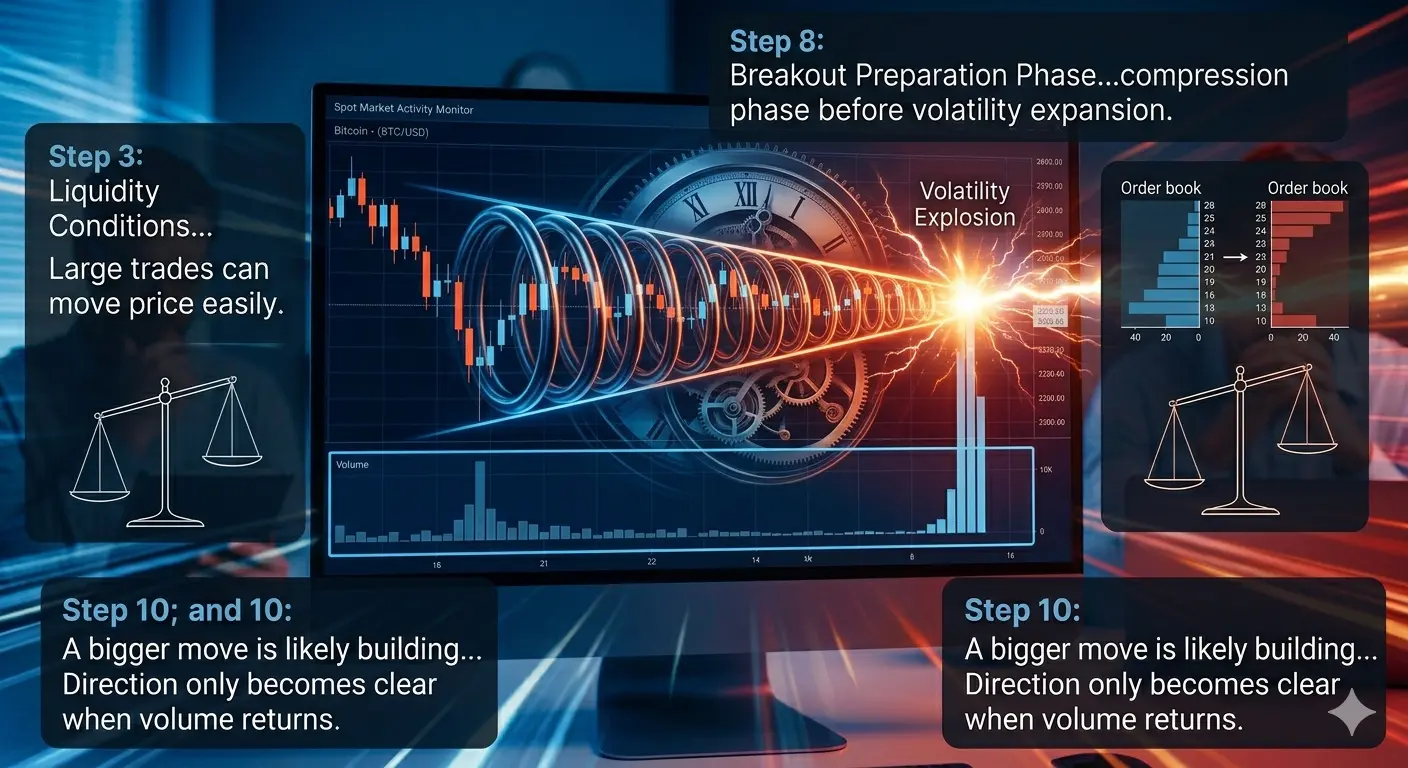
Step 3: Liquidity Conditions
When volume hits a new low:
Order books become thinner
Large trades can move price easily
Market becomes fragile and sensitive
This creates unstable conditions where sudden spikes can happen.
Step 4: Market Psychology Behind It
Low volume usually signals:
Trader hesitation
Lack of confidence
Waiting behavior
It reflects a phase where the market is in decision mode, not trend mode.
Step 5: Price Behavior During Low Volume
In most cases:
Price moves slowly or sideways
Fake breakouts can appear
Trends lose strength
Because there is no strong participation, moves lack conviction.
Step 6: Possible Bullish Interpretation
Low volume is not always negative. It can mean:
Sellers are exhausted
Strong holders are not selling
Market is quietly accumulating
This can become bullish if demand returns suddenly.
Step 7: Possible Bearish Interpretation
It can also indicate weakness:
Buyers are absent
Demand is fading
Price may slowly drift down
If selling pressure appears during low volume, downside can accelerate.
Step 8: Breakout Preparation Phase
Low volume often appears before:
Major news events
Macro economic changes
ETF inflow/outflow shifts
This is why traders call it a compression phase before volatility expansion.
Step 9: Confirmation Factors Needed
Volume alone is not enough. Traders watch:
Price support/resistance
Momentum indicators
On-chain activity
Futures open interest
Without confirmation, the signal is incomplete.
Step 10: Final Market Conclusion
A Bitcoin spot volume new low is not a buy or sell signal by itself. It is a market energy indicator. It tells you:
Market is quiet
Participation is low
A bigger move is likely building
Direction only becomes clear when volume returns with price movement.
  • Reward
  • Comment
  • Repost
  • Share
#BitcoinSpotVolumeNewLow Step 1: Market Signal Definition
A Bitcoin spot volume new low means trading activity in the real Bitcoin spot market has dropped to its lowest recent level. In simple terms, fewer people are actively buying or selling Bitcoin on exchanges. This is not about price—it is about participation level in the market.
Step 2: What Spot Volume Actually Represents
Spot volume reflects real transactions, not leveraged bets. It shows:
Actual BTC being bought
Actual BTC being sold
Low spot volume means real market participation is weak, even if price is moving.
Step 3: Liquidity Co
BTC0.97%
ShainingMoon
#BitcoinSpotVolumeNewLow Step 1: Market Signal Definition
A Bitcoin spot volume new low means trading activity in the real Bitcoin spot market has dropped to its lowest recent level. In simple terms, fewer people are actively buying or selling Bitcoin on exchanges. This is not about price—it is about participation level in the market.
Step 2: What Spot Volume Actually Represents
Spot volume reflects real transactions, not leveraged bets. It shows:
Actual BTC being bought
Actual BTC being sold
Low spot volume means real market participation is weak, even if price is moving.
Step 3: Liquidity Conditions
When volume hits a new low:
Order books become thinner
Large trades can move price easily
Market becomes fragile and sensitive
This creates unstable conditions where sudden spikes can happen.
Step 4: Market Psychology Behind It
Low volume usually signals:
Trader hesitation
Lack of confidence
Waiting behavior
It reflects a phase where the market is in decision mode, not trend mode.
Step 5: Price Behavior During Low Volume
In most cases:
Price moves slowly or sideways
Fake breakouts can appear
Trends lose strength
Because there is no strong participation, moves lack conviction.
Step 6: Possible Bullish Interpretation
Low volume is not always negative. It can mean:
Sellers are exhausted
Strong holders are not selling
Market is quietly accumulating
This can become bullish if demand returns suddenly.
Step 7: Possible Bearish Interpretation
It can also indicate weakness:
Buyers are absent
Demand is fading
Price may slowly drift down
If selling pressure appears during low volume, downside can accelerate.
Step 8: Breakout Preparation Phase
Low volume often appears before:
Major news events
Macro economic changes
ETF inflow/outflow shifts
This is why traders call it a compression phase before volatility expansion.
Step 9: Confirmation Factors Needed
Volume alone is not enough. Traders watch:
Price support/resistance
Momentum indicators
On-chain activity
Futures open interest
Without confirmation, the signal is incomplete.
Step 10: Final Market Conclusion
A Bitcoin spot volume new low is not a buy or sell signal by itself. It is a market energy indicator. It tells you:
Market is quiet
Participation is low
A bigger move is likely building
Direction only becomes clear when volume returns with price movement.
repost-content-media
  • Reward
  • Comment
  • Repost
  • Share
#FedHoldsRateButDividesDeepen #FedHoldsRateButDividesDeepen 📊
The latest decision from the Federal Reserve has once again captured global market attention. While the central bank chose to hold interest rates steady, the real story lies beneath the surface—deepening divisions among policymakers that signal uncertainty about the economic path ahead.
At a headline level, the rate pause might appear predictable. Inflation has shown signs of cooling, but not fast enough to declare victory. At the same time, economic growth remains resilient, and the labor market continues to demonstrate strength.
BTC0.97%
ShainingMoon
#FedHoldsRateButDividesDeepen #FedHoldsRateButDividesDeepen 📊
The latest decision from the Federal Reserve has once again captured global market attention. While the central bank chose to hold interest rates steady, the real story lies beneath the surface—deepening divisions among policymakers that signal uncertainty about the economic path ahead.
At a headline level, the rate pause might appear predictable. Inflation has shown signs of cooling, but not fast enough to declare victory. At the same time, economic growth remains resilient, and the labor market continues to demonstrate strength. This balancing act is exactly why the Fed opted to stay cautious rather than commit to immediate cuts or further hikes.
However, the internal divide is what traders and investors are focusing on. Some members of the Federal Open Market Committee (FOMC) believe that inflation risks are still too high and that tightening may need to resume if price pressures persist. Others argue that the current policy is already restrictive enough and that pushing further could risk slowing the economy too aggressively.
This split creates a powerful narrative for financial markets. It introduces uncertainty, and uncertainty often translates into volatility. For crypto traders, stock investors, and forex participants alike, this environment can create both opportunity and risk.
From a market perspective, the decision to hold rates tends to provide short-term stability. Lower expectations of immediate rate hikes can support risk assets like Bitcoin and equities. However, the lack of clear forward guidance means markets remain highly sensitive to incoming economic data—especially inflation reports and employment figures.
Another key takeaway is the shift in tone. Even without a rate change, communication from the Fed has become more nuanced. Instead of a clear tightening or easing bias, policymakers are emphasizing data dependency. This means every major economic release now has the potential to reshape expectations instantly.
For crypto markets, this is especially important. Digital assets often react strongly to liquidity conditions. If markets begin pricing in future rate cuts, it could fuel bullish momentum. On the other hand, any surprise inflation spike could revive hawkish sentiment and pressure risk assets.
In essence, the Fed’s decision is less about what happened and more about what comes next. The deepening divisions highlight that there is no unified view on the economic outlook. This lack of consensus increases the probability of sudden shifts in policy direction, which traders must be prepared for.
Strategically, this is a time for discipline. Overconfidence in a single narrative—whether bullish or bearish—can be costly. Instead, adaptability becomes the key advantage. Monitoring macro signals, staying updated with Fed commentary, and managing risk carefully are essential moves in this environment.
repost-content-media
  • Reward
  • Comment
  • Repost
  • Share
#WCTCTradingKingPK
Trading is not just a game of buy and sell, but a structured system where every decision is based on logic, discipline, and risk management. The core concept of this style is that a trader is not emotional, but calculated. Every trade is entered with a plan, which includes entry, stop loss, and take profit predefined. The first step is to understand the market, because without understanding the market structure, taking any trade is equivalent to gambling. The market always moves in three phases: uptrend, downtrend, and sideways. A professional trader's job is to identify wh
Vortex_King
#WCTCTradingKingPK
Trading is not just a game of buy and sell, but a structured system where every decision is based on logic, discipline, and risk management. The core concept of this style is that a trader is not emotional, but calculated. Every trade is entered with a plan, which includes entry, stop loss, and take profit predefined. The first step is to understand the market, because without understanding the market structure, taking any trade is equivalent to gambling. The market always moves in three phases: uptrend, downtrend, and sideways. A professional trader's job is to identify what the current phase is, because each phase requires a different strategy.
When the market is in an uptrend, it makes higher highs and higher lows, meaning buyers are in control. In this situation, a smart trader buys on dips, rather than entering at the top out of FOMO. Similarly, when the market is in a downtrend, lower highs and lower lows form, where sellers dominate. Here, selling on rallies is a safer approach. The sideways market is the trickiest, where price stays within a range, and overtrading causes the most losses. A professional trader either trades within the range or waits for a breakout.
The next important step is understanding the concept of support and resistance. Support is the level where price repeatedly stops and bounces upward, while resistance is the level where price hits and gets rejected. These levels are psychological because they trigger strong reactions from buyers and sellers. A strong strategy is to buy near support and sell near resistance, but not blindly—only with confirmation. Confirmation includes candlestick patterns, volume spikes, or breakout retests.
Candlestick analysis is also a powerful tool that is an important part of the #WCTCTradingKingPK approach. Candles reflect market psychology. For example, a bullish engulfing pattern shows strong buying pressure, while a bearish engulfing indicates selling pressure. Doji candles represent confusion where the market is undecided about direction. A professional trader never relies on a single candle but makes decisions in context.
Volume analysis provides the next level of confirmation. Price movement is weak without volume. If a breakout occurs with high volume, it has a higher chance of success. But if a breakout happens on low volume, it could be a false breakout. That’s why a smart trader always analyzes volume along with price. This is a hidden edge that beginners often ignore.
Now, let’s talk about indicators. Indicators are tools, but over-reliance on them is dangerous. The most common indicators include RSI, Moving Averages, and MACD. RSI shows overbought and oversold conditions. When RSI is above 70, the market is overbought; below 30, it is oversold. But trading solely based on RSI is a mistake; it should be used with structure. Moving averages help identify trends. For example, if the price is above the 200 EMA, the long-term trend is bullish. MACD shows momentum and crossovers provide potential entry signals.
Risk management is the factor that helps a trader survive. The #WCTCTradingKingPK mindset’s most important rule is to risk only a small portion of your capital on any trade, usually 1% or 2%. This means that even if 10 trades in a row result in losses, the account won’t blow up. Setting a stop loss is mandatory. Stop loss is the level where the trade automatically closes if the market moves against you. Beginners’ biggest mistake is ignoring or moving the stop loss, which eventually turns into a big loss.
Take profit is just as important as entry and stop loss. A professional trader sets realistic targets, not greedy ones. The concept of risk-to-reward ratio applies here. A good trade is one where the reward exceeds the risk, such as 1:2 or 1:3. This means if you risk 1 dollar, your target should be 2 or 3 dollars. With this approach, even a 50% win rate can keep a trader profitable.
Trading psychology is the hidden backbone. Emotions are the biggest enemy in the market. Fear and greed are both dangerous. When the market drops, fear compels traders to sell quickly, and when the market pumps, greed causes late entries. A professional trader controls their emotions and follows the plan only. Discipline is what makes an average trader an expert.
Overtrading is also a common problem. Not every movement requires a trade. Sometimes, the best decision is not to trade at all. The market always offers opportunities, but patience is essential. The #WCTCTradingKingPK approach focuses on quality trades, not quantity.
Leverage should be used carefully. High leverage multiplies profits but also increases losses at the same speed. Beginners should start with low leverage until their system becomes stable.
Backtesting and journaling are professional habits. A trader should record every trade, including entry, exit, reason, and result. This helps identify mistakes and improve strategies. Continuous learning and adaptation are the secrets to long-term success.
The final mindset should be that trading is a marathon, not a sprint. Quick-rich schemes usually fail. Consistency, discipline, and patience are the real edges. The #WCTCTradingKingPK mindset involves making calculated decisions, controlling risk, and focusing on long-term growth. If this system is followed properly, a trader gradually improves their skills, survives in the market, and generates profits.
repost-content-media
  • Reward
  • Comment
  • Repost
  • Share
#USSeeksStrategicBitcoinReserve
The United States' concept of a “Strategic Bitcoin Reserve” is not just a simple crypto headline, but a potentially game-changing development for the global financial system. Just as historically countries have kept gold, oil, and foreign currencies in their reserves, considering Bitcoin as a digital reserve asset represents a new paradigm shift. The core idea is that Bitcoin should not only be viewed as a speculative asset but as a long-term strategic hedge — much like gold is used against inflation and currency devaluation.
If we understand this concept at a
BTC0.97%
Vortex_King
#USSeeksStrategicBitcoinReserve
The United States' concept of a “Strategic Bitcoin Reserve” is not just a simple crypto headline, but a potentially game-changing development for the global financial system. Just as historically countries have kept gold, oil, and foreign currencies in their reserves, considering Bitcoin as a digital reserve asset represents a new paradigm shift. The core idea is that Bitcoin should not only be viewed as a speculative asset but as a long-term strategic hedge — much like gold is used against inflation and currency devaluation.
If we understand this concept at a foundational level, the purpose of reserve assets is to provide economic stability. The United States traditionally maintains dominance of the US dollar in its reserves, but the global landscape is rapidly changing. China, Russia, and other countries are exploring alternative financial systems where dollar dependency is decreasing. In this context, Bitcoin emerges as a neutral, decentralized asset that is not controlled by any single government. That’s why the idea of a “Strategic Bitcoin Reserve” is gradually entering policy discussions.
Bitcoin’s greatest strength is its scarcity. Only 21 million coins will exist, making it digital gold. When governments or institutions consider it as a reserve asset, they are essentially adopting an asset with a fixed supply that cannot be artificially inflated. This feature is the complete opposite of fiat currencies, where central banks can print unlimited money. That’s why Bitcoin is also seen as an inflation hedge.
If the United States officially begins building a Bitcoin reserve, it will directly impact market demand. Government-level buying means large-scale accumulation, which can significantly push prices in the long term. This situation is similar to how central banks accumulate gold — when demand increases and supply is fixed, prices naturally come under upward pressure. It also has a psychological effect, boosting confidence among retail and institutional investors.
There is also a geopolitical angle to this development. If the US adopts Bitcoin as a reserve asset, it signals that digital assets have become a permanent part of the global financial system. Other countries may follow this trend, potentially sparking a “digital reserve race.” Just as there was a historical gold accumulation race, Bitcoin accumulation could become part of future strategic competition.
However, challenges are also associated with this concept. Bitcoin’s volatility is a major concern. Governments traditionally prefer stable assets, while Bitcoin is highly volatile in the short term. Managing this volatility will be a challenge for policymakers. A possible solution is to include Bitcoin as a small percentage allocation in reserves, rather than as the primary asset.
Regulation is also an important factor. Crypto regulation in the United States is still evolving, and without a clear framework, large-scale adoption is difficult. If the government holds Bitcoin itself, it will need to establish regulatory clarity, which would indirectly be a positive development for the entire crypto industry.
Security concerns cannot be ignored either. Bitcoin is a digital asset that requires advanced custody solutions for security. For government-level reserves, institutional-grade security infrastructure will be necessary, including cold storage, multi-signature wallets, and cyber defense systems.
From a market impact perspective, this narrative could serve as a strong bullish catalyst. Whenever such news or speculation hits the market, sudden price spikes are observed. However, professional traders do not blindly trade on news but wait for confirmation. If Bitcoin breaks strong resistance levels with high volume, it signals trend continuation.
In this scenario, support and resistance levels play a critical role. If Bitcoin breaks a major resistance and turns it into support, it signals a long-term bullish structure. Conversely, if the price shows rejection despite the news, it indicates the market has already priced it in or a liquidity trap is forming.
Institutional adoption has a long-term effect, while retail reactions create short-term volatility. Traders differentiate between the two. They avoid short-term hype and focus on identifying the long-term trend. If government accumulation is confirmed, it could lay the foundation for a multi-year bullish cycle.
Another important aspect is that Bitcoin’s correlation with traditional markets is gradually changing. If it becomes a reserve asset, its behavior could resemble gold, acting as a safe haven during economic uncertainty. This transformation would signal maturity in the crypto market.
Psychological impact is also significant. When the world’s largest economy adopts Bitcoin, public perception changes drastically. People who previously viewed crypto as risky or a scam start seeing it as a legitimate asset class. This shift accelerates adoption, ultimately increasing demand.
However, every bullish narrative carries risks. Government involvement can sometimes tighten market control and regulation. Excessive regulation could slow innovation. Therefore, a balanced approach is essential to maintain both adoption and freedom.
In final analysis, #USSeeksStrategicBitcoinReserve is not just a policy idea but a preview of the future financial system. It creates a bridge between digital and traditional finance. If it becomes a reality, Bitcoin’s status could shift from “speculative asset” to “strategic global reserve.”
From a macro perspective, such narratives are not ignored. Professional traders use these developments as long-term trend indicators but always base entries and exits on technical confirmation. This combination of macro awareness and technical precision is the edge that can make a trader consistently profitable in the market.
repost-content-media
  • Reward
  • Comment
  • Repost
  • Share
##FedHoldsRateButDividesDeepen
The macro narrative behind reflects a critical moment in monetary policy where the central bank chooses stability on the surface, but internal disagreements reveal deeper uncertainty about the economic path ahead. When the Federal Reserve “holds rates,” it means it has decided not to increase or decrease interest rates during a policy meeting. On paper, this signals caution and patience. However, the second part—“divides deepen”—is where the real story lies. It indicates that policymakers within the Fed are no longer aligned on what should happen next, and that
BTC0.97%
Vortex_King
##FedHoldsRateButDividesDeepen
The macro narrative behind reflects a critical moment in monetary policy where the central bank chooses stability on the surface, but internal disagreements reveal deeper uncertainty about the economic path ahead. When the Federal Reserve “holds rates,” it means it has decided not to increase or decrease interest rates during a policy meeting. On paper, this signals caution and patience. However, the second part—“divides deepen”—is where the real story lies. It indicates that policymakers within the Fed are no longer aligned on what should happen next, and that divergence creates volatility across financial markets.
To understand the significance, one must first grasp why interest rates matter. The Federal Reserve uses interest rates as a primary tool to control inflation and manage economic growth. When inflation is high, rates are typically raised to slow down spending and borrowing. When the economy weakens, rates are lowered to stimulate activity. So, when the Fed decides to hold rates, it usually means the economy is at a delicate balance point—neither strong enough to justify hikes nor weak enough to require cuts.
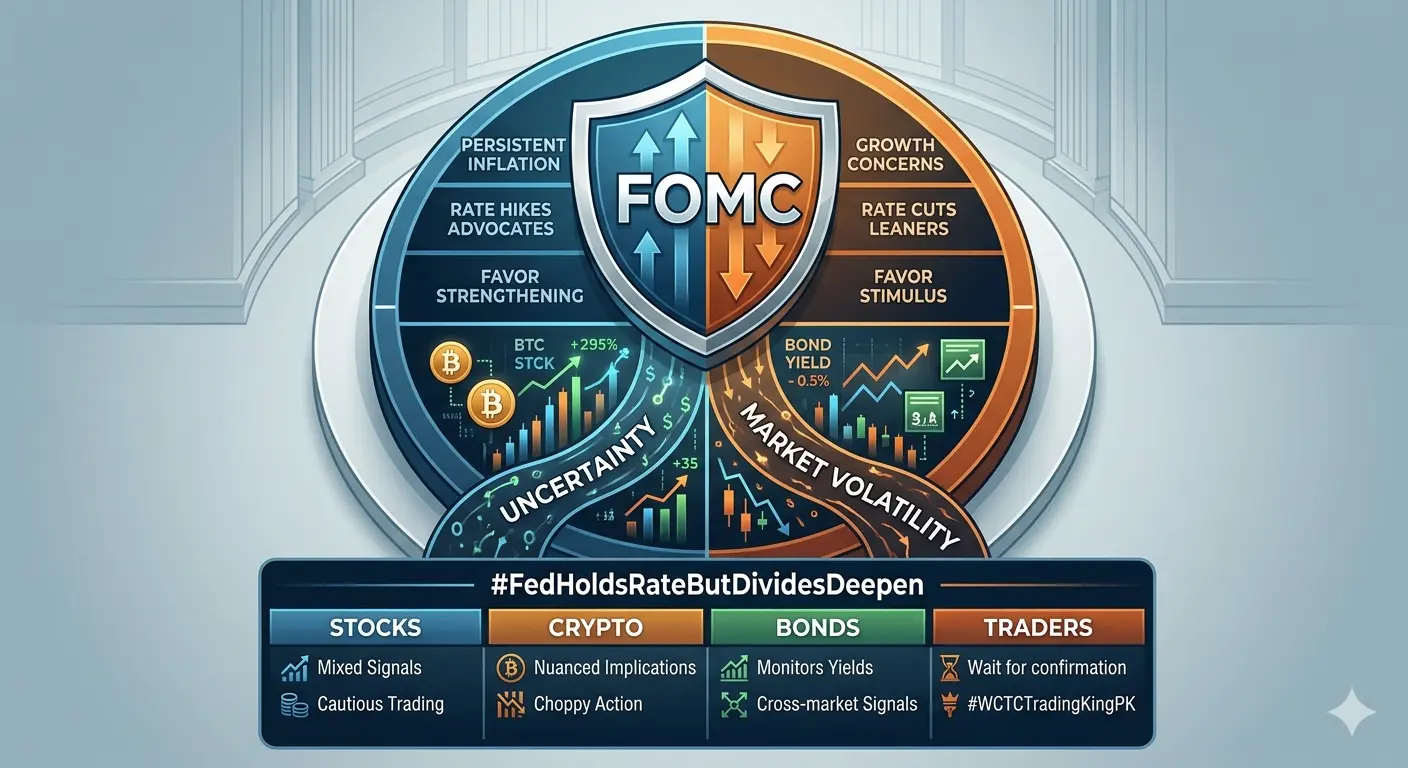
However, a rate hold does not mean clarity. In fact, it often signals uncertainty. The phrase “divides deepen” suggests that within the Federal Open Market Committee (FOMC), some members may favor future rate hikes due to persistent inflation risks, while others may lean toward rate cuts due to slowing economic growth or rising unemployment concerns. This internal disagreement is important because it shapes future policy expectations, and markets are highly sensitive to expectations rather than just current decisions.
From a market perspective, this kind of environment creates mixed signals. On one hand, holding rates can be interpreted as neutral or slightly bullish for risk assets like stocks and cryptocurrencies, because it avoids tightening financial conditions further. On the other hand, internal divisions introduce uncertainty, which markets typically dislike. Uncertainty leads to cautious behavior among institutional investors, reduced conviction, and often increased short-term volatility.
For Bitcoin and the broader crypto market, the implications are nuanced. Bitcoin tends to perform well in environments where monetary policy is loose or expected to become accommodative. If some Fed members are signaling future rate cuts, that can be seen as a bullish long-term signal. However, if other members are still concerned about inflation and hint at possible hikes, it creates a conflicting narrative. This tug-of-war can result in choppy price action rather than a clear trend.
From a perspective, this is a classic “wait for confirmation” scenario. A professional trader does not react blindly to headlines but instead observes how the market interprets them. If Bitcoin holds key support levels and begins forming higher highs after such news, it suggests that bullish sentiment is gaining control. Conversely, if price struggles near resistance and shows rejection, it indicates that uncertainty is dominating.
Another important factor is liquidity. When the Fed holds rates, liquidity conditions do not tighten further, which is generally supportive for financial markets. However, without a clear direction, large institutions may reduce aggressive positioning and instead focus on hedging strategies. This often leads to range-bound markets where price oscillates between support and resistance rather than trending strongly in one direction.
Bond markets also play a crucial role in interpreting Fed decisions. If bond yields rise despite a rate hold, it suggests that markets expect higher rates in the future, which can pressure risk assets. If yields fall, it indicates expectations of future rate cuts, which can support bullish momentum. Therefore, traders who follow a professional framework monitor cross-market signals rather than focusing on a single headline.
Psychologically, this environment is challenging for retail traders. A rate hold might initially appear as positive news, leading to impulsive buying. But when mixed signals emerge from Fed officials, the market can quickly reverse, trapping emotional traders. This is where discipline becomes critical. The #WCTCTradingKingPK mindset emphasizes patience, structured planning, and avoiding trades based purely on news-driven emotions.
Risk management becomes even more important during such periods. Since volatility can increase without a clear trend, traders should reduce position sizes, tighten stop losses, and avoid over-leveraging. The goal is not to catch every move but to preserve capital until a clearer direction emerges. Survival in uncertain conditions is what allows traders to capitalize on future opportunities.
In the long term, “divides deepen” may actually be a precursor to a major policy shift. Historically, when central bank members begin to disagree significantly, it often signals that the current policy stance is nearing its limits. This could eventually lead to a decisive move—either a rate cut cycle if economic weakness dominates, or renewed tightening if inflation resurges. Identifying this transition early is where macro-aware traders gain an edge.
In conclusion, represents a complex macro environment where stability in action masks uncertainty in direction. For markets, this translates into mixed signals, increased volatility, and a lack of strong trends in the short term. From a professional trading standpoint, it is not a moment for aggressive speculation but for careful observation, disciplined execution, and strategic positioning. The traders who navigate such conditions successfully are those who combine macro understanding with technical precision—staying patient until the market reveals its next clear move.
repost-content-media
  • Reward
  • Comment
  • Repost
  • Share
#DeFiLossesTop600MInApril
The narrative behind #DeFiLossesTop600MInApril reflects one of the most critical realities of decentralized finance: rapid innovation comes with equally high security risks. Decentralized finance (DeFi) is built on blockchain-based smart contracts that allow users to lend, borrow, and trade without intermediaries. However, this same open and permissionless structure also creates vulnerabilities, making the ecosystem a frequent target for exploits, hacks, and scams.
To understand the $600M+ losses in April, it is important to break down how these losses typically occ
Vortex_King
#DeFiLossesTop600MInApril
The narrative behind #DeFiLossesTop600MInApril reflects one of the most critical realities of decentralized finance: rapid innovation comes with equally high security risks. Decentralized finance (DeFi) is built on blockchain-based smart contracts that allow users to lend, borrow, and trade without intermediaries. However, this same open and permissionless structure also creates vulnerabilities, making the ecosystem a frequent target for exploits, hacks, and scams.
To understand the $600M+ losses in April, it is important to break down how these losses typically occur. Unlike traditional finance, where institutions provide layers of protection, DeFi relies heavily on code. If there is a flaw in a smart contract or governance system, attackers can exploit it instantly. In many cases, these attacks are not simple “hacks” but sophisticated exploits involving flash loans, oracle manipulation, or access control failures. Because transactions on blockchain are irreversible, once funds are stolen, recovery becomes extremely difficult.
A major contributor to April 2026 losses was large-scale protocol breaches. For example, one of the biggest incidents involved a decentralized exchange suffering a cyberattack that resulted in losses estimated between $130 million and $280 million. This single event alone highlights how one vulnerability can wipe out hundreds of millions within hours. Such attacks often exploit governance systems or administrative controls rather than just coding bugs, showing that operational security is just as important as technical security.
Another key factor behind these losses is social engineering and human error. In early 2026, a DeFi platform lost around $40 million after attackers compromised devices belonging to executives, gaining access to treasury wallets. This demonstrates that even if the protocol itself is secure, weak human-level security can still lead to catastrophic losses. In DeFi, private keys are everything—if they are compromised, the funds are effectively gone.
When aggregated across multiple incidents—ranging from protocol exploits to phishing scams—the total losses for April crossed the $600M mark. This is not just a number; it reflects a systemic issue in the DeFi ecosystem. The open nature of DeFi, while empowering, also removes traditional safeguards. There is no central authority to reverse transactions, no insurance by default, and often limited accountability.
From a structural perspective, DeFi’s composability (often called “money legos”) increases risk exposure. Protocols are interconnected, meaning that a vulnerability in one protocol can cascade into others. For example, if a lending protocol relies on a compromised price oracle, it can trigger liquidations, draining liquidity across multiple platforms. This interconnected risk amplifies the scale of losses.
From a perspective, this kind of news is not just negative—it is informative. Professional traders do not panic when they see headlines like $600M losses; instead, they analyze the impact on market structure. Typically, such news creates short-term bearish sentiment, leading to sharp drops in DeFi tokens and sometimes broader crypto markets. However, these dips can also create opportunities if strong support levels hold.
Market psychology plays a major role here. Retail traders often react emotionally, selling at the bottom after hearing about hacks. Institutions, on the other hand, assess whether the issue is isolated or systemic. If the broader market structure remains intact, they may accumulate during fear-driven dips. This difference in behavior creates volatility, which skilled traders can capitalize on.
Risk management becomes even more critical in such environments. Increased exploits mean higher uncertainty, and higher uncertainty means traders should reduce position sizes and avoid excessive leverage. Capital preservation becomes the priority. In the #WCTCTradingKingPK framework, survival during uncertain phases is more important than aggressive profit-seeking.
Another important angle is regulation. Large-scale losses often accelerate regulatory discussions. Governments and financial authorities may push for stricter compliance, audits, and security standards in DeFi. While this can slow down innovation in the short term, it may strengthen the ecosystem in the long run by increasing trust and institutional participation.
Technologically, these losses also drive improvement. Every major hack exposes weaknesses, leading to better smart contract audits, bug bounty programs, and security frameworks. Over time, this iterative process makes the ecosystem more resilient. In fact, many of today’s security standards exist because of past failures.
From a long-term perspective, DeFi remains a high-risk, high-reward sector. Its core value proposition—open, permissionless finance—remains powerful. However, until security infrastructure matures further, such loss events are likely to continue. This means traders and investors must approach DeFi with caution, proper research, and strict risk controls.
In conclusion, is not just a headline—it is a reflection of the growing pains of a rapidly evolving financial system. It highlights vulnerabilities in smart contracts, governance, and human security, while also reinforcing the importance of discipline, risk management, and strategic thinking. From a professional trading standpoint, such events should be treated as volatility catalysts—moments of risk, but also potential opportunity for those who remain rational, prepared, and patient.
repost-content-media
  • Reward
  • Comment
  • Repost
  • Share
#DailyPolymarketHotspot
The concept behind revolves around identifying, analyzing, and strategically participating in high-interest prediction markets on platforms like Polymarket. Unlike traditional trading, where participants buy and sell assets such as stocks or cryptocurrencies, prediction markets allow users to speculate on the outcomes of real-world events. These events can range from politics and economics to global news, technology developments, and even social trends. The “hotspot” refers to the most active, trending, and high-volume markets of the day—where attention, liquidity, and
BTC0.97%
Vortex_King
#DailyPolymarketHotspot
The concept behind revolves around identifying, analyzing, and strategically participating in high-interest prediction markets on platforms like Polymarket. Unlike traditional trading, where participants buy and sell assets such as stocks or cryptocurrencies, prediction markets allow users to speculate on the outcomes of real-world events. These events can range from politics and economics to global news, technology developments, and even social trends. The “hotspot” refers to the most active, trending, and high-volume markets of the day—where attention, liquidity, and opportunity are concentrated.
To understand how this works, it is important to first grasp the structure of prediction markets. On platforms like Polymarket, each market is based on a yes/no outcome. For example, a question might be: “Will Bitcoin reach $100K this month?” Traders can buy “Yes” or “No” shares, with prices ranging from $0 to $1, representing the probability of the event occurring. If “Yes” shares are trading at $0.70, it implies a 70% perceived probability. This pricing mechanism turns collective market sentiment into a real-time probability indicator.
The “Daily Hotspot” focuses on markets that are experiencing sudden spikes in volume, volatility, or public attention. These hotspots are often driven by breaking news, major announcements, or unexpected global events. For instance, if there is a major policy shift by a central bank, a geopolitical conflict, or a high-profile corporate decision, related prediction markets will quickly become active. Traders who identify these hotspots early can take advantage of mispriced probabilities before the market fully adjusts.
From a #WCTCTradingKingPK perspective, the key to success in these markets is not guessing but analyzing. Each prediction market is essentially a data-driven narrative. A professional participant evaluates multiple factors, including historical trends, current news flow, expert opinions, and statistical probabilities. For example, if a market is asking about a political outcome, the trader might analyze polling data, past election patterns, and recent developments. This transforms the process from speculation into informed decision-making.
Another critical element is timing. In prediction markets, price movements can be rapid, especially when new information emerges. Early entry into a mispriced market can yield significant returns, while late entry often results in limited upside and higher risk. This is similar to trading breakouts in financial markets—being early provides the edge. However, timing must be combined with confirmation. Jumping into every trending market without proper analysis leads to inconsistent results.
Liquidity plays a major role in determining the quality of a hotspot. High-liquidity markets allow for easier entry and exit, tighter spreads, and more reliable pricing. Low-liquidity markets, on the other hand, can be manipulated or may not accurately reflect true probabilities. Professional traders prioritize markets where volume is strong and participation is broad, as these conditions create a more efficient environment.
Risk management in prediction markets is often underestimated. While the maximum loss is typically limited to the amount invested, repeated poor decisions can quickly erode capital. A disciplined approach involves allocating only a small percentage of total capital to each market, diversifying across multiple events, and avoiding overexposure to a single narrative. The #WCTCTradingKingPK mindset emphasizes survival and consistency over aggressive betting.
Psychology is equally important. Prediction markets are heavily influenced by crowd sentiment, which can lead to overreactions. For example, a sudden news headline may cause a market’s probability to spike dramatically, even if the long-term implications are uncertain. Emotional traders chase these moves, often buying at inflated prices. In contrast, a rational trader evaluates whether the new information truly justifies the price change or if it is an overreaction that can be exploited.
Another advanced concept is arbitrage. Sometimes, related markets may present inconsistencies. For instance, two different markets about the same event might imply conflicting probabilities. Skilled participants can exploit these inefficiencies by taking positions that guarantee profit regardless of the outcome. While such opportunities are rare and require quick execution, they represent one of the most sophisticated strategies in prediction markets.
The role of information cannot be overstated. In information is the primary driver of price. Traders who have faster access to reliable data or who can interpret complex developments more effectively gain a significant advantage. This creates a competitive environment where knowledge and analysis directly translate into profit potential.
From a broader perspective, prediction markets like Polymarket are also valuable as forecasting tools. They aggregate the collective intelligence of participants, often producing more accurate predictions than individual experts. This makes them not only trading platforms but also insights platforms, where probabilities reflect real-time consensus.
In conclusion, represents the intersection of news, data, and market psychology. It is a dynamic environment where opportunities arise from rapid changes in information and sentiment. From a professional standpoint, success in these markets requires a combination of analytical thinking, disciplined execution, and emotional control. By treating each market as a probability-based decision rather than a gamble, traders can navigate hotspots effectively and build a consistent edge over time.
repost-content-media
  • Reward
  • Comment
  • Repost
  • Share
#TapAndPayWithGateCard
The concept behind #TapAndPayWithGateCard represents a major step toward bridging the gap between cryptocurrency and everyday real-world payments. At its core, it refers to a crypto-linked payment card offered by Gate.io that allows users to spend their digital assets seamlessly using contactless “tap-and-pay” technology. This means that instead of converting crypto manually into fiat currency through exchanges, users can directly use their crypto balances to make purchases at merchants that accept standard card payments.
To understand its importance, it is essential to
BTC0.97%
ETH0.86%
Vortex_King
#TapAndPayWithGateCard
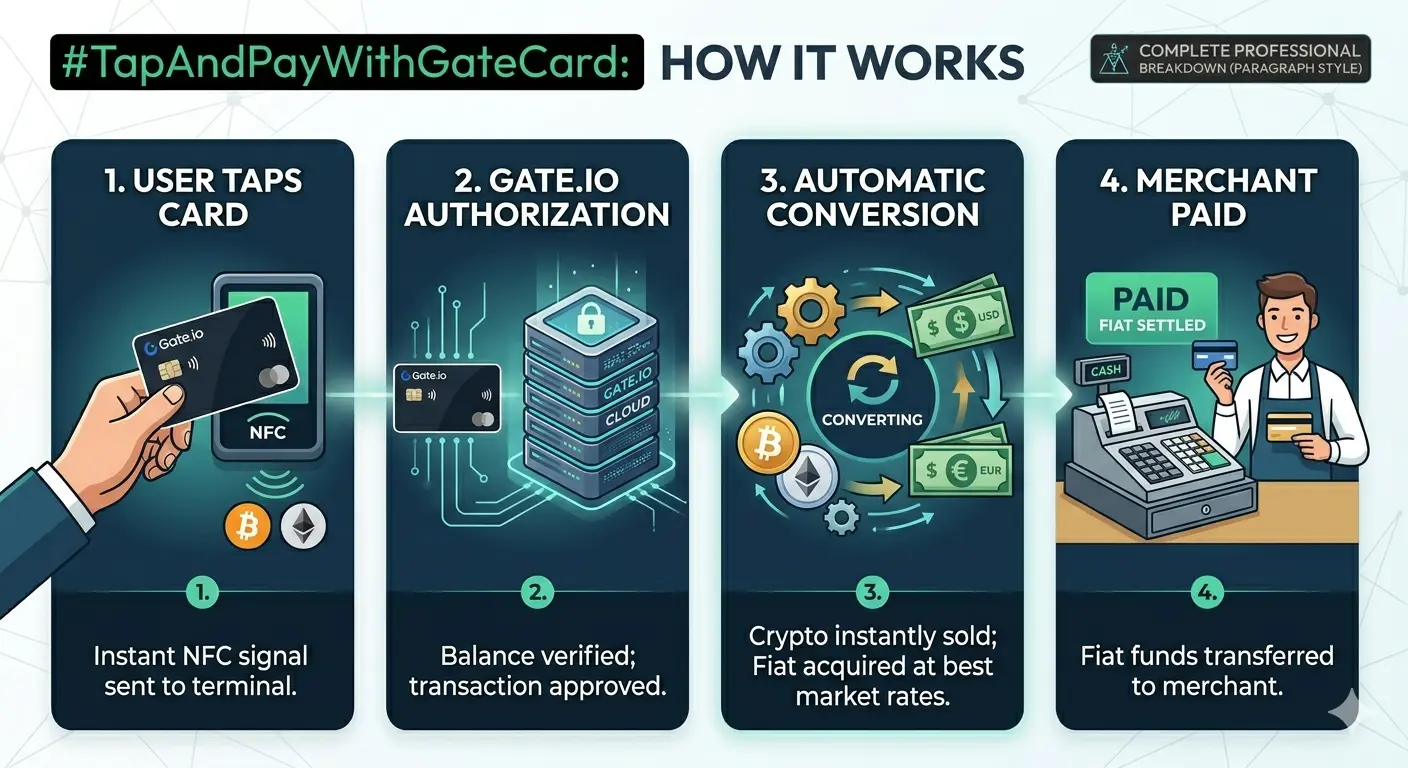
The concept behind #TapAndPayWithGateCard represents a major step toward bridging the gap between cryptocurrency and everyday real-world payments. At its core, it refers to a crypto-linked payment card offered by Gate.io that allows users to spend their digital assets seamlessly using contactless “tap-and-pay” technology. This means that instead of converting crypto manually into fiat currency through exchanges, users can directly use their crypto balances to make purchases at merchants that accept standard card payments.
To understand its importance, it is essential to first recognize one of the biggest challenges in crypto adoption: usability. While cryptocurrencies like Bitcoin and Ethereum are widely known, their real-world usage has historically been limited due to complexity and lack of merchant integration. The Gate Card addresses this problem by acting as an intermediary layer. When a user taps the card at a payment terminal, the system automatically converts crypto into fiat currency behind the scenes, enabling instant payment without requiring the merchant to accept crypto directly.
The “tap-and-pay” functionality is powered by near-field communication (NFC) technology, which is the same system used by modern debit and credit cards. This makes the user experience identical to traditional payments—fast, simple, and widely accepted. From a behavioral standpoint, this is crucial because mass adoption depends on familiarity. Users are far more likely to adopt crypto payments if they do not have to change their habits or learn new systems.
From a financial perspective, the Gate Card transforms crypto from a speculative asset into a usable medium of exchange. Traditionally, many users hold crypto primarily for investment purposes, waiting for price appreciation. However, with a payment card, crypto becomes liquid in a practical sense—it can be used instantly for daily expenses such as groceries, travel, or online shopping. This shift increases the functional value of digital assets and strengthens their role in the broader financial ecosystem.
Another important aspect is convenience. Without such a card, users typically need to go through multiple steps to spend crypto: transfer funds to an exchange, sell them for fiat, withdraw to a bank account, and then use a debit card. This process is time-consuming and sometimes costly. The Gate Card eliminates these steps by integrating everything into a single action. The result is a smoother and more efficient user experience, which is essential for mainstream adoption.
From a #WCTCTradingKingPK perspective, this development should be viewed as a long-term bullish signal for the crypto industry. Increased usability leads to increased demand. When more people can easily spend crypto, its perceived value rises, and its integration into daily life becomes stronger. However, it is important to note that this does not necessarily lead to immediate price increases. Market prices are influenced by many factors, including macroeconomic conditions, liquidity, and investor sentiment.
Security is another critical consideration. Since the card is linked to a crypto account, it must be protected against unauthorized access. Platforms like Gate.io typically implement multiple layers of security, including two-factor authentication, transaction monitoring, and spending limits. Users also play a role in maintaining security by safeguarding their account credentials and enabling all available protections.
Fees and conversion rates are also important factors to evaluate. While the convenience of instant conversion is valuable, users should be aware of any associated costs, such as transaction fees, currency conversion spreads, or card maintenance charges. A professional approach involves understanding these costs and incorporating them into financial decisions, especially for frequent usage.
Another dimension is regulatory compliance. Payment cards operate within traditional financial systems, which means they must adhere to banking regulations and regional laws. This can affect availability, features, and usage depending on the user’s location. As governments continue to develop crypto regulations, such products may evolve further, potentially offering more features or facing certain limitations.
Psychologically, products like the Gate Card play a major role in shaping public perception. When users can tap a card and pay with crypto just like any other payment method, it normalizes the technology. This reduces skepticism and builds trust, which are essential for long-term adoption. Over time, such tools can shift crypto from being seen as a niche investment to a mainstream financial utility.
From a broader industry perspective, is part of a larger trend where exchanges and fintech companies are building infrastructure to integrate crypto with traditional finance. This includes payment cards, mobile wallets, and banking services. Each of these developments brings crypto closer to everyday life, expanding its reach beyond trading platforms.
In conclusion, lrepresents more than just a payment feature—it is a strategic step toward real-world crypto adoption. By combining convenience, speed, and familiarity, it removes key barriers that have historically limited crypto usage. From a professional standpoint, this development should be viewed as a long-term positive for the ecosystem, while users should approach it with awareness of security, fees, and practical considerations. This balance between innovation and discipline aligns perfectly with the mindset, where opportunity is embraced but always managed with careful strategy.
repost-content-media
  • Reward
  • Comment
  • Repost
  • Share
#BitcoinSpotVolumeNewLow
The narrative behind #BitcoinSpotVolumeNewLow highlights a critical market condition where trading activity in Bitcoin’s spot market has dropped to unusually low levels. Spot volume refers to the actual buying and selling of Bitcoin (not derivatives), where real ownership of the asset is transferred between participants. When this volume declines significantly, it signals reduced participation, weaker conviction, and a potential shift in market dynamics. While price often gets the most attention, volume is the underlying force that validates or questions any price mov
BTC0.97%
Vortex_King
#BitcoinSpotVolumeNewLow
The narrative behind #BitcoinSpotVolumeNewLow highlights a critical market condition where trading activity in Bitcoin’s spot market has dropped to unusually low levels. Spot volume refers to the actual buying and selling of Bitcoin (not derivatives), where real ownership of the asset is transferred between participants. When this volume declines significantly, it signals reduced participation, weaker conviction, and a potential shift in market dynamics. While price often gets the most attention, volume is the underlying force that validates or questions any price movement.
To understand why low spot volume matters, it is important to recognize the relationship between price and participation. In a healthy bullish trend, rising prices are typically supported by increasing volume, indicating strong demand. Similarly, in a strong bearish trend, falling prices are often accompanied by high selling volume. However, when volume drops to new lows, it suggests that fewer participants are actively trading, and the market may lack clear direction. This creates an environment where price movements become less reliable and more prone to sudden fluctuations.
One of the most important implications of low spot volume is reduced liquidity. Liquidity refers to how easily an asset can be bought or sold without significantly affecting its price. When volume is low, liquidity decreases, meaning that even relatively small buy or sell orders can cause disproportionate price movements. This can lead to sharp spikes or drops that do not necessarily reflect genuine market sentiment but rather the absence of strong opposing orders.
From a perspective, low volume is a warning sign rather than an opportunity for aggressive trading. Professional traders understand that markets with weak participation are unpredictable. Breakouts in such conditions are often unreliable because they lack confirmation from strong volume. A price may temporarily move above resistance or below support, only to reverse quickly once liquidity returns. This phenomenon is commonly referred to as a “fake breakout” or “liquidity trap.”
Another key factor to consider is the role of institutional activity. Institutions typically contribute significantly to market volume. When spot volume drops to new lows, it may indicate that large players are temporarily inactive or waiting for clearer signals. This often happens during periods of macro uncertainty, such as unclear central bank policies, conflicting economic data, or major upcoming events. In such phases, institutions prefer to stay on the sidelines rather than commit capital.
At the same time, derivatives markets may still remain active even when spot volume declines. This creates a disconnect between real buying/selling and leveraged speculation. When derivatives dominate, the market becomes more sensitive to liquidations and sudden volatility spikes. In simple terms, price movements may be driven more by leverage and positioning than by actual demand for Bitcoin. This increases the risk of sudden reversals.
Psychologically, low volume often reflects indecision. Market participants are uncertain about the next major move, leading to hesitation and reduced activity. Retail traders may feel confused, while institutions wait for confirmation. This “quiet phase” is often a precursor to a larger move, as markets rarely stay inactive for long. The key challenge is that predicting the direction of the eventual breakout is difficult without additional confirmation.
From a strategic standpoint, patience becomes the most valuable asset. The #WCTCTradingKingPK mindset emphasizes waiting for volume to return before committing to significant positions. A high-probability setup occurs when price breaks a key level with strong volume, confirming that real participation is backing the move. Until then, traders should either stay out of the market or focus on short-term, low-risk trades within established ranges.
Risk management is especially critical in low-volume conditions. Because price can move erratically, stop losses must be carefully placed and strictly followed. Position sizes should be reduced to account for increased uncertainty. Over-leveraging in such an environment is particularly dangerous, as sudden spikes can trigger liquidations quickly. The goal is to protect capital rather than chase uncertain opportunities.
It is also important to consider the broader context. Low spot volume does not necessarily mean a bearish market. In some cases, it represents a consolidation phase where the market is preparing for the next major trend. Historically, periods of low volume have often been followed by significant breakouts, either upward or downward. The key is to identify when volume begins to increase again and align with that momentum.
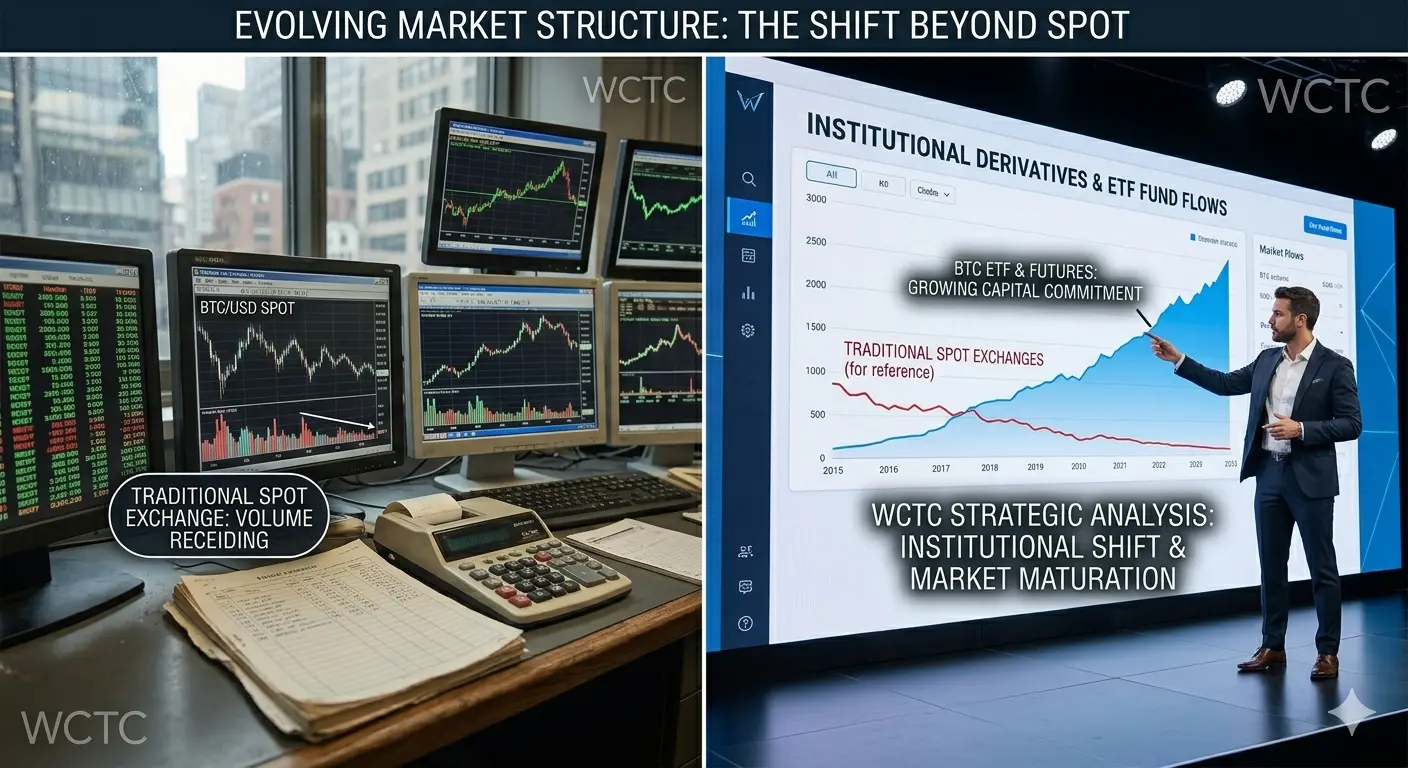
From a long-term perspective, declining spot volume can also reflect changes in market structure. As more participants move to derivatives or as institutional products like ETFs gain traction, traditional spot exchanges may see reduced activity. This does not weaken Bitcoin itself but changes how and where trading activity occurs. Understanding this shift is important for interpreting volume data correctly.
In conclusion, is a signal of reduced participation, lower liquidity, and increased uncertainty in the market. It creates conditions where price movements are less reliable and more prone to sudden changes. From a professional trading standpoint, this is a phase that պահանջ patience, discipline, and careful risk management. Rather than forcing trades, successful traders wait for volume confirmation, align with strong participation, and position themselves for the next clear and decisive move.
repost-content-media
  • Reward
  • Comment
  • Repost
  • Share
#BitcoinETFOptionLimitQuadruples
The represents one of the most important structural developments in the evolution of Bitcoin as a financial asset. At its core, this change revolves around expanding the position limits on Bitcoin ETF options, particularly those tied to major products like the iShares Bitcoin Trust (IBIT) managed by BlackRock. Previously, traders were restricted in how many options contracts they could hold, typically capped around 250,000 contracts. The new proposal—and in some cases implementation—raises that limit to 1,000,000 contracts, effectively quadrupling the exposure
Vortex_King
#BitcoinETFOptionLimitQuadruples
The represents one of the most important structural developments in the evolution of Bitcoin as a financial asset. At its core, this change revolves around expanding the position limits on Bitcoin ETF options, particularly those tied to major products like the iShares Bitcoin Trust (IBIT) managed by BlackRock. Previously, traders were restricted in how many options contracts they could hold, typically capped around 250,000 contracts. The new proposal—and in some cases implementation—raises that limit to 1,000,000 contracts, effectively quadrupling the exposure large institutions can take in a regulated environment.
This is not just a technical upgrade. It fundamentally changes how capital flows into Bitcoin markets, how risk is managed, and how price movements are amplified. To understand the depth of this shift, you need to break it down step by step from a structural, institutional, and trading perspective.
From a structural standpoint, position limits exist to prevent market manipulation and excessive concentration of risk. When regulators and exchanges allow a fourfold increase, it signals confidence that the market infrastructure is mature enough to handle significantly larger flows. In this case, platforms like Nasdaq and NYSE Arca are essentially saying that Bitcoin ETF options have reached a level of liquidity, transparency, and stability comparable to traditional financial instruments like equity index ETFs. That is a major milestone because it places Bitcoin derivatives within the same operational framework as legacy markets.
From an institutional perspective, this change unlocks a new level of participation. Before this expansion, hedge funds, pension funds, and large asset managers faced constraints when trying to build or hedge large Bitcoin positions. With a 1,000,000 contract limit, these players can now deploy significantly more capital without hitting regulatory ceilings. This means Bitcoin is no longer just a speculative asset for retail traders or crypto-native funds—it becomes a scalable instrument for global capital allocation. Institutions that manage hundreds of billions of dollars can now meaningfully engage with Bitcoin without structural limitations holding them back.
Another key dimension is how this affects liquidity. When position limits increase, market makers and institutional traders provide deeper order books and tighter spreads. This results in smoother execution for large trades and reduces slippage. However, there is a dual effect here. While liquidity improves under normal conditions, it can also lead to larger volatility events during periods of stress. This is because bigger positions mean bigger hedging flows, and those flows can cascade rapidly through both the options and spot markets.
To understand this mechanism, you need to look at how options influence the underlying asset. When institutions buy or sell options on Bitcoin ETFs, market makers hedge their exposure by buying or selling the underlying Bitcoin or ETF shares. This creates a feedback loop. For example, if a large number of call options are bought, market makers may need to buy Bitcoin to hedge, pushing the price higher. Conversely, heavy put buying can create downward pressure. With quadrupled limits, this hedging activity becomes significantly larger, which means options markets will have a stronger influence on Bitcoin’s spot price than ever before.
This brings us to volatility dynamics. Increased position limits introduce the possibility of massive “gamma squeezes” or “volatility shocks.” Gamma refers to how quickly an option’s delta changes relative to price movements. When large positions are concentrated around certain strike prices, small moves in Bitcoin can trigger large hedging adjustments. With more contracts in play, these adjustments become more aggressive, potentially leading to rapid price spikes or crashes within short timeframes. Traders need to understand that while long-term stability may improve due to institutional participation, short-term price action could become more explosive.
Another important layer is strategy complexity. Institutions do not trade options in a simple directional manner. They use advanced strategies such as spreads, straddles, strangles, and volatility arbitrage. The expansion of limits allows them to scale these strategies significantly. For example, a hedge fund might run a large volatility-selling strategy, collecting premium while hedging dynamically. Alternatively, macro funds might use long-dated call options to express a bullish thesis on Bitcoin without directly holding the asset. These strategies add depth to the market but also introduce new risks, particularly if crowded trades unwind simultaneously.
From a macro perspective, this development aligns with the broader financialization of Bitcoin. Over the past few years, Bitcoin has transitioned from a niche digital asset to a recognized component of global portfolios. The introduction of spot ETFs was the first major step, allowing traditional investors to gain exposure بسهولة. Now, expanding options limits is the next phase, enabling sophisticated risk management and speculative strategies. This progression mirrors the evolution of other asset classes, where derivatives markets eventually become larger and more influential than the underlying spot market.
The role of major institutions like BlackRock cannot be overstated. Their involvement brings credibility, regulatory alignment, and massive capital inflows. When a firm of this scale supports higher limits, it signals confidence not only in Bitcoin but in the entire infrastructure surrounding it. This includes custody solutions, regulatory compliance, and market surveillance mechanisms. For smaller players, this acts as validation, encouraging further participation and reinforcing the growth cycle.
However, it is important to address the risks. Larger position limits can lead to increased concentration of power among a few dominant players. If a handful of institutions control a significant portion of options exposure, they could influence market direction, intentionally or unintentionally. Additionally, during periods of market stress, forced liquidations or rapid unwinding of positions could amplify volatility. This is particularly relevant in crypto markets, which are already known for their high volatility compared to traditional assets.
From a trader’s perspective, adapting to this new environment is critical. Retail traders need to recognize that the market is increasingly driven by institutional flows rather than purely sentiment or technical patterns. Traditional indicators may still work, but they must be interpreted in the context of options positioning, expiry dates, and institutional hedging behavior. For example, large options expiries can act as “magnets,” pulling the price toward certain levels as market makers adjust their positions. Understanding these dynamics can provide a significant edge.
Another practical implication is the importance of risk management. With higher volatility potential, using stop-loss orders and position sizing becomes even more crucial. Traders should avoid overleveraging and be prepared for sudden price movements that may not align with typical technical setups. The presence of large institutional players means that markets can move sharply and unpredictably, especially during high-impact events or macroeconomic announcements.
Looking ahead, the quadrupling of ETF options limits could pave the way for even more advanced financial products. This might include structured products, volatility indices for Bitcoin, and more complex derivatives that attract institutional capital. As these products develop, Bitcoin’s correlation with traditional markets may increase, further integrating it into the global financial system. This could reduce some of its استقلال but also enhance its legitimacy as an asset class.
In conclusion, #BitcoinETFOptionLimitQuadruples is not just a headline—it is a turning point. It signifies the transition of Bitcoin into a fully institutionalized asset, supported by deep derivatives markets and large-scale capital participation. The benefits include increased liquidity, broader adoption, and more sophisticated trading strategies. However, these come with trade-offs, including higher short-term volatility and the potential for market manipulation by large players.
For anyone involved in crypto trading or investing, understanding this shift is essential. The market you are participating in today is not the same as it was a few years ago. It is more complex, more interconnected, and increasingly dominated by institutional forces. Those who adapt to these changes—by learning how options markets work, tracking institutional flows, and managing risk effectively—will be better positioned to navigate the opportunities and challenges ahead.
repost-content-media
  • Reward
  • Comment
  • Repost
  • Share
#WCTCTradingKingPK
The WCTC Season 8 campaign is designed to reward traders not just for performance, but for participation, creativity, and strategic thinking. This is not simply a trading competition—it is a full ecosystem where traders build visibility, showcase their skills, and compete for multiple reward layers. If you approach it correctly, you are not relying on luck; you are leveraging structure, discipline, and smart positioning to maximize outcomes.
First, understand the core idea behind this campaign. It is built around engagement + performance. That means even if you are not at t
Vortex_King
#WCTCTradingKingPK
The WCTC Season 8 campaign is designed to reward traders not just for performance, but for participation, creativity, and strategic thinking. This is not simply a trading competition—it is a full ecosystem where traders build visibility, showcase their skills, and compete for multiple reward layers. If you approach it correctly, you are not relying on luck; you are leveraging structure, discipline, and smart positioning to maximize outcomes.
First, understand the core idea behind this campaign. It is built around engagement + performance. That means even if you are not at the very top of the trading leaderboard, you can still extract value through content, strategy sharing, and team participation. This makes it extremely important to think beyond just “buy and sell” and start thinking like a complete trader-creator.
Now let’s break it down step by step.
---
🔹 Step 1: Understand the Four Reward Tracks Clearly
The campaign revolves around four different reward categories, and each one targets a different type of trader behavior.
The Team Bonus focuses on collaboration. Here, your goal is to show that you are part of a team. The key is not just joining any team, but choosing one with activity, communication, and consistent updates. When you share your team participation publicly, you increase your chances of being selected among the winners. This is not about luck—it’s about visibility and consistency.
The Pro Bonus is where real traders stand out. This is for those who can explain their strategy clearly. Posting random trades is not enough. You must explain:
Why you entered the trade
What market structure you followed
Where your stop loss and take profit are placed
What psychology you maintained during the trade
This transforms you from a gambler into a strategist. The platform rewards clarity and logic.
The Champion Bonus is performance-based but simplified. You don’t need to be number one globally—you just need to show your results. A screenshot of your PK (profit/loss performance) acts as proof. This is powerful because it builds credibility. Even small consistent wins matter here more than risky large trades.
The Leaderboard Bonus is where influence matters. Engagement becomes your weapon. If your posts attract attention—likes, comments, shares—you move closer to platform-wide exposure. This is where branding meets trading. Traders who understand social momentum dominate this category.
---
🔹 Step 2: Build a Posting Strategy (Not Random Posting)
Most traders fail here because they post without structure. To maximize rewards, your posting must follow a system.
Start with a trade setup post. This includes:
Market direction (bullish/bearish/sideways)
Entry zone
Stop loss
Take profit levels
Risk percentage
Then follow it with a trade execution update. Show whether your trade is active, how price is reacting, and whether you adjusted your stop loss.
Finally, post a result summary. This is where you show your profit or loss and explain what you learned.
This 3-step posting cycle (Setup → Execution → Result) dramatically increases engagement because people follow your journey instead of seeing random outcomes.
---
🔹 Step 3: Focus on Risk Management (Key to Winning Consistency)
No reward system can save a trader who ignores risk. If you overtrade or risk too much, you will eventually lose both capital and credibility.
Apply strict rules:
Risk only 1–2% per trade
Never enter without a defined stop loss
Avoid revenge trading after a loss
Stick to planned setups only
The competition rewards consistency, not reckless gains. A trader who makes 5% steadily is more valuable than someone who gains 50% and loses it all.
---
🔹 Step 4: Use Market Structure Instead of Guessing
Professional traders rely on structure, not emotions. Every trade you post should be based on at least one of the following:
Support and resistance levels
Breakouts and retests
Trend continuation patterns
Liquidity zones
When you explain your trades using these concepts, your posts naturally qualify for the Pro Bonus because they demonstrate real understanding.
---
🔹 Step 5: Build Psychological Discipline
Trading is not just technical—it is mental. The competition environment adds pressure because you are being watched.
Control these emotions:
Fear of missing out (FOMO)
Overconfidence after winning trades
Panic during drawdowns
Your posts should reflect calm and calculated thinking. When your mindset is stable, your trading becomes predictable—and that is what long-term winners rely on.
---
🔹 Step 6: Maximize Engagement for Leaderboard Advantage
To compete for leaderboard rewards, you must treat your posts like content strategy.
Improve engagement by:
Writing clear and simple explanations
Using structured formatting (headings, spacing)
Posting consistently (not once and disappearing)
Sharing insights, not just results
Ask questions in your posts. For example: “Do you think this level will hold or break?”
This invites interaction, which increases visibility.
---
🔹 Step 7: Timing Matters More Than You Think
Posting at the right time increases reach. Try to post:
During high market volatility
Around major price movements
When traders are most active
This ensures your content is seen when people are actually paying attention.
---
🔹 Step 8: Position Yourself as a Trader, Not a Gambler
Anyone can post profits. Very few can explain how they achieved them.
Your goal is to build authority:
Show your logic
Admit mistakes
Share lessons
This builds trust. And trust brings engagement. And engagement leads to rewards.
---
🔹 Step 9: Combine All Tracks for Maximum Rewards
Most participants focus on only one reward category. Smart traders target all four simultaneously.
For example:
Join a team → qualify for Team Bonus
Post structured strategies → qualify for Pro Bonus
Share results → qualify for Champion Bonus
Engage audience → qualify for Leaderboard Bonus
This multiplies your chances instead of relying on a single outcome.
---
🔹 Step 10: Stay Consistent Until the End
Many traders start strong and disappear halfway. That is the biggest mistake.
Consistency is your edge:
Post regularly
Trade with discipline
Keep improving your analysis
Even if your early results are average, consistency allows you to catch momentum later.
---
🔥 Final Insight
This campaign is not just about rewards—it is a testing ground for becoming a complete trader. It combines strategy, execution, psychology, and communication into one system.
If you approach it seriously, you gain:
Trading discipline
Public credibility
Strategic thinking
Potential financial rewards
The traders who win are not the ones who take the biggest risks—they are the ones who follow a clear plan, manage risk intelligently, and communicate their ideas effectively.
---
🚀 Conclusion
Treat this opportunity like a professional environment. Plan your trades, structure your posts, manage your risk, and stay consistent. When you align all these elements, rewards become a byproduct of your process—not something you chase blindly.
Post smart. Trade smart. Stay disciplined.
repost-content-media
  • Reward
  • Comment
  • Repost
  • Share
#WCTCTradingKingPK
Here is your detailed B (BUSDT
📊 Market Snapshot (From Your Screenshot)
🔹 Current Situation
B coin is currently in a strong bullish trend, as clearly visible from the 1-hour chart. The price has recently made a sharp impulsive move upward, followed by a consolidation phase just below resistance. This type of structure is typically known as a bullish continuation pattern, where buyers are maintaining control after a breakout. The presence of multiple “B” (buy) signals and limited “S” (sell) pressure indicates sustained bullish sentiment. Volume clusters on the order book a
Vortex_King
#WCTCTradingKingPK
Here is your detailed B (BUSDT
📊 Market Snapshot (From Your Screenshot)
🔹 Current Situation
B coin is currently in a strong bullish trend, as clearly visible from the 1-hour chart. The price has recently made a sharp impulsive move upward, followed by a consolidation phase just below resistance. This type of structure is typically known as a bullish continuation pattern, where buyers are maintaining control after a breakout. The presence of multiple “B” (buy) signals and limited “S” (sell) pressure indicates sustained bullish sentiment. Volume clusters on the order book also show stronger buy-side liquidity compared to sell-side resistance, suggesting accumulation rather than distribution.
The moving averages (MA5, MA10, MA30) are aligned in a bullish stacking formation, where shorter-term averages are above longer-term ones. This alignment confirms trend strength and suggests that dips are being bought aggressively.
---
💰 Current Price
The current trading price of B coin is approximately:
👉 $0.3690 USDT
This price sits just below a recent local resistance zone, indicating that the market is preparing for either a breakout or a short-term rejection before continuation.
---
🧱 Support Levels
Support levels are critical zones where buyers are likely to step in and defend the price. Based on your chart and order book structure, the key supports are:
Immediate Support: $0.3685 – $0.3679
This is a short-term support zone formed by recent consolidation and minor pullbacks.
Strong Support: $0.3500 – $0.3380
This aligns with MA10 and previous breakout structure, making it a high-probability demand zone.
Major Support: $0.3060
This is near MA30 and represents the base of the recent rally. A drop here would indicate a deeper correction.
These levels are important for dip-buying strategies and risk management setups.
---
🚧 Resistance Levels
Resistance levels show where selling pressure may increase. Current key levels are:
Immediate Resistance: $0.3880
This is clearly marked on your chart and has already rejected price once.
Next Resistance: $0.4150
A breakout above 0.3880 could push price quickly toward this level due to low resistance in between.
Major Resistance Zone: $0.4500 – $0.4800
This is a psychological and structural resistance where profit-taking is likely.
---
📈 Forecast Price
If the current bullish momentum continues, the likely scenarios are:
Bullish Scenario:
If price breaks and holds above $0.3880, we can expect:
➡️ $0.4150 (short-term target)
➡️ $0.4500 (mid-term target)
➡️ $0.4800+ (extended rally target)
Bearish Scenario:
If price fails to break resistance:
➡️ Pullback to $0.3500
➡️ Possible deeper correction to $0.3380
➡️ Worst-case retest of $0.3060
Overall, probability currently favors bullish continuation, but only after a confirmed breakout.
---
🧠 Traders’ Thoughts
Smart traders are likely approaching this setup in three ways:
1. Breakout Traders
Waiting for a clean break above $0.3880 with volume confirmation before entering long positions.
2. Dip Buyers
Looking to accumulate around $0.3500 support for safer risk-reward entries.
3. Short-Term Scalpers
Trading between $0.3680 and $0.3880 range until a breakout occurs.
Most professional traders will avoid chasing price at resistance and instead wait for confirmation or retracement.
---
📊 Market Trends
The overall trend for B coin is:
✅ Short-Term Trend: Bullish
Strong upward momentum with higher highs and higher lows.
✅ Mid-Term Trend: Bullish Reversal
Recent breakout suggests trend shift from accumulation to expansion.
⚠️ Volatility: High
Rapid price movements indicate strong speculation and liquidity shifts.
📌 Order book data shows:
Buy Pressure: ~54%
Sell Pressure: ~46%
This imbalance supports continued upward movement but not without pullbacks.
---
⚙️ Strategy Insight (Important for WCTC Style Trading)
A disciplined trader would approach this market with:
Entry Plan:
Buy on breakout above $0.3880 OR buy dip near $0.3500
Stop Loss (SL):
Below $0.3380 for swing trades
Below $0.3670 for scalping trades
Take Profit (TP):
TP1: $0.4150
TP2: $0.4500
TP3: $0.4800
Risk management is key here because price is already extended after a strong rally.
---
🔥 Final Summary
B coin is currently showing strong bullish structure with consolidation under resistance, which is typically a continuation signal. The market is dominated by buyers, supported by moving averages and order book strength. However, price is sitting at a critical decision zone, where either a breakout will trigger the next rally or a rejection will lead to a healthy pullback.
For traders, the smartest move is patience—either trade the breakout or buy the dip, but avoid emotional entries in the middle of the range.
repost-content-media
  • Reward
  • Comment
  • Repost
  • Share
#GENIUSImplementationRulesDraftReleased
The Definitive Guide to GENIUS Act Rulemaking & Stablecoin Regulation (2026)
Updated with the latest regulatory developments as of April 2026.
Introduction: Why GENIUS Matters
The Guiding and Establishing National Innovation for U.S. Stablecoins Act (GENIUS Act) represents the first comprehensive federal law in the United States designed to regulate payment stablecoins — digital assets pegged to fiat currency that are used for payments, settlements, and broader financial activity. The law was signed into effect on July 18, 2025, marking a historic turn
Vortex_King
#GENIUSImplementationRulesDraftReleased
The Definitive Guide to GENIUS Act Rulemaking & Stablecoin Regulation (2026)
Updated with the latest regulatory developments as of April 2026.
Introduction: Why GENIUS Matters
The Guiding and Establishing National Innovation for U.S. Stablecoins Act (GENIUS Act) represents the first comprehensive federal law in the United States designed to regulate payment stablecoins — digital assets pegged to fiat currency that are used for payments, settlements, and broader financial activity. The law was signed into effect on July 18, 2025, marking a historic turning point in how digital currencies intersect with traditional financial regulation.
The GENIUS Act is not merely another policy paper — it is a framework that will shape how stablecoins are issued, managed, supervised, and integrated into the financial system. Over the course of 2025 and early 2026, federal agencies including the Treasury Department, Office of the Comptroller of the Currency (OCC), Federal Deposit Insurance Corporation (FDIC), and National Credit Union Administration (NCUA) have been engaged in drafting and proposing implementing rules — the actual regulations that will bring the law to life.
The recent release of the Draft Implementation Rules — referred to here as #GENIUSImplementationRulesDraftReleased — marks a crucial phase where the public, industry participants, and policymakers can see the practical interpretation of the law and provide feedback. In this post, we explain:
What the GENIUS Act requires
What the Draft Implementation Rules propose
Key regulatory and compliance provisions
Impact on stablecoin issuers and service providers
Industry reactions and controversies
Strategic implications for crypto businesses and financial institutions
1. Overview of the GENIUS Act
1.1 What the Law Is and What It Does
The GENIUS Act establishes a federal regulatory framework for payment stablecoins in the United States. Stablecoins are digital assets that are pegged to fiat currencies (e.g., the U.S. dollar) and are widely used in cryptocurrency markets for trading, payments, remittances, and DeFi protocols.
Key elements of the law include:
A prohibition on any person other than a “permitted payment stablecoin issuer” from issuing a payment stablecoin in the U.S.
A prohibition on digital asset service providers offering or selling stablecoins unless certain conditions are met (e.g., the issuer is approved or foreign issuers meet specific requirements)
A requirement that federal regulators issue implementing regulations within one year of enactment — i.e., by July 18, 2026
The law’s goal is to balance innovation in digital payments with consumer protection, financial stability, and anti-money-laundering (AML) safeguards.
2. The Regulatory Implementation Process
Passing the GENIUS Act was only the first step. The law mandates that multiple federal agencies issue regulations to interpret and enforce its provisions. This includes:
Treasury Department — for overarching guidance and coordination, especially state regulatory frameworks.
OCC (Office of the Comptroller of the Currency) — for federal stablecoin issuer regulation.
FDIC (Federal Deposit Insurance Corporation) — for draft rules on stablecoin applications tied to insured institutions.
NCUA (National Credit Union Administration) — for draft rules on stablecoin issuance by credit unions.
Each agency has been working through Notice of Proposed Rulemaking (NPRM) or draft regulations that lay out how the law will function in practice.
3. Treasury’s Draft Rules & Public Comment Period
One of the most recent developments is the Treasury Department’s notice of proposed rulemaking, which seeks public input on how to implement key aspects of the GENIUS Act.
3.1 State-Level Regulatory Regimes
The Treasury’s proposal focuses on establishing broad principles for determining whether a state-level regulatory regime is “substantially similar” to the federal framework. This is critical because:
Stablecoin issuers with less than $10 billion in outstanding issuance may opt for state regulation instead of full federal oversight — but only if the state regime is certified as substantially similar.
This creates a federal-state regulatory partnership model where states can regulate smaller issuers — but under principles set by the federal government.
3.2 Public Comment & Participation
The Treasury’s NPRM invites comments from all stakeholders, and the public comment period is open for 60 days after publication in the Federal Register. This means industry participants, academics, legal experts, and the general public can influence how stablecoin regulation is shaped.
4. OCC’s Proposed Rulemaking for Stablecoin Issuers
The OCC’s draft rule — a major piece of the implementation puzzle — was issued in early 2026. This proposed rule would:
Define what constitutes a permitted payment stablecoin issuer (PPSI) under federal law.
Clarify the types of entities that can be PPSIs (national banks, federal savings associations, foreign issuers meeting specific requirements, etc.).
Specify restrictions on custody, issuance, and operational activities related to stablecoins.
A key takeaway is that the rule generally limits stablecoin issuance to PPSIs — effectively eliminating unregulated issuance and placing stablecoin creation under the supervision of federal regulators.
5. FDIC & NCUA Draft Rules
In parallel with Treasury and OCC activity:
The FDIC released draft rules for stablecoin applications tied to insured institutions, providing guidance on how banks can participate in stablecoin issuance under GENIUS.
The NCUA unveiled draft rules for credit unions that seek to become stablecoin issuers, further expanding the regulated pathways.
These draft regulations signal that multiple regulatory paths are being developed — but all with strict compliance requirements.
6. Key Regulatory Themes in the Draft Rules
Across the draft regulations from Treasury, OCC, FDIC, and NCUA, several major themes emerge:
6.1 Permitted Payment Stablecoin Issuers (PPSIs)
A central concept is the designation of PPSIs — entities authorized to issue stablecoins. The draft rules propose clear criteria and supervision mechanisms for PPSIs, including capital, risk management, and compliance expectations.
6.2 Prohibitions on Unregulated Issuance
The draft rules reiterate that only PPSIs may issue payment stablecoins in the U.S., and digital asset service providers cannot offer or sell stablecoins unless certain conditions are met.
This has profound implications for exchanges, wallets, and DeFi platforms that currently facilitate stablecoin trading without issuer status.
6.3 Federal vs. State Oversight
The Treasury’s proposed principles for state regulation create a dual-track system where smaller issuers can choose state oversight — but only if the state framework meets federal standards.
6.4 AML, Consumer Protection, and Risk Management
Draft regulations emphasize:
Strong AML/CFT (Anti-Money Laundering/Counter-Terrorist Financing) controls
Consumer protection safeguards
Risk management and operational resilience
These requirements mirror traditional financial regulation but are tailored to digital asset risks.
7. Industry Reactions & Controversies
The regulatory proposals have sparked diverse reactions within the crypto community and broader financial industry.
7.1 Concerns About Innovation
Some stakeholders argue that stringent rules may stifle innovation, especially for nonbank and decentralized entities that have historically driven stablecoin development. Critics say that limiting issuance to PPSIs could centralize stablecoin creation among large financial institutions.
7.2 Yield-Bearing Stablecoins Debate
Another major controversy is the treatment of yield-bearing stablecoins — tokens that pay interest or rewards. The GENIUS Act did not explicitly address this category, leading to regulatory uncertainty and debate in Congress and among regulators.
8. Strategic Implications for Market Participants
The release of the draft implementation rules means that crypto firms, financial institutions, and technology providers must start preparing for compliance:
8.1 For Stablecoin Issuers
Entities that want to issue stablecoins in the U.S. will likely need to:
Apply for PPSI status
Build robust compliance programs
Align with federal or certified state regulatory frameworks
This may involve partnerships with banks or state regulators to meet requirements.
8.2 For Exchanges & Wallets
Platforms that list or facilitate stablecoin transactions will need to:
Verify issuer status
Ensure compliance with AML and consumer protection standards
Adjust product offerings to align with new regulations
9. What’s Next? Timeline & Expectations
The regulatory process is still unfolding:
Public comments on draft rules are ongoing through 2026.
Agencies are expected to finalize regulations by July 18, 2026, per the law’s timeline.
Implementation and compliance phases will continue into 2027 and beyond as enforcement mechanisms and supervisory structures are put in place.
10. Conclusion: A New Era for Stablecoin Regulation
The release of the #GENIUSImplementationRulesDraftReleased marks a watershed moment in digital asset regulation. For the first time, stablecoins — a cornerstone of modern cryptocurrency ecosystems — are being integrated into a comprehensive federal regulatory framework that aims to balance innovation with safety, transparency, and financial stability.
This regulatory evolution will shape how stablecoins operate, how businesses interact with them, and how consumers and institutions use digital assets in the years ahead. The draft rules reflect both the promise and complexity of bringing digital finance into the regulated financial system.
Stakeholders across the crypto and financial sectors should engage with the public comment process, assess compliance requirements, and prepare for a future where stablecoins are a regulated part of mainstream finance.
repost-content-media
  • Reward
  • Comment
  • Repost
  • Share
#PreciousMetalsPullBackUnderPressure
The global commodities market is experiencing a powerful shift—and right now, precious metals are under serious pressure.
After one of the strongest rallies in modern history, gold, silver, and other metals are pulling back sharply. What makes this moment so important is not just the decline itself—but why it’s happening.
Because this is not a normal correction.
👉 This is a complex mix of macroeconomics, geopolitics, liquidity flows, and market structure
👉 And understanding it gives you a huge edge as an investor
This
Vortex_King
#PreciousMetalsPullBackUnderPressure
The global commodities market is experiencing a powerful shift—and right now, precious metals are under serious pressure.
After one of the strongest rallies in modern history, gold, silver, and other metals are pulling back sharply. What makes this moment so important is not just the decline itself—but why it’s happening.
Because this is not a normal correction.
👉 This is a complex mix of macroeconomics, geopolitics, liquidity flows, and market structure
👉 And understanding it gives you a huge edge as an investor
This is your deep, Gate-style 3000-word research and analysis 👇
🔥 1. The Big Picture: From Boom to Pullback
Precious metals had an explosive run leading into 2026.
Gold surged to near record highs
Silver experienced a parabolic rally
Massive inflows from institutions and retail investors
But now…
👉 The market has entered a sharp correction phase
Recent observations show:
Gold has seen one of its steepest monthly declines in years
Silver fell even more aggressively
Platinum and palladium also declined
👉 This is not just profit-taking
👉 This is a multi-layered macro reset
⚠️ 2. The Core Reason: Interest Rates Are Crushing Metals
This is the #1 factor driving the pullback.
Precious metals like gold and silver are non-yielding assets.
That means:
👉 They don’t pay interest
👉 They rely on price appreciation only
Now look at what’s happening:
Inflation concerns remain elevated
Central banks are cautious about cutting rates
Bond yields remain attractive
As a result:
👉 Interest rates stay higher for longer
👉 Cash and bonds become more appealing
And this is negative for metals.
Because investors now prefer:
✔ Yield-generating assets
✔ Safer income streams
Instead of:
❌ Holding non-yielding gold
💵 3. The Dollar Effect: The Silent Killer
The US dollar plays a crucial role in precious metals pricing.
Here’s the relationship:
👉 Strong dollar = Weak metals
👉 Weak dollar = Strong metals
Right now:
Global capital is flowing into USD
Higher interest rates support dollar strength
Investors seek liquidity and safety
This creates:
👉 Downward pressure on gold and silver prices
Because metals become more expensive for non-dollar buyers.
🧠 4. The “Crowded Trade” Problem
One of the most overlooked reasons behind the correction:
👉 Too many investors were already bullish
Before the pullback:
Gold was heavily overbought
Hedge funds were heavily positioned long
Sentiment was extremely optimistic
When markets become crowded:
👉 Even small negative triggers can cause large declines
What happened next:
Profit-taking accelerated
Funds reduced exposure
Selling pressure increased rapidly
⚡ 5. The Liquidity Shock: Why Everything Fell Together
Here’s a key insight:
👉 In times of stress, even safe assets get sold
Why?
Because investors need liquidity.
During volatility:
Margin calls increase
Institutions reduce risk
Cash becomes king
So even gold:
👉 Gets sold to cover losses elsewhere
This explains why metals dropped alongside other assets.
🛢️ 6. Oil, Inflation, and the Paradox
Normally:
👉 Higher inflation = bullish for gold
But currently:
👉 Inflation is driven by energy prices
Oil price increases push inflation higher
Central banks respond by staying hawkish
This leads to:
👉 Higher interest rates
👉 Stronger dollar
👉 Pressure on metals
This creates a paradox:
👉 Inflation rises, but gold falls
📉 7. Silver Is Falling Harder — And Here’s Why
Silver behaves differently from gold.
👉 It has dual roles:
Precious metal
Industrial commodity
Key reasons for its sharper drop:
1. Overextended Rally
Silver rose faster → bigger correction
2. Economic Sensitivity
Industrial demand fears affect price
3. Volatility
Silver naturally moves more aggressively
👉 This makes silver more vulnerable during pullbacks
🏦 8. Central Banks: Still Quietly Buying
While prices fall:
👉 Central banks continue accumulating gold
Reasons include:
Diversification of reserves
Reducing dependence on foreign currencies
Long-term stability
👉 This creates underlying support for gold prices
📊 9. Technical Analysis: Market Structure
From a technical perspective:
Gold is stabilizing near key support levels
Resistance zones remain above current price
Momentum is slowing but not collapsing
Silver:
Showing volatility
Attempting to form a base
Still under resistance pressure
👉 The structure suggests consolidation, not breakdown
🧩 10. Crash or Healthy Correction?
Let’s evaluate both sides:
Bearish Scenario:
Interest rates stay high
Dollar remains strong
Risk sentiment improves
👉 Metals stay weak
Bullish Scenario:
Economic slowdown emerges
Central banks cut rates
Financial stress increases
👉 Metals rebound strongly
👉 Current data suggests this is a correction, not a collapse
🌍 11. Geopolitical Influence
Global tensions remain elevated.
However:
👉 Markets are not reacting in traditional ways
Gold typically rises during crises—but timing matters.
Often:
👉 Initial phase = volatility
👉 Later phase = sustained rally
This suggests:
👉 Metals may strengthen later
🔄 12. Market Psychology
Market sentiment has shifted.
Before:
👉 Greed and optimism
Now:
👉 Uncertainty and caution
This creates:
Short-term volatility
Rapid price swings
Confusion among retail investors
👉 Emotional markets create opportunities
🚀 13. Long-Term Outlook
Despite short-term pressure, long-term fundamentals remain strong.
Key drivers:
✔ Global debt expansion
✔ Currency devaluation risks
✔ Central bank accumulation
✔ Industrial demand (silver)
✔ Geopolitical uncertainty
👉 These factors support future upside
⚠️ 14. Risks to Watch
Investors should monitor:
1. Interest Rate Decisions
Major influence on metals
2. Dollar Strength
Key inverse relationship
3. Inflation Trends
Direction matters
4. Liquidity Conditions
Market stability
5. Global Events
Can trigger sudden moves
🧠 15. Strategy for Investors
❌ Avoid:
Panic selling
Overtrading
Ignoring macro trends
✅ Focus on:
Long-term positioning
Gradual accumulation
Diversification
Risk management
🔥 Final Insight
This pullback reflects a shift in priorities.
👉 Markets are favoring yield over safety
But this is not permanent.
When conditions change:
👉 Metals can regain strength quickly
🧾 Final Conclusion
The pullback in precious metals is driven by:
✔ High interest rates
✔ Strong US dollar
✔ Profit-taking
✔ Liquidity pressures
✔ Inflation dynamics
But underneath:
👉 Structural demand remains intact
📌 Bottom Line
Precious metals are not collapsing.
👉 They are adjusting to new macro conditions
And in financial markets:
👉 Corrections often create the biggest opportunities
VORTEX KING
VORTEX KING
repost-content-media
  • Reward
  • Comment
  • Repost
  • Share
#DriftProtocolHacked
🚨 #DriftProtocolHacked
The crypto market just witnessed one of the biggest shocks of 2026 — and it’s shaking confidence across the entire DeFi ecosystem.
A massive exploit targeting Drift Protocol has resulted in hundreds of millions of dollars stolen, triggering panic, market volatility, and serious questions about DeFi security.
Here’s your deep research + analysis breakdown of what happened, why it matters, and what comes next 👇
🔥 1. What Happened — The Hack Explained
Drift Protocol, a Solana-based DeFi platform, suffered a major exploit
Estimated losses: $200M – $2
SOL1.8%
ETH0.86%
Vortex_King
#DriftProtocolHacked
🚨 #DriftProtocolHacked
The crypto market just witnessed one of the biggest shocks of 2026 — and it’s shaking confidence across the entire DeFi ecosystem.
A massive exploit targeting Drift Protocol has resulted in hundreds of millions of dollars stolen, triggering panic, market volatility, and serious questions about DeFi security.
Here’s your deep research + analysis breakdown of what happened, why it matters, and what comes next 👇
🔥 1. What Happened — The Hack Explained
Drift Protocol, a Solana-based DeFi platform, suffered a major exploit
Estimated losses: $200M – $285M+
Large amounts of funds were transferred to suspicious wallets
Immediately after detecting the breach:
👉 The platform suspended deposits and withdrawals
👉 Users were warned not to deposit funds
👉 Security firms began tracking stolen assets
👉 This is now one of the largest crypto hacks of 2026
💸 2. Where Did the Money Go?
Blockchain tracking shows:
Funds moved to unknown wallet addresses
Converted into major assets like stablecoins and ETH
Bridged across multiple blockchains
Gradually swapped to reduce traceability
👉 Classic laundering pattern:
Bridge → Swap → Obfuscate → Repeat
And here’s the reality:
👉 Transactions are visible
👉 But recovery is extremely difficult
⚠️ 3. How Did the Hack Happen? (Early Analysis)
The exact exploit is still under investigation, but early signs suggest:
🧠 Possible Attack Vectors:
1. Oracle Manipulation
Price feeds may have been manipulated
Fake pricing enabled abnormal borrowing
2. Fake Collateral Attack
Worthless or manipulated tokens used as collateral
Real assets drained against false value
3. Smart Contract Weakness
Logic flaws or overlooked vulnerabilities
👉 Likely a combination of multiple weaknesses rather than a single bug
🧨 4. Why This Hack Is Different
This is not just another exploit.
1. Timing
Occurs during growing institutional interest in DeFi
2. Scale
Hundreds of millions lost
3. Impact
Affects trust across the entire ecosystem
👉 This makes it a system-level event, not just a protocol issue
📉 5. Market Reaction
Immediate effects:
Sharp drop in related token prices
Increased volatility across DeFi assets
Fear spreading in the broader crypto market
👉 One major hack can impact the entire sector
🏦 6. The Bigger Problem: DeFi Security Crisis
This event highlights a core issue:
👉 Innovation is moving faster than security
Key weaknesses:
❌ Complex Smart Contracts
More features increase risk
❌ Oracle Dependencies
External data feeds can be exploited
❌ Governance Risks
Human decision layers can be manipulated
❌ Limited Emergency Controls
Decentralization slows reaction speed
👉 Result: Large-scale vulnerabilities
🔄 7. The Custody Problem
Important insight:
👉 In DeFi, you don’t fully control your funds
Even though wallets are user-controlled:
Funds are locked in smart contracts
Bugs = total loss
👉 This creates a major contradiction:
Decentralization offers freedom—but also full responsibility
⚖️ 8. Regulation Will Accelerate
Events like this push regulators to act faster.
Expected outcomes:
Stricter compliance requirements
Mandatory audits
Security certifications
Pressure for user protection systems
👉 The era of “unregulated DeFi” is fading
🧠 9. Key Lessons for Investors
🚨 1. No Protocol Is 100% Safe
Even large platforms can fail
🚨 2. High Returns Come With High Risk
Yield often reflects underlying danger
🚨 3. Diversification Is Essential
Never rely on a single platform
🚨 4. Stay Informed
Monitoring activity can reduce exposure
🔍 10. What Happens Next?
Key questions:
1. Can Funds Be Recovered?
Very difficult, but tracking continues
2. Will Attackers Be Identified?
Possible through blockchain analysis
3. Will the Platform Recover?
Depends on response and compensation
4. Will Regulation Increase?
Highly likely
⚔️ 11. Impact on the Future of DeFi
This event may lead to:
🔒 Stronger Security Standards
Better audits and protections
🏦 Institutional Frameworks
More structured systems
🧱 Improved Infrastructure
Safer protocol design
👉 Growth will continue—but with stricter rules
🔥 Final Insight
This hack is more than a loss of funds.
👉 It is a critical warning for the entire industry
It reveals:
Structural weaknesses
Security gaps
Systemic risks
At a time when adoption is accelerating
🧾 Final Conclusion
The Drift Protocol exploit shows:
✔ Massive losses can happen instantly
✔ Transparency does not equal safety
✔ DeFi is still evolving
But also:
👉 These events drive improvement and maturity
📌 Bottom Line
This is not the end of DeFi.
👉 But it marks the end of blind trust
The next phase will be:
✔ More secure
✔ More regulated
✔ More institutional
VORTEX KING
VORTEX KING
repost-content-media
  • Reward
  • Comment
  • Repost
  • Share
  • Pinned