Leeessa

vip
Futures Trading Strategist
On-chain Analyst
Airdrop Hunter
My character is defined by respect, integrity, and a strong belief in equal opportunity for everyone
#EDGE (edgeX) Market Analysis: Is the 23% Rally the Beginning of a New Uptrend or a Short-Term Bull Trap?
Current Market Overview
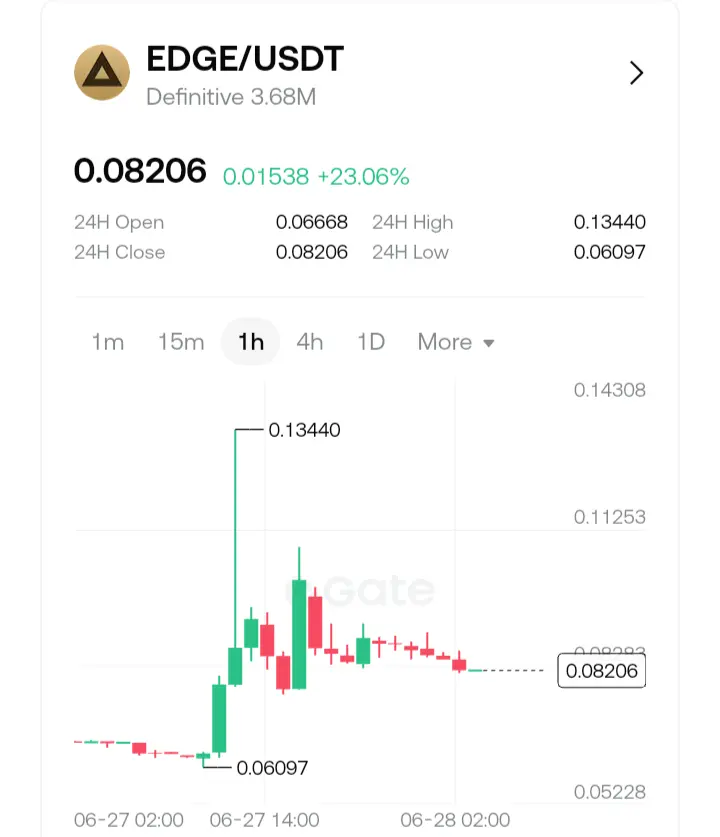
EDGE (edgeX) is currently trading around $0.08206, posting an impressive 23.06% gain over the last 24 hours. During the session, the token reached a high of $0.1344 before retracing, while the daily low was $0.06097. With approximately $305,882 in 24-hour trading volume, the market has attracted fresh attention, but the relatively modest volume compared to the price increase suggests traders should remain cautious.
Price Action Analysis
The latest rally demonstrates
EDGE-2.27%
EDGEX25.37%
MrFlower_XingChen
#EDGE (edgeX) Market Analysis: Is the 23% Rally the Beginning of a New Uptrend or a Short-Term Bull Trap?
Current Market Overview
EDGE (edgeX) is currently trading around $0.08206, posting an impressive 23.06% gain over the last 24 hours. During the session, the token reached a high of $0.1344 before retracing, while the daily low was $0.06097. With approximately $305,882 in 24-hour trading volume, the market has attracted fresh attention, but the relatively modest volume compared to the price increase suggests traders should remain cautious.
Price Action Analysis
The latest rally demonstrates strong short-term momentum after buyers aggressively pushed the price above recent resistance. However, the long upper wick toward $0.1344 indicates that profit-taking emerged at higher levels. This suggests buyers remain active, but sellers are also beginning to defend higher prices, increasing the probability of continued volatility over the coming sessions.
Support Levels
The first important support now sits around $0.080–$0.083, where recent consolidation occurred before the breakout. If buyers successfully defend this zone, the current bullish structure remains intact. The second major support lies near $0.070, while stronger long-term support is found around $0.061, which marked the recent daily low. Losing these levels would weaken bullish momentum considerably.
Resistance Levels
Immediate resistance remains near $0.095–$0.100, where psychological selling pressure is expected. Beyond this, the previous intraday high near $0.1344 becomes the next critical breakout level. If bulls reclaim this resistance with expanding volume, the market could begin targeting significantly higher price zones over the medium term.
Moving Average Analysis
The daily chart recently produced a Golden Cross, where shorter-term moving averages crossed above longer-term averages. This technical event is often viewed as an early indication of improving market momentum. While no indicator guarantees future gains, Golden Cross formations generally increase trader confidence when supported by rising volume and continued higher highs.
Trend Strength (ADX)
The Average Directional Index (ADX) currently indicates that the existing uptrend is strengthening rather than weakening. A rising ADX suggests momentum is becoming more established instead of remaining a temporary price spike. As long as ADX continues rising while price holds above support, buyers maintain the technical advantage.
Bollinger Band Analysis
EDGE has broken above the upper Bollinger Band while the bands continue expanding. This pattern normally reflects increasing volatility and stronger directional momentum. However, prolonged movement outside the upper band can also indicate that the market is becoming overstretched, especially if volume begins fading during additional price increases.
MACD Analysis
The daily MACD has started showing signs of improving bullish momentum following its previous bullish divergence. This indicates that downside momentum has weakened substantially compared to earlier price declines. Nevertheless, traders should continue monitoring MACD for any bearish crossover that could signal fading momentum after the recent rally.
CCI Indicator Analysis
One of the strongest warning signals currently comes from the Commodity Channel Index (CCI). The indicator has entered overbought territory, suggesting that the recent rally may have advanced too quickly. Overbought conditions do not automatically trigger a reversal, but they often increase the probability of consolidation or short-term pullbacks before the next major move.
Volume Analysis
Despite the impressive price increase, trading volume remains below its recent average, creating a classic price-up, volume-down divergence. Sustainable bull markets typically require expanding participation from buyers. Without stronger volume confirmation, the current rally remains vulnerable to profit-taking and sudden corrections.
Volatility Analysis
The token recorded approximately 26% daily volatility, highlighting the aggressive nature of current price movements. High volatility creates excellent opportunities for experienced traders but also exposes investors to rapid price swings and sharp liquidation events. Proper position sizing and disciplined risk management remain essential under these market conditions.
Community Sentiment
Discussion across X (formerly Twitter) has increased noticeably during the recent rally. Most conversations focus on three areas: the Edgechain AI sports betting ecosystem, short-term trading strategies concentrated around the $0.08–$0.083 accumulation zone, and highly optimistic long-term projections that mention a possible $0.83 price target. While growing community engagement is positive, ambitious targets should always be viewed as speculative until supported by continued technical confirmation and fundamental ecosystem growth.
Short-Term Price Targets
If buyers successfully defend the $0.080 support area while volume improves, the next upside objectives become $0.095, $0.105, and a retest of $0.1344. A confirmed breakout above the recent high could open the path toward $0.15–$0.18 over the medium term. However, failure to maintain support may trigger a correction toward $0.070 or even $0.061 before another bullish attempt develops.
Key Risk Factors
Although the technical trend has improved significantly, several risks remain. The combination of overbought CCI readings, below-average trading volume, 26% daily volatility, and the possibility of aggressive profit-taking means traders should avoid chasing price after large green candles. Waiting for either healthy consolidation or stronger volume confirmation may provide a more favorable risk-to-reward opportunity.
Final Outlook
EDGE currently presents one of the more technically interesting setups among smaller-cap cryptocurrencies. The Golden Cross, strengthening ADX, and Bollinger Band breakout all support the bullish narrative. However, weakening volume and overbought momentum indicators suggest the market may first experience consolidation before attempting another major advance. For now, maintaining support above $0.080 remains the most important signal to watch, while a decisive break above $0.1344 would significantly strengthen the longer-term bullish outlook.
#PredictWorldCupWin40000U @Gate_Square @GateSquare
repost-content-media
  • Reward
  • Comment
  • Repost
  • Share
#SUSDT Market Analysis: Can the Recent 9.80% Rally Evolve Into a Sustainable Trend?
Current Market Overview
SUSDT has recently attracted attention after posting a 9.80% daily gain, with the token trading inside a $0.019–$0.028 price range. Although this recovery looks encouraging, the broader market structure still reflects a highly volatile low-cap asset rather than a confirmed bullish trend. Price action remains driven by speculative trading instead of strong fundamental developments, meaning traders should remain cautious despite the short-term momentum.
Market Availability
One important fa
SUSD6.51%
MrFlower_XingChen
#SUSDT Market Analysis: Can the Recent 9.80% Rally Evolve Into a Sustainable Trend?
Current Market Overview
SUSDT has recently attracted attention after posting a 9.80% daily gain, with the token trading inside a $0.019–$0.028 price range. Although this recovery looks encouraging, the broader market structure still reflects a highly volatile low-cap asset rather than a confirmed bullish trend. Price action remains driven by speculative trading instead of strong fundamental developments, meaning traders should remain cautious despite the short-term momentum.
Market Availability
One important factor many traders overlook is accessibility. SUSDT is currently unavailable on Gate.io Alpha Trading, meaning users cannot directly trade the asset on the platform. Before entering any position, investors should verify where the token is listed, confirm the official contract address, and avoid fake or duplicate tokens that often appear in low-cap markets.
Price Structure Analysis
The current market is moving inside a wide consolidation channel between $0.019 and $0.028. This range shows that buyers and sellers remain balanced, with neither side establishing complete control. Until price escapes this structure, traders should expect continued volatility and rapid swings in both directions rather than a sustained trend.
Support Zone Analysis
The strongest support currently sits between $0.01900 and $0.02009. This area has repeatedly attracted buyers and represents the first major defense against additional downside. If this support continues holding, market confidence could gradually improve. However, a confirmed breakdown below this zone would likely increase selling pressure and expose lower price levels as stop-loss orders begin triggering.
Resistance Zone Analysis
The first major resistance lies between $0.02380 and $0.02688. Sellers have consistently defended this region, preventing further upside expansion. A successful breakout above resistance, accompanied by significantly higher trading volume, would indicate improving bullish momentum and increase the probability of a continuation toward higher price targets.
Volume Analysis
Trading volume remains one of the most important indicators for SUSDT. While the recent price increase is encouraging, sustainable rallies require expanding volume to confirm genuine market participation. If volume continues declining during price increases, the rally may lose strength quickly. Conversely, increasing volume alongside higher prices would provide stronger confirmation that buyers are gaining control.
Market Liquidity
Liquidity remains one of the biggest risks facing SUSDT. As a low-cap cryptocurrency, relatively small buy or sell orders can move the market significantly. This creates attractive opportunities for experienced traders but also increases slippage, volatility, and the possibility of sharp price reversals. Proper position sizing and disciplined risk management remain essential.
Market Sentiment
Current sentiment appears neutral to slightly bullish. Social media discussions remain focused primarily on technical charts instead of major ecosystem developments or viral narratives. This suggests the recent rally is currently being driven by technical trading activity rather than strong fundamental news or widespread community excitement.
Key Bullish Factors
Several factors could support additional upside. Holding above the primary support zone, increasing trading volume, improving exchange availability, stronger community engagement, and a successful breakout above resistance would all strengthen the bullish case. These developments would indicate growing market confidence and attract additional participants.
Key Bearish Risks
Despite the recent recovery, investors should remain aware of the risks. Low liquidity, limited exchange listings, high volatility, and the absence of major fundamental catalysts continue to weigh on the token. Failure to defend the support region could quickly erase recent gains as traders exit positions.
Potential Price Targets
If buyers successfully reclaim $0.02688 with strong volume confirmation, the next upside targets could be $0.030, followed by $0.034, and potentially $0.038 if bullish momentum accelerates. However, if price loses the $0.01900 support level, downside targets near $0.017 and $0.015 become increasingly likely.
Trading Strategy
For conservative traders, patience remains the best strategy. Waiting for either a confirmed breakout above resistance or a healthy pullback toward strong support provides a better risk-to-reward ratio than chasing short-term green candles. Protecting capital should always take priority over maximizing returns.
Final Outlook
SUSDT remains a high-risk, high-reward cryptocurrency. The recent 9.80% gain demonstrates that buyers are still active, but the market has yet to confirm a long-term trend reversal. Until resistance is broken with strong volume and liquidity improves, traders should continue treating SUSDT as a speculative asset rather than assuming the beginning of a sustained bull market. Monitoring support, resistance, volume, liquidity, and market sentiment together will provide a much clearer picture than relying on price movement alone.
#PredictWorldCupWin40000U @Gate_Square @GateSquare

$SUSD
repost-content-media
  • Reward
  • Comment
  • Repost
  • Share
#Get2SharesOfSKHynixAtZeroCost
AI Memory Innovation: Why Advanced Memory Is Becoming the Foundation of the AI Economy
AI Is Reshaping the Semiconductor Industry
The semiconductor industry is undergoing one of the biggest structural transformations in its history. In previous technology cycles, chip demand was primarily driven by smartphones, personal computers, and consumer electronics. Today, artificial intelligence has become the dominant growth engine. As AI models become larger, more complex, and increasingly data-intensive, the need for faster, more efficient semiconductor solutions cont
DRAM6.65%
MrFlower_XingChen
#Get2SharesOfSKHynixAtZeroCost
AI Memory Innovation: Why Advanced Memory Is Becoming the Foundation of the AI Economy
AI Is Reshaping the Semiconductor Industry
The semiconductor industry is undergoing one of the biggest structural transformations in its history. In previous technology cycles, chip demand was primarily driven by smartphones, personal computers, and consumer electronics. Today, artificial intelligence has become the dominant growth engine. As AI models become larger, more complex, and increasingly data-intensive, the need for faster, more efficient semiconductor solutions continues to accelerate. This shift has transformed advanced memory from a supporting component into one of the most valuable technologies within the global AI ecosystem.
Why High-Bandwidth Memory (HBM) Matters
One of the biggest beneficiaries of this AI revolution is High-Bandwidth Memory (HBM). Unlike traditional DRAM, HBM delivers extremely high data transfer speeds while maintaining lower power consumption. Modern AI accelerators and GPUs process enormous amounts of information every second, and without advanced memory capable of feeding data quickly enough, even the most powerful processors become bottlenecked. This makes HBM one of the most critical technologies enabling next-generation artificial intelligence.
Growing Demand Across Multiple Industries
Demand for advanced memory is expanding far beyond technology companies. Cloud computing providers, hyperscale data centers, AI research organizations, autonomous vehicle developers, healthcare institutions, financial services, cybersecurity platforms, robotics companies, and enterprise software providers are all investing heavily in AI infrastructure. Every expansion in AI workloads increases demand for faster memory solutions, creating a long-term structural growth trend rather than the traditional boom-and-bust cycles that previously defined the semiconductor market.
Supply Constraints Create Long-Term Value
One of the strongest indicators supporting the semiconductor industry is limited production capacity. Building advanced fabrication facilities requires billions of dollars in capital investment, years of engineering development, highly specialized manufacturing equipment, and an experienced workforce. Production cannot be expanded overnight. When demand grows faster than manufacturing capacity, companies with advanced technology often benefit from stronger pricing power, healthier profit margins, and greater long-term revenue visibility.
Technology Leadership Creates Competitive Advantages
Advanced semiconductor manufacturing is no longer based solely on production volume. Leadership now depends on process technology, packaging innovation, manufacturing efficiency, yield optimization, and the ability to consistently deliver high-performance products at scale. Companies capable of maintaining technological leadership often establish competitive advantages that become increasingly difficult for rivals to replicate, especially in specialized markets such as AI memory.
Artificial Intelligence Is Building an Entire Ecosystem
Artificial intelligence should never be viewed as a single industry. Instead, it represents an interconnected ecosystem that depends on semiconductor manufacturers, advanced memory producers, GPU designers, networking companies, cloud infrastructure providers, software developers, cybersecurity firms, and energy infrastructure. Every breakthrough in AI creates additional demand across this entire value chain. Understanding these relationships allows investors to identify opportunities beyond the companies receiving the most media attention.
Semiconductors Have Become Strategic National Assets
Governments worldwide increasingly recognize semiconductor manufacturing as essential national infrastructure. Domestic chip production now supports economic competitiveness, supply chain resilience, technological independence, defense capabilities, and national security. Large public and private investments into semiconductor research, fabrication plants, and advanced manufacturing demonstrate that chips have become strategic assets supporting the future of AI, cloud computing, robotics, quantum research, and digital economies.
Investment Perspective on the AI Supply Chain
Markets frequently reward companies solving critical technological bottlenecks rather than those generating the largest headlines. While AI software companies often receive significant public attention, the hardware ecosystem—including advanced memory manufacturers, semiconductor equipment suppliers, networking providers, and cloud infrastructure operators—forms the foundation upon which artificial intelligence operates. Investors who understand this complete ecosystem may identify structural opportunities before they become widely recognized.
Potential Growth Drivers
Several long-term factors continue supporting semiconductor growth, including increasing AI adoption, expanding cloud infrastructure, rising enterprise AI investment, higher demand for AI-enabled consumer devices, autonomous driving development, edge computing, industrial automation, robotics, and continued digital transformation across global industries. These trends collectively create multiple independent demand sources instead of relying on a single technology cycle.
Key Risks Investors Should Monitor
Despite the strong long-term outlook, investors should remain aware of several risks. Semiconductor markets remain sensitive to geopolitical tensions, global economic slowdowns, export regulations, supply chain disruptions, technological competition, and cyclical inventory corrections. High valuations following strong rallies may also increase short-term volatility as investors take profits. Long-term opportunities remain attractive, but disciplined risk management is still essential.
Long-Term Outlook
Artificial intelligence is still in the early stages of global adoption. Every new generation of AI models requires greater computational performance, faster networking, larger data centers, and increasingly advanced memory technology. As these infrastructure requirements continue expanding, companies supplying the essential building blocks of AI may remain among the primary beneficiaries of the next decade of technological innovation.
My Perspective
I believe the strongest long-term investment opportunities often emerge where technological necessity intersects with limited supply. Advanced memory has become one of the few technologies that virtually every major AI platform requires, while only a limited number of manufacturers possess the expertise and production capacity to deliver it at scale. Rather than focusing exclusively on AI applications, I prefer understanding the infrastructure enabling artificial intelligence itself. Throughout technology history, the companies building foundational infrastructure have frequently generated some of the most sustainable long-term value.
#PredictWorldCupWin40000U @Gate_Square @GateSquare

repost-content-media
  • Reward
  • Comment
  • Repost
  • Share
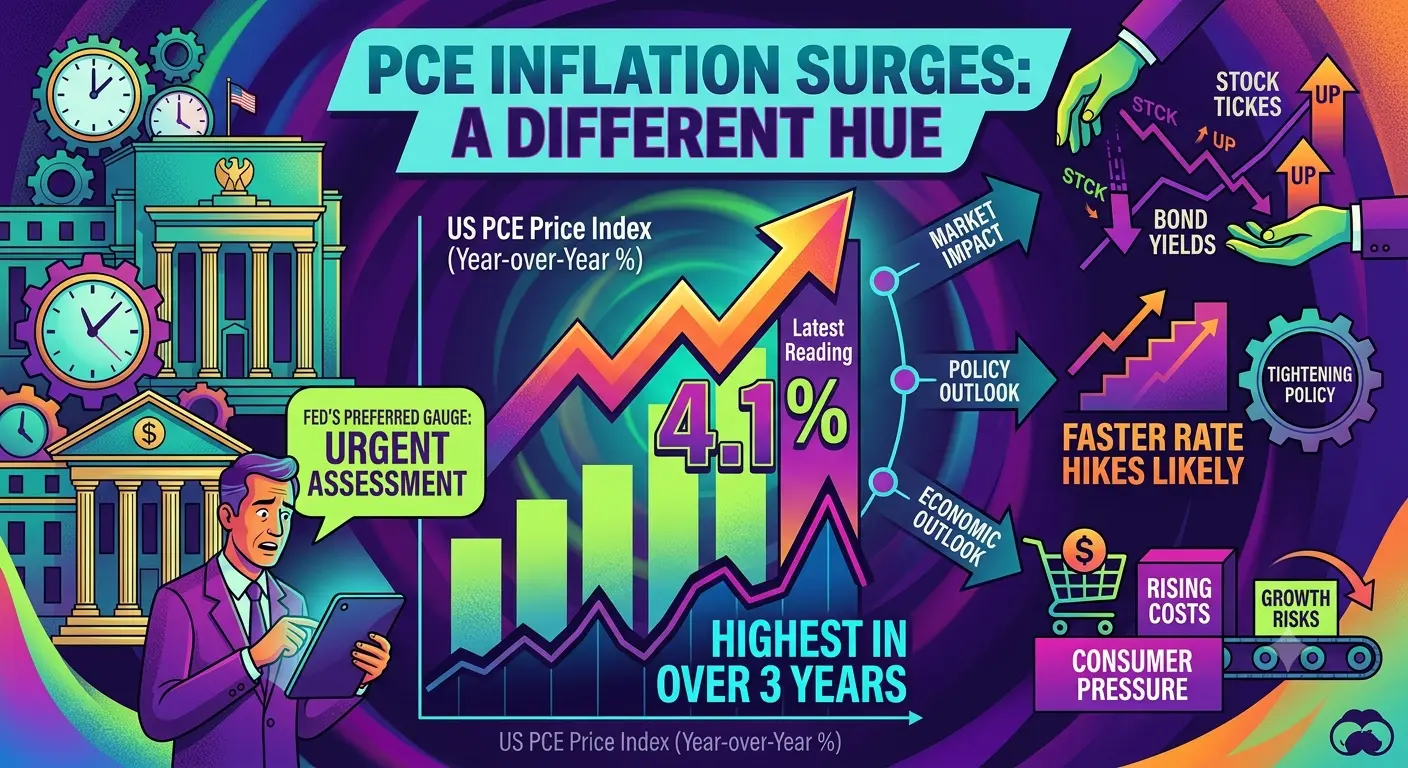
#USMayPCEInflationRisesTo4.1%HighestIn3Years
Market Overview
The latest U.S. Personal Consumption Expenditures (PCE) Price Index has climbed to 4.1% year-over-year, marking the highest inflation reading in more than three years. Since the PCE Index is the Federal Reserve's preferred inflation gauge, this report immediately became one of the most important macroeconomic events for global financial markets. Rising inflation changes expectations for future interest rates, liquidity, bond yields, equities, and cryptocurrencies, making this data highly relevant for every investor.
Why the PCE Repo
BTC0.42%
ETH0.47%
MrFlower_XingChen
#USMayPCEInflationRisesTo4.1%HighestIn3Years
Market Overview
The latest U.S. Personal Consumption Expenditures (PCE) Price Index has climbed to 4.1% year-over-year, marking the highest inflation reading in more than three years. Since the PCE Index is the Federal Reserve's preferred inflation gauge, this report immediately became one of the most important macroeconomic events for global financial markets. Rising inflation changes expectations for future interest rates, liquidity, bond yields, equities, and cryptocurrencies, making this data highly relevant for every investor.
Why the PCE Report Matters
Unlike the Consumer Price Index (CPI), the PCE Index measures a broader range of consumer spending and adjusts for changing purchasing behavior. Because of this, the Federal Reserve places significant emphasis on PCE when determining monetary policy. A higher-than-expected reading suggests inflationary pressures remain persistent, reducing the likelihood of rapid interest-rate cuts and keeping financial conditions tighter for longer.
Federal Reserve Outlook
The stronger inflation data reinforces expectations that the Federal Reserve may maintain a cautious policy stance. Rather than rushing to reduce interest rates, policymakers are likely to wait for additional evidence showing inflation is moving sustainably toward the long-term 2% target. This "higher-for-longer" interest-rate environment generally limits market liquidity and increases volatility across risk assets.
Impact on Financial Markets
Financial markets immediately reassess future monetary policy after major inflation reports. Rising inflation often pushes Treasury yields higher, strengthens the U.S. dollar, and increases volatility in equities, commodities, and digital assets. Investors begin repricing expectations for borrowing costs, economic growth, and corporate profitability, making inflation reports some of the most influential events on the economic calendar.
Why Interest Rates Matter for Crypto
Higher interest rates increase the attractiveness of lower-risk investments such as government bonds and money-market funds. Institutional investors managing large portfolios continuously compare risk-adjusted returns across multiple asset classes. When fixed-income investments offer higher yields, capital frequently rotates away from speculative assets like cryptocurrencies, reducing buying pressure throughout the digital asset market.
Liquidity Remains the Key Driver
Liquidity remains the foundation of every major cryptocurrency bull market. Expanding liquidity allows new capital to flow into exchanges, venture investments, stablecoins, and digital assets. Conversely, tighter monetary policy slows money creation and reduces available investment capital. Even fundamentally strong crypto projects can struggle to sustain rallies when overall market liquidity continues contracting.
Bitcoin's Response to Inflation
Bitcoin continues serving as the benchmark for the entire cryptocurrency market. Although many investors describe Bitcoin as "digital gold," short-term price action remains highly sensitive to macroeconomic developments. Persistent inflation and delayed interest-rate cuts may keep Bitcoin trading inside a volatile range until markets gain greater clarity regarding future Federal Reserve policy. Over the long term, however, Bitcoin's limited supply continues supporting its value proposition.
Ethereum and Altcoin Performance
Ethereum and the broader altcoin market generally display even greater sensitivity to changing liquidity conditions. During periods of tightening financial conditions, investors often reduce exposure to higher-risk digital assets first. While Ethereum's ecosystem continues expanding through decentralized finance, tokenization, AI integrations, and real-world assets, macroeconomic uncertainty may temporarily outweigh positive blockchain developments.
Institutional Investment Strategy
Large investment firms rarely react emotionally to individual headlines. Instead, they evaluate inflation data alongside employment reports, GDP growth, consumer spending, manufacturing activity, corporate earnings, and Federal Reserve guidance before adjusting portfolio allocations. This disciplined approach explains why institutional capital sometimes remains patient despite temporary market recoveries.
Volume and Market Structure
Trading volume should always be analyzed alongside price action. High volume during market declines may represent liquidation rather than genuine selling conviction, while increasing volume during breakouts often confirms stronger buyer participation. Successful investors combine price structure, support and resistance levels, derivatives positioning, and macroeconomic data instead of relying on a single technical indicator.
Investor Psychology
Market sentiment frequently amplifies the effects of macroeconomic news. Inflation surprises often trigger emotional reactions, leading some investors to sell during uncertainty while others attempt to buy short-term dips aggressively. History shows that disciplined investors generally focus on long-term trends rather than reacting impulsively to every economic report. Emotional control remains one of the most valuable advantages in volatile markets.
Artificial Intelligence and Blockchain Continue Advancing
Although inflation currently dominates market attention, technological innovation continues accelerating. Artificial intelligence, blockchain infrastructure, decentralized computing, tokenization, cloud services, and semiconductor development remain long-term structural growth industries. Temporary macroeconomic challenges may slow capital flows, but they rarely stop technological progress itself.
Potential Market Scenarios
If future inflation reports begin showing consistent moderation, markets could gradually price in lower interest rates, improving liquidity and supporting both equities and cryptocurrencies. However, if inflation remains elevated, financial conditions may stay restrictive for longer, increasing short-term volatility. Investors should prepare for multiple outcomes rather than relying on a single market prediction.
Long-Term Investment Perspective
Every market cycle experiences periods of optimism, correction, uncertainty, and recovery. While inflation data may influence short-term price movements, long-term value is ultimately created through innovation, adoption, productivity growth, and technological development. Blockchain technology, artificial intelligence, institutional participation, decentralized finance, and tokenized assets continue evolving despite temporary macroeconomic headwinds. Investors who combine macroeconomic awareness with disciplined risk management are often better positioned to navigate uncertainty while identifying sustainable long-term opportunities.
#PredictWorldCupWin40000U @Gate_Square @GateSquare
repost-content-media
  • Reward
  • Comment
  • Repost
  • Share
How On-Chain Staking Is Transforming Stablecoins Into Productive Yield-Generating Assets
The Evolution of Stablecoins
Stablecoins have evolved from simple digital representations of fiat currency into one of the most important foundations of decentralized finance (DeFi). Initially designed to reduce volatility and simplify crypto transactions, stablecoins now support lending, borrowing, payments, trading, cross-border settlements, and passive income generation. Instead of allowing digital dollars to remain idle, investors increasingly seek opportunities to generate sustainable returns while ma
MrFlower_XingChen
How On-Chain Staking Is Transforming Stablecoins Into Productive Yield-Generating Assets
The Evolution of Stablecoins
Stablecoins have evolved from simple digital representations of fiat currency into one of the most important foundations of decentralized finance (DeFi). Initially designed to reduce volatility and simplify crypto transactions, stablecoins now support lending, borrowing, payments, trading, cross-border settlements, and passive income generation. Instead of allowing digital dollars to remain idle, investors increasingly seek opportunities to generate sustainable returns while maintaining relatively stable exposure within the crypto ecosystem.
Why On-Chain Staking Is Growing
On-chain staking has become one of the fastest-growing applications for stablecoins because it allows users to earn rewards without constantly trading volatile assets. Rather than relying solely on price appreciation, investors can generate yield directly from blockchain-based financial protocols. Automated smart contracts distribute rewards transparently, while blockchain technology enables continuous participation without traditional banking hours or geographical limitations.
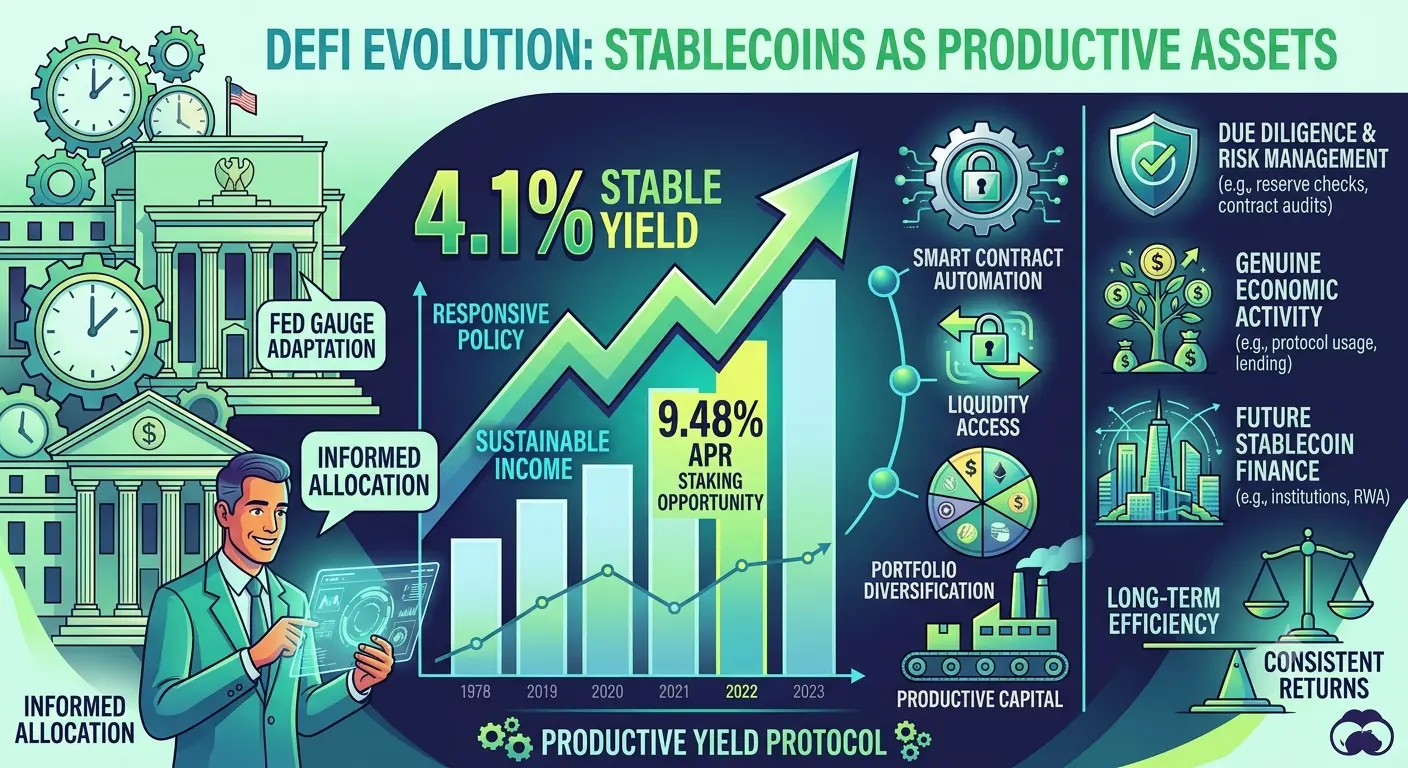
Understanding the 9.48% APR Opportunity
An advertised 9.48% Annual Percentage Rate (APR) represents the estimated yearly return based on the current reward structure. Unlike fixed bank deposits, however, APR in decentralized finance may fluctuate depending on market demand, protocol incentives, liquidity conditions, and participation levels. Investors should understand that yields are dynamic rather than permanently guaranteed, making continuous monitoring an important part of responsible portfolio management.
Capital Efficiency Matters
One of the greatest advantages of staking stablecoins is improved capital efficiency. Instead of leaving assets inactive inside a wallet, investors can potentially generate passive income while preserving exposure to a relatively stable digital asset. This transforms stablecoins from simple storage instruments into productive financial tools capable of contributing to overall portfolio performance even during periods of lower market volatility.
Liquidity and Flexibility
Liquidity remains one of the most valuable characteristics of on-chain financial products. Many staking solutions allow investors to redeem or withdraw assets with relatively few restrictions compared to traditional fixed-term investment products. Maintaining access to capital enables investors to react quickly when new opportunities emerge, market conditions change, or portfolio rebalancing becomes necessary.
Portfolio Diversification Benefits
Stablecoins continue playing an increasingly important role in diversified investment strategies. During periods of heightened volatility, they provide a defensive allocation where investors can temporarily reduce exposure to price fluctuations without completely exiting the digital asset ecosystem. When these holdings also generate yield, they contribute both stability and passive income, strengthening overall portfolio efficiency.
The Technology Behind On-Chain Staking
Modern staking platforms rely on smart contracts to automate deposits, reward calculations, and distributions. Every transaction is recorded on-chain, improving transparency compared to many traditional financial systems. Decentralized infrastructure reduces dependence on manual processing while enabling continuous settlement and verification. This technological innovation continues expanding access to financial services across global markets.
Understanding the Risks
Yield should never be evaluated independently of risk. Before participating in any staking program, investors should carefully examine the underlying protocol, smart contract security, platform reputation, liquidity management, reserve mechanisms, and overall ecosystem stability. Higher advertised yields sometimes compensate for higher risks, making due diligence essential before allocating capital.
What Drives Sustainable Yield
Long-term sustainable returns depend on genuine economic activity rather than temporary promotional incentives. Healthy staking ecosystems are typically supported by real protocol usage, transaction activity, liquidity demand, lending markets, or ecosystem revenue generation. Investors should always understand where staking rewards originate instead of focusing exclusively on the advertised APR.
The Future of Stablecoin Finance
Stablecoins are becoming increasingly integrated into decentralized exchanges, payment networks, institutional settlement systems, tokenized real-world assets, and cross-border financial infrastructure. As blockchain adoption expands globally, stablecoins are expected to play a larger role in digital commerce while continuing to develop as income-generating financial instruments rather than simple payment tokens.
Building a Smarter Passive Income Strategy
Passive income has become an increasingly important objective for long-term investors. Rather than relying exclusively on capital appreciation, many portfolios now combine growth assets with yield-generating positions to improve consistency and reduce overall volatility. Productive stablecoins represent one example of how blockchain technology continues expanding the range of financial tools available to investors seeking balanced long-term strategies.
My Perspective
I believe one of the most significant innovations in decentralized finance is the ability to transform stable assets into productive capital without requiring continuous trading. While price appreciation remains important, generating sustainable income from existing holdings improves overall capital efficiency and creates additional flexibility during uncertain market conditions. The strongest investment strategies typically combine growth potential, liquidity, and disciplined risk management rather than focusing exclusively on maximizing returns.
Final Thoughts
The evolution of stablecoins reflects the broader transformation occurring across digital finance. What began as a simple solution for reducing cryptocurrency volatility has grown into an ecosystem supporting payments, decentralized applications, lending markets, institutional settlement, and passive income generation. As blockchain infrastructure continues maturing, productive stablecoins may become one of the most important components of diversified digital portfolios, helping investors balance stability, liquidity, and long-term capital efficiency while navigating changing market cycles.
#StakeUSD1Earn9.48%APR #MyGateTradeStory #MyGateTradingMoment #PredictWorldCupWin40000U @Gate_Square @GateSquare
repost-content-media
  • Reward
  • Comment
  • Repost
  • Share
Why AI Memory Has Become One of the Most Valuable Segments in the Technology Industry
A Historic Milestone for AI Infrastructure
Micron's recent surge has become one of the biggest stories in the technology sector, highlighting how artificial intelligence is reshaping the semiconductor industry. The company's strong rally reflects growing investor confidence that advanced memory has become a critical component of AI infrastructure rather than a traditional cyclical business. As AI adoption accelerates worldwide, companies supplying essential hardware are receiving increasing attention from bot
MrFlower_XingChen
Why AI Memory Has Become One of the Most Valuable Segments in the Technology Industry
A Historic Milestone for AI Infrastructure
Micron's recent surge has become one of the biggest stories in the technology sector, highlighting how artificial intelligence is reshaping the semiconductor industry. The company's strong rally reflects growing investor confidence that advanced memory has become a critical component of AI infrastructure rather than a traditional cyclical business. As AI adoption accelerates worldwide, companies supplying essential hardware are receiving increasing attention from both institutional and retail investors.
Strong Earnings Changed Market Sentiment
The biggest catalyst behind Micron's rally was its latest quarterly earnings report. Revenue growth significantly exceeded market expectations, demonstrating that demand for AI-related memory products continues accelerating. Strong financial performance is particularly important because it confirms that the current AI investment cycle is supported by real customer spending rather than speculation alone. Investors typically reward companies that combine technological leadership with rapidly expanding revenue and improving profitability.
High-Bandwidth Memory Is the Real Growth Engine
The primary driver behind Micron's momentum is High-Bandwidth Memory (HBM). Unlike conventional memory, HBM provides extremely high data transfer speeds while maintaining better power efficiency. Modern AI accelerators and advanced GPUs rely on HBM to process enormous amounts of information simultaneously. As AI models become larger and more computationally demanding, demand for advanced memory continues increasing alongside demand for AI processors.
Supply Constraints Support Pricing Power
One of the strongest bullish factors is that much of Micron's HBM production capacity has already been committed well into the future. When customers secure long-term supply agreements, it demonstrates confidence that demand will remain strong for several years. Limited manufacturing capacity combined with rising demand often allows semiconductor companies to maintain stronger pricing power, improve profit margins, and increase long-term revenue visibility.
The AI Infrastructure Cycle Is Expanding
Artificial intelligence is no longer driven solely by GPU manufacturers. Every AI data center requires processors, advanced memory, networking equipment, storage solutions, cooling systems, and high-performance power infrastructure. This creates a complete ecosystem where multiple industries benefit simultaneously. Companies providing these foundational technologies may continue experiencing structural growth as AI investment expands across cloud computing, enterprise software, healthcare, robotics, finance, and autonomous systems.
Why Memory Has Become a Strategic Asset
For many years, memory manufacturers were viewed as cyclical suppliers whose revenues fluctuated with consumer electronics demand. AI has fundamentally changed that perception. Today, advanced memory is one of the most important bottlenecks in AI infrastructure because even the most powerful processors cannot reach maximum performance without extremely fast data access. This shift has transformed memory companies into strategic partners within the global AI ecosystem.
What This Means for the Semiconductor Industry
Micron's performance also strengthens the investment case for other companies involved in advanced memory manufacturing. As global demand for AI servers continues increasing, leading memory producers may benefit from stronger utilization rates, higher average selling prices, and expanding production capacity. However, competition, technological innovation, and manufacturing execution will remain key factors determining which companies capture the largest market share over the coming years.
Institutional Capital Is Following AI Infrastructure
Large investment firms increasingly view AI infrastructure as one of the strongest long-term technology themes. Instead of investing only in software developers, institutions are allocating capital across the entire semiconductor supply chain, including memory manufacturers, chip designers, equipment suppliers, networking companies, and cloud infrastructure providers. This diversified approach reflects growing confidence that AI investment will continue expanding over the next decade.
Potential Risks Investors Should Watch
Despite the strong momentum, investors should remain aware of potential risks. Semiconductor stocks can experience significant volatility following rapid rallies, particularly if future earnings fail to meet elevated expectations. Other challenges include increasing competition, production expansion costs, geopolitical uncertainty, export restrictions, and potential cyclical slowdowns in technology spending. Strong long-term fundamentals do not eliminate the possibility of short-term market corrections.
AI and Cryptocurrency Share Similar Infrastructure Trends
The rapid growth of AI infrastructure also has implications for the cryptocurrency industry. Many blockchain projects increasingly integrate artificial intelligence, decentralized computing, GPU networks, and high-performance cloud infrastructure. As investment flows into AI hardware continue increasing, related blockchain ecosystems supporting decentralized computation, tokenized infrastructure, and digital finance may also benefit from broader technological adoption.
Long-Term Investment Perspective
The most important lesson from Micron's recent performance is that transformative technologies often create value throughout an entire ecosystem rather than within a single company. AI requires advanced processors, memory, networking, cloud infrastructure, and energy systems working together. Investors who understand these interconnected industries may identify opportunities before they become widely recognized. While short-term market fluctuations are inevitable, companies providing essential AI infrastructure appear well positioned to benefit as artificial intelligence continues reshaping the global economy.
#MicronOvertakesMetaInMarketValue #MyGateTradeStory #MyGateTradingMoment #PredictWorldCupWin40000U @Gate_Square @GateSquare

repost-content-media
  • Reward
  • Comment
  • Repost
  • Share
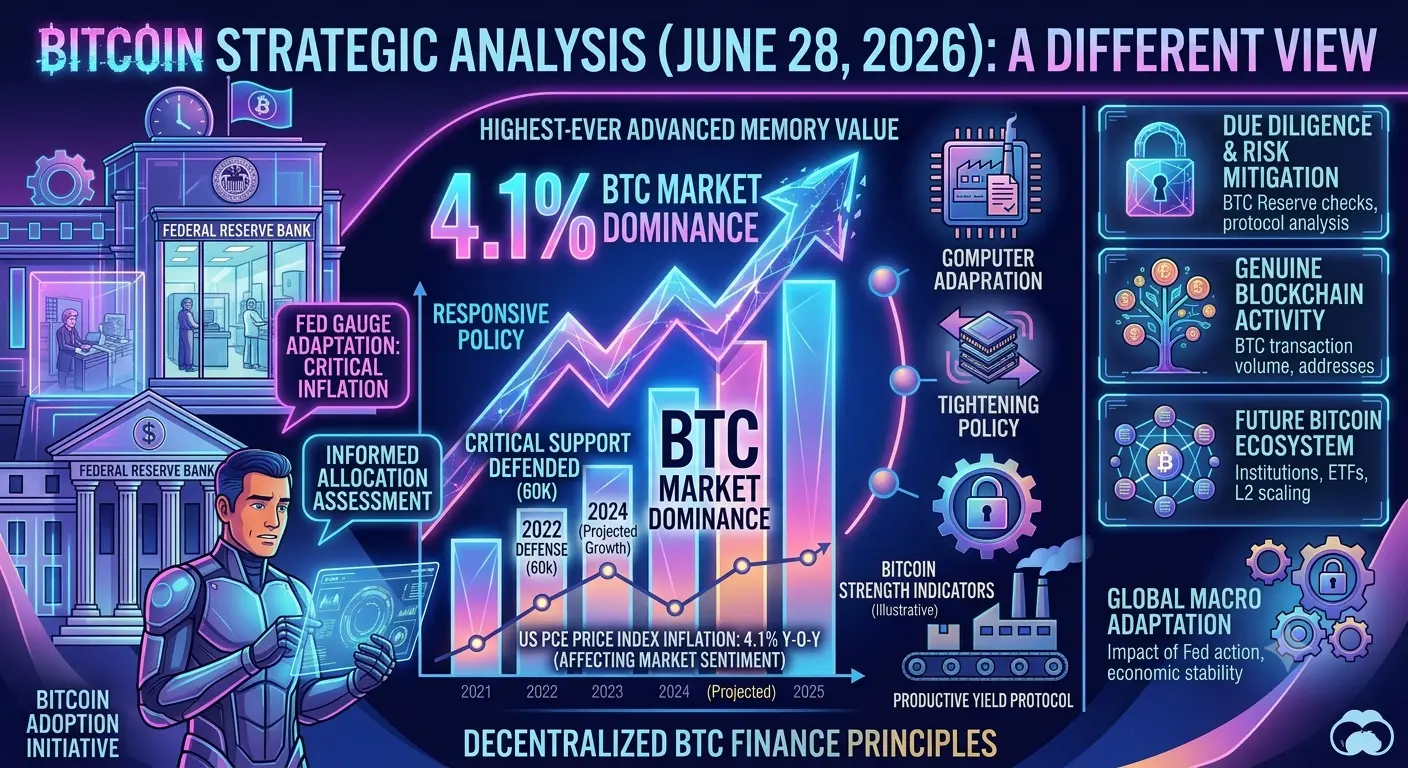
#BTCProbes60KKeySupportLevel
Bitcoin Market Analysis (June 28, 2026)
Current Market Overview
Bitcoin is currently trading around $60,780, recovering slightly after defending the critical $60,000 psychological support. During the past 24 hours, BTC has traded between approximately $59,550 and $60,940, showing that buyers are attempting to stabilize price above a key technical level. While the short-term rebound is encouraging, the broader market structure remains cautious after several weeks of downside pressure.
Trend Analysis
The daily trend remains bearish to neutral. Bitcoin is still tradi
BTC0.42%
MrFlower_XingChen
#BTCProbes60KKeySupportLevel
Bitcoin Market Analysis (June 28, 2026)
Current Market Overview
Bitcoin is currently trading around $60,780, recovering slightly after defending the critical $60,000 psychological support. During the past 24 hours, BTC has traded between approximately $59,550 and $60,940, showing that buyers are attempting to stabilize price above a key technical level. While the short-term rebound is encouraging, the broader market structure remains cautious after several weeks of downside pressure.
Trend Analysis
The daily trend remains bearish to neutral. Bitcoin is still trading below several important moving averages, indicating that sellers continue to control the larger trend. However, the pace of selling has slowed, suggesting bearish momentum may be weakening. Bulls must reclaim higher resistance zones before a confirmed trend reversal can be established.
RSI Analysis
The Relative Strength Index (RSI) remains around the 35–40 region. This indicates weak momentum but also places Bitcoin close to oversold territory. Historically, RSI readings below 40 often lead to short-term relief rallies, although confirmation from price and volume is still required before expecting a sustained recovery.
MACD Analysis
The MACD continues to show a bearish crossover on the daily timeframe, but the histogram is gradually becoming less negative. This suggests downside momentum is fading. A bullish crossover would provide the first technical confirmation that buyers are beginning to regain market control.
Support Levels
The most important support remains $60,000–60,300. This is currently the key level separating short-term stability from another wave of selling. Below this, the next support sits around $58,800–59,000, followed by the critical demand zone at $57,000–58,000. Losing these areas could expose Bitcoin to another decline toward $55,000.
Resistance Levels
The first resistance remains at $61,600–62,500. A successful breakout above this range would improve short-term sentiment and increase the probability of a move toward $64,000–65,700. The major breakout zone remains $66,500–68,000, where Bitcoin would need strong buying volume to invalidate the current bearish structure.
Trading Volume Analysis
Volume has stabilized following the recent correction but remains below the levels typically seen during strong bull-market breakouts. For Bitcoin to sustain a meaningful recovery, buying volume must expand significantly. Without increasing participation, rallies are more likely to face resistance from profit-taking and institutional selling.
On-Chain Analysis
Despite weak price action, on-chain fundamentals remain relatively constructive. Long-term holders continue controlling a record percentage of Bitcoin supply, whale wallets have accumulated during recent weakness, and dormant coins remain largely inactive. These metrics suggest that long-term investors are holding rather than distributing their positions, reducing structural selling pressure over time.
Institutional Flow Analysis
Spot ETF outflows have slowed compared with earlier in June, indicating that institutional selling pressure is gradually easing. While inflows have not yet returned strongly enough to drive a new bullish trend, stabilizing institutional activity is a positive sign that market conditions may be improving if macroeconomic sentiment becomes more supportive.
Market Sentiment
Market sentiment remains cautious following recent inflation data and uncertainty surrounding future Federal Reserve policy. Investors continue monitoring interest rates, bond yields, ETF flows, and economic indicators, all of which are influencing risk appetite across cryptocurrency markets.
Bullish Scenario
If Bitcoin continues holding above $60,000 while trading volume gradually improves, buyers could attempt a recovery toward $62,500, followed by $64,000–65,700. A decisive breakout above $66,500 would significantly strengthen the technical outlook and increase confidence that a broader trend reversal is underway.
Bearish Scenario
Failure to defend $60,000 would likely increase downside pressure toward $58,800, with the next critical support around $57,000–58,000. A decisive break below this zone could trigger another wave of liquidations, opening the path toward $55,000.
Final Outlook
Bitcoin remains at one of the most important technical levels of the current market cycle. The $60,000 support zone continues to act as the primary battleground between buyers and sellers. While on-chain fundamentals and slowing ETF outflows provide reasons for cautious optimism, the broader trend remains bearish until Bitcoin reclaims $66,500 with expanding trading volume. Until then, traders should expect elevated volatility and closely monitor macroeconomic developments, institutional flows, and volume confirmation before anticipating a sustained bullish reversal.
#PredictWorldCupWin40000U @Gate_Square @GateSquare
repost-content-media
  • Reward
  • Comment
  • Repost
  • Share
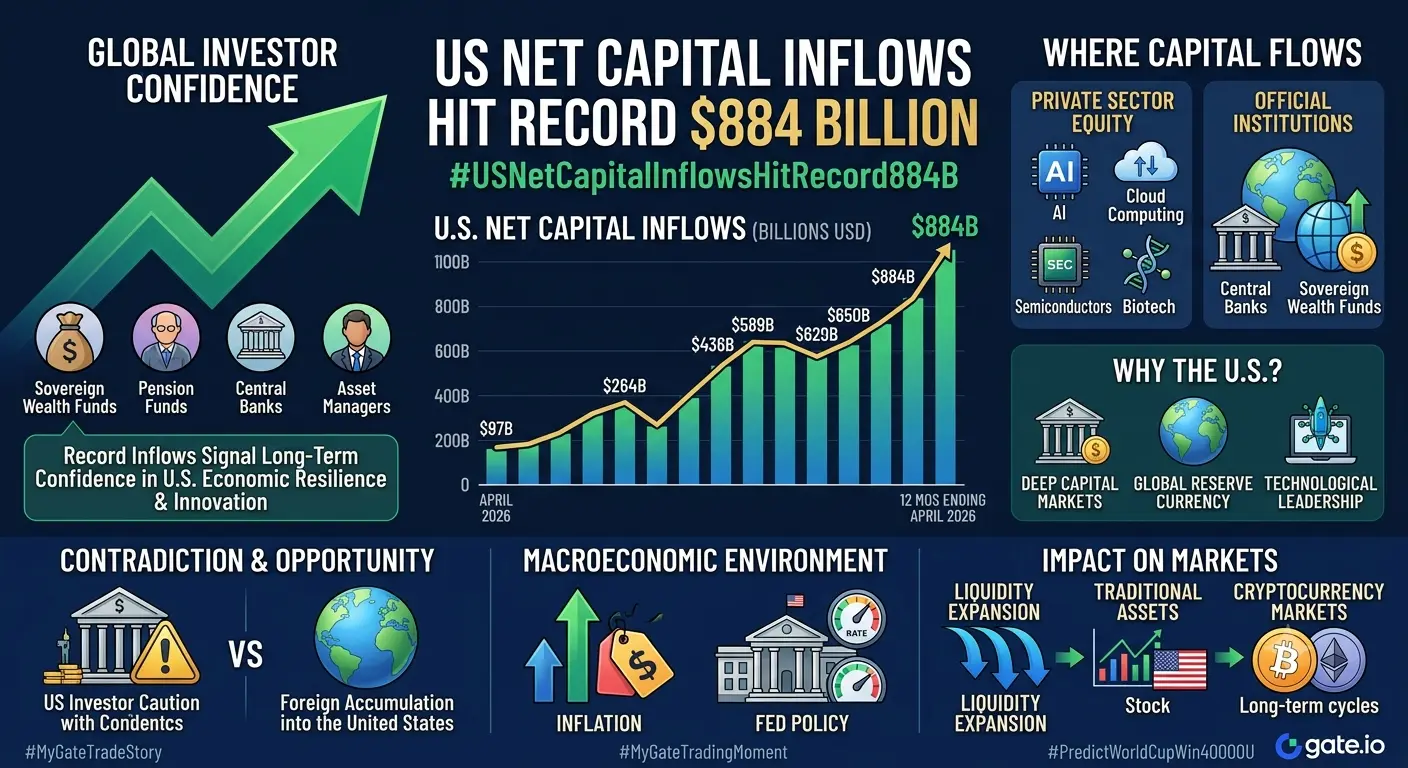
#USNetCapitalInflowsHitRecord884B
Why Record Global Capital Inflows Into the United States Could Shape the Next Investment Cycle
Record Capital Inflows Signal Strong Global Confidence
The United States attracted a record $884 billion in net capital inflows during the 12 months ending April 2026, highlighting one of the strongest shifts in global investment allocation in recent years. Such a large movement of international capital suggests that institutional investors, sovereign wealth funds, and global asset managers continue viewing the U.S. as the world's leading destination for long-term i
BTC0.42%
MrFlower_XingChen
#USNetCapitalInflowsHitRecord884B
Why Record Global Capital Inflows Into the United States Could Shape the Next Investment Cycle
Record Capital Inflows Signal Strong Global Confidence
The United States attracted a record $884 billion in net capital inflows during the 12 months ending April 2026, highlighting one of the strongest shifts in global investment allocation in recent years. Such a large movement of international capital suggests that institutional investors, sovereign wealth funds, and global asset managers continue viewing the U.S. as the world's leading destination for long-term investment despite higher interest rates and ongoing market volatility. Rather than focusing on short-term uncertainty, many investors are positioning capital around long-term economic resilience and technological leadership.
Understanding Treasury International Capital (TIC) Data
The Treasury International Capital (TIC) report measures how much foreign capital flows into U.S. financial assets such as stocks, bonds, and Treasury securities. Strong positive inflows generally indicate growing international confidence in the U.S. financial system. Unlike speculative trading activity, sustained TIC inflows often reflect strategic portfolio allocations by governments, pension funds, central banks, insurance companies, and other long-term institutional investors.
Private Investment Continues Accelerating
One of the most significant developments within the report is the record level of private-sector investment into U.S. equities. Global asset managers continue allocating capital toward companies leading innovation in artificial intelligence, cloud computing, semiconductors, cybersecurity, biotechnology, and digital infrastructure. Investors increasingly recognize that technological leadership remains one of the strongest long-term drivers of corporate earnings and economic growth.
Central Banks and Sovereign Wealth Funds Are Increasing Exposure
Official institutions also expanded their U.S. investments substantially. Central banks and sovereign wealth funds generally prioritize long-term capital preservation over short-term market speculation. Their increasing allocations suggest continued confidence in the stability, liquidity, and global importance of U.S. financial markets. These institutions often invest with multi-year horizons, making their participation particularly significant.
Why Capital Continues Moving Into the U.S.
Several structural factors continue attracting international investment. The United States offers the world's deepest capital markets, highly liquid financial instruments, global reserve currency status, leading technology companies, transparent regulatory institutions, and continued innovation across artificial intelligence, cloud infrastructure, biotechnology, and advanced manufacturing. These advantages continue attracting long-term global capital despite periodic market corrections.
The Market Contradiction
One of the most interesting aspects of the current environment is the contrast between domestic and international investor behavior. While some U.S.-based investors have reduced exposure because of inflation concerns, elevated interest rates, and recent technology-sector weakness, many overseas institutions have viewed the correction as an opportunity to accumulate high-quality assets at more attractive valuations. This divergence illustrates how different investor groups often interpret the same market conditions differently.
Inflation and Federal Reserve Policy
Inflation remains one of the most important macroeconomic variables influencing financial markets. With May PCE inflation at 4.1% and Core PCE at 3.4%, both readings remain above the Federal Reserve's long-term target. Higher inflation increases the possibility that policymakers maintain restrictive monetary conditions for longer, keeping borrowing costs elevated and influencing investment decisions across global markets.
Why Innovation Continues Attracting Capital
Although tighter monetary policy typically creates challenges for financial markets, investors continue allocating capital toward companies driving technological transformation. Artificial intelligence, semiconductor manufacturing, cloud computing, advanced networking, robotics, and automation remain long-term structural growth industries. Innovation continues attracting investment because these sectors have the potential to generate sustained earnings growth regardless of short-term economic fluctuations.
What This Means for Cryptocurrency Markets
Record foreign investment into U.S. financial assets creates both opportunities and challenges for cryptocurrency investors. In the short term, stronger demand for dollar-denominated assets can support the U.S. dollar and temporarily reduce liquidity available for higher-risk assets such as Bitcoin and altcoins. However, over longer investment cycles, expanding global capital often benefits multiple asset classes as confidence improves and investors gradually increase exposure to alternative investments.
Liquidity Remains the Most Important Market Driver
Every major bull market—whether in equities, cryptocurrencies, or commodities—has historically been supported by expanding liquidity. When institutional capital increases across financial markets, liquidity eventually spreads throughout the investment ecosystem. Although timing remains uncertain, improving financial conditions have historically supported stronger participation in both traditional and digital asset markets once macroeconomic uncertainty begins easing.
Key Risks Investors Should Monitor
Despite encouraging capital inflows, investors should continue monitoring inflation trends, Federal Reserve policy decisions, geopolitical developments, corporate earnings, global economic growth, and financial market liquidity. Rising interest rates, slowing economic activity, or unexpected geopolitical events could temporarily alter investment flows even within a structurally positive long-term environment.
Long-Term Outlook
The record $884 billion in net capital inflows demonstrates that global investors continue viewing the United States as the leading destination for innovation, stability, and long-term economic opportunity. While short-term volatility will remain a natural part of financial markets, capital generally follows productivity, technological leadership, and sustainable economic growth. For investors across equities, artificial intelligence, semiconductors, and cryptocurrencies, understanding where global liquidity is moving may become one of the most valuable advantages when identifying future investment opportunities.
#PredictWorldCupWin40000U @Gate_Square @GateSquare
repost-content-media
  • Reward
  • Comment
  • Repost
  • Share
#STRCHitsAllTimeLow
STRC Hits an All-Time Low: What It Means for Strategy, Bitcoin, and Investors
𝐈𝐧𝐭𝐫𝐨𝐝𝐮𝐜𝐭𝐢𝐨𝐧
The recent decline in STRC has become one of the most closely watched developments in the Bitcoin investment market. Although many investors expected periods of volatility, the speed and depth of this decline have sparked a much broader discussion about Strategy's financing model and the sustainability of a Bitcoin-backed capital structure during a prolonged bear market. This is no longer just about the price of one preferred share. It is about how confidence, market psyc
MrFlower_XingChen
#STRCHitsAllTimeLow
STRC Hits an All-Time Low: What It Means for Strategy, Bitcoin, and Investors
𝐈𝐧𝐭𝐫𝐨𝐝𝐮𝐜𝐭𝐢𝐨𝐧
The recent decline in STRC has become one of the most closely watched developments in the Bitcoin investment market. Although many investors expected periods of volatility, the speed and depth of this decline have sparked a much broader discussion about Strategy's financing model and the sustainability of a Bitcoin-backed capital structure during a prolonged bear market. This is no longer just about the price of one preferred share. It is about how confidence, market psychology, and capital markets interact when conditions become unfavorable.
𝐔𝐧𝐝𝐞𝐫𝐬𝐭𝐚𝐧𝐝𝐢𝐧𝐠 STRC
STRC was introduced as a perpetual preferred security designed to provide investors with an attractive dividend while allowing Strategy to continue raising capital for its long-term Bitcoin accumulation strategy. The structure worked well while Bitcoin prices were rising and investor demand remained strong. As long as confidence stayed high, Strategy could continue issuing securities, raise fresh capital, and increase its Bitcoin holdings. However, market conditions have changed dramatically, forcing investors to reconsider how resilient this model truly is under sustained pressure.
𝐓𝐡𝐞 𝐏𝐚𝐫 𝐕𝐚𝐥𝐮𝐞 𝐈𝐥𝐥𝐮𝐬𝐢𝐨𝐧
One of the biggest lessons from the recent decline is that a security's par value should never be confused with a guaranteed market value. Many investors naturally assume that a preferred share designed around a $100 par value should remain close to that level. In reality, financial markets price assets according to expectations, risk, liquidity, and future cash flows—not according to design targets. Once confidence weakens, prices can move far away from their original reference point, demonstrating that market perception is often stronger than financial engineering.
𝐓𝐡𝐞 𝐁𝐢𝐭𝐜𝐨𝐢𝐧 𝐅𝐥𝐲𝐰𝐡𝐞𝐞𝐥
For several years, Strategy benefited from what many analysts describe as a capital flywheel. The company raised money through equity and preferred shares, purchased additional Bitcoin, benefited from Bitcoin appreciation, saw its valuation improve, and then raised even more capital. Every successful cycle strengthened the next one. During bullish conditions this approach created powerful momentum. However, financial flywheels operate in both directions. When Bitcoin falls, financing becomes more expensive, investor demand weakens, and every part of the cycle begins working against itself.
𝐖𝐡𝐲 𝐁𝐢𝐭𝐜𝐨𝐢𝐧 𝐑𝐞𝐦𝐚𝐢𝐧𝐬 𝐭𝐡𝐞 𝐂𝐞𝐧𝐭𝐞𝐫 𝐨𝐟 𝐭𝐡𝐞 𝐒𝐭𝐨𝐫𝐲
Bitcoin remains the single most important variable affecting Strategy's future. Since the company's balance sheet is heavily concentrated in Bitcoin, every major movement in BTC directly impacts investor confidence, financing costs, and future capital-raising opportunities. A strong Bitcoin recovery could restore confidence relatively quickly, while an extended period of weakness would continue placing pressure on the company's entire financial structure.
𝐃𝐢𝐯𝐢𝐝𝐞𝐧𝐝 𝐒𝐮𝐬𝐭𝐚𝐢𝐧𝐚𝐛𝐢𝐥𝐢𝐭𝐲
High dividend yields often appear attractive during market downturns, but investors should always ask why those yields have become so large. In many cases, rising yields simply reflect declining share prices and increasing uncertainty. The market is effectively demanding higher compensation for taking greater risk. Sustainable dividends depend on sufficient cash flow, healthy liquidity, and stable financing conditions. If these factors weaken, investors naturally begin questioning whether current payout levels can continue over the long term.
𝐌𝐚𝐫𝐤𝐞𝐭 𝐏𝐬𝐲𝐜𝐡𝐨𝐥𝐨𝐠𝐲
Behavioral finance plays an enormous role during periods like this. Anchoring bias encourages investors to compare today's price with previous reference levels, creating the illusion that every decline automatically represents a bargain. At the same time, normalcy bias leads many participants to believe that every previous recovery guarantees another recovery ahead. Successful investing requires separating emotions from objective analysis. Markets frequently change faster than investor expectations.
𝐌𝐒𝐓𝐑 𝐚𝐧𝐝 𝐍𝐀𝐕
Another important factor is the relationship between Strategy's share price and the value of its underlying Bitcoin holdings. During strong bull markets, investors were willing to pay a significant premium because they expected Bitcoin prices to continue rising. If that premium continues shrinking, issuing additional shares becomes less attractive and more dilutive. This reduces the efficiency of the capital-raising model that previously supported aggressive Bitcoin accumulation.
𝐓𝐞𝐜𝐡𝐧𝐢𝐜𝐚𝐥 𝐌𝐚𝐫𝐤𝐞𝐭 𝐋𝐞𝐯𝐞𝐥𝐬
Bitcoin continues trading in an environment where every major support and resistance level carries significant importance. The area around $58,000 has become one of the most closely watched support zones. If buyers successfully defend this level, market confidence could gradually improve. However, a decisive break below support may expose Bitcoin to further downside toward the next major demand zones near $55,000 and potentially $50,000 if broader market sentiment continues deteriorating. On the upside, reclaiming $60,000–62,000 would represent an important first step toward rebuilding bullish momentum.
𝐌𝐚𝐜𝐫𝐨 𝐄𝐧𝐯𝐢𝐫𝐨𝐧𝐦𝐞𝐧𝐭
Cryptocurrency markets are no longer influenced solely by Bitcoin fundamentals. Global interest rates, institutional investment flows, ETF demand, geopolitical uncertainty, inflation expectations, and capital rotation into artificial intelligence companies all compete for investor attention. These broader macroeconomic forces determine where institutional capital flows and can significantly influence Bitcoin's performance regardless of long-term fundamentals.
𝐑𝐢𝐬𝐤𝐬 𝐈𝐧𝐯𝐞𝐬𝐭𝐨𝐫𝐬 𝐒𝐡𝐨𝐮𝐥𝐝 𝐖𝐚𝐭𝐜𝐡
Several risks deserve careful monitoring over the coming weeks. Financing costs could remain elevated if investor demand for new preferred securities weakens. Continued Bitcoin weakness would increase unrealized losses across Strategy's balance sheet. Regulatory developments, legal investigations, and changing institutional sentiment could also influence market confidence. At the same time, excessive dilution through future capital raises may reduce shareholder value if market conditions remain unfavorable.
𝐏𝐨𝐭𝐞𝐧𝐭𝐢𝐚𝐥 𝐏𝐨𝐬𝐢𝐭𝐢𝐯𝐞 𝐂𝐚𝐭𝐚𝐥𝐲𝐬𝐭𝐬
Despite current challenges, investors should not ignore potential positive developments. A sustained Bitcoin recovery, renewed ETF inflows, improving macroeconomic conditions, stronger institutional demand, or successful management of Strategy's financing needs could gradually restore confidence. Financial markets often recover before sentiment fully improves, making future developments worth monitoring closely rather than relying solely on current market conditions.
𝐈𝐧𝐯𝐞𝐬𝐭𝐨𝐫 𝐋𝐞𝐬𝐬𝐨𝐧𝐬
The biggest lesson from recent events is that investors should understand the underlying structure of every investment rather than relying on headline yields or reference prices. Risk management, diversification, and disciplined position sizing remain essential regardless of how attractive an investment opportunity appears. Every financial structure performs well during favorable conditions, but true resilience is measured during periods of stress.
𝐅𝐮𝐭𝐮𝐫𝐞 𝐎𝐮𝐭𝐥𝐨𝐨𝐤
The coming weeks could become one of the most important periods for both Strategy and Bitcoin. Market participants will closely monitor Bitcoin's ability to defend key support levels, investor appetite for Strategy's financing instruments, dividend sustainability, and management's future capital allocation decisions. If Bitcoin stabilizes and confidence gradually returns, the capital engine could begin recovering. However, if selling pressure continues, financing challenges may remain elevated for longer than many investors currently expect.
Ultimately, STRC's decline is more than a single security reaching an all-time low. It highlights how closely market confidence, capital markets, and Bitcoin performance are connected. Whether this period becomes a temporary setback or a defining turning point will depend on how successfully Strategy navigates its financial obligations while the broader cryptocurrency market searches for stability. For investors, the focus should remain on understanding structural risks, managing exposure responsibly, and making decisions based on careful analysis rather than emotion.
#MyGateTradeStory #PredictWorldCupWin40000U @Gate_Square @GateSquare

  • Reward
  • Comment
  • Repost
  • Share
#PredictionMarketsHitRecordVolume
Prediction Markets Are Entering a New Era of Growth
For years, prediction markets were viewed as a niche experiment within the cryptocurrency industry, attracting a relatively small community of traders who enjoyed forecasting elections, sports, or Bitcoin price movements. Today, that perception is changing rapidly. What was once considered a specialized corner of Web3 is evolving into one of the fastest-growing sectors in digital finance. The combination of blockchain technology, transparent market pricing, and real financial incentives has created an entire
MrFlower_XingChen
#PredictionMarketsHitRecordVolume
Prediction Markets Are Entering a New Era of Growth
For years, prediction markets were viewed as a niche experiment within the cryptocurrency industry, attracting a relatively small community of traders who enjoyed forecasting elections, sports, or Bitcoin price movements. Today, that perception is changing rapidly. What was once considered a specialized corner of Web3 is evolving into one of the fastest-growing sectors in digital finance. The combination of blockchain technology, transparent market pricing, and real financial incentives has created an entirely new way for people to evaluate future events. Rather than relying solely on opinions, prediction markets transform expectations into tradable probabilities, allowing collective market intelligence to shape forecasts in real time.
The World Cup Has Accelerated Mainstream Adoption
The 2026 FIFA World Cup has become one of the biggest catalysts for prediction market adoption. Every major match attracts millions of viewers worldwide, and many fans are now participating in blockchain-based prediction platforms alongside watching the games. This surge in activity has introduced countless first-time users to decentralized applications, digital wallets, and crypto assets. For many participants, prediction markets represent their very first interaction with Web3 technology. Sports have become the perfect bridge between traditional audiences and decentralized finance, demonstrating how blockchain can solve real-world problems beyond simple cryptocurrency trading.
Record Growth Reflects Strong Market Demand
Recent industry data highlights how quickly this sector is expanding. Annualized platform revenue has moved beyond the billion-dollar level, while daily trading volume has reached new records during major sporting events. Large liquidity pools are allowing markets to function more efficiently than ever before, reducing trading friction and attracting additional participants. Unlike previous crypto cycles driven mainly by speculation, prediction markets are benefiting from continuous user engagement as new events are created every day. Whether the topic is sports, economics, politics, or technology, there is always another market waiting to price future outcomes.
Collective Intelligence Creates Better Forecasts
One of the most fascinating aspects of prediction markets is their ability to aggregate information from thousands of independent participants. Every trader enters the market with unique knowledge, research, or opinions. When all of those views interact through buying and selling, market prices gradually reflect the collective probability of an event occurring. This process often adjusts much faster than traditional surveys or expert panels because traders have real capital at risk. Financial incentives encourage participants to seek accurate information instead of simply expressing personal beliefs, making these markets valuable indicators of public expectations.
Beyond Sports: Unlimited Market Possibilities
Although football has driven recent growth, prediction markets extend far beyond sports. Investors can monitor expectations surrounding inflation, central bank interest-rate decisions, cryptocurrency prices, artificial intelligence development, corporate earnings, elections, climate trends, scientific discoveries, and countless other global events. Every uncertain outcome has the potential to become a prediction market. This flexibility transforms prediction platforms into real-time information networks capable of reflecting global sentiment across multiple industries simultaneously. As adoption continues to increase, entirely new categories of markets are likely to emerge.
Why Liquidity Is the Foundation of Success
Liquidity is one of the most important drivers behind healthy prediction markets. As more participants join, bid-ask spreads become smaller, execution improves, and market prices respond more efficiently to new information. Greater liquidity also makes manipulation significantly more difficult because larger pools of capital require substantially greater resources to influence prices artificially. Every additional participant strengthens the ecosystem, creating a positive network effect where increased activity attracts even more users. This self-reinforcing cycle is one of the primary reasons prediction markets have been expanding so rapidly.
A Powerful Real-World Use Case for Crypto
The cryptocurrency industry has often searched for practical applications capable of attracting mainstream audiences. Prediction markets may prove to be one of the strongest examples yet. Many users who have little interest in decentralized finance, NFTs, or blockchain infrastructure are comfortable participating in event forecasting because it feels familiar and engaging. Behind the scenes, however, they are learning how to use digital wallets, stablecoins, and decentralized protocols. In this way, prediction markets quietly serve as an educational gateway into the broader Web3 ecosystem while providing genuine utility beyond speculation.
Institutional Interest Continues to Grow
Professional investors are increasingly paying attention to prediction markets as an alternative source of market intelligence. Traditional financial models often rely on surveys, analyst reports, and historical data to estimate future outcomes. Prediction markets introduce another layer by measuring how participants are actually positioning capital around uncertain events. This information can provide valuable insights into market sentiment before official announcements occur. As liquidity expands and participation becomes more diverse, these probability markets may eventually complement traditional financial research for hedge funds, asset managers, and institutional analysts.
Challenges Still Need to Be Addressed
Despite impressive growth, prediction markets continue to face important obstacles. Regulatory frameworks remain inconsistent across different jurisdictions, creating uncertainty for both platforms and users. Smart contract security must remain a top priority as larger amounts of capital flow into decentralized applications. Some smaller markets continue to experience liquidity limitations, while governance and dispute resolution mechanisms must operate fairly to maintain long-term trust. Market manipulation attempts may also occur during low-volume events. Successfully addressing these challenges will be essential for sustainable long-term growth.
Technology Will Continue Expanding Market Capabilities
Future innovation could significantly expand what prediction markets are capable of achieving. Artificial intelligence may improve probability analysis, while decentralized identity systems could strengthen market integrity. Cross-chain interoperability may allow liquidity to flow seamlessly between blockchain ecosystems, making participation easier for global users. Faster settlement solutions and lower transaction costs could also improve accessibility, encouraging even greater adoption among retail and institutional participants alike. As blockchain infrastructure matures, prediction markets are likely to become more efficient, secure, and user-friendly.
The Next Generation of Forecasting
Looking ahead, prediction markets may evolve into one of the world's most valuable information systems. Markets could continuously price expectations surrounding AI breakthroughs, medical innovations, climate developments, space exploration, geopolitical events, financial regulations, and emerging technologies. Instead of waiting for expert opinions after news breaks, market participants will be able to observe changing probabilities as information emerges in real time. This dynamic pricing mechanism has the potential to reshape how governments, businesses, investors, and researchers interpret uncertainty.
Final Thoughts
Prediction markets are no longer simply another trend within cryptocurrency. They represent a growing financial ecosystem built around transparency, incentives, and collective intelligence. Crossing the milestone of more than one billion dollars in annualized revenue demonstrates that adoption is accelerating beyond its experimental stage. While challenges remain, the long-term opportunity appears far larger than sports forecasting alone. As liquidity increases, technology improves, and institutional participation expands, prediction markets could become one of the defining applications of blockchain over the coming decade. The future is no longer only being predicted—it is being continuously priced by millions of participants around the world.
Which prediction market are you watching most closely right now? Share your thoughts below!
#PredictWorldCupWin40000U @Gate_Square @GateSquare

repost-content-media
  • Reward
  • Comment
  • Repost
  • Share
#广场预测世界杯赢40000U. Netherlands vs Tunisia – Full Match Prediction & Expert Analysis
The Netherlands head into this crucial Group F clash as overwhelming favorites, and based on everything we have seen so far in the tournament, it is difficult to look beyond a Dutch victory. With qualification and group positioning still at stake, the Oranje have every reason to approach this match with full focus and intensity.
After two group-stage matches, the Netherlands have collected 4 points. They opened with an entertaining 2-2 draw against Japan before delivering one of the most dominant performances of
CryptoGladiator
#广场预测世界杯赢40000U. Netherlands vs Tunisia – Full Match Prediction & Expert Analysis
The Netherlands head into this crucial Group F clash as overwhelming favorites, and based on everything we have seen so far in the tournament, it is difficult to look beyond a Dutch victory. With qualification and group positioning still at stake, the Oranje have every reason to approach this match with full focus and intensity.
After two group-stage matches, the Netherlands have collected 4 points. They opened with an entertaining 2-2 draw against Japan before delivering one of the most dominant performances of the tournament with a stunning 5-1 victory over Sweden. That win showcased the team's attacking power, tactical discipline, and ability to punish opponents in transition.
Tunisia's campaign has been the complete opposite. The North African side have suffered back-to-back heavy defeats, losing 5-1 against Sweden and 4-0 against Japan. With 9 goals conceded and only 1 scored, Tunisia have struggled defensively and have found it difficult to compete against high-tempo attacking teams.
One of the biggest advantages for the Netherlands is their attacking depth. Players such as Cody Gakpo, Xavi Simons, and the Dutch midfield unit have consistently created chances and controlled games. The team has scored 7 goals in just two matches, highlighting their efficiency in the final third.
Motivation is another key factor. The Netherlands are still fighting for the best possible position in Group F, and finishing top of the group could provide a significantly easier route in the knockout stages. Tunisia, meanwhile, are already eliminated and will mainly be playing for pride and respect.
Key Statistics
• Netherlands: 4 points from 2 matches
• Goals scored: 7
• Goals conceded: 3
• Tunisia: 0 points from 2 matches
• Goals scored: 1
• Goals conceded: 9
• Netherlands unbeaten in the tournament
Expected Match Scenario
The Dutch are expected to dominate possession, control the midfield, and create the majority of scoring opportunities. If they score early, Tunisia may be forced to open up defensively, which could lead to even more chances for the Netherlands.
Win Probability
🇳🇱 Netherlands Win: 78%
🤝 Draw: 15%
🇹🇳 Tunisia Win: 7%
Predicted Score
Netherlands 3-0 Tunisia
Alternative Predictions: • Netherlands 2-0 Tunisia • Netherlands 4-1 Tunisia • Netherlands 3-1 Tunisia
Final Verdict
Current form, squad quality, attacking firepower, tournament motivation, and overall balance all point toward a Netherlands victory. Tunisia will fight hard, but over 90 minutes the Dutch should have too much quality in every department. Netherlands to win comfortably and strengthen their position at the top of Group F.
  • Reward
  • 3
  • Repost
  • Share
Venüs_:
To The Moon 🌕
View More
#HoldUSD1EarnYield
#MyGateTradeStory
The Gate USD1 Hold and Earn Yield program represents a growing trend in the cryptocurrency industry where exchanges are no longer limited to trading infrastructure alone, but are increasingly evolving into full-scale financial ecosystems. In this new phase of digital finance, users are not only looking for access to markets, but also for stable income opportunities, capital preservation tools, and simplified wealth-building strategies that do not require constant trading activity or advanced technical knowledge.
At its foundation, the USD1 Hold and Earn Y
MrFlower_XingChen
#HoldUSD1EarnYield
#MyGateTradeStory
The Gate USD1 Hold and Earn Yield program represents a growing trend in the cryptocurrency industry where exchanges are no longer limited to trading infrastructure alone, but are increasingly evolving into full-scale financial ecosystems. In this new phase of digital finance, users are not only looking for access to markets, but also for stable income opportunities, capital preservation tools, and simplified wealth-building strategies that do not require constant trading activity or advanced technical knowledge.
At its foundation, the USD1 Hold and Earn Yield program is built around a simple concept: users hold USD1 stablecoins in their Gate account and earn a predefined annualized yield of up to 15 percent. USD1 is a stablecoin designed to maintain a 1:1 peg with the United States dollar, meaning its primary objective is stability rather than price appreciation. Unlike volatile cryptocurrencies such as Bitcoin or Ethereum, stablecoins are designed to reduce exposure to market fluctuations, making them suitable for users who prefer predictable value storage.
This combination of stability and yield generation creates an interesting financial structure. Traditionally, stable assets such as bank deposits or government bonds provide relatively low returns in exchange for safety. In contrast, crypto-based yield programs attempt to enhance returns while maintaining similar stability characteristics. This is why stablecoin earning programs have become increasingly popular among both retail and institutional participants seeking alternatives to traditional savings products.
The mechanics of the USD1 Earn program are intentionally designed to be simple. Users do not need to actively trade, manage positions, or monitor market charts. Once USD1 is deposited or purchased and held within an eligible Gate account, yield generation begins automatically. Earnings are typically distributed on a regular basis, allowing users to observe continuous growth in their holdings over time. This automation is one of the key reasons such programs appeal to beginners, passive investors, and long-term holders who prefer low-effort financial strategies.
One of the most important aspects of any yield-generating system is compounding. While annual yield rates are often discussed in simple percentage terms, the real impact becomes more visible when returns are reinvested over time. For example, a stable principal earning a consistent yield can gradually increase in size not only through interest payments but also through the reinvestment of those earnings. Over longer time horizons, compounding can significantly enhance total returns, assuming rates remain stable and conditions unchanged.
To better understand the appeal of such a system, it is important to compare it with traditional financial instruments. In conventional banking systems, savings accounts often offer low interest rates due to regulatory structures, monetary policy environments, and risk limitations. Even high-yield savings accounts in many developed economies rarely exceed a few percentage points annually. By contrast, crypto-based yield programs often advertise significantly higher returns, reflecting both the competitive nature of digital asset platforms and the evolving structure of decentralized and centralized financial systems.
However, higher yields also require careful consideration of underlying risks. In stablecoin-based programs, the primary risk is not price volatility of the asset itself, since stablecoins are designed to maintain a fixed value. Instead, risks may be associated with platform operations, reserve management, regulatory changes, and broader market conditions affecting liquidity. This is why experienced investors often evaluate not only the yield percentage but also the credibility, transparency, and security infrastructure of the platform offering the program.
Gate positions itself as a global cryptocurrency exchange with a broad ecosystem that extends beyond simple trading services. Its infrastructure includes spot trading, futures markets, investment products, and various earning mechanisms designed to serve different types of users. The USD1 Hold and Earn Yield program fits into this broader strategy by offering a passive income product that complements active trading tools.
From a user experience perspective, simplicity is a major advantage. Many individuals entering the cryptocurrency market are overwhelmed by the complexity of trading strategies, market timing, and technical analysis. A structured yield program removes these barriers by offering a straightforward alternative: hold a stable asset and earn predictable returns. This allows users to participate in the crypto ecosystem without needing deep technical expertise or constant market engagement.
Another important feature of such programs is liquidity flexibility. Unlike traditional fixed-term financial products that require locking funds for specific durations, many crypto yield products are designed with flexible withdrawal options. This means users can access their capital when needed, while still benefiting from ongoing yield generation during the holding period. This balance between liquidity and income generation is one of the key innovations in modern digital finance.
The broader significance of stablecoin yield programs extends beyond individual investors. They represent a shift in how capital is stored and utilized within the digital economy. Stablecoins are increasingly being used as settlement layers for transactions, as hedging instruments during volatile periods, and as base assets for earning strategies. This multi-functional role reflects their growing importance in the overall crypto financial system.
Institutional interest in stable yield products has also increased in recent years. Larger investors often require predictable income streams and low-volatility exposure for cash management purposes. Stablecoin-based earning programs can serve as an alternative to traditional money market instruments, especially in environments where digital asset adoption is expanding. This institutional participation further contributes to liquidity and stability within the ecosystem.
It is also important to consider the psychological aspect of yield-generating products. In financial markets, consistent returns often create a sense of stability and confidence among investors. Unlike speculative trading, where outcomes are uncertain and highly variable, yield programs offer a more structured and predictable experience. This can be particularly appealing during periods of market uncertainty when investors prefer capital preservation over aggressive growth strategies.
At the same time, it is essential to maintain a realistic perspective on risk and return. No financial product is completely risk-free, and yield rates are not guaranteed indefinitely. Market conditions, platform policies, and broader economic factors can influence the sustainability of returns over time. Responsible participation requires understanding these dynamics and aligning investment decisions with individual risk tolerance and financial goals.
From a technological standpoint, stablecoin yield systems rely on robust blockchain infrastructure and secure asset management frameworks. Transparency in reserve management, auditing processes, and operational security are key components that influence user trust. As the crypto industry matures, regulatory oversight and compliance frameworks are also expected to play a larger role in shaping how such products operate.
Looking at the broader evolution of cryptocurrency exchanges, there is a clear trend toward financial product diversification. Early exchanges primarily functioned as trading platforms. Today, they increasingly resemble full-service financial ecosystems offering lending, staking, savings, and structured yield products. This transformation reflects growing user demand for integrated financial solutions within a single platform environment.
The USD1 Hold and Earn Yield program can be viewed as part of this transition. It bridges the gap between traditional savings mechanisms and modern digital asset infrastructure, offering users a familiar financial concept—earning interest on deposits—within a blockchain-based system. This hybrid structure is one of the key reasons stablecoin yield products have gained widespread attention.
In terms of user strategy, such programs are often used as part of broader portfolio management approaches. Investors may allocate a portion of their holdings to stable yield products while maintaining exposure to higher-risk assets such as cryptocurrencies or emerging blockchain projects. This allows for a balance between stability and growth potential, depending on individual investment preferences.
Education also plays an important role in adoption. Many users entering the crypto space for the first time may not fully understand the differences between trading, staking, lending, and yield programs. Clear communication and educational resources help users make informed decisions and better understand how their capital is being utilized within the platform.
In conclusion, the USD1 Hold and Earn Yield program represents a significant development in the evolution of digital finance. It combines the stability of a dollar-pegged asset with the earning potential of modern crypto infrastructure, creating a product that appeals to a wide range of users from beginners to experienced investors. While offering attractive yield opportunities, it also highlights the importance of understanding risk, platform structure, and long-term sustainability.
As the cryptocurrency industry continues to mature, products like USD1 Earn are likely to play an increasingly important role in shaping how users interact with digital assets. They reflect a broader shift toward financial systems that prioritize accessibility, flexibility, and integrated earning opportunities. Ultimately, the success of such programs depends not only on yield rates but also on trust, transparency, and the continued evolution of the underlying digital financial ecosystem.
#PredictWorldCupWin40000U #PredictWorldCupShare20000U Gate_Square @GateSquare
repost-content-media
  • Reward
  • 1
  • Repost
  • Share
Venüs_:
2026 GOGOGO 👊
#TradFiCFDGoldMasters
Financial markets rarely move in a straight line, and even more rarely do they turn when the crowd expects them to. In fact, some of the most important transitions in market cycles tend to occur precisely when sentiment feels most one-sided, uncertain, or exhausted. This disconnect between perception and underlying positioning is what often creates the early foundation for the next major move. In the current environment, Bitcoin and broader digital assets appear to be operating within this kind of transitional phase.
Over the past several months, market conditions have r
BTC0.42%
MrFlower_XingChen
#TradFiCFDGoldMasters
Financial markets rarely move in a straight line, and even more rarely do they turn when the crowd expects them to. In fact, some of the most important transitions in market cycles tend to occur precisely when sentiment feels most one-sided, uncertain, or exhausted. This disconnect between perception and underlying positioning is what often creates the early foundation for the next major move. In the current environment, Bitcoin and broader digital assets appear to be operating within this kind of transitional phase.
Over the past several months, market conditions have reflected a clear shift toward caution. Persistent inflation concerns, elevated interest rates across major economies, and tighter global liquidity conditions have collectively reduced risk appetite among both retail and institutional participants. As borrowing costs rise, speculative capital tends to contract, and assets that depend on liquidity expansion often experience slower momentum. Bitcoin, despite its growing institutional presence, has not been immune to this macroeconomic pressure.
At the same time, geopolitical uncertainty and uneven global growth have contributed to a more defensive positioning across financial markets. Investors are increasingly selective, prioritizing capital preservation over aggressive risk-taking. This environment naturally creates headwinds for high-volatility assets, where price movement is heavily influenced by changes in sentiment and liquidity conditions.
However, beneath the surface of price action, market structure often tells a more nuanced story. While Bitcoin has been trading within a broader consolidation range, downside momentum has gradually slowed compared to earlier phases of correction. This type of behavior is important because market reversals rarely occur through sudden V-shaped movements. Instead, they typically develop through a process of declining volatility, reduced selling pressure, and gradual accumulation by longer-term participants who are less reactive to short-term price fluctuations.
One of the key elements being observed in this phase is the behavior of long-term holders. On-chain patterns suggest that a significant portion of experienced market participants continue to maintain their positions rather than exiting during periods of weakness. Historically, this type of behavior often signals that conviction remains intact beneath surface-level volatility. At the same time, exchange balances have not shown the kind of sharp inflows typically associated with panic-driven selling cycles, suggesting that large-scale capitulation may be less pronounced than in previous downturns.
Macroeconomic conditions continue to play a central role in shaping sentiment. Central banks remain focused on balancing inflation control with economic stability, maintaining a restrictive stance that limits excess liquidity in the financial system. Higher interest rates tend to reduce the attractiveness of non-yielding or speculative assets, which helps explain the cautious tone across risk markets. However, monetary policy operates in cycles, and markets consistently begin to reprice expectations well before policy direction actually changes.
Another important factor is investor positioning. Sentiment indicators across digital asset markets continue to reflect a generally cautious outlook, with many participants expecting either prolonged consolidation or further downside before a sustained recovery can take hold. From a contrarian perspective, this type of positioning often becomes most interesting when pessimism is widespread but selling pressure begins to weaken. When expectations are already heavily negative, even relatively small positive catalysts can have an outsized impact on price behavior and sentiment reversal.
Institutional participation remains one of the most structurally significant developments in this cycle. Traditional financial institutions are continuing to expand their presence in digital assets through regulated investment products, custody solutions, and blockchain infrastructure initiatives. This gradual integration into the traditional financial system suggests that digital assets are increasingly being viewed not as isolated speculative instruments, but as components of a broader financial architecture that is still evolving.
Parallel to this, the development of tokenized real-world assets, stablecoin settlement systems, and blockchain-based financial infrastructure continues to progress at a steady pace. While these developments do not always immediately influence price action, they contribute to long-term adoption trends that shape the underlying demand profile for digital assets. This creates a divergence that is often observed in emerging technologies: short-term price volatility driven by macro and sentiment cycles, alongside consistent long-term structural growth.
From a market psychology standpoint, periods like the current one are defined by uncertainty rather than clarity. Participants are often divided between expectations of further downside and anticipation of eventual recovery, resulting in range-bound conditions and inconsistent directional conviction. It is precisely within these environments that smart capital tends to position itself gradually rather than aggressively, accumulating exposure while broader sentiment remains hesitant.
Volatility is likely to remain a defining feature of the market in the near term. Economic data releases, central bank policy decisions, and geopolitical developments will continue to influence short-term price behavior. However, successful long-term positioning often depends less on reacting to each individual event and more on understanding the broader cycle in which these events are occurring.
The current phase may not yet represent a confirmed transition into a new bullish cycle, but it does reflect characteristics commonly associated with early-stage accumulation environments. Reduced downside momentum, steady institutional engagement, and persistent long-term holder conviction all contribute to a foundation that can support future market expansion if macro conditions begin to stabilize.
Ultimately, financial markets tend to reward patience during periods when certainty is low and punish emotional decision-making when volatility is high. The challenge for most participants is not identifying trends after they have fully formed, but recognizing the structural shifts that begin long before those trends become obvious to the broader market.
In that sense, the current environment is less about immediate direction and more about positioning for what comes next when sentiment eventually realigns with underlying market structure.
#MyGateTradeStory
#PredictWorldCupWin40000U #PredictWorldCupShare20000U Gate_Square @GateSquare.
repost-content-media
  • Reward
  • 1
  • Repost
  • Share
Venüs_:
2026 GOGOGO 👊
#GateProofOfReservesReport
Gate Strengthens Proof of Reserves as Total Reserve Ratio Reaches 115%
Transparency and asset security have become some of the most important factors influencing trust in the cryptocurrency industry. As digital asset adoption continues to expand globally, users are paying closer attention to how exchanges manage reserves, safeguard customer funds, and maintain financial stability during periods of market volatility. Against this backdrop, Gate's latest Proof of Reserves update highlights continued growth in both user participation and reserve strength, with the plat
BTC0.42%
ETH0.47%
USDC-0.02%
USD1-0.03%
MrFlower_XingChen
#GateProofOfReservesReport
Gate Strengthens Proof of Reserves as Total Reserve Ratio Reaches 115%
Transparency and asset security have become some of the most important factors influencing trust in the cryptocurrency industry. As digital asset adoption continues to expand globally, users are paying closer attention to how exchanges manage reserves, safeguard customer funds, and maintain financial stability during periods of market volatility. Against this backdrop, Gate's latest Proof of Reserves update highlights continued growth in both user participation and reserve strength, with the platform's overall reserve ratio reaching 115%, covering nearly 500 different user assets.
A reserve ratio above 100% means that an exchange holds more assets than are required to fully cover customer balances. This additional reserve layer provides an extra margin of protection and demonstrates a commitment to maintaining strong liquidity even during periods of elevated withdrawals or market stress. In an industry where transparency has become increasingly important, maintaining reserves above customer liabilities helps reinforce confidence among both retail and institutional participants.
Among the most closely watched assets, Bitcoin continues to show significant reserve strength. Gate currently holds approximately 25,292 BTC in reserves, while user asset holdings have increased from 17,216 BTC to 19,054 BTC. This results in an excess reserve ratio of 32.73%, indicating that the platform maintains a substantial buffer above customer holdings. The increase in user-held Bitcoin also suggests growing participation and continued confidence in the platform's custody infrastructure.
Ethereum reserves remain equally robust. The platform reports approximately 423,960 ETH in reserves with an excess reserve ratio of 22.91%. As Ethereum continues serving as a foundational layer for decentralized finance, tokenization, and blockchain innovation, maintaining strong ETH reserves is particularly important for supporting user activity across multiple ecosystem sectors.
Stablecoin reserves represent another critical component of exchange liquidity management. USDC, one of the most widely used dollar-pegged stablecoins in the industry, currently maintains an excess reserve ratio of 30.75%, with platform reserves reaching approximately 117 million USDC. Strong stablecoin reserves provide flexibility for withdrawals, trading activity, and capital movement across markets, helping ensure operational efficiency during periods of increased demand.
One of the most notable developments in the latest reserve report involves USD1. User asset holdings have expanded dramatically from approximately 6.82 million USD1 to roughly 712 million USD1, reflecting substantial growth in adoption and participation. Platform reserves currently stand at approximately 782 million USD1, resulting in an excess reserve ratio of 9.87%. This growth highlights increasing interest in stablecoin-based products and demonstrates how rapidly new digital financial instruments can scale when adoption accelerates.
Another standout asset is GUSD, where user holdings increased significantly from approximately 108 million coins to 185 million coins. Gate currently maintains an excess reserve ratio of 72.81% for GUSD, representing one of the strongest reserve cushions among major assets. Such reserve levels provide additional reassurance regarding liquidity and operational stability.
The platform's native ecosystem token GT continues to maintain a reserve ratio of 134.18%, while XRP reserves stand at 116.92%. Both figures remain comfortably above the widely recognized industry benchmark of 100%, reinforcing the platform's commitment to maintaining reserves that exceed customer obligations. Consistently maintaining reserve levels above industry standards helps strengthen long-term trust and demonstrates prudent financial management.
The broader significance of these figures extends beyond individual assets. Proof of Reserves has become one of the defining transparency standards within the cryptocurrency industry. Following previous industry challenges involving custodial risk and reserve uncertainty, users increasingly expect exchanges to provide verifiable evidence that customer assets are fully backed. Platforms capable of demonstrating strong reserve positions often gain a competitive advantage as trust becomes a key factor in user decision-making.
Another important takeaway is the continued growth in user asset balances across multiple categories. Increases in BTC, USD1, and GUSD holdings suggest that users are not only maintaining assets on the platform but also expanding participation over time. This growth often reflects confidence in platform security, liquidity, and operational reliability.
As the cryptocurrency market continues evolving, transparency, reserve management, and financial accountability are becoming essential pillars of exchange competitiveness. Users today evaluate platforms not only based on trading features and asset listings but also on their ability to demonstrate responsible custody practices and maintain strong reserve positions under all market conditions.
Gate's latest reserve update illustrates how reserve strength, user growth, and transparency can work together to support a healthier digital asset ecosystem. With total reserves reaching 115% across nearly 500 supported assets, the platform continues to emphasize financial resilience while reinforcing confidence among its growing global user base.
#MyGateTradeStory
#PredictWorldCupWin40000U #PredictWorldCupShare20000U Gate_Square @GateSquare
$ETH
$BTC
repost-content-media
  • Reward
  • 1
  • Repost
  • Share
Venüs_:
2026 GOGOGO 👊
#MyGateTradeStory
One of the biggest lessons I learned in crypto came from a trade that resulted in a painful loss. Looking back, the loss was not caused by bad luck, market manipulation, or unexpected news. It was caused by a single mistake that many beginners make: I ignored my risk management rules because I became too confident.
At the time, the market was extremely bullish. Every chart seemed to be moving higher, social media was filled with profit screenshots, and many traders were claiming that prices would continue rising indefinitely. After several successful trades, I started believ
MrFlower_XingChen
#MyGateTradeStory
One of the biggest lessons I learned in crypto came from a trade that resulted in a painful loss. Looking back, the loss was not caused by bad luck, market manipulation, or unexpected news. It was caused by a single mistake that many beginners make: I ignored my risk management rules because I became too confident.
At the time, the market was extremely bullish. Every chart seemed to be moving higher, social media was filled with profit screenshots, and many traders were claiming that prices would continue rising indefinitely. After several successful trades, I started believing that I had finally mastered the market. Instead of following my normal strategy, I began increasing position sizes and taking larger risks.
The opportunity looked perfect. The project had strong momentum, trading volume was increasing, and the community sentiment was overwhelmingly positive. I convinced myself that this trade was different from all the others. Rather than waiting for proper confirmation and setting a strict stop-loss, I entered aggressively because I was afraid of missing further gains.
Initially, everything seemed to go exactly as planned. The position moved into profit, and I watched my unrealized gains grow rapidly. Instead of taking partial profits or protecting my capital, greed started influencing my decisions. I kept telling myself that the market would continue moving higher and that selling early would be a mistake.
Then the market changed.
A sudden wave of selling pressure appeared. What looked like a small pullback quickly became a sharp correction. At first, I refused to accept that the trend was changing. I told myself it was only temporary. When the price fell further, I still did nothing. Because I had not placed a stop-loss, every percentage drop translated into a larger loss.
The most damaging part was not the market decline itself—it was my refusal to react. I kept hoping the price would recover instead of following a predefined trading plan. Hope replaced discipline, and emotion replaced strategy. The longer I waited, the larger the loss became.
Eventually, I was forced to close the position at a significant loss. Weeks of profits from previous trades disappeared because of one decision. The experience was frustrating, but it taught me a lesson that no trading book or tutorial could fully explain.
I realized that successful trading is not about finding the perfect coin, predicting every market move, or chasing the biggest gains. It is about protecting capital. A trader can be wrong many times and still survive if risk is controlled. But a single uncontrolled loss can erase months of hard work.
Since that experience, my entire approach to trading has changed. I never enter a position without knowing where I will exit if the trade fails. I use stop-loss orders consistently. I avoid risking large portions of my portfolio on a single idea. Most importantly, I no longer let confidence convince me that market rules do not apply to me.
For beginners entering crypto today, the lesson is simple: your first goal is not making money—it is preserving capital. Opportunities will always exist in the market, but lost capital is much harder to recover. Patience, discipline, and risk management may not seem exciting during bull markets, but they become invaluable when volatility returns.
My biggest loss ultimately became my most valuable trading lesson. The market charged an expensive tuition fee, but the knowledge gained from that experience has helped me become a more disciplined and realistic trader.
Sometimes the trade that hurts the most teaches the lesson that matters the most.
#PredictWorldCupWin40000U #PredictWorldCupShare20000U Gate_Square @GateSquare
repost-content-media
  • Reward
  • 1
  • Repost
  • Share
Venüs_:
2026 GOGOGO 👊
#MyGateTradeStory
The cryptocurrency market is once again entering a period where patience may become more important than prediction. Over the past several weeks, Bitcoin has remained under pressure as investors navigate a difficult combination of macroeconomic uncertainty, slowing liquidity growth, and changing expectations regarding monetary policy. While many traders continue searching for the next major bullish catalyst, current market conditions suggest that Bitcoin may first need to complete a longer period of consolidation before a sustainable upward trend can emerge.
One of the bigges
BTC0.42%
MrFlower_XingChen
#MyGateTradeStory
The cryptocurrency market is once again entering a period where patience may become more important than prediction. Over the past several weeks, Bitcoin has remained under pressure as investors navigate a difficult combination of macroeconomic uncertainty, slowing liquidity growth, and changing expectations regarding monetary policy. While many traders continue searching for the next major bullish catalyst, current market conditions suggest that Bitcoin may first need to complete a longer period of consolidation before a sustainable upward trend can emerge.
One of the biggest challenges facing the market today is the Federal Reserve's increasingly hawkish stance. Earlier in the year, many investors expected that monetary policy would gradually shift toward easing as inflation cooled. However, recent comments from Federal Reserve officials, including Chair Kevin Warsh, have reinforced the message that inflation remains a priority and that interest rates may stay elevated longer than markets previously anticipated. This change in expectations has reduced enthusiasm across risk assets and created additional uncertainty for investors seeking direction.
Historically, Bitcoin has performed best during periods when liquidity is expanding throughout the financial system. Lower interest rates encourage borrowing, increase capital flows, and often boost investor appetite for higher-risk assets. The current environment is the opposite. Financial conditions remain relatively tight, borrowing costs are elevated, and global investors are becoming more selective about where they allocate capital. As a result, Bitcoin's ability to generate strong momentum has been limited despite continued long-term adoption growth.
Another important factor is the visible slowdown in market liquidity. During the strongest phase of the previous bull market, daily spot trading volume regularly exceeded hundreds of billions of dollars. Today, trading activity has fallen significantly. Lower trading volume does not automatically mean prices must decline, but it does indicate that fewer participants are actively driving the market. Without strong new capital entering the ecosystem, large upward moves become increasingly difficult to sustain.
Stablecoin growth provides another valuable insight into current conditions. Throughout previous expansion phases, rapid growth in stablecoin supply often acted as a leading indicator of fresh capital entering the crypto ecosystem. Recently, however, the growth rate of major stablecoins has slowed considerably. This suggests that new liquidity entering the market is not expanding at the same pace seen during earlier bullish periods. Since stablecoins often serve as the primary bridge between traditional finance and digital assets, slower growth can limit buying pressure across the broader market.
Institutional participation remains one of the most closely watched factors. Although spot Bitcoin ETF outflows have slowed compared to earlier weeks, they have not yet transformed into a strong wave of net inflows. This distinction is important. A reduction in selling pressure is certainly positive, but a sustainable bull market typically requires active buying rather than merely reduced selling. Investors will continue monitoring ETF flows closely because they remain one of the clearest indicators of institutional sentiment toward Bitcoin.
At the same time, broader geopolitical developments continue influencing market psychology. Ongoing uncertainty surrounding global conflicts, energy markets, and international trade conditions creates an environment where investors often prefer defensive positioning. While these factors do not directly determine Bitcoin's long-term value, they can significantly affect short-term market behavior by influencing risk appetite and capital allocation decisions.
From a technical perspective, Bitcoin is currently trading near a critical area. The support region around $62,500 remains one of the most important levels for bulls to defend. As long as this support holds, the market can continue building a foundation for future recovery. However, a decisive breakdown below this zone could increase selling pressure and potentially trigger a deeper move toward the $60,000 level or below.
On the upside, resistance levels remain clearly defined. Bitcoin must first reclaim and hold above the $65,000 area before attempting a move toward $67,200 and $68,500. Beyond that, the psychologically important $70,000 level remains a major target. However, for a more meaningful trend reversal, Bitcoin would likely need to establish itself above the $73,700 region, where the broader market structure would begin shifting back toward a stronger bullish outlook.
Despite the current challenges, it is important to recognize that today's market differs significantly from the conditions that existed during the 2022 bear market. Institutional adoption is far stronger, spot Bitcoin ETFs now provide regulated access for traditional investors, and long-term holders continue demonstrating remarkable conviction. These structural improvements create a stronger foundation beneath the market than existed during previous cycles.
Because of these differences, the most likely outcome may not be a dramatic collapse but rather a prolonged accumulation phase. Markets often require time to absorb excess speculation, reduce leverage, and rebuild confidence before a new expansion cycle can begin. While this process may feel frustrating for traders seeking immediate gains, it often serves as the foundation for the next major bull market.
In many ways, the current environment resembles a period of preparation rather than conclusion. Selling pressure appears weaker than before, leverage has been reduced, and long-term adoption trends remain intact. Although strong bullish catalysts are currently limited, the ongoing consolidation process may ultimately create the conditions necessary for a healthier and more sustainable rally in the future.
The market may not be ready for explosive growth today, but history has repeatedly shown that some of the most important opportunities emerge during periods when optimism is scarce and patience is tested. If liquidity eventually improves, institutional demand returns, and macroeconomic conditions become more supportive, the foundation being built during this phase could become the starting point of the next major chapter in Bitcoin's long-term growth story.
#PredictWorldCupWin40000U #PredictWorldCupShare20000U Gate_Square @GateSquare
repost-content-media
  • Reward
  • Comment
  • Repost
  • Share
#MyGateTradeStory
In trading, most people think the story starts with profit — but in reality, it always starts with survival. Every trader enters the market with expectations of quick gains, but the market quickly teaches a different lesson: consistency matters more than excitement, and risk control matters more than prediction.
When I first started observing the markets, I believed success was about finding the right direction. I thought if I could correctly predict whether Bitcoin or altcoins would go up or down, the profits would naturally follow. But over time, I realized something deepe
BTC0.45%
MrFlower_XingChen
#MyGateTradeStory
In trading, most people think the story starts with profit — but in reality, it always starts with survival. Every trader enters the market with expectations of quick gains, but the market quickly teaches a different lesson: consistency matters more than excitement, and risk control matters more than prediction.
When I first started observing the markets, I believed success was about finding the right direction. I thought if I could correctly predict whether Bitcoin or altcoins would go up or down, the profits would naturally follow. But over time, I realized something deeper — even correct analysis can lead to losses if position sizing and risk management are ignored.
One of the biggest turning points in my understanding came from watching how volatility behaves. Markets don’t move in straight lines. They expand, contract, and often move against the majority before confirming a direction. This is where many traders fail — not because they are wrong about direction, but because they are unprepared for temporary uncertainty.
That’s when position sizing became the core of my approach. Instead of asking “how much can I make,” the focus shifted to “how much can I lose if I am wrong.” This small mindset shift changes everything. It removes emotional trading and replaces it with structured decision-making.
Risk per trade became the foundation — not profit targets. A single trade stopped being a life-changing event and became just another controlled experiment. Once this mindset is adopted, fear and greed lose most of their power.
Another important realization was that leverage is not the enemy, but misunderstanding leverage is. Many traders associate leverage with aggression, but in reality it is just a tool for capital efficiency. The real risk comes from oversized positions, not leverage itself. When position size is controlled properly, even leveraged trading becomes manageable.
Over time, I also learned that losses are not failures — they are part of the system. What matters is whether losses are small and controlled or large and emotional. The difference between a surviving trader and a blown account is not win rate, but loss structure.
Markets also taught me patience. Not every opportunity needs to be traded. Sometimes the best position is no position at all. Sitting in cash, waiting for clarity, and avoiding unnecessary risk is also a form of strategy.
What I now understand is simple but powerful: trading is not about predicting the future, it is about managing uncertainty. No one controls the market, but everyone can control risk exposure.
The traders who survive long enough eventually realize that consistency builds capital, not single big wins. Small controlled gains over time matter far more than aggressive bets that end in liquidation.
In the end, my trading journey is still ongoing, but one principle remains unchanged — protect capital first, everything else comes after.
Because in trading, the real edge is not finding perfect entries… it is staying in the game long enough for your strategy to work.
#MyGateTradeStory @Gate_Square @GateSquare
repost-content-media
  • Reward
  • Comment
  • Repost
  • Share
#MyGateTradeStory
Most traders don’t fail because they don’t know analysis. They fail because they don’t know how to behave when the market suddenly stops agreeing with them.
Imagine this situation.
You enter a trade after a clean setup. Everything looks perfect on the chart. Trend is strong, volume looks supportive, and you feel confident this time the market will move in your direction. You even size the position a little bigger than usual because the setup feels “safe.”
At first, everything goes as expected. Price moves slightly in your favor. You relax a bit. Maybe even start thinking ab
MrFlower_XingChen
#MyGateTradeStory
Most traders don’t fail because they don’t know analysis. They fail because they don’t know how to behave when the market suddenly stops agreeing with them.
Imagine this situation.
You enter a trade after a clean setup. Everything looks perfect on the chart. Trend is strong, volume looks supportive, and you feel confident this time the market will move in your direction. You even size the position a little bigger than usual because the setup feels “safe.”
At first, everything goes as expected. Price moves slightly in your favor. You relax a bit. Maybe even start thinking about profit.
Then suddenly, the market changes.
A sharp move appears out of nowhere. Price rejects hard and starts dropping fast. In a few minutes, your small profit disappears… and turns into a loss. This is the moment everything changes.
Now it is no longer about analysis. It becomes emotional.
You start thinking maybe it’s just a pullback. You tell yourself the trade is still valid. You hesitate to close it. You wait.
Then the loss increases.
Now fear enters. You look at the chart again and again. You start hoping it comes back. You think about removing the stop-loss or widening it just a little.
This is where most traders lose control without realizing it.
Because the next step is usually revenge thinking. “If I add more here, I can recover faster.” Or “it will bounce soon, I just need to survive this move.”
But this is not strategy anymore. This is emotional trading.
A disciplined trader does something very different.
They don’t argue with the market. They don’t negotiate with the loss. If the stop-loss is hit, they exit. Simple.
They accept that being wrong is part of trading. They don’t try to prove the trade was right. They move on to the next opportunity.
And this is the real difference in trading.
The market does not destroy accounts because traders are wrong.
It destroys accounts because traders refuse to be wrong.
In the long run, survival matters more than any single trade. Because only traders who survive can improve, adjust, and eventually become consistent.
So the real question is not “how many trades will you win?”
repost-content-media
  • Reward
  • Comment
  • Repost
  • Share
#MyGateTradeStory
My Losses, Real Experience & Lessons Every Beginner Should Know
When I first entered trading, I was full of confidence but completely unprepared for reality. I believed the market would reward effort and quick decisions. I thought if I stayed active, watched charts, and entered many trades, I would automatically become profitable.
But the market doesn’t work like that.
My biggest crash came when I started increasing position sizes after a few small wins. I felt I had finally understood the market. I stopped respecting risk. I removed stop-losses in some trades because I “bel
MrFlower_XingChen
#MyGateTradeStory
My Losses, Real Experience & Lessons Every Beginner Should Know
When I first entered trading, I was full of confidence but completely unprepared for reality. I believed the market would reward effort and quick decisions. I thought if I stayed active, watched charts, and entered many trades, I would automatically become profitable.
But the market doesn’t work like that.
My biggest crash came when I started increasing position sizes after a few small wins. I felt I had finally understood the market. I stopped respecting risk. I removed stop-losses in some trades because I “believed” the price would come back. That was the beginning of my biggest losses.
---
The Moment Everything Changed
There was a period where volatility increased due to sudden macro and news-driven movements. I entered multiple positions without proper analysis. At first, small profits made me overconfident. Then the market reversed sharply.
Within a short time, my account went from stable to heavily drawdown. I kept averaging losing positions, thinking I could recover quickly. Instead, losses kept growing.
The worst part was not the loss itself — it was the emotional pressure. I started making revenge trades. I stopped following rules. Every decision became emotional instead of logical.
That phase taught me something painful but important: the market does not punish mistakes immediately, it allows you to destroy yourself slowly if you ignore risk.
---
What I Learned From My Losses
After that crash, I stepped back and analyzed everything honestly. I realized my problem was not the strategy — it was my behavior.
Here are the real lessons I learned:
1. Risk management is everything
No strategy survives without stop-loss discipline. One wrong trade can wipe out many good trades.
2. Overtrading destroys capital
More trades do not mean more profit. Most of my losses came from unnecessary entries.
3. Emotions are the biggest enemy
Fear and greed controlled my decisions. I stopped thinking logically and started reacting emotionally.
4. Averaging losing trades is dangerous without structure
I thought I was improving my entry, but I was actually increasing risk exposure.
5. Markets don’t need your opinion
Even if you are confident, the market can move completely against you.
---
The Recovery Phase — Rebuilding My Discipline
After the loss, I completely changed my approach. I stopped focusing on making money quickly and started focusing on protecting capital.
I introduced strict rules:
Fixed stop-loss on every trade
Lower position sizes
No revenge trading
No trading during high emotional stress
Focus only on high-probability setups
I also started using structured approaches like DCA instead of entering all at once. This helped reduce emotional pressure and improved consistency.
---
The Most Important Truth I Realized
The biggest lesson from my crash was simple:
Surviving in the market is more important than winning in the market.
Profits come and go, but capital protection decides how long you can stay in the game.
Many beginners focus only on entries and profits, but professionals focus on risk, discipline, and patience.
---
Final Advice for Beginners
If I can give one honest message from my experience, it is this:
Do not rush the market. Do not increase risk after small wins. Do not remove stop-losses. And never let emotions control your decisions.
The market will always give new opportunities, but it will not give back your lost capital easily.
Learn slowly, stay disciplined, and focus on survival first.
That is the real path to long-term success.
#PredictNBAFinalsWin20000U #PredictWorldCupShare20000U #PredictWorldCupWin40000U Gate_Square @GateSquare
repost-content-media
  • Reward
  • Comment
  • Repost
  • Share
#MyGateTradeStory
My Losses, Real Experience & Lessons Every Beginner Should Know
When I first entered trading, I was full of confidence but completely unprepared for reality. I believed the market would reward effort and quick decisions. I thought if I stayed active, watched charts, and entered many trades, I would automatically become profitable.
But the market doesn’t work like that.
My biggest crash came when I started increasing position sizes after a few small wins. I felt I had finally understood the market. I stopped respecting risk. I removed stop-losses in some trades because I “bel
MrFlower_XingChen
#MyGateTradeStory
My Losses, Real Experience & Lessons Every Beginner Should Know
When I first entered trading, I was full of confidence but completely unprepared for reality. I believed the market would reward effort and quick decisions. I thought if I stayed active, watched charts, and entered many trades, I would automatically become profitable.
But the market doesn’t work like that.
My biggest crash came when I started increasing position sizes after a few small wins. I felt I had finally understood the market. I stopped respecting risk. I removed stop-losses in some trades because I “believed” the price would come back. That was the beginning of my biggest losses.
---
The Moment Everything Changed
There was a period where volatility increased due to sudden macro and news-driven movements. I entered multiple positions without proper analysis. At first, small profits made me overconfident. Then the market reversed sharply.
Within a short time, my account went from stable to heavily drawdown. I kept averaging losing positions, thinking I could recover quickly. Instead, losses kept growing.
The worst part was not the loss itself — it was the emotional pressure. I started making revenge trades. I stopped following rules. Every decision became emotional instead of logical.
That phase taught me something painful but important: the market does not punish mistakes immediately, it allows you to destroy yourself slowly if you ignore risk.
---
What I Learned From My Losses
After that crash, I stepped back and analyzed everything honestly. I realized my problem was not the strategy — it was my behavior.
Here are the real lessons I learned:
1. Risk management is everything
No strategy survives without stop-loss discipline. One wrong trade can wipe out many good trades.
2. Overtrading destroys capital
More trades do not mean more profit. Most of my losses came from unnecessary entries.
3. Emotions are the biggest enemy
Fear and greed controlled my decisions. I stopped thinking logically and started reacting emotionally.
4. Averaging losing trades is dangerous without structure
I thought I was improving my entry, but I was actually increasing risk exposure.
5. Markets don’t need your opinion
Even if you are confident, the market can move completely against you.
---
The Recovery Phase — Rebuilding My Discipline
After the loss, I completely changed my approach. I stopped focusing on making money quickly and started focusing on protecting capital.
I introduced strict rules:
Fixed stop-loss on every trade
Lower position sizes
No revenge trading
No trading during high emotional stress
Focus only on high-probability setups
I also started using structured approaches like DCA instead of entering all at once. This helped reduce emotional pressure and improved consistency.
---
The Most Important Truth I Realized
The biggest lesson from my crash was simple:
Surviving in the market is more important than winning in the market.
Profits come and go, but capital protection decides how long you can stay in the game.
Many beginners focus only on entries and profits, but professionals focus on risk, discipline, and patience.
---
Final Advice for Beginners
If I can give one honest message from my experience, it is this:
Do not rush the market. Do not increase risk after small wins. Do not remove stop-losses. And never let emotions control your decisions.
The market will always give new opportunities, but it will not give back your lost capital easily.
Learn slowly, stay disciplined, and focus on survival first.
That is the real path to long-term success.
#PredictNBAFinalsWin20000U #PredictWorldCupShare20000U #PredictWorldCupWin40000U Gate_Square @GateSquare
repost-content-media
  • Reward
  • Comment
  • Repost
  • Share
  • Pinned