#GateRanksTop2InBTCAndETHOpenInterest 🚨 GATE RANKS TOP 2 IN BTC & ETH OPEN INTEREST — THE TOP 4 SIGNALS THE MARKET SHOULD NOT IGNORE
This is not just another exchange ranking.
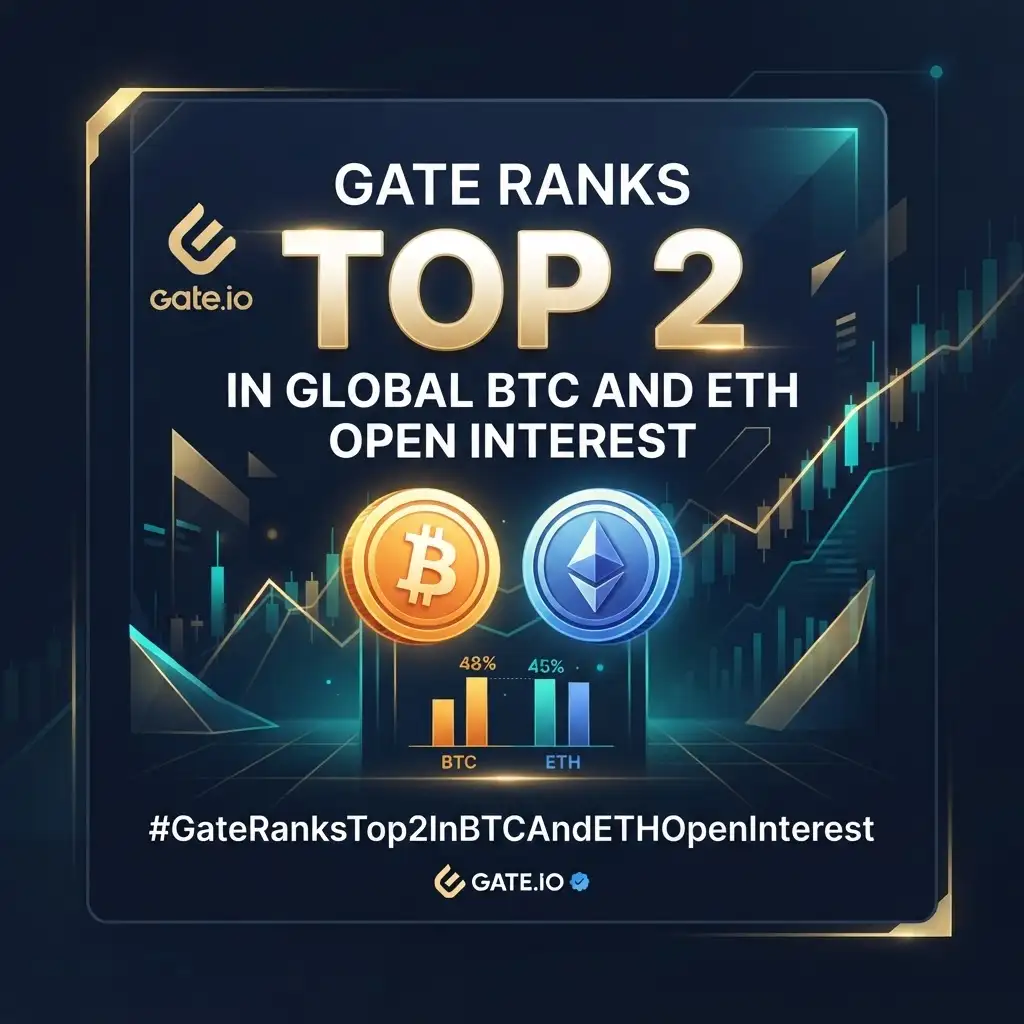
Gate has secured a Top 2 position in BTC and ETH open interest, putting its derivatives activity directly into the spotlight.
And for anyone tracking where serious crypto-market liquidity is concentrating, this deserves a much closer look.
Open interest is not simply a number.
It represents the total value of outstanding derivatives positions and provides an important window into how much capital and leverage are currently active in a market.
So when an exchange ranks among the leaders in both Bitcoin and Ethereum open interest, the signal becomes considerably more significant.
Here are the TOP 4 reasons this Gate development deserves attention.
---
🥇
#1 — BTC + ETH OPEN INTEREST IS A POWERFUL MARKET SIGNAL
Bitcoin and Ethereum remain two of the most important assets in the digital-asset derivatives market.
They attract institutional participants.
They attract professional traders.
They attract market makers.
And they account for a substantial portion of crypto derivatives activity.
That makes Gate's Top 2 position across both BTC and ETH open interest particularly noteworthy.
It indicates that Gate is competing in one of the most sophisticated segments of the crypto market:
leveraged derivatives liquidity.
This is not about simply having a large number of listed tokens.
It is about attracting active market participants who are using advanced trading products.
And that distinction matters.
The deeper the derivatives market becomes, the more important liquidity, execution, risk management and infrastructure become.
Gate's position therefore deserves to be viewed through the broader lens of market infrastructure, not just exchange rankings.
---
🥈
#2 — OPEN INTEREST SHOWS WHERE TRADING ACTIVITY IS BUILDING
Why should investors care about open interest?
Because price alone doesn't tell the complete story.
Imagine Bitcoin rises 5%.
That tells us BTC appreciated.
But if open interest is simultaneously expanding, the market is telling us something additional:
More derivatives positions are being created.
That can signal increasing trader participation and leverage.
However, open interest must always be interpreted alongside funding rates, liquidation data, volume and spot flows.
High open interest can support market liquidity.
But excessive leverage can also increase liquidation risk.
That is why professional traders do not look at one metric in isolation.
They examine the entire market structure.
And Gate's Top 2 standing in BTC and ETH open interest puts its derivatives platform firmly inside that conversation.
---
🥉
#3 — THIS STRENGTHENS GATE'S POSITION AS A MULTI-MARKET TRADING PLATFORM
There is a major difference between being known primarily for spot trading and becoming a platform with significant derivatives activity.
Derivatives require sophisticated infrastructure.
They require deep liquidity.
They require reliable order matching.
They require risk-management systems.
They require traders who are actively willing to deploy capital.
Gate's strong position in BTC and ETH open interest highlights the growing importance of its derivatives ecosystem.
And this is happening while the broader Gate ecosystem continues expanding across trading, Web3, blockchain infrastructure and digital assets.
That creates a larger strategic picture:
Spot + Futures + Web3 + Infrastructure + Community
The more comprehensive the ecosystem becomes, the more opportunities users have to remain within one platform across different stages of their crypto journey.
That is strategically important in an increasingly competitive market.
---
🏆
#4 — GATE IS COMPETING WHERE LIQUIDITY MATTERS MOST
The crypto exchange landscape is brutally competitive.
Every platform wants:
More users.
More volume.
More liquidity.
More institutional participation.
More derivatives activity.
But not all market segments carry the same significance.
BTC and ETH derivatives are among the most closely watched areas of the market.
That is why Gate's Top 2 ranking deserves attention.
It demonstrates that the platform is not merely competing for retail spot users.
It is also participating in a market where professional trading activity and liquidity depth are critical.
And this is where the Gate story becomes much larger than a single ranking.
The real question is:
CAN GATE CONTINUE TURNING MARKET ACTIVITY INTO DEEPER, MORE SUSTAINABLE LIQUIDITY?
That is the metric worth watching next.
---
🚨 WHY OPEN INTEREST MATTERS RIGHT NOW
The timing is particularly important.
Crypto markets are experiencing periods of rapidly changing volatility.
Bitcoin and Ethereum can move sharply within hours.
When derivatives positioning grows, those moves can become amplified.
More open positions can mean more liquidity.
But it can also mean more leverage.
And more leverage can create larger liquidations when the market moves aggressively.
That makes exchange infrastructure increasingly important.
Traders need platforms capable of handling intense periods of activity while maintaining reliable execution.
Gate's growing presence in BTC and ETH derivatives therefore becomes part of a much broader market-infrastructure discussion.
---
🔥 THE BIGGER GATE NARRATIVE
Gate's Top 2 position in BTC and ETH open interest should not be viewed in isolation.
It fits into a broader evolution of the Gate ecosystem.
The crypto industry is moving toward platforms that provide users with a complete financial and Web3 environment.
Users increasingly want access to:
🔹 Spot trading
🔹 Futures and derivatives
🔹 Earn products
🔹 Web3 applications
🔹 On-chain ecosystems
🔹 Token launches
🔹 Market research
🔹 Community engagement
The competition is no longer simply:
“Who has the most trading pairs?”
It is increasingly:
“Who can build the deepest and most complete crypto ecosystem?”
Gate is clearly positioning itself within that competition.
---
⚡ THE 4 METRICS TO WATCH NEXT
If Gate wants to convert this Top 2 position into a longer-term competitive advantage, four areas deserve attention:
1️⃣ OPEN INTEREST
Does Gate continue maintaining strong BTC and ETH derivatives participation?
2️⃣ LIQUIDITY
Can traders execute large positions efficiently during volatile markets?
3️⃣ VOLUME
Does strong open interest translate into sustained trading activity?
4️⃣ ECOSYSTEM GROWTH
Can derivatives strength contribute to broader Gate ecosystem adoption?
These metrics will tell a much deeper story than a single ranking.
---
🚀 FINAL TAKEAWAY
GATE RANKS TOP 2 IN BTC AND ETH OPEN INTEREST.
That is a powerful market signal.
But the real significance goes beyond the ranking.
It highlights Gate's growing role in one of crypto's most competitive segments: derivatives liquidity and trading infrastructure.
BTC.
ETH.
Futures.
Liquidity.
Open interest.
Professional trading.
These are the areas where the next generation of crypto platforms will increasingly compete.
And Gate is putting itself directly into that conversation.
🔥 Don't just watch the ranking. Watch the infrastructure behind it.
Track Gate's derivatives activity.
Monitor BTC and ETH open interest.
Follow liquidity and volume.
Explore the wider Gate ecosystem.
And stay connected with Gate Square for the latest market developments and ecosystem narratives.
GATE IS NOT JUST FOLLOWING THE MARKET.
IT IS COMPETING FOR A LARGER SHARE OF THE MARKET'S LIQUIDITY.
The ranking is the headline.
The real story is what Gate builds from here.
@Gate_Square