#WarshIMFSpeech
CORE MESSAGE FROM WARSH AT IMF FORUM 🏛️
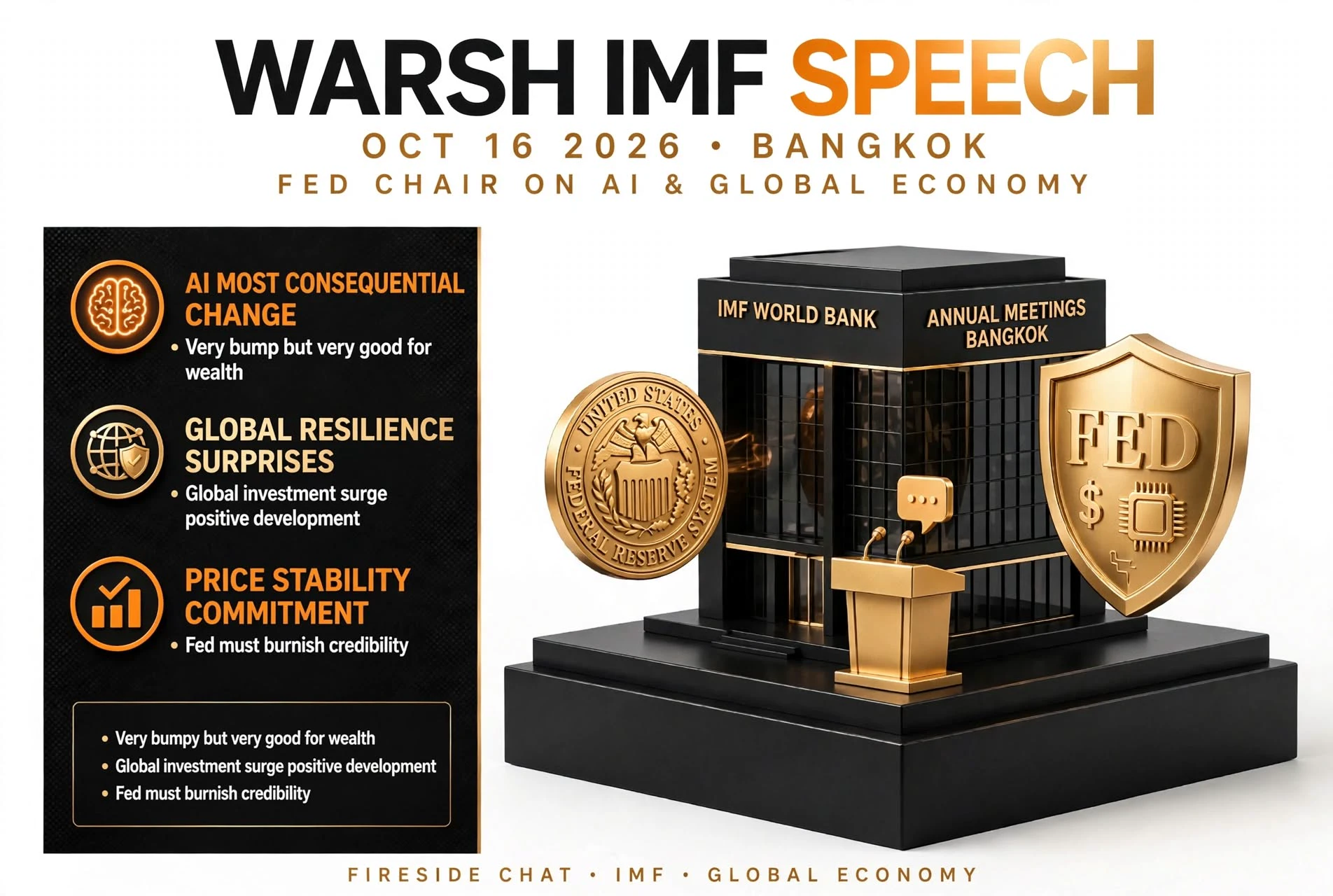
Kevin Warsh used his IMF speech to lay out a clear view on money, trust and central bank role. He framed recent years as a test of credibility. Easy money helped in crisis, but long spell of low rates plus large balance sheet left lasting costs.
His main point was simple. Price stability is core duty. When that duty slips, all other goals suffer.
WHY CREDIBILITY AND PRICE STABILITY MATTER 💡
Warsh argued that a central bank earns trust by keeping purchasing power firm over time. When inflation rises and stays high, trust erodes. Households and firms start to expect higher prices and act in ways that keep prices high.
He warned against mission creep. When a central bank tries to solve too many tasks at once, focus on inflation can blur. Clear mandate and clear talk help anchor expectations.
BALANCE SHEET AND POLICY TOOLS UNDER REVIEW 🔧
A key part of his speech focused on balance sheet size. Warsh noted that large asset holdings blur line between fiscal and monetary action. Smaller, more agile balance sheet gives more room to act in next shock.
He also called for humility in forecasting. Models are useful, but real economy often moves in ways models miss. Policy should be steady, data driven and ready to shift when facts change, not tied to rigid forward path.
FISCAL AND MONETARY LINK IN FOCUS 🏦
Warsh stressed link between fiscal stance and monetary outcome. High public debt and large deficits can make inflation fight harder. If fiscal path is loose, monetary tool must work harder, which lifts cost for private sector.
He urged closer look at how fiscal and monetary forces interact, without losing central bank independence. Independence, in his view, means freedom to act for long run price health, even when short run pressure pushes other way.
MARKET READ AND FORWARD SIGNAL 🚀
Market read his speech as hawkish on inflation but pragmatic on tools. Message was not about quick rate moves, but about framework. Keep policy tight enough to bring inflation back to target, keep balance sheet on path to more normal size, and keep communication honest about risks.
For investors, take away was that Fed credibility remains anchor for global finance. If credibility holds, long run rates can stay contained and growth can resume on solid base. If it slips, risk premium rises.
In sum, Warsh IMF speech was a call for focus, discipline and clear mandate. Less noise, more clarity on core job of keeping money sound.
$MU $INTC $NVDA $CRWV $LLY
CORE MESSAGE FROM WARSH AT IMF FORUM 🏛️
Kevin Warsh used his IMF speech to lay out a clear view on money, trust and central bank role. He framed recent years as a test of credibility. Easy money helped in crisis, but long spell of low rates plus large balance sheet left lasting costs.
His main point was simple. Price stability is core duty. When that duty slips, all other goals suffer.
WHY CREDIBILITY AND PRICE STABILITY MATTER 💡
Warsh argued that a central bank earns trust by keeping purchasing power firm over time. When inflation rises and stays high, trust erodes. Households and firms start to expect higher prices and act in ways that keep prices high.
He warned against mission creep. When a central bank tries to solve too many tasks at once, focus on inflation can blur. Clear mandate and clear talk help anchor expectations.
BALANCE SHEET AND POLICY TOOLS UNDER REVIEW 🔧
A key part of his speech focused on balance sheet size. Warsh noted that large asset holdings blur line between fiscal and monetary action. Smaller, more agile balance sheet gives more room to act in next shock.
He also called for humility in forecasting. Models are useful, but real economy often moves in ways models miss. Policy should be steady, data driven and ready to shift when facts change, not tied to rigid forward path.
FISCAL AND MONETARY LINK IN FOCUS 🏦
Warsh stressed link between fiscal stance and monetary outcome. High public debt and large deficits can make inflation fight harder. If fiscal path is loose, monetary tool must work harder, which lifts cost for private sector.
He urged closer look at how fiscal and monetary forces interact, without losing central bank independence. Independence, in his view, means freedom to act for long run price health, even when short run pressure pushes other way.
MARKET READ AND FORWARD SIGNAL 🚀
Market read his speech as hawkish on inflation but pragmatic on tools. Message was not about quick rate moves, but about framework. Keep policy tight enough to bring inflation back to target, keep balance sheet on path to more normal size, and keep communication honest about risks.
For investors, take away was that Fed credibility remains anchor for global finance. If credibility holds, long run rates can stay contained and growth can resume on solid base. If it slips, risk premium rises.
In sum, Warsh IMF speech was a call for focus, discipline and clear mandate. Less noise, more clarity on core job of keeping money sound.
$MU $INTC $NVDA $CRWV $LLY