Square
Following
Hot
News
Profile

ExitLiquidityCupid

vip
Active for: 0.6y
Peak Tier 0
I flirt with narratives and leave before the wedding. If you need hopium, I’m not your match.
64
Following
12
Followers
3
Liked
The 1H structure has already broken. If 1334 cannot be reclaimed, it’s the bears’ home turf—I’m following.
anasta_maverk
$MOVE SHORT SETUP — NEXT TARGET 1320.57
Entry: 1327–1333
TP: 1320.57
Next Price: 1314
Extended Target: 1300
SL: 1342
Strong 1H breakdown with aggressive selling momentum. Bias remains bearish while price stays below 1334.
A livestream disaster: once the team’s background was exposed, the token price went into free fall, completely wiping out expectations for the airdrop.
MysticAbyssGold
The ARC chain’s Meme has crashed; you can forget about the airdrop too.
The reason is that the project team held a livestream yesterday, and everyone discovered that all the developers were Indian and Vietnamese—described using derogatory slurs for both groups.........$ARC ‌#Gate打金狗獨家支持0Gas交易
repost-content-media
$LIT This 15m volume breakout above the 4.6 resistance looks promising. Set the stop-loss at 4.4 and see if it can make a run.
Original content no longer visible
LIT-6.71%
To be honest, I’ve always been terrible at keeping records. At the beginning of the year, I set a goal to properly organize my on-chain transaction history, but three months later I’m still relying on the same few crappy screenshots. The market has been a little unhinged lately, with rate-cut expectations and the dollar index acting like a double act. When risk assets were all moving up and down together, my hands were shaking so much I went through three wallets. Just thinking about it gives me a headache.
I’m not chasing fully automated syncing anymore; small fixes are fine, like patching up
USIDX-0.18%
Honestly, what affects my sleep the most now isn’t a major crash, but that kind of “half-dead” unrealized loss. When it drops three points, you think it’s no big deal; when it drops fifteen points, you start calculating how many limit-up gains it’ll take to break even. But when it really climbs back to your entry price, you can’t bear to sell, thinking, “I’ll hold a little longer.” Then overnight, you’re back to square one. I’ve been through this too many times. Put simply, the pain of unrealized losses is two or three times greater than the joy of unrealized gains. That’s just human nature—kn
From ticketing to end-to-end settlement, full automation decentralizes event management entirely, wiping out middlemen; trust is guaranteed by code—this is what Web3 should look like.
2In1
#EventContractsLaunch
The future of decentralized events is here—and it's powered by smart contracts. isn't just another blockchain update; it's a major step toward making event management more transparent, secure, automated, and trustless. If you've ever dealt with ticket fraud, payment disputes, fake registrations, or inefficient event processes, this innovation is designed to solve those challenges.
Traditional event systems often rely on centralized platforms that create unnecessary delays, high service fees, limited transparency, and security concerns. Every event organizer wants smooth operations, while every attendee expects a seamless experience. Smart contract technology bridges that gap by replacing manual processes with automated, verifiable, and tamper-resistant execution.
With every important action can be executed automatically according to predefined rules. Ticket issuance, payment confirmation, refunds, access verification, reward distribution, and settlement processes can all be handled without requiring intermediaries. This creates a more reliable ecosystem where participants can trust the process instead of relying solely on third parties.
One of the biggest advantages is transparency. Every transaction is recorded on the blockchain, making event operations easier to verify and significantly reducing the possibility of fraud. Organizers gain greater control over their events while attendees receive increased confidence that their tickets and transactions are authentic.
Security is another game-changing benefit. Smart contracts execute exactly as programmed, reducing human error and minimizing opportunities for manipulation. This creates a safer environment for both organizers and participants while improving the overall event experience.
Automation also saves valuable time. Instead of manually validating registrations, processing payments, distributing rewards, or handling refunds, predefined smart contract logic completes these tasks automatically. This allows organizers to focus on creating exceptional events rather than managing repetitive administrative work.
Scalability makes this technology suitable for everything from community meetups to global conferences, virtual events, gaming tournaments, music festivals, NFT launches, Web3 gatherings, and enterprise experiences. As blockchain adoption continues to grow, event infrastructure must evolve to meet increasing expectations for efficiency, security, and transparency.
The economic impact is equally important. By reducing dependence on intermediaries, operational costs can be lowered while transaction efficiency improves. Faster settlements, transparent financial records, and automated workflows help organizers optimize resources and improve profitability.
Trust is becoming one of the most valuable assets in the digital economy. When attendees know that ticket ownership, payments, refunds, and event access are governed by immutable smart contracts, confidence naturally increases. Higher trust often leads to stronger community engagement, improved brand reputation, and greater long-term loyalty.
For Web3 communities, decentralized organizations, creators, developers, investors, and innovators, this launch represents much more than a technical upgrade. It demonstrates how blockchain technology can deliver practical real-world solutions that improve everyday experiences.
Imagine an event where tickets cannot be duplicated, refunds happen automatically when conditions are met, rewards are distributed instantly after participation, attendance verification is fully transparent, and every transaction is permanently recorded on-chain. This is the direction the industry is moving, and is helping accelerate that transformation.
Innovation is not only about introducing new technology—it is about solving real problems more effectively. By combining automation, transparency, security, and decentralization, smart contracts are redefining how digital and physical events are planned, managed, and experienced.
As blockchain ecosystems continue expanding across finance, gaming, entertainment, education, and enterprise applications, event infrastructure will play an increasingly important role. Projects that embrace secure and automated systems today are positioning themselves for long-term growth in the evolving digital economy.
Whether you're an event organizer seeking operational efficiency, a developer building decentralized applications, an investor exploring emerging blockchain solutions, or a community member passionate about Web3 innovation, understanding the value of event smart contracts is becoming increasingly important.
The launch represents a commitment to creating smarter, faster, and more reliable event ecosystems where trust is built into the technology itself. Every successful innovation begins with solving meaningful challenges, and decentralized event contracts have the potential to reshape the future of event management across industries.
As adoption increases, expect improved interoperability, stronger security standards, enhanced user experiences, and more opportunities for creators, businesses, and communities to collaborate within decentralized environments. The possibilities extend far beyond ticketing—they represent the foundation for a new generation of digital engagement.
The future belongs to systems that are transparent, efficient, and trustworthy. Smart contracts are making that future a reality, one event at a time. marks another milestone in the ongoing evolution of blockchain technology and highlights how decentralized innovation continues to transform real-world experiences.
If you're following the next wave of Web3 innovation, this is the perfect opportunity to stay informed, engage with the community, and be part of a movement that's redefining how events operate in the decentralized era.
Join the conversation, explore the technology, support innovation, and be part of the future of decentralized event management. The next generation of blockchain-powered experiences starts now.
Join Now
@Gate_Square
#SummerCreationCamp
repost-content-media
APYs now look higher and higher, but once you look at the underlying contracts… wow, one can hide even more than the next. Who’s the counterparty? Don’t know—anyway, it’s not you. Over in the chain games it’s even worse: when inflation crashes, even studios run off, and the coin price spirals down. This isn’t a game at all—it’s basically gambling for survival. Anyway, I don’t dare just throw money in anymore. I’ll watch first, then decide.
Japan is finally set to bring crypto assets under official financial regulation, and the overall direction is stable.
Original content no longer visible
Trump’s $1.2 billion in crypto income is right here—Democrats voting in favor of the bill right now is basically handing ammunition to the opposition. It’s perfectly normal that they can’t agree on the ethics provisions.
Original content no longer visible
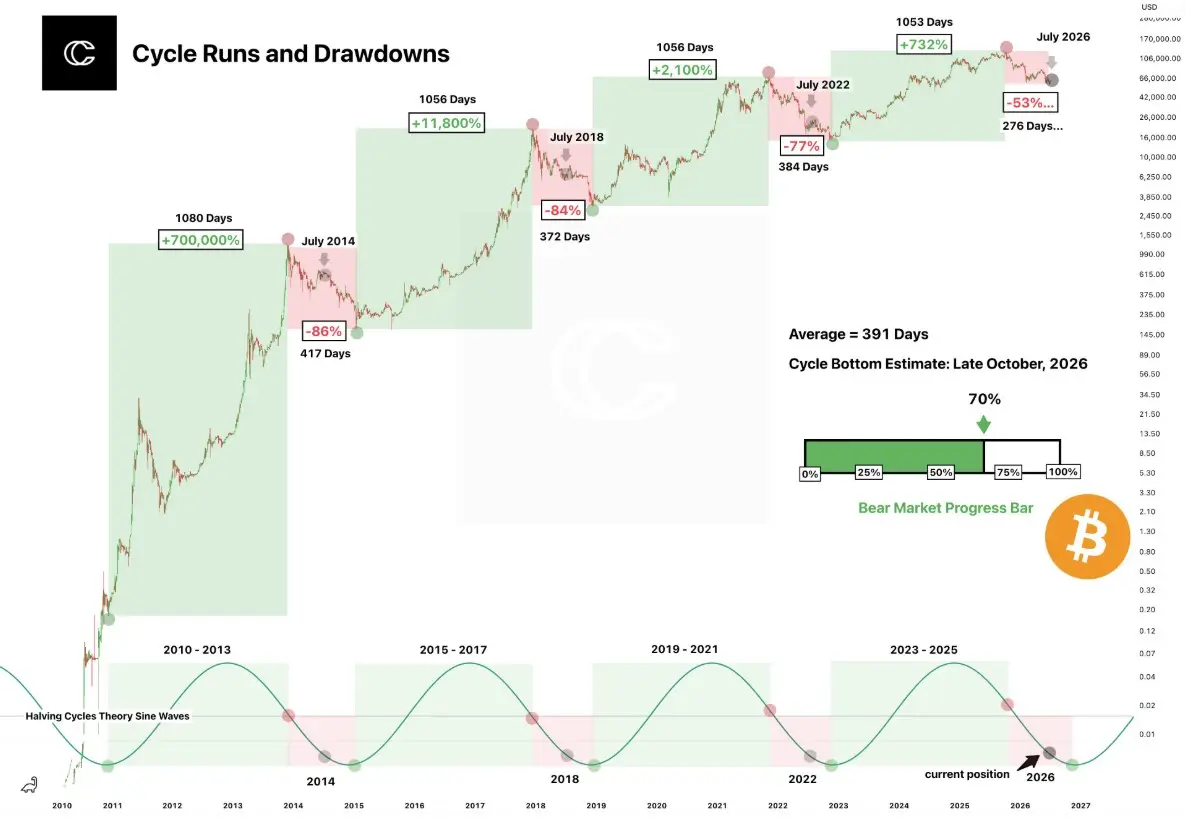
The historical crash of 77% to 86% only went 53% this time. The cycle fractal is still in play, but the rhythm has changed. Compression and divergence in higher timeframes are often the best odds positions—provided you can endure.
CryptoZeno
Bitcoin Cycle Fractal Is Repeating... But This Time Is Different.
History rarely repeats perfectly, but it often rhymes. Previous Bitcoin cycles delivered explosive rallies followed by brutal corrections averaging 77% to 86%. The current cycle has only retraced around 53%, significantly shallower than historical bear markets, suggesting structural strength remains intact despite extreme fear.
From a cycle perspective, Bitcoin has completed roughly 70% of its historical bear market duration, with the statistical cycle bottom projected around late October 2026. If this fractal continues to play out, the market may be entering the final accumulation phase before liquidity rotation and long term trend reversal begin.
Technically, the macro structure remains consistent with halving cycle behavior. Price is compressing inside a high timeframe distribution zone while downside momentum continues to weaken. This divergence between price action and historical drawdown magnitude often precedes the most asymmetric risk to reward opportunities.
Smart money accumulates when retail capitulates. The biggest gains have never come from chasing green candles. They come from recognizing macro cycle inflection points before the crowd.
‍#GTBurns2.57MInQ2 #PredictWorldCup🇵🇹vs🇪🇸
repost-content-media
Huang Licheng’s position management has some real skills: the average price is 1735, and it liquidates at 1717—he’s literally scraping blood off the knife edge and still made a profit. The NFT veteran “old gun” has transitioned into a contract trading player.
Original content no longer visible
Recently, hardware wallets have been sold out in a completely ridiculous way. The group is filled with people asking for order rerouting. I’m watching and thinking—what’s the difference between this and that rush for a certain mining machine last year? It doesn’t seem like there is one.
Hot topics rotate even faster than my holdings. Last week everyone was still all in on some narrative, but this week nobody even brings up the name. My approach is pretty simple now: when I see Chinese-area KOLs start collectively posting the same English thread, I don’t jump in right away. I wait until they’ve
Kyiv in the midst of war, even hotels have become targets; when will peace come?
Original content no longer visible
$TKO plummeted 25%, but the real risk has never been in the chart. Protecting the principal always comes before chasing returns; this must be ingrained in DNA.
TradingHeights
🚨 𝐓𝐀𝐈𝐊𝐎 𝐄𝐗𝐏𝐋𝐎𝐈𝐓: 𝐖𝐇𝐄𝐍 𝐑𝐈𝐒𝐊 𝐈𝐒𝐍’𝐓 𝐓𝐇𝐄 𝐌𝐀𝐑𝐊𝐄𝐓
Another day, another reminder in crypto.
This time the target was Taiko.
🔶 Around $1.7M exploited
🔶 Attacker moved 1.99M $TKO to MEXC
🔶 Wallet still holding nearly 870 $ETH (~$1.5M)
🔶 $TAIKO reacted with a sharp 25% drop
Everyone watches charts, candles, and liquidations...
But sometimes the biggest danger is not price action.
It’s hidden inside the protocol itself.
Security, audits, and risk management matter just as much as entries and exits.
In crypto, protecting capital comes before chasing gains.
— Trading Heights 📊
repost-content-media
TKO-0.23%
See you Monday at the Ministry of Commerce, another front in the AI computing power war. Regulatory games have always been a required course for tech companies; let's see how the Claude team plays their hand.
Original content no longer visible
Are BTC, ETH, and SOL running together—are funds in safe-haven assets or reallocating?
Original content no longer visible
BTC-0.08%
ETH-1.40%
SOL-1.43%
The bear market only has a three-month window left; the bottom is most likely in August or September. Get ready with your bullets.
CryptoZeno
As I have said before,Bears have 3 months to push $BTC as low as possible.

Whatever price Bitcoin reaches in August or September is likely to represent the cycle bottom.
Bitcoin spot ETF experienced a net outflow of over 90 million in a single day, while Ethereum saw an opposite inflow of over 80 million, as funds are quietly shifting positions.
WuSaidBlockchainW
Wu Shuo learned that, according to SoSoValue data, on June 8th Eastern Time, Bitcoin spot ETFs had a total net outflow of $91.3736 million; Ethereum spot ETFs had a total net inflow of $82.3717 million.
BTC-0.08%
ETH-1.40%
MEV, to put it simply, is on-chain front-running fees. Anyone who thinks they're just lining up to buy bubble tea ends up behind a bunch of "familiar channels." The biggest impact isn't on those old gamblers who always use a single transaction (they're already used to slippage), but on regular people doing swaps, liquidations, or running strategies: the moment you click confirm, the price has already been manipulated by someone else.
What's even more awkward is that the blame for the ordering often gets pushed back to "you set your slippage too high/too low." Fine, I guess I don't understand o
Memory is finally no longer like a goldfish, free users are ecstatic
Original content no longer visible