Square
Following
Hot
News
Profile

ColdWalletUnderTheAurora

vip
Active for: 0.5y
Peak Tier 0
Trusts hardware wallets and slow-paced allocation more, bullish on infrastructure in the long term. Doesn't speak often, but always includes some risk warnings each time.
63
Following
10
Followers
8
Liked
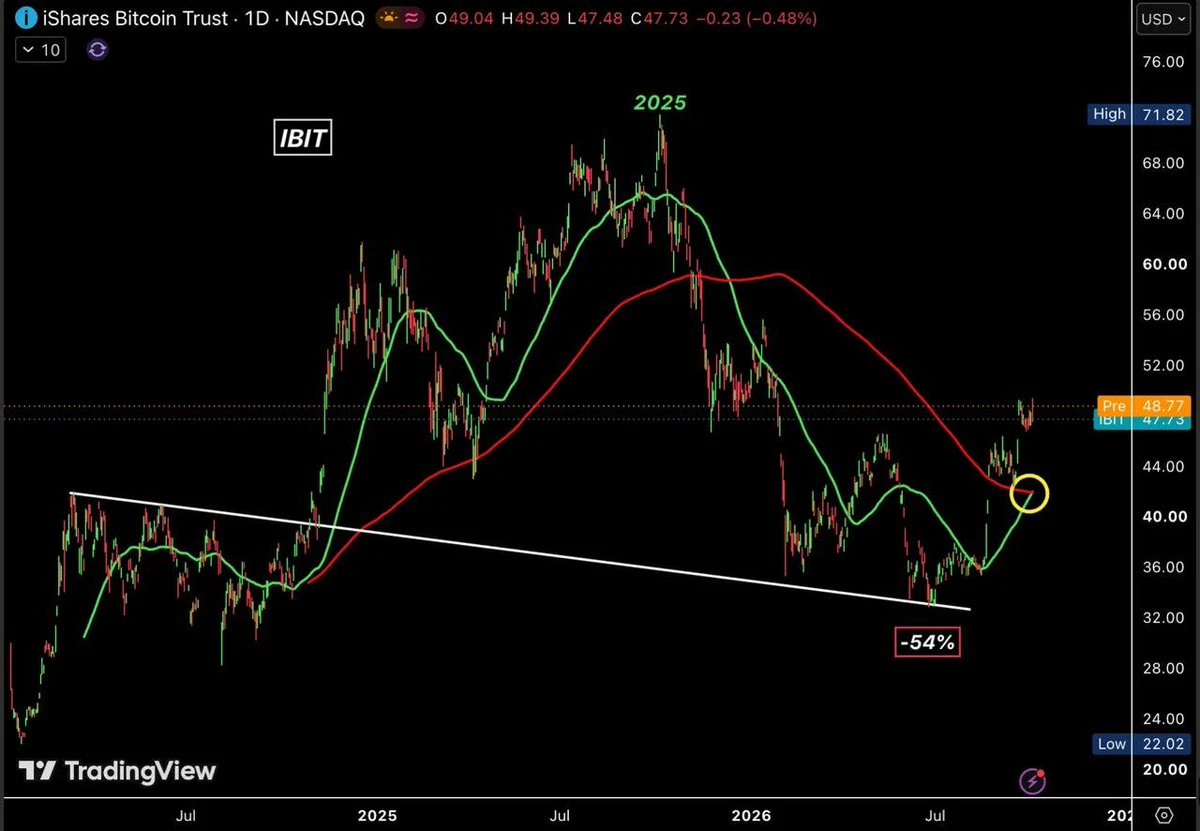
BlackRock’s Bitcoin ETF has flashed a golden cross signal, indicating a bullish trend, but it is not a guaranteed win and remains under observation.
alimadao
BLACKROCK’S BITCOIN ETF $IBIT JUST PRINTED ITS FIRST-EVER GOLDEN CROSS.
After falling 54% from its 2025 high of $71.82 to the 2026 low, $IBIT spent months struggling below its 200 day moving average, which acted as resistance.
Now, price has reclaimed both the 50day & 200day moving averages, confirming a golden cross.
This is an important trend signal but it’s not a guaranteed buy signal.
From here, I’m watching two key scenarios:
• Hold above both MAs → bullish trend remains intact
• Lose both MAs → momentum could turn bearish
For me, the key is whether $IBIT can sustain this breakout and build above the moving averages.
repost-content-media
BTC+0.66%
Mark it first; don’t rush to follow—signals from those who move fast should be read contrarianly.
MysticAbyssGold
He still doesn’t qualify as a true KOL. Observe for a few days or several rounds first, and also look at the coin’s price pattern: is it at a peak or a low, and is it rising or falling? You can only use the coins this person buys as a reference, because they usually move faster than you.
repost-content-media
$350 is a critical level—if it holds above, $360 is next; if it fails to hold, it will pull back to $340 for support, with both bulls and bears waiting for direction.
Jens
$GOOGLG is trading near $344.47 after a mild decline.
Price is currently between $340 support and $350 resistance.
A break above $350 could target $360. Losing $340 would put buyers under additional pressure.
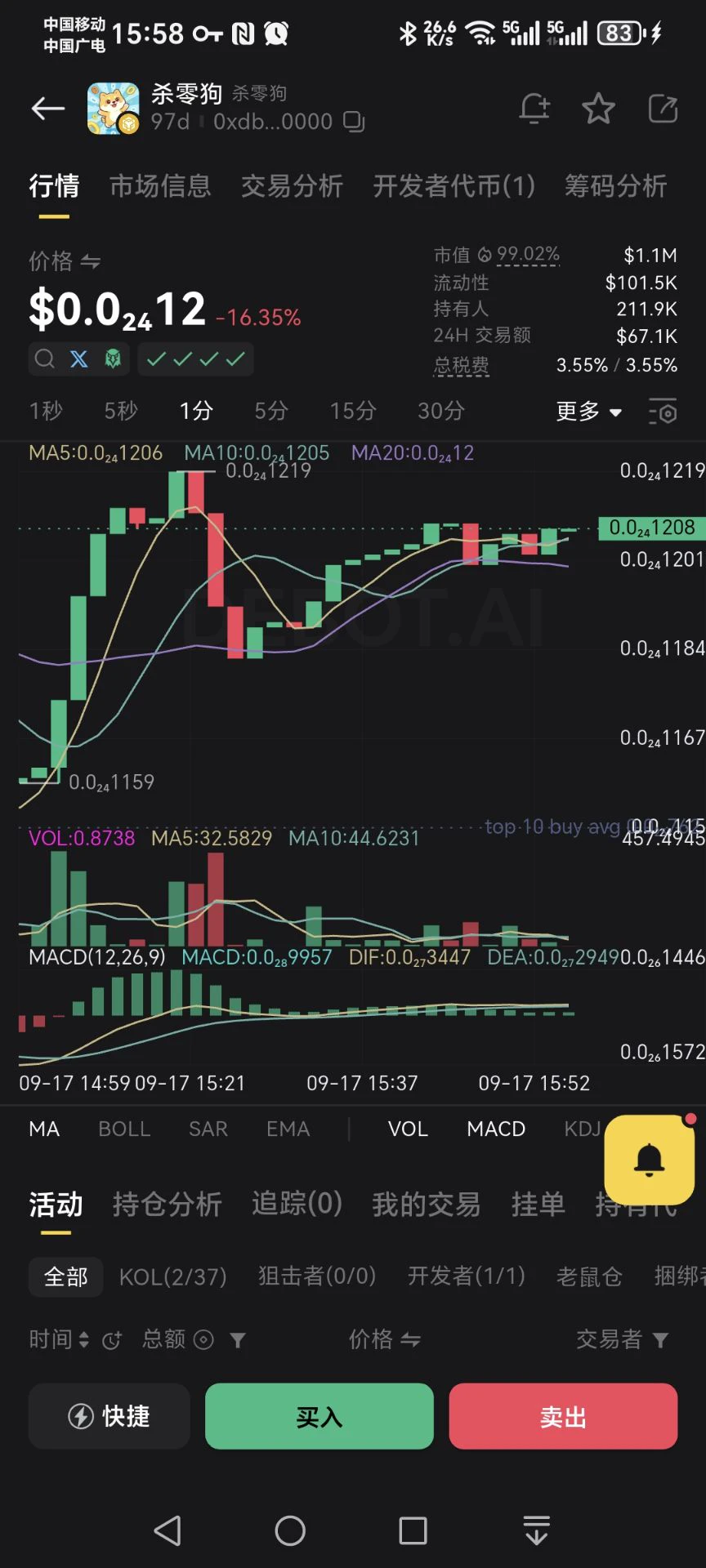
The bearish structure is clear. If the rebound is rejected in the $1,215-$1,220 area, another sharp drop is highly likely. Don’t take too large a position.
HECTOR
$SKHYNIX — Bearish Setup 📉
$SKHYNIX remains under pressure after a sharp breakdown, with sellers in control below $1,220.
📍 Entry: $1,200–$1,207
🎯 TP: $1,188 / $1,175 / $1,160
🛑 SL: $1,220
A rejection near $1,215–$1,220 could trigger another downside move. DYOR.
#SKHYNIX #GPRO #RBLX #StockTrading #CoinMarketCap
Honestly, it took me a while to figure out how to handle multichain wallets. I used to create one for every chain, claim airdrops here and there, and save screenshots across a dozen-plus documents. Eventually, I’d get confused trying to find anything. So I streamlined: core assets go in a hardware wallet, limited to the few chains I truly trust; temporary-use funds and small amounts go in a hot wallet as pocket money—if they’re lost, it won’t be a major setback. I confirm every transfer twice now anyway, so a little extra time is fine.
Hardware wallets have been sold out everywhere lately, whi
Recently everyone has been talking about restaking and shared security, and there’s some questioning about “matryoshka doll” yield stacking and whatnot. To be honest, I feel a bit dizzy. Anyway, I’m pretty laid-back: I hold onto the infrastructure long-term and can’t be bothered to move it around. No matter how high the “doll within a doll” yields are, the real headache is only when, during year-end tax filing, the books don’t match.
Personally, I’ve gotten into the habit of tagging each on-chain operation in my hardware wallet notes—things like “staking,” “transfer,” “airdrop”—and then pairin
Just saw someone in the group posting their market-making profits, and honestly I’m pretty scared. That AMM curve looks smooth, but impermanent loss is not something to mess with—especially during big swings. The liquidity you provide feels like fuel for the market: you could be taking losses and not even realize it. With funding rates so extreme lately, everyone’s arguing about whether there’ll be a reversal or whether people will keep squeezing the bubble—either way, I don’t dare to add to a pool at a time like this. That’s it—I’m going to check whether I should withdraw a bit from my LP pos
Suddenly remembered a liquidation record from a testnet I looked at a couple of days ago—the oracle’s price feed delay was pretty obvious. It was only a few seconds, but in those few seconds, several positions were wiped out. Anyway, since it’s just a testnet, it’s fine. If this were happening on the mainnet, that would be really rough.
Honestly, I trust slower-paced configuration more. For infrastructure-type projects, stretching things out doesn’t seem like a big problem to me. But with oracles, once something goes wrong—especially price feed delays for cross-chain bridges or low market-cap
Just saw a whale address buying, and I almost followed in. I calmed down and checked the on-chain data—it's quite a large amount, but on closer inspection it's actually going toward an exchange, so it could be hedging and not a real new position. When it comes to copy-trading, you really can’t just look at appearances—tell whether it’s positioning or hedging, or otherwise you’re likely to end up as the bag-holder. The old players are right: don’t always think you can make it out with the last baton. If I’m a bit timid, then so be it—less loss is still profit.
Lately, there’s been a lot of chatter in the group about MEV. Everyone’s talking about on-chain “front-running” issues. To put it plainly, someone can see your transaction early and steal the run, or sandwich you in the middle. This really is a bit annoying—ordinary users get worse slippage and costs go straight up. Anyway, I feel that if the sorter is too centralized, then it’s not much different from the little shady practices in traditional finance.
Recently, a bunch of testnets have been rolling out points-based incentives, and everyone is charging pretty hard. No one knows whether the mai
Seeing new users still charge into those contracts with unlimited allowances really makes me restless. Anyway, I recently revoked the approvals for a few of my old contracts, so I can sleep easy. (Danmaku: Don’t ask—ask and you’ll know I’ve been scammed before.)
To be honest, now it’s meme rounds and celebrity shilling call-outs taking turns. Old players are all advising you not to take the last step of the relay, but there’s always someone who thinks, “This time is different.” I think it’s better to lock down those “unlimited allowance” permissions first, instead of chasing the latest hot top
MEME+1.02%
Just saw someone comparing RWA with on-chain U.S. Treasury yield products. I haven’t studied it deeply either, but I can’t shake the feeling that those that routinely offer annualized returns of dozens of percentage points—before anything else, you should look through their GitHub and audit reports. Not just whether they have been audited, but which team performed the audit, whether there’s a publicly available list of known issues, and whether the addresses for upgraded multisigs are transparent. I personally put 0.1 ETH into a slowly configured pool; after waiting for two weeks, I only then
RWA+1.49%
ETH+0.98%
Recently, a lot of people in the group have been farming testnet points. It was originally just something to practice, but now it feels like fighting—staring at the rankings every day. For my part, I think these points are basically just expectations; once your expectation is satisfied, it’s easy to get carried away. On-chain data tools have recently been criticized for being laggy—there are even people who intentionally spam tags to trick others into getting into the pool. You’ve seen this kind of thing a lot—if you believe it, it wins. I wrote one line in my notes: Don’t take your testnet pe
I just came across that staking unlock calendar—seeing a huge list of unlock schedules made my heart skip a beat. People say there’s anxiety about sell pressure, but I think: machines can automatically run strategies, but when to reach in and close the gate, it still has to be reviewed by a human.
AI Agents have been getting a lot of hype lately—automatic interactions, automatic trading, and it’s definitely hassle-free. But what about the core permissions? Who manages the private keys? If the contract has a backdoor, the faster the Agent runs, the more completely it all goes bad. In the end, t
Just saw people in the group talking about market making again—some nonsense like “easy money lying down.” This is my third time reminding myself: don’t fall for that. Once you run the numbers on the AMM curve, impermanent loss can wipe out your profits in minutes, especially in pools with high volatility. Last week, a friend told me that one of his LP positions went into the red—not because of some tug-of-war on both ends. Plainly put, it’s just being the one who catches the fallout for someone else—getting stuck as the bag-holder. As for me now, I only dare to use stablecoins or a clearly es
Recently, I’ve been watching stablecoin supply rise and rise, with ETF funds flowing in and out. A lot of people are directly saying, “Over-the-counter capital is here, and the bull run is about to start.” Honestly, I’m quite afraid of this kind of linear reasoning—correlation and causation can be way too far apart. Back in the DeFi summer over the past couple of years, liquidity also surged. And what happened then? It actually reminded me not to get carried away by short-term data.
The whole “shared security + yield stacking” re-staking setup has also been under heavy debate lately. Some peop
Honestly, stopping losses is like a breakup—the longer you drag it on, the worse it feels. If you accept the loss sooner, you can free up capital and do something else. Anyway, the interest is money you’re saving too. Lately, after looking at an upgrade on a certain blockchain, the group chat started guessing again whether ecosystem projects might migrate with their whole setup. I’m not in a rush—I’ve been used to a slow pace of allocation. I keep it in a hardware wallet; less tinkering means more peace of mind. Talk again next time.
To be honest, every time I see someone in a group chat share a screenshot of sandwich trading arbitrage, my first reaction isn’t envy—I’m actually worried for them. All that “profit” is basically other people’s slippage; in plain terms, it’s just fees wearing a different name. Lately, during the airdrop season, the anti-sybil tasks platforms have been cracking down so hard, and the points-based system has become a grind like clocking in for work. Anyway, I’m a laid-back player—I’m too lazy to get involved. I’d rather slowly accumulate some basic infrastructure instead; at least then I can slee
Chasing “airdrop free money” is starting to feel more and more like going to work—staring at tasks, calculating points, and screening out botting/sybil activity is even more exhausting than writing weekly reports. Last year’s low-guarantee (welfare-style) playbook has basically been wiped out this year—scoring rules keep getting changed, and if you mess up even a little, you get filtered out. Lately I keep seeing big on-chain transfers being interpreted as “smart money” anomalies; anyway, I don’t understand these signals at all, and I’m afraid that if I follow them, I’d just end up as the bagh
Testnet points are getting competitive too—honestly, it’s pretty interesting. Before, I thought it was just pure practice, but now everyone is chasing it with expectations. Still, once you start putting time and effort in, sunk cost makes it hard to just stop. I set a rule for myself: first, check the source—whether there’s any clear expectation for token allocation—then see whether it’s actually an application I genuinely want to use. If it’s just bandwagon farming, then treat it as training and don’t genuinely treat it as an investment. Like the whole NFT royalty thing—people keep arguing th