








#黄仁勋复职英伟达一度大涨30% What Changed and What Stayed the Same After Jensen Huang's Return
Looking at the history of Silicon Valley, founders' “returns” after losing the helm have evolved into four models:
1️⃣ The first is “enduring hardship” (the Steve Jobs model). With an 11% stake under a one-share-one-vote structure, he was shown the door by the board, with no dual-class voting rights to protect him. He could only tough it out for 12 years and build NeXT, waiting until Apple was just 90 days from bankruptcy before making a comeback through its acquisition.
2️⃣ The second is “a substitute taking the place of another” (the Larry Page model). Early on, VCs pressured him to hand the CEO role to Schmidt as an “adult supervisor,” but when Google went public in 2004, he quietly gave himself Class B shares carrying 10 votes per share. With control in his hands, when he wanted to return in 2011, one sentence was enough to reclaim the helm.
3️⃣ The third is “the Chenqiao mutiny” (the Sam Altman model). He didn't even own 1% of the company. After the board ambushed and fired him, he relied on more than 700 employees signing a collective resignation letter to force the board's hand, plus Microsoft, the major backer, providing a backstop. In 5 days, he completed a spectacular counterstrike and reclaimed the throne.
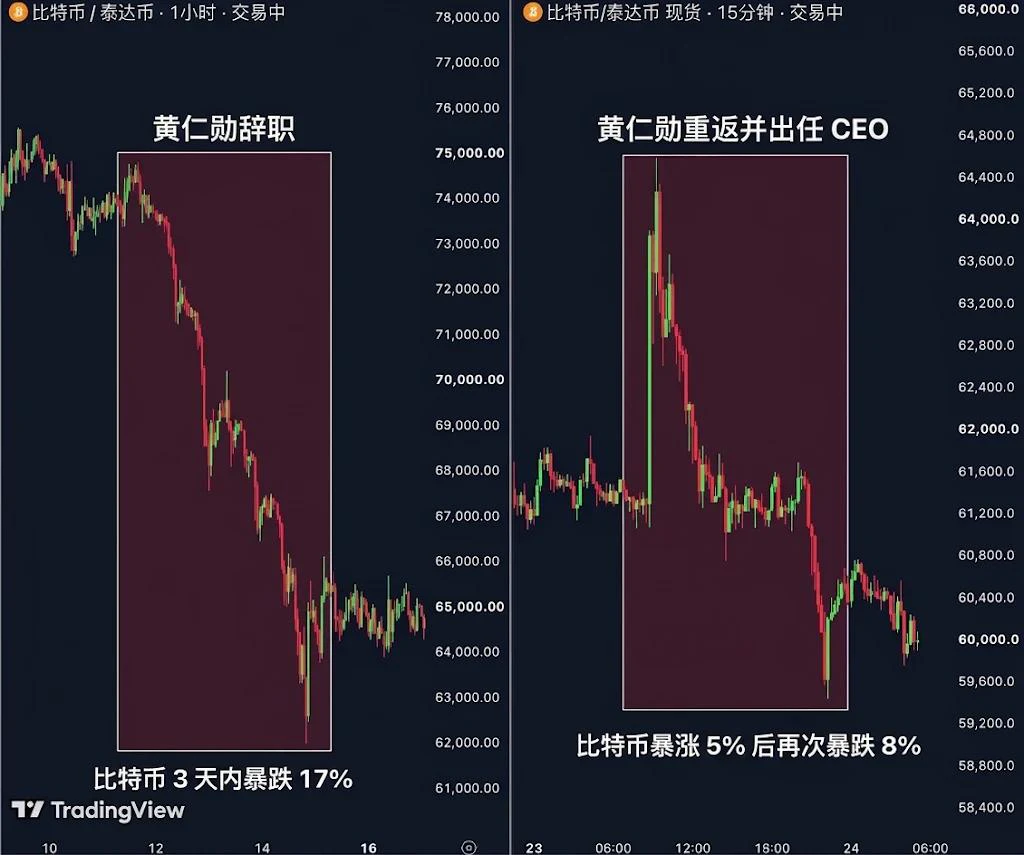
4️⃣ The fourth is Jensen Huang's play of “national destiny + market cap forcing the issue.” There are no dual-class shares, and he has only a 3.58% diluted stake. But after he left, even though the company delivered its strongest quarterly earnings report ever, with $115.8 billion in revenue, its stock still plunged 33%, wiping out more than $1 trillion in market value.
Wall Street has proven with real money that Jensen Huang alone is worth $1 trillion.
At the basic level, power comes from the chips you hold; at the intermediate level, it comes from dual-class shares; at the highest level, it's called “too big to fail.” When you have become the sole person in control of a $4 trillion empire and the linchpin of the U.S. bull market, you no longer need super-voting rights, because the entire market will vote for you.
Understanding Jensen Huang's return as CEO:
1. Nvidia itself is both a supplier and a market maker. Jensen Huang's return has stabilized this arrangement, restoring market confidence in the cycle underpinning the global AI narrative.
2. At the same time, note that the board says the investigation is ongoing and has not reached a conclusion. December: Jensen Huang's closed-door deposition, Lutnick's public hearing, and Jensen Huang's public hearing before the Senate Banking Committee. Warren will take over as chair of the Senate Banking Committee next January. Pay particular attention to the outcomes of these legal proceedings.
3. The AI supply chain's dependence on a single point. One person's departure and return can make more than $1 trillion in global market capitalization disappear and reappear. This has never happened before in the history of investing.
4. At least from the AI technology perspective, Jensen Huang's return has increased market confidence in continued AI technological progress. This is positive for domestic AI applications and the overseas AI supply chain, neutral for domestic supply chains; the determining factor lies in the U.S. Congress.
What Changed and What Stayed the Same After Old Huang's Return
What changed is the power structure and political character; what stayed the same are the fundamentals and strategic direction.
Changes:
He's back, but the board has built three firewalls around him.
First, the relevant investigation is still underway, and the board retains the authority to initiate disciplinary action again;
Second, a new “National Security and Export Controls Committee” has been set up. Decision-making authority over matters involving business with China and export controls has been transferred from the CEO to a group of independent directors;
Third, a chief compliance officer position has been added, and the role does not report to the CEO.
The relationship between Nvidia and Washington has changed.
Huang's return this time clearly has backing from senior U.S. officials: the board consulted senior U.S. government officials during its decision-making process, and Trump personally intervened to apply pressure. Deep government involvement in the appointment or removal of a publicly traded company's CEO is uncommon in the United States.
Nvidia has signaled its position through organizational changes, elevating export controls and national security issues to the board level to earn the U.S. government's trust. Huang's position is supported by Washington, and Nvidia is likely to take a more cautious approach to its business with China going forward. The decision to pause deliveries of Hopper chips to China is unlikely to be reversed in the short term. The price of becoming a “quasi-national champion” is reduced corporate independence: the company's strategy will be more tightly bound to U.S. industrial and foreign policy, and policy factors will carry significantly more weight in its valuation.
His personal influence has been directly priced in by the capital markets: the market believes this one person is worth $1 trillion in market capitalization. The underlying logic behind this valuation is his ability to maintain Nvidia's market share and product premium. Conversely, having one person underpin $1 trillion in market value also magnifies key-person risk, and succession planning will likely be accelerated.
What Stayed the Same:
Core strategic priorities, such as the technology roadmap, product iteration pace, and ecosystem development, will likely get back on track with Jensen Huang's return;
The cautious financing discipline mentioned by the CFO on the earnings call—tightening customer selection criteria when financing new computing-power projects, prioritizing investment in land, power, and data center infrastructure, and bringing in third-party capital—is unlikely to change substantially under current conditions;
The fragmentation of the global AI chip market will continue to accelerate. Over the long term, two incompatible AI computing ecosystems may emerge globally, and Nvidia's market share in China is unlikely to recover to previous levels.$NVDA